Correspondence with intuitionistic propositional logic This - - PowerPoint PPT Presentation

correspondence with intuitionistic propositional logic
SMART_READER_LITE
LIVE PREVIEW

Correspondence with intuitionistic propositional logic This - - PowerPoint PPT Presentation

Correspondence with intuitionistic propositional logic This interpretation correponds exactly to that of intuitionistic logic, reading negative events e co as e, transition slashes as logical implication, and the composition of events in


slide-1
SLIDE 1

Correspondence with intuitionistic propositional logic

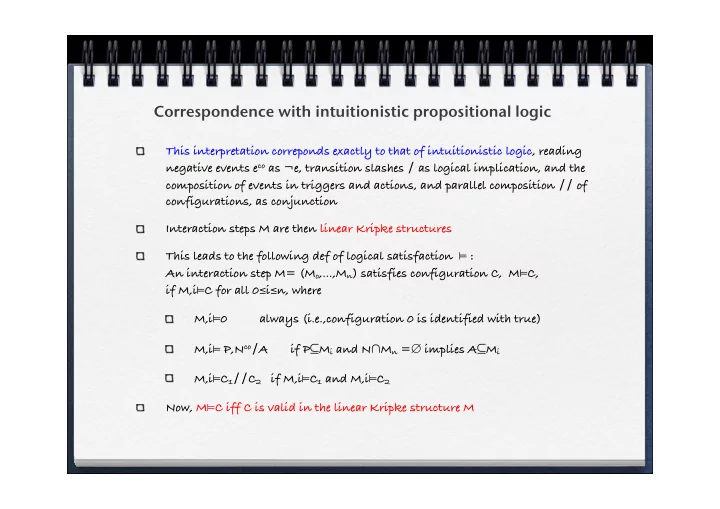
This interpretation correponds exactly to that of intuitionistic logic, reading negative events eco as ¬e, transition slashes ∕ as logical implication, and the composition of events in triggers and actions, and parallel composition ∕∕ of configurations, as conjunction Interaction steps M are then linear Kripke structures This leads to the following def of logical satisfaction ⊨ : An interaction step M= (Mo,...,Mn) satisfies configuration C, M⊨C, if M,i⊨C for all 0≤i≤n, where M,i⊨0 always (i.e.,configuration 0 is identified with true) M,i⊨ P,Nco∕A if P⊆Mi and N∩Mn =∅ implies A⊆Mi M,i⊨C1∕∕C2 if M,i⊨C1 and M,i⊨C2 Now, M⊨C iff C is valid in the linear Kripke structure M

slide-2
SLIDE 2

Main Result

Note that for interaction steps of lenght 1, the notions of interaction model and classical model coincide, and we simply write M1 for (M1) Step responses of a config C in the sense of Pnueli and Shalev are now exactly those interaction models of lenght 1, called response models, that are not suffixes of interaction models N=(N0,...,Nm,M) of C with lenght m≥0. For, if such a singleton interaction model was suffix of a longer interaction model, the reaction would be separable and hence not causal. Thus we have Theorem 3 (Correctness and Completeness). If C is a configuration and M ⫅∏, then M is a Pnueli-Shalev step response of C iff M is a response model of C

slide-3
SLIDE 3
slide-4
SLIDE 4
slide-5
SLIDE 5
slide-6
SLIDE 6
slide-7
SLIDE 7

Game-Theoretic Perspective

slide-8
SLIDE 8

Relation to Logic Programming

slide-9
SLIDE 9

Pnueli-Shalev semantics has been implemented in answer-set programming!

slide-10
SLIDE 10

Amir’s view summer 1986

slide-11
SLIDE 11