
SLIDE 1
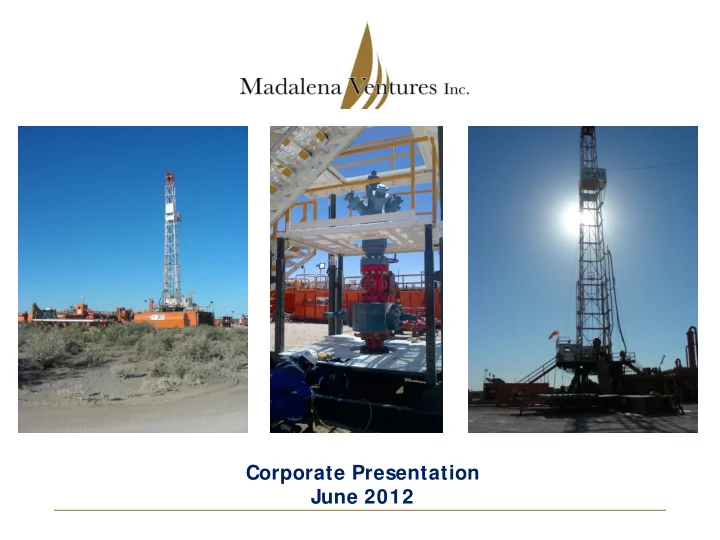
Corporate Presentation June 2012 Forward Looking Statements This - - PowerPoint PPT Presentation
Corporate Presentation June 2012 Forward Looking Statements This presentation includes forward-looking statements, which are statements other than of historical fact, such as information regarding drilling potential and production forecasts.
2
This presentation includes forward-looking statements, which are statements other than of historical fact, such as information regarding drilling potential and production forecasts. Factors that could cause actual results to differ materially from our expectations include exploration and development risks, commodity prices and operating hazards. A barrel of oil equivalent (boe), derived by converting gas to oil in the ratio of six thousand cubic feet of gas to one barrel of oil, may be misleading, particularly if used in isolation. A boe conversion is based on an energy equivalency conversion method primarily applicable at the burner tip and does not represent a value equivalency at the wellhead. This slide is limited as to space in order to be readable if projected. Please review detailed risks and limitations statements at the end of this document.
Dwayne Warkentin: President and Chief Executive Officer, Director Anthony J. Potter: Vice President Finance and Chief Financial Officer, Director Ruy Riavitz: Country Manager, Madalena Austral S.A. _____________________________________________________________________ Ray Smith: Chairman, Madalena Ventures I nc. and President and CEO, Bellatrix Exploration Ltd. Barry Larson: VP and COO, Parex Resources I nc. Michael J. Lock: President, Upsilon Holdings Ltd. Keith Macdonald: President, Bamako I nvestment Management Ltd. Jay Reid: Partner, Burnet, Duckworth and Palmer LLP Ving Woo: Vice-President and COO, Bellatrix Exploration Ltd.
3
Argentina
infrastructure
targets
gas windows
exploration
4
5
Source: EIA World Shale Gas Resources, April 2011
Technically Recoverable Shale Gas Resources
Source: US EIA 2011 Data: Argentine Institute of Oil and Gas
2011 5.9% 2011 3.4%
6
prograde toward the north and west
wedge typically contains the best source rock characteristics
exists over most of the mature part of the area where Vaca Muerta is present
is oil prone, with gas dominating in the deeper, thicker (700 m+ ) western area around the Cortadera block
7
50 km
C.I. = 100m
Bakken 30 m Eagle Ford 60m Barnett 90m
reflectance values
(every new well provides refined maturity outlook)
window; Cortadera within the gas window; Curamhuele is in a transitional area
well has produced ~ 750MBOE
428 km2, YPF announced 927 MMBOE VM resource discovery * I n February 2012, YPF released results of Ryder Scott audit reporting a total resource of 22.8 billion BOE over 2 million acres
world class oil and gas resource development
50 km
8
9
10
Other large acreage holders include:
Cortadera 40% Curamhuele 90% Coiron Amargo 35%
Americas Petrogas New entrants have farmed-in or acquired existing blocks in order to build meaningful acreage positions:
Madalena
Gross Acres Net Acres Coiron Amargo 99,923 34,973 Curamhuele 56,216 50,595 Cortadera 123,503 49,401 Total 279,642 134,969
11
Majority of drilling to date has been adjacent to or on Coiron Amargo Block
12 Coiron Amargo 404 km2 vs. 428 km2 for YPF lands proven to date
network
network including export capacity
first major non-conventional resource areas to be developed
pipelines and facilities
13
CAS.x-2 Drilled March 2012 CAS.x-4 Drilled Feb 2012 Full Core VM
CAS.x-1 CAN.x-2
10 km Faults on Sierras Blancas
Multiple Stacked Formations
Six light oil discoveries to date, multi-well development. North area facilities development.
Gas pools on east and west sides
Oil shows on block, producing pools nearby
110 – 150 m thick oil saturated section over entire block
Gas prone deep zones
Land area: 100,077 acres or 405 km² (156 mi² )
14
Sierras Blancas Structures
CAN 5 Drilled May 2012 CAN 7 Drilled June 2012
Northern 108 km2 converted to 25 year exploitation licence in March 2012
has been shown to be productive several km’s to the west by YPF
have exhibited oil shows while drilling the Vaca Muerta
the Vaca Muerta on the block is the lower Vaca Muerta which ranges from 40-65m thick - produced 750 MBOE in a well 10 km north of block
discovery
Vaca Muerta Thickness
15
CAS.x-1 Frac’d Q1 2012
YPF reports 927 MMBOE resource over 428 km2 (5.6mmboe/ section) in the Vaca Muerta *
while drilling
16
22,000 bbls
northeast to southwest
% of total production from each zone by PLT
17
Operators in early stages of determining how best to create “manufacturing” play:
within and between basins
development wells
proppant, number of stages and size
basin
associated with various completion techniques
Basin Bakken
Eagle Ford Neuquén Unconv Current Prod. Est. 420,000 bopd 300,000 boepd 5,000+ boepd (VM) # Wells to Date est. 3,000 producers 4,000 25 # Wells – 2012 est. 2,300 3,000 100 Type Wells Mainly Horizontal Mainly Horizontal Mainly Vertical Drilling Rigs 220 250+ 10-15 Frac Stages 20-30 15-20 3-5 Horsepower – 2012 est. 400,000 2,300,000 190,000 Frac Crews 30 50-60 8 Rigs Serviced per Frac Crew 7 4-5 2
Source: Compiled by Madalena from various contributors
18
Land area: 56,000 acres or 227 km² (88 mi² )
Existing light oil well on block More section to test Oil tested in 2 other wells on block
Existing gas well on block Lower sandier section yet to be tested
200 – 600 m over block To be drilled or deepened with an existing well. Majors have secured surrounding blocks.
19
Curamhuele Block is ideally located in a thick area with > 180m of section, where depth is sufficient to cause
created a good source rock in the centre of the basin, before the remainder of the cycle fills the basin with dominantly sandstone
is continuous and similar
the block and several adjacent wells
Shale Basin
25 km C.I. = 25 m
Intrusive body replacing L Agrio
20
SJ.Nq.Yp.x-1 TD=3880.0 7.4 km SJ.Nq.Ch.x-1 TD=3457.0
Correlation 200 API3150 3200 3250 3300 3350 3400 3450 3500 3550 3600 3650 3700
Correlation 200 API2800 2850 2900 2950 3000 3050 3100 3150 3200 3250
The green fill between Resistivity and Sonic curves indicates high TOC, potential unconventional reservoir
Mulichinco Lower Agrio Lower Agrio Shale Upper Agrio Quintuco Yp.x-1 swabbed a small amount of 40º
treatment Ch.x-1 flowed 26 m3/d of 36º-41 oil without stimulation: Over-Pressured 0.74 psi/ft Ch.x-1 will be fractured and tested in 2012
21 Appears similar to the Vaca Muerta Formation
22
fracture stimulation at Curamhuele X- 1 well location
Lower Agrio in the Neuquén Basin
frac
Mulichinco near the Cortadera and Curamhuele Blocks
potential to contain the lowermost and coarser clastic part of the formation that was deposited during the initial lowstand period
very little of this clastic section
Cur X-1 also remains to be tested
Potential area of coarse lowstand sandstone west of this line Mulichinco ~ 1TCF in Sierra Chata field
25 km
Mulichinco tested 10mmcfd in Yp.x-1
23
Correlation 200 API
50 MV 6 16 IN 250
0.2 2000 0.2 2000 0.2 2000 2 20000 0.2 2000 0.450
1908 2898 KG/MT 450 90 US/MT 20 B/E
3650 3700 3750 3800 3850
Lower Agrio Mulichinco Quintuco Mulichinco Lowstand
Mud gas readings rose by 2 orders of magnitude at the top of Mulichinco
24
after acidizing yielded 10 mmcfd of gas and 500 bpd of 51º condensate
Mulichinco tested in Yp.x-1 has a high carbonate content
enough to encounter much of the sandier lowstand cycle
the Vaca Muerta on the block will also penetrate the sandy lowstand Mulichinco objective
reflectance values:
Pink = Dry gas window Yellow = Wet gas window Green = Oil window
been penetrated in Curamhuele
including joint Vaca Muerta and Agrio study in progress
entry or new drill will be chosen to test the Vaca Muerta on Curamhuele
Isopach C.I. = 100m
25
25 km
26
thick (plan view)
hydraulic fracture stimulation:
CorS.x-1
Regional seismic line
Thickest potential section in basin
Mulichinco: 206m thick
Vaca Muerta: 708m thick
Quintuco: 617m thick
Agrio
targeting both tight gas and shale gas
Muerta formation performed in Q1/ 2012
(Quintuco, Mulichinco, and Agrio zones) yet to be tested
27
Land area: 124,000 acres or 500 km² (193 mi² )
tight sands
Mulichinco near the Cortadera and Curamhuele Blocks
potential to contain the lowermost and coarser clastic part of the Mulichinco that was deposited during the initial lowstand period
exist in the majority of the central part of the basin
Potential area of coarse lowstand sandstone west of this line High mud gas readings in CorS.x-1 Mulichinco gas in these wells Mulichinco ~ 1TCF in Sierra Chata field Chihuidos Anticline
25 km
28
reflectance values:
Pink = Dry gas window Yellow = Wet as window Green = Oil window
from a YPF presentation. Potential for condensate in the northern portion of block.
prospective for Vaca Muerta unconventional shale plays
tremendous thickness in the Vaca Muerta
Plus pricing
Isopach C.I. = 100m
29
25 km
30
31
The information in this presentation contains certain forward-looking statements. These statements relate to future events or
looking statements are often, but not always, identified by the use of words such as "seek", "anticipate", "plan", "continue", "estimate", "approximate", "expect", "may", "will", "project", "predict", "potential", "targeting", "intend", "could", "might", "should", "believe", "would" and similar expressions. These statements involve substantial known and unknown risks and uncertainties, certain of which are beyond the Corporation’s control, including: the impact of general economic conditions; industry conditions; changes in laws and regulations including the adoption of new environmental laws and regulations and changes in how they are interpreted and enforced; fluctuations in commodity prices and foreign exchange and interest rates; stock market volatility and market valuations; volatility in market prices for oil and natural gas; liabilities inherent in oil and natural gas operations; uncertainties associated with estimating oil and natural gas reserves; competition for, among other things, capital, acquisitions, of reserves, undeveloped lands and skilled personnel; incorrect assessments of the value of acquisitions; changes in income tax laws or changes in tax laws and incentive programs relating to the oil and gas industry ; geological, technical, drilling and processing problems and other difficulties in producing petroleum reserves; and obtaining required approvals of regulatory authorities. The Corporation’s actual results, performance or achievement could differ materially from those expressed in, or implied by, such forward-looking statements and, accordingly, no assurances can be given that any of the events anticipated by the forward-looking statements will transpire or occur or, if any of them do, what benefits that the Corporation will derive from
actual results to differ materially from those anticipated or implied in the forward-looking statements. The Corporation’s forward-looking statements are expressly qualified in their entirety by this cautionary statement. The forward-looking information and statements contained in this presentation speak only as of the date hereof, and the Corporation assumes no
applicable laws. Except as required by law, the Corporation undertakes no obligation to publicly update or revise any forward-looking statements. Investors are encouraged to review and consider the additional risk factors set forth in the Corporation's Annual Information Form which is available on SEDAR at www.sedar.com.
32
All amounts in this presentation are stated in Canadian dollars unless otherwise specified. In accordance with Canadian practice, reserve and similar volumes and production volumes and revenues are reported on a gross basis, before deduction of royalties, unless otherwise stated. Where applicable, natural gas has been converted to barrels of oil equivalent ("BOE") based on 6 Mcf:1
represent a value equivalent at the wellhead. Use of BOE in isolation may be misleading. This presentation may also contain references to Original Oil-In-Place (‘OOIP”) and Original Gas-In Place (‘OGIP”) (collectively "PIIP“) and the term "recoverable", which are not and should not be confused with references to oil and gas reserves. PIIP is that quantity of petroleum that is estimated to exist originally in naturally occurring accumulations. It includes that quantity of petroleum that is estimated, as of a given date, to be contained in known accumulations, prior to production, plus those estimated quantities in accumulations yet to be discovered. PIIP is comprised of Discovered PIIP and Undiscovered PIIP Discovered PIIP is that quantity
estimates may differ materially from estimates prepared in accordance with the Canadian Oil and Gas Evaluation Handbook (“COGE Handbook”) and National Instrument 51-101 – Standards of Disclosure for Oil and Gas Activities (“NI 51-101”).
* Analogous I nformation
Certain information in this document may constitute "analogous information" as defined in National Instrument 51-101 – Standards
production and decline rates and economics information relating to the areas in geographical proximity to exploratory lands held by Madalena or other shale plays in development in North America. Such information has been obtained from government sources, regulatory agencies or other industry participants. Management of Madalena believes the information is relevant as it helps to define the reservoir characteristics and the reserves and production potential in which Madalena holds an interest. Such information includes resource estimates using categories such as Original Oil-In-Place and Original Gas-In Place which are not derived from the Canadian Oil and Gas Evaluation Handbook ("COGE Handbook") and have therefore not been prepared in accordance with NI 51-
Such information is not an estimate of the resources attributable to lands held or to be held by Madalena and there is no certainty that the reservoir data, resource estimates, production and decline rates and economics information for the lands held by Madalena will be similar to the information presented herein. The reader is cautioned that the data relied upon by Madalena may be in error and/or may prove not be analogous to the lands be held by Madalena.
33