Coronavirus Disease Updated Status for Italy (10.6.2019) Sum - - PDF document
Coronavirus Disease Updated Status for Italy (10.6.2019) Sum Summary Key data at national level (distribution of cases over time; cumulative incidence and 7-day incidence per 100.000 population; Rt Index) Preventive measures to
Sum Summary
- Key data at national level (distribution of cases over time; cumulative
incidence and 7-day incidence per 100.000 population; Rt Index)
- Preventive measures to ensure safe travel and accommodation
- Regional Breakdown of statistics
Italy a at a Glanc nce: e: Key N National Data
Flatten ening t the c e curve, e, s streng engthen hening i ng inten ensive c e care capabi bilities es, e ensur uring s g safe travel el a and a d accomodation:
- n:
Italy a at a gl glance ce
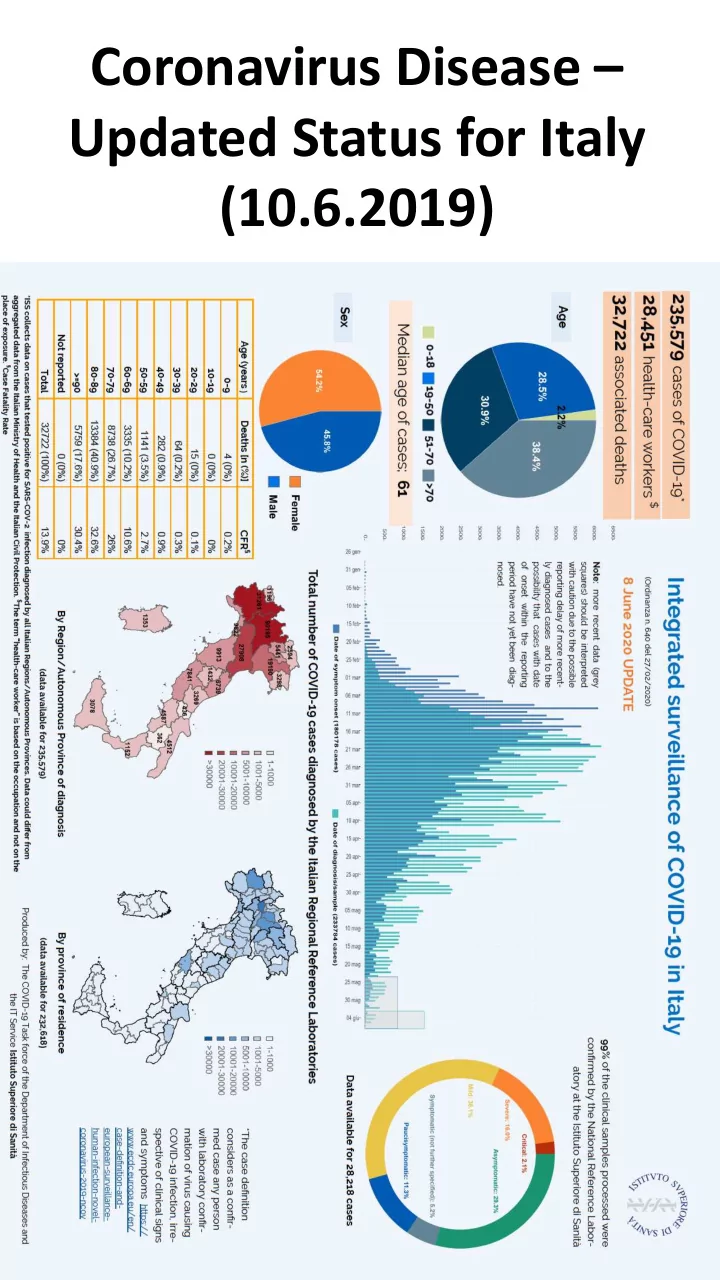
- Overall 2.281 new cases have been validated from May 29th to June 4th (3,78 cumulative incidence per 100.000 population). Rt
Index is now below one in all Regions.
- On June 8th, Italy reported less than 35.000 positive cases, with an increase of 280 new cases on a daily basis. The current total of
positive cases is 34.730 (- 532 cases on a daily basis). 283 patients are in intensive care units (-4 on a daily basis), 4.729 patients are hospitalized with symptoms(-135), whereas 29.718 people, equal to 86% of all infected cases, are in isolation without symptoms or with mild symptoms. 166.584 people have recovered from their COVID-19 infection (+ 747 on a daily basis). Intensive care capabilities increased significantly: intensive care beds increased from 5.703 to 8.979 units (+ 57.4% with respect to January) and semi-intensive care beds increased from 6.525 to 34.545 units (+ 429%). Further 300 intensive care beds and 10.750 semi- intensive care beds are being contracted.
- On June 9th the Conference of Italian Regions updated its guidance standards for hospitality reopening. Social distancing, contact
tracing and sanitization measures are foreseen for all tourism infrastructure. Indoors, face masks and a one-metre distance to
- thers are mandatory. In open-air, a distance of one meter must be maintained between persons not living in the same household
(1.5 meters for beach resorts, differentiated regulations are in place for each type of activity according to different risk assessments).
- The tracing App ”Immuni” is in place, and on its launch day (June, 8th) it had half a million downloads, registering a strong response
from Italian users. The system is based on Bluetooth Low Energy technology and will be interoperational with similar Apps developed by partner countries. During the pilot-project phase, users who test positive for the virus can upload their cryptographic keys to Immuni's server only in the four regions participating in the pilot (Abruzzo, Liguria, Marche, and Puglia). This enables Immuni to notify the users with whom they've had contact that they may be at risk. Therefore, during the pilot phase, Immuni will
- nly notify those users who have been exposed to users who tested positive for the virus after a swab test performed in the
abovementioned regions.
Distribution of cases over time, by date of onset Distribution of cases over time, by date of reporting Evolution of positive cases: flattening the curve
Region / Autonomous Province Total number of cases % on overall cases Cumulative incidence (cases/ 100.000 pop.) Number of new cases in the last 7 days (25.5 – 31.5) 7-day incidence per 100.000 pop. (25.5 – 31.5) Rt Index in the last 14 days (CI – prediction interval) Lombardia 89.205 38.1 886,68 1.549 15.4 0.91 (0.78-1.09) Piemonte 31.140 13.3 714,81 399 9.16 0.58 (0.44-0.71) Emilia-Romagna 27.828 11.9 624,02 215 4.82 0.58 (0.39-0.77) Veneto 19.168 8.2 390,72 55 1.12 0.61 (0.35-1.06) Toscana 9.907 4.2 265,63 42 1.13 0.72 (0.43-1.23) Liguria 9.746 4.2 628,51 75 4.84 0.48 (0.26-0.72) Lazio 7.779 3.3 132,32 66 1.12 0.75 (0.43-1.21) Marche 6.720 2.9 440,58 15 0.98 0.86 (0.29-1.79) A.P. Trento 5.432 2.3 1.003,88 34 6.28 0.86 (0.55-1.22) Campania 4.573 2.0 78,82 39 0.67 0.58 (0.01-1.79) Puglia 4.499 1.9 111,66 35 0.87 0.78 (0.32-1.79) Friuli Venezia Giulia 3.273 1.4 269,33 31 2.55 0.76 (0.38-1.28) Abruzzo 3.255 1.4 248,17 18 1.37 0.76 (0.33-1.37) Sicilia 3.071 1.3 61,42 29 0.58 0.55 (0.07-1.46) A.P. Bolzano 2.593 1.1 488,16 5 0.94 0.86 (0.17-2.05) Umbria 1.431 0.6 162,24 1 0.11 0.65 (0-1.73) Sardegna 1.349 0.6 82,28 3 0.18 0.14 (0-0.47) Valle d’Aosta 1.193 0.5 949,34 6 4.77 0.47 (0.02-1.75) Calabria 1.157 0.5 59,42 1 0.05 0.37 (0-0.9) Molise 436 0.2 142,66 4 1.31 0.59 (0-2.14) Basilicata 364 0.2 64,67 2 0.36 0 (0-0) TOTAL 234.119 2.624
Number of COVID-19 cases diagnosed by the Italian Regional Reference Laboratories
Estimate of average Rt Index (Interval: 12th May – 25th May; Estimation made on June, 3rd)
Regional distribution of COVID-19 Cases
Inc per 100000 - Fonte: ISS 0.01-50 50.01-100 100.01-200 200.01-500 >500
In terms of 7-day incidence per 100.000 population (May 25th – May 31st), the ten Italian Regions with lowest ratios are Calabria (0.05), Umbria (0.11), Sardegna (0.18), Basilicata (0.36), Sicilia (0.58), Campania (0.67), Puglia (0.87), Bolzano - Autonomous Province (0.94), Marche (0.98) and Veneto /Latio (1.12 both). More than 70% Regions and Autonomous Provinces enjoy a 7-day incidence which is less than 2.5.
Cumulative incidence in Italian Provinces (cases/ 100.000 pop.)
Preven entive m e mea easur ures es t to
- ens
ensur ure s e safe e travel el a and nd accommo mmodation
Tourism: General overview (1/2)
- It is possible to travel from one Italian region to the other. Travelling to and from the following States is allowed: Member
States of the European Union, States parties to the Schengen Agreement, the United Kingdom of Great Britain and Northern Ireland, Andorra, Monaco. Circulation restrictions for specific areas of the country can be restored at any time in the event of a worsening of the epidemiological situation. Cruises by Italian flag passenger ships are suspended.
- The activities of accommodation facilities (hotels, bed&breakfast, etc.) are allowed, provided that the interpersonal safety
distance of one metre is guaranteed in the common areas.
- The opening to the public of museums and other cultural sites (libraries, archives, archaeological areas and parks,
monumental complexes) is allowed. By all means, contingent fruition methods must be guaranteed, or in any case such as to avoid gatherings of people and to allow visitors to respect the distance of at least one meter between one another.
- The opening to the public of bars, pubs, restaurants, ice cream shops, pastry shops and the like is allowed. All premises
- pen to the public must comply with guidelines and protocols identified by the autonomous regions and provinces to
prevent or reduce the risk of contagion.
- The activities of beach resorts are allowed, in compliance with the guidelines and protocols identified by the autonomous
regions and provinces to prevent or reduce the risk of contagion. Regional protocols and guidelines also cover access to free beaches.
- The opening to the public of all commercial activities is allowed, provided that the interpersonal distance of at least one
metre is ensured. Customers will be able to enter the stores a fixed number at a time, and will be able to stay inside only for the time necessary to purchase the goods.
Tourism: General overview (2/2)
- From the 15th of June, shows in theatres, concert halls, cinemas and other outdoor spaces are allowed. The performances
must be held with pre-assigned and spaced seats, and at the condition that the interpersonal distance of at least one meter is ensured for both the staff and the spectators, with the maximum number of 1000 spectators for outdoor shows and 200 people for performances or each individual hall in closed places.
- Access to parks, villas, playgrounds and public gardens is allowed. Outdoor recreational activities are allowed.
- It is allowed to do outdoor sports or physical activity, observing the distance of at least two meters for the sports activity
and at least one meter for any other activity. Minors and non-self- sufficient persons can do sports or physical activity if they are accompanied.
- The opening to the public of public of gyms, swimming pools, sports centres and clubs is allowed, in compliance with the
rules of social distancing and without any gathering.
- The activities of wellness centres, spas (with the exception of the provision of services falling within the essential levels of
care), cultural centres and social centres are suspended.
- The opening of places of worship is conditioned by the adoption of organizational measures such as to avoid gathering of
people, guaranteeing the possibility for visitors to observe the distance of at least one meter from one another. Religious services are allowed with the participation of persons, in compliance with the Protocols signed by the government and by the respective religious denominations referred to in attachments 1 to 7 to the Presidential Decree of the Council of Ministers of the 17th of May 2020.
Public Transport: General overview
- Regions and autonomous provinces may anticipate or postpone the opening of different activities, taking into account
their compatibility with the development of the contagion.
- Regions decide on the planning of local public transport services (bus, metro, tram), to avoid overcrowding of the means of
transport in the daily time slots with the greatest presence of passengers. The minister of infrastructure and transport, in agreement with the minister of health, may order reductions, suspensions or limitations in transport services, including international, automotive, rail, air, sea and inland waters transport.
- It is mandatory to wear masks in closed spaces, including means of transport, and in any situation where it's not possible
to guarantee the interpersonal safety distance. Children under six years of age and persons with forms of disability not compatible with the use of the mask are not subject to the obligation.
Prevention measures: Restaurants
- Suitable information on prevention measures must be displayed which can also be understood by non-Italian speakers.
- Clients must wear masks whenever they are not seated at tables.
- Body temperature can be measured and access denied to those with temperatures of over 37.5°C.
- Hand cleaning products must be made available for clients and staff including in multiple locations, especially at the entrance and near toilets, which must be
cleaned several times per day.
- Magazines and info material for multiple use must be removed.
- In businesses with seating areas access via booking is to be prioritised with a list of those booking to be kept for a 14 day period. In such businesses numbers
- f clients within the building must not exceed available seating spaces.
- In businesses without seating areas, only a limited number of clients at a time must be allowed to enter, in such a way as to ensure a distance of at least one
metre between clients.
- Where possible, outside spaces should be preferred (gardens, terraces and courtyards), always leaving at least one metre between clients.
- Tables must be arranged in such a way as to ensure at least a one metre gap between clients This distance can only be reduced by means of physical barriers
between the various tables capable of preventing droplet contagion.
- Serving staff in contact with clients must wear masks and clean their hands with hydro-alcohol solutions frequently (prior to each table service).
- Cash desks must be equipped with physical barriers (e.g. screens). In the absence of these staff must wear masks and have hand cleansing gel available.
Electronic payment methods must, in any case, be encouraged, preferably at tables.
- Internal spaces must be aired frequently. As regards air conditioning, where technically possible all air circulation must be totally excluded. Where this is not
technically possible natural air circulation measures must be reinforced and air filters cleaned, to maintain adequate filtering/removal standards in line with Istituto Superiore di Sanità document technical guidelines.
- At the end of each table service all customary surface cleaning and disinfecting measures must be applied, avoiding reusable utensils and containers (salt
shakers, salad dressing containers, etc.) which cannot be disinfected as far as possible. Online mobile phone menus, plastic covered menus which can be disinfected after use or disposable paper menus are to be preferred.
Prevention measures: Seaside and Beach facilities
- Suitable information on prevention measures which can also be understood by non-Italian speakers must be displayed. The use of beach stewards to
accompany clients to their sun umbrella and to illustrate the prevention measures to be followed is encouraged
- Hand cleaning products must be made available for clients and staff in multiple locations.
- Access to facilities via booking is to be preferred and lists of bookings should be kept for a 14 day period.
- Body temperature can be measured and access denied to those with temperatures of over 37.5°C.
- Cash desks must be equipped with physical barriers (e.g. screens). In the absence of these staff must wear masks and have hand cleansing gel available.
Electronic payment methods must, in any case, be encouraged, possibly at the booking stage.
- Spaces should be reorganised to ensure ordered access, avoid people gathering and ensure distances of at least one metre between users, with the
exception of people between whom interpersonal distancing is not currently required, with this latter being a matter of personal responsibility. Where possible separate entrances and exits should be provided.
- A distance between sun umbrellas (or other shade systems) providing at least 10 square metres of space per umbrella, whatever the setup of the beach (in
horizontal rows or lozenge style) is to be ensured.
- A distance of at least 1.5 metres between beach equipment (sunbeds, deck chairs) must be ensured when these are not under umbrellas.
- Shared spaces such as changing rooms, cabins, showers, toilets, etc. must be regularly cleaned and disinfected.
- Equipment such as sunbeds, deckchairs and sun umbrellas must be disinfected with each client/family changeover and in any case at the end of the day.
- For free-access beaches, it is recommended the monitoring by surveillance staff to ensure that distances of at least one metre between people are
respected and the cleaning and disinfecting of any equipment..
- Amusement/sporting activities in group formation are banned.
- Individual sports frequent on beaches (such as beach tennis) or in the sea (e.g. swimming, surfing, windsurfing and kitesurfing) can continue as long as
interpersonal distancing guidelines are complied with.
Prevention measures for accommodation services: Hotels, complementary accommodation facilities and agritourism resorts
- Suitable information on prevention measures which can also be understood by non-Italian speakers must be displayed.
- Interpersonal distances of at least one metre are obligatory in shared use areas. This must thus be facilitated via the use of differentiated trajectories within buildings,
especially entrances and exits. To this end, information points and/or space indications are recommended.
- Interpersonal distancing does not apply to members of the same family or cohabiting group nor to people staying in the same room nor to people not covered by current
interpersonal distancing regulations.
- Reception and cash desks must be equipped with physical barriers (e.g. screens). In their absence, staff must wear masks and have hand cleansing gel available on all
- ccasions involving contact with users. Electronic payment and online booking management is to be encouraged with automatic check in and check out where possible.
- Reception staff must clean their work surfaces and the equipment used at the end of every shift.
- Guests must use masks at all times in closed common use areas. In open air common-use areas masks must be worn when interpersonal distances of at least one metre
cannot be respected and staff must wear masks at all times when in proximity to clients and when interpersonal distances of at least one metre cannot be ensured.
- Availability and access to hand cleansing systems must be ensured with hydro-alcohol solutions at multiple locations, encouraging frequent client and staff use.
Magazines and info material for multiple use must be removed.
- All objects supplied to guests must be disinfected prior to being handed over to guests.
- Use of lifts must allow interpersonal distances to be respected, with masks, with exceptions applying in the case of family members, those cohabiting and people
- ccupying the same room and as regards those to whom interpersonal distancing regulations do not apply with this latter being the personal responsibility of those
involved.
- All spaces must be frequently cleaned and disinfected with special attention being paid to common use areas and frequently touched surfaces (handrails, light switches,
lift buttons, door and window handles, etc.).
- Internal spaces must be aired frequently. As regards air conditioning, where technically possible all air circulation must be totally excluded. Where this is not technically
possible natural air circulation measures must be reinforced and air filters cleaned, to maintain adequate filtering/removal standards in line with Istituto Superiore di Sanità document technical guidelines.
- Spaces, furnishings and linen should be cleaned and disinfected at each client changeover.
Prevention measures for accommodation : Open Air facilities (camping)
- Guests’ mobile accommodation (e.g. tents, caravans and campers) must be positioned inside delimited spaces in such a way as to ensure
respect for interpersonal distancing between the various visitor groups of no less than three metres between the entrances to units, where these face one another. A distance of at least 1.5 metres must also be maintained in the event of the use of accessories or adjuncts (e.g. tables, chairs, sunbeds, deck chairs).
- Guests must use masks at all times in indoor spaces (e.g. retail outlets, common use spaces and toilets) and in any case when interpersonal
distances of at least one metre (with the exception of family members and those sharing sleeping accommodation) cannot be respected.
- Hand cleansing systems using hydro-alcohol solutions must be easy to access at various locations inside the facility, encouraging frequent
use by clients and staff.
- All spaces must be frequently cleaned and disinfected with special attention being paid to common use areas and frequently touched
surfaces (handrails, light switches, lift buttons, door and window handles, etc.). Adequate airing of indoor spaces must be ensured.
- Public toilets must be cleaned at least twice a day given the specific features of these facilities. In the event of greater visitor numbers with
70% or more of the spaces without on-site toilets (thus excluding mobile homes, bungalows and spaces with private toilets), cleaning and disinfecting must take place at least three times per day.
- Airing/ventilation systems and air filter cleaning must be monitored and kept up.
- Guests must be encouraged to clean and disinfect external as well as internal furnishings.
Prevention measures for accommodation: mountain huts
- Where possible, the hut’s outdoor spaces must be demarcated allowing for regulated access. Where tables and benches are present an information panel must be set up
to highlight the health norms and safety distances and trajectories making it possible to avoid direct contact between people set up.
- A dispenser containing hand cleanser must be set up at the entrance.
- Inside the area managers must invite guests to respect interpersonal distancing of at least one metre and use personal protection such as masks and gloves. This does not
apply to members of the same family, those cohabiting and people sharing the same room as well as those to whom interpersonal distancing regulations do not apply.
- Single-use tablecloths are mandatory as is disinfecting tables and chairs before client changeover.
- Only table service is permitted.
- A portion of the external seating areas is set aside for reserved guests.
- In external areas, where a special area for picnicking has been set aside, this will also be limited access. Where possible outside areas should be equipped with gazebos,
umbrellas and canopies, thus limiting excess pressure at the entrance to the mountain hut.
- Inside mountain huts: 1) Entrance is conditional on capacity and access is dependent on mask and glove use; 2) Counter service is not allowed, only table service; 3)
Mandatory routes inside the hut should be identified to avoid direct contact between people. Overnight stays and meals should be by reservation only, and guest lists should kept for at least 14 days.
- Access to internal mountain hut areas: 1) Movement between rooms is conditional on use of safety measures. Visitors are banned from entering the accommodation
area in walking boots and must wear their own slippers; 2) In the event that maximum seating space numbers in accordance with safe distance rules are reached in the internal dining area, managers must set up an information board at the entrance to stop people coming in; 3) Thorough cleaning and disinfection will be performed at least 2 times a day. Particular attention will be paid to the cleaning and disinfection of shared toilets, showers and washbasins. In any case, cleaning and disinfection kits must be delivered or made available to customers for autonomous use.
- Bedrooms: 1) A gel dispenser must be set up at the entrance to each room; 2) Beds must include mattresses with washable mattress covers and a disposable set made
up of single use mattress cover and pillow case or in material washable at 90°C; 3) Personal sleeping bags are, in any case, mandatory; 4) Where single use sheets are used these must supplement but not replace single use mattress and pillow covers; 5) In rooms with beds intended for mixed use, or for customers under interpersonal distancing rules, further precautionary measures must be taken: guaranteeing interpersonal distancing of at least one meter, with a distance between beds of 1.5 meters.
Prevention measures for accommodation: youth hostels
- Whenever possible, the area outside the hostel must be delimited, allowing for regulated access. In the presence of stalls (tables, benches ...) it is necessary to insert a
sign that recalls the hygiene rules and safety distances and to provide paths that do not allow people to cross.
- A dispenser with hand sanitizer must be placed at the entrance to the area.
- In outdoor areas, when there is a dedicated area for packed lunches, the same must have limited access. Where possible, it is advisable to provide external coverage with
gazebos, tents, shelters, thus limiting excessive pressure at the hostel entrance.
- Reception. Overnight stay and eventual meal delivery can only be provided on compulsory booking; attendance must be kept for at least 14 days
- Access to common areas. 1) Movement between the rooms of the hostel takes place only using safety devices. It is forbidden to move in the sleeping area with your own
shoes: guests must wear their own slippers; 2) In the event that the maximum occupancy of the seating for catering within the hostel is reached, in compliance with the safety distances, the manager must prepare an entrance sign that blocks access; 3) For access to the facility's toilets and showers, which must be cleaned several times a day, it is necessary to make hand hygiene products available. 4) The common structures (bathrooms, toilets, showers, sinks, sinks), where present, must be managed to make use possible by respecting the interpersonal spacing of at least one meter and avoiding gatherings, 5) Thorough cleaning and disinfection will be carried out at least 2 times a day. Particular attention will be paid to the cleaning and disinfection of shared toilets, showers and washbasins. In any case, cleaning and disinfection kits must be delivered or made available to customers for autonomous use prior to the use of the service.
- Bedrooms. 1) A disinfectant gel dispenser must be provided at the entrance of each room for mixed use and without toilets. 2) The bed must include a mattress with a
mattress cover in washable fabric, a disposable set consisting of mattress cover and disposable pillowcase, or possibly linen in fabric that can be washed at 90 ° C. 3) If you want to use disposable sheets, these must be additional to the mattress cover and disposable pillowcase. 4) In rooms with beds intended for mixed use, or customers subject to respect for interpersonal distancing, specific and more precautionary measures must be taken: guaranteeing interpersonal distancing of at least one meter, with a distance between beds of 1.5 meters.
Prevention measures for personal services: hair stylists and beauticians
- Access to facilities via booking only and lists of bookings should be kept for a 14 day period.
- Body temperature can be measured and access denied to those with temperatures of over 37.5°C.
- Clients must remain in the building only for the time strictly required for the service or treatment booked. Only a limited number of clients in the building at the same
time is allowed in accordance with available space.
- Spaces should be reorganised in accordance with logistical and structural conditions to ensure that a distance of at least one metre is available between individual work
stations and between clients. Work spaces should be separated by suitable physical barriers capable of preventing droplet contagion.
- Hydro-alcohol solutions for client and staff hand cleansing is to be made available and frequent use of these recommended. Magazines and info material for multiple use
must be removed.
- Client and staff must wear airway protection masks where an interpersonal distance of less than a metre is required (in addition, for staff, to individual protection such as
FFP2 masks or protection visors as well as gloves, single-use aprons and so on linked to the specific risks associated with their professions). For beauticians and tattoo artists, in particular, where services require personal proximity, staff must wear protection visors and FFP2 valve-less masks.
- Staff must clean their hands with hydro-alcohol solutions frequently (before and after client services and beauticians should possibly use single use overalls/aprons).
Different gloves must be used in treatments from those used in the normal environment.
- Work surfaces must be cleaned and disinfected before serving clients and equipment and accessories must be disinfected as appropriate. Work stations must be
disinfected after each client. Toilets must be regularly cleaned and disinfected.
- Internal spaces must be aired frequently. As regards air conditioning, where technically possible all air circulation must be totally excluded. Where this is not technically
possible natural air circulation measures must be reinforced and air filters cleaned when the air conditioning is switched off, to maintain adequate filtering/removal standards in line with Istituto Superiore di Sanità document technical guidelines.
- Saunas, steam baths and Jacuzzis are forbidden. Only single exclusive use, by reservation only, is permitted.
- Cash desks must be equipped with physical barriers (e.g. screens). In the absence of these staff must wear masks and have hand cleansing gel available. Electronic
payment methods must, in any case, be encouraged, where possible at the booking stage.
Prevention measures: Retail Shops
- Adequate information on prevention measures must be displayed.
- Body temperature may be measured, especially in supermarkets and shopping malls and access denied to those with temperatures of over 37.5°C.
- Access rules must be drawn up on the basis of individual shop type in order to avoid the presence of large numbers of people and ensure distances of at least one metre
between clients.
- Hand cleansing systems using hydro-alcohol solutions must be easy to access and frequent use of these by clients encouraged.
- In the event of independent purchases and product handling by clients, hand disinfecting must be made obligatory. Alternatively single use gloves must be made
- bligatory.
- Clients must wear masks as must staff on all occasions in which interaction with clients is involved.
- Sales staff must clean their hands regularly with hydro-alcohol solutions (before and after each client service).
- Common-use areas must be cleaned and disinfected on a daily basis.
- Internal spaces must be aired frequently. As regards air conditioning, where technically possible all air circulation must be totally excluded. Where this is not technically
possible natural air circulation measures must be reinforced and air filters cleaned when the air conditioning is switched off, to maintain adequate filtering/removal standards in line with Istituto Superiore di Sanità document technical guidelines.
- Cash desks must be equipped with physical barriers (e.g. screens). In the absence of these staff must wear masks and have hand cleansing gel available. Electronic
payment methods must, in any case, be encouraged.
Prevention measures: Retail Activities in public spaces (markets and craft markets)
For public areas devoted to retail activities, Town Councils are obliged to :
- Ensure the reorganization of the spaces, also by means of signs on the ground, to allow orderly - and if necessary restricted - access, in order to avoid gatherings of
people and to ensure the maintenance of at least 1 meter of separation between users, with the exception of members of the same family or cohabitants.
- ensure interpersonal distancing at all times;
- facilitate access to hand disinfecting systems. In particular these must be made available near payment areas;
- impose the use of masks by both staff and clients;
- distribute information on client distancing at the entrance gates, with information available at least in Italian and English, to notify clients of appropriate behaviour;
- Greater distancing between stalls and, to this end and where possible, enlarging the market area;
- An area should be identified for each stall subject to client number limits in order to ensure one metre interpersonal distances.
- Where such a need should emerge, town councils should also consider suspending the sale of used items.
Measures to be observed by stall holders:
- equipment must be cleaned and disinfected every day prior to market sales;
- masks are mandatory, while gloves can be replaced by frequent hand cleansing;
- hydro-alcohol solutions available to clients for hand cleansing at each stall;
- Respect of interpersonal distancing of at least one metre;
- Respect of interpersonal distancing of at least one metre from other stall holders including during loading and unloading operations;
- In the event of independent purchases and product handling by clients, hand disinfecting must be made obligatory. Alternatively single use gloves must be made
- bligatory;
- Where second hand goods are being sold, clothing and footwear must be cleaned and disinfected before being offered for sale.
Prevention measures: Swimming Pools
These guidelines apply to public swimming pools and water park swimming pools for collective use incorporated into complexes principally used for other visitor activities (e.g. public facilities, farm holiday hotels, camp sites, etc.).
- Adequate information on prevention measures must be displayed. Users must obey the guidelines given them by instructors and assistants at all times. Managers must
provide for appropriate signs, publicise messages on monitors and/or maxi screens and otherwise facilitate people management and raise awareness on appropriate behaviour with suitable signs. Body temperature can be measured and access denied to those with temperatures of over 37.5°C.
- Public access to the spectator area is forbidden. Events, festivals and entertainment are forbidden.
- Activity programmes should be planned to avoid gatherings as far as possible and regulate numbers of people in the waiting areas to foster social distancing of at least
- ne metre, with the exception of people between whom interpersonal distancing is not currently required, with this latter being a matter of personal responsibility.
Where possible separate entrances and exits should be provided.
- Access to facilities via booking is to be preferred and lists of bookings should be kept for a 14 day period.
- Changing rooms and showers should be organised in such a way as to ensure distances of at least one metre (for example through alternate use stations or barriers)
- All personal clothing and objects must be kept in personal bags even where these are stored in lockers. Generalised use of the lockers is best avoided and bags should be
made available for personal effects.
- Facilities should be equipped with hydro-alcohol solution dispensers for user hand cleansing at visible points near the entrance with it being mandatory to use these on
- entering. Dispensers should otherwise be available in areas of frequent transit, in the solarium area and in other strategic areas in order to encourage hand cleansing by
users.
- In the pool itself user density is to be calculated according to a 7 square metres of water surface per person ratio. For green and solarium areas a distance between sun
umbrellas (or other shade systems) should be assured such as to ensure 10 square metres per sun umbrella. As far as equipment is concerned (sunbeds, deck chairs) when these are not located under umbrellas, a distance of at least 1.5 metres is to be guaranteed.
- The effectiveness of the water treatment chain must be ensured and active free chlorine parameters in the pool should be between 1 and 1.5 mg/l with a combined
chlorine of less than 0.4 mg/l; PH6.5 – 7.5. These limits must be strictly monitored whenever bathers are present. These parameters should be checked a maximum of every two hours. All corrective measures must be promptly adopted in the event of non-conformity.
- Prior to pool opening, the suitability of the water to bathing must be checked and chemical and microbiological tests done by suitable laboratories. Laboratory analysis
must be repeated during the swimming pool opening period on a monthly basis, or even more frequently should specific needs arise. 13
Prevention measures: Mountain guides and ski instructors
- Before beginning activities participants on technical professional access exams may have their body temperatures measured.
- Suitable information on prevention measures which can also be understood by non-Italian speakers must be shown.
- Small groups should be the norm.
- Hand washing and disinfecting must be frequent.
- Food and drink must not be shared.
- Activity programmes must be as planned as possible, i.e. via booking with attendance lists kept for 14 days.
- Clothing and equipment must not be exchanged (e.g. harnesses, helmets, ice axes, goggles, glasses, skis, poles).
- Safety equipment must not be shared (radios, avalanche equipment, wax).
- Liquid magnesite in alcohol solution is to be used in climbing.
- Equipment must be disinfected in accordance with maker guidelines.
- Interpersonal distances of at least two metres must be respected and groups must be avoided.
Prevention measures: Fitness centres
These guidelines apply to local and public bodies and private gym owners including physical exercise classes (without interpersonal physical contact).
- A planned programme of activities is to be drawn up, as far as possible, (e.g. with booking) and access is to be regulated in such a way as to avoid groups and gatherings.
A list of those taking part should be kept for 14 days. Body temperature can be measured and access denied to those with temperatures of over 37.5°C.
- Changing rooms and showers should be organised in such a way as to ensure distances of at least one metre (for example alternate use stations or physical barriers)
including by regulating access to these.
- Regulating traffic, waiting areas, access to the various areas and equipment and machine location, including closing off certain areas for the purposes of ensuring safe
distances: 1) at least one metre for people when physical exercise is not underway; 2) at least two metres during physical exercise
- Facilities should be equipped with hydro-alcohol solution dispensers for user hand cleansing at visible points near the entrance with it being mandatory to use this on
entering/exiting.
- After using each individual object, the gym’s managers should ensure that machines and equipment used has been disinfected. Machines and equipment which cannot
be disinfected must not be used.
- Frequent cleaning and disinfecting of spaces, equipment and machinery is to be ensured (including several times a day between one shift and the next) and changing
rooms (including lockers) should be disinfected at the end of the day.
- Flasks, cups and bottles should not be shared and objects such as towels, bath robes and other items should not be exchanged with other users.
- Footwear exclusive to this purpose should be used at the gym.
- All personal clothing and objects must be kept in personal bags even where these are stored in lockers. Generalised use of the lockers is best avoided and bags should be
made available for personal effects.
- Air circulation situation and ventilation equipment should be assessed and appropriate airing to ensure indoor air quality, including by 1) ensuring periodic natural airing
periodically in all spaces equipped with external windows and doors; 2) increasing incoming air filter pack replacement and maintenance; 3) in relation to air expulsion
- utlets, ensuring that equipment conditions are such as to avoid health issues in the space between expulsion and aspiration; 4) activating air extraction/input at least
- ne hour before and after public access; 5) in buildings equipped with specific ventilation systems with external air input via controlled mechanical ventilation,
eliminating air circulation totally; 6) as regards heating/cooling systems using heat pumps, fan coils or convector heaters, wherever an appropriate temperature cannot be
- btained without these, filter levels should be cleaned in accordance with producer specifications, with the plant switched off, and inadequate filters removed; 7) plugs
and ventilation grilles should be cleaned with clean microfibre cloths moistened with soap and water or ethyl alcohol at 75%; 8) spraying cleaning products and disinfectants directly onto filters should be avoided in order to prevent breathing in pollutants during functioning.
Prevention measures: Outdoor fitness
These guidelines apply to all sports facilities at which outdoor exercise takes place and which have indoor spaces (reception, equipment storerooms, meeting rooms, changing rooms, race management, etc.).
- Adequate information on prevention measures must be displayed.
- Activity programmes should be as planned as far as possible to discourage groups from forming, regulate traffic in waiting and other areas and guarantee interpersonal
distancing.
- Body temperature can be measured and access denied to those with temperatures of over 37.5°C.
- Equipment and machinery must be distanced and demarcated in order to ensure that safe distancing measures can be respected and trajectories allowing minimum
distances of one metre between people while exercise is not taking place and masks must be worn where this cannot be respected. During physical activity (with special attention to intense activity) at least two metre distancing must be ensured.
- Trained staff must be present to check that health and safety and social distancing rules are being obeyed and encourage users to do so.
- Spaces, equipment and machinery must be cleaned and disinfected after each individual training session.
- Machines and equipment which cannot be disinfected must not be used.
- Hand cleansing is obligatory for users before and after access.
- Flasks, cups and bottles should not be shared and objects such as towels, bath robes and other items should not be exchanged with other users.
- Sufficient quantities of cleaning and disinfecting materials must be ensured for each user (near machines or sets of equipment) so that users can disinfect machines and
equipment themselves.
Prevention measures: Museums, Archives and Libraries
These guidelines apply to public and private museums alike, archive and library owners and other cultural sites.
- Adequate information on all prevention measures adopted must be displayed. Visitors must wear masks at all times.
- A specific access plan needs to be drawn up for visitors (opening days, times, maximum visitor numbers, booking systems, etc.) which must be exhibited and notified to
the public (e.g. social networks, websites and press releases). Body temperature can be measured and access denied to those with temperatures of over 37.5°C.
- Staff must wear airway protection masks at all times, when visitors are present and in any case when interpersonal distances of at least one metre cannot be guaranteed.
- Where possible staff-user contact areas should be separated by suitable physical barriers capable of preventing droplet contagion.
- Hydro-alcohol solution should be made available for hand cleansing in all spaces.
- A planned access programme should be drawn up (e.g. online or telephone booking) which establishes maximum visitor numbers and regulates access in order to avoid
large numbers of people gathering in certain areas.
- Where appropriate, trajectories should be laid out and areas highlighted including with signs on the floor in order to encourage interpersonal distancing and separating
entrances and exits.
- Guaranteeing suitable surface and space cleaning and disinfecting with special attention to those touched most frequently (e.g. handles, switches, handrails, etc.).
- Internal spaces must be aired frequently. As regards air conditioning, where technically possible all air circulation must be totally excluded. Where this is not technically
possible natural air circulation measures must be reinforced and air filters cleaned when the air conditioning is switched off, to maintain adequate filtering/removal standards in line with Istituto Superiore di Sanità document technical guidelines.
- The use of lifts should be limited to those with reduced mobility where possible.
- Locker and cloakroom use is to be regulated.
- Audio guides and IT supports can be used only if they are suitably disinfected after each use. Use of personal devices for information purposes should be encouraged.
- Any educational activities must take account of social distancing rules and the use of shifts is recommended, via prior organisation and prioritising open spaces.
- As far as documentary and library collections are concerned, isolation storage procedures are recommended after use, as their disinfection could prove harmful.
Prevention measures: Tour Guides
- Guides and participants must wear masks.
- Hand washing must be frequent.
- Distancing and group formation rules must be applied.
- Adequate information on all prevention measures adopted must be displayed.
- Activity programmes must be as planned as possible, i.e. via booking with attendance lists kept for 14 days.
- Small groups should be the norm.
- Audio guides and IT supports can be used only if they are suitably disinfected after each use.
- Use of personal devices for information purposes should be encouraged.
- Leaflets and other paper supports must be sent to participants online prior to the tour
Prevention measures: Cinemas and live performances (1/3)
These guidelines apply to cinemas, theatres, cirques, theatre gazebos, arenas, live festivals and shows in general, including roadshows.
- All spectators must wear masks. A ceiling of 200 participants (indoor shows) and of 1.000 participants (outdoor shows) must be respected, with dedicated structures
being set up to split up the audience.
- Suitable information on prevention measures to be understood by non-Italian speakers must be displayed.
- Spaces reorganisation and ordered access must be ensured in order to impede groups forming and ensure distances of at least one metre between users. Where possible
separate entrances and exits should be provided. Members of the same family, those cohabiting and those exempted by the current regulations are not required to respect interpersonal distancing rules.
- Access to facilities via booking is to be preferred and lists of bookings should be kept for a 14 day period.
- Body temperature can be measured and access denied to those with temperatures of over 37.5°C.
- Reception and cash desks can be equipped with physical barriers (e.g. screens) and electronic payment is to be preferred.
- Hand cleaning products must be made available for clients and staff in multiple locations, especially near the entrance.
- Seating layout must ensure minimum distances of at least one metre, both frontally and laterally, between spectators and require them to sit down. Family members and
those cohabiting can sit next to one another, guaranteeing a minimum distance of one metre between them and other spectators and social distances can be reduced in the event of possible moveable plexiglass dividers between different groups of spectators.
- Any interaction between performers and the audience must respect health guidelines and, in particular, performer-audience distances of at least two metres.
- Staff must use suitable airway protection masks in both shared use spaces and when in contact with the public.
- All spaces must be frequently cleaned and disinfected with special attention being paid to common use areas and frequently touched surfaces handrails, light switches,
lift buttons, door and window handles, etc.). Internal spaces must be aired frequently.
- As regards air conditioning, where technically possible all air circulation must be totally excluded. Where this is not technically possible natural air circulation measures
must be reinforced and air filters cleaned when the air conditioning is switched off, to maintain adequate filtering/removal standards in line with Istituto Superiore di Sanità document technical guidelines.
Prevention measures: Cinemas and live performances (2/3)
LYRIC, SYMPHONIC AND ORCHESTRAL PRODUCTIONS AND MUSICAL SHOWS. In compliance with the general measures indicated above, the following additional indications constitute specific guidelines for lyrical and symphonic productions and for musical performances. These indications are valid for the respective tests.
- The entrance and exit from the stage must take place by wearing the mask, which can be removed during the performance of the artistic performance if interpersonal
distances are maintained, and in an orderly manner, maintaining interpersonal distancing, giving priority to those who will have to position yourself in the positions furthest from the access (when exiting the stage, proceed in the reverse order).
- The orchestra members will have to keep the interpersonal distance of at least 1 meter; for wind instruments, the minimum interpersonal distance will be 1.5 meters; for
the conductor, the minimum distance to the first row of the orchestra must be 2 meters. These distances can only be reduced by resorting to physical barriers, including mobile ones, adequate to prevent contagion by droplet.
- For brass instruments, each station must be equipped with a condensate collection tray containing a sanitizing liquid.
- The members of the choir must maintain a lateral interpersonal distance of at least 1 meter and at least 2 meters between any rows of the choir and other people present
- n stage. These distances can only be reduced by resorting to physical barriers, including mobile ones, adequate to prevent contagion by droplet.
- The use of promiscuous changing rooms must be avoided and preference should be given to the arrival of orchestras in theatre already dressed in a performance suit.
THEATRICAL PRODUCTIONS. In compliance with the above general measures, the following additional indications apply to staff of theatrical and choreutic productions (artists, costume designers, make-up artists, director, assistants, producers, technicians, etc.). These indications are valid for the respective tests.
- Access to the facility hosting the tests must take place in an orderly manner, maintaining interpersonal distancing; the same distance must be guaranteed at the end of
the tests exiting the structure.
- In the common areas giving access to the artist's dressing rooms, the tailoring workshop, the make-up room / area and the premises / areas that house the lighting and
sound management systems, the production office, etc. interpersonal distancing must be maintained and passages must be identified in order to exclude interference
- The promiscuous use of dressing rooms is to be avoided except ensuring adequate interpersonal distancing combined with adequate cleaning of the surfaces.
- The staff (artists, workers working in the stagecraft and tailoring laboratories, set-up and dismantling workers of the scenography, etc.) must wear a mask when the
activity does not allow respect for interpersonal distancing. This measure is not applied for families, cohabitants and people who are not subject to interpersonal distancing according to the provisions in force (this last aspect pertains to individual responsibility).
- For the preparation of the artists, make-up and hairstyle, the indications provided for the reference sectors are applied; for the dressing, the operator and the actor for
the period in which they must keep the distance less than 1 meter must wear an airway protection mask, the operator must also wear gloves.
- Any objects used for the scene must be handled by the actors wearing gloves.
- Stage costumes must be individual; they cannot be shared by individual artists before they have been sanitized.
Prevention measures: Cinemas and live performances (3/3)
DANCE PRODUCTIONS. In addition to the general measures and those envisaged for theatrical productions, given the specificity of the dance activities, these further measures are being applied. Given that the main measures of prevention of contagion (spacing, hand and surface hygiene and the prevention of the dispersion of droplets through the use of masks and visors) are difficult to implement in the practice of dance, they must be taken into consideration also other mitigation measures, defined by the individual companies and borrowed from the protocols for sports training developed for the professional team sportsman, to which the "dancers" category can be considered assimilable. In general, the training / shows of a dance company usually take place in a special structure (the rehearsal room or the stage) similar to a gym. In particular, the following must be implemented: ▪ the reduction of the total number of people (including any accompanying persons) present on the site, also through shifts; ▪ the reorganization of the activities and their training, also using remote connection tools; ▪ the obligation, for the dancers, when not directly engaged in training / shows, to keep the distance of at least one meter between them and the other operators present and to wear a mask.
Prevention measures: Amusement parks
These guidelines apply to permanent amusement parks, themed parks, water parks, adventure parks, zoos and other entertainment sites.
- Suitable understandable information on prevention measures must be displayed including, for non-Italian speakers, both with appropriate signs and info panels and via
audio and video systems and for staff tasked with monitoring and promoting respect for prevention measures, by encouraging visitors to take responsibility for this.
- A booking system should be provided with ticket payment and form filling online in order to avoid gatherings and a register of visitors is to be kept for 14 days, in
accordance with data privacy laws. Early ticket office opening and reduced capacity may help reduce crowding for the purposes of ensuring interpersonal distancing. Cash desks must be equipped with physical barriers (e.g. screens) where these are not already present. Mandatory entrance and exit routes for areas/attractions must be set up where possible and entrance/exit turnstiles or bars modified to ensure hands-free use.
- Body temperature can be measured, and access denied to those with temperatures of over 37.5°C. Hand cleaning products must be made available to users and staff at
multiple points with use of these being mandatory before entry to/exits from each area, attraction, ticket office, toilets, etc. For water parks measures applying to swimming pools apply.
- Space reorganisation and ordered access must be ensured (including in queues for access to individual areas/attractions) in order to stop groups forming and ensure
distances of at least one metre between users with the exception of family members and those cohabiting or for those not covered by existing interpersonal distancing
- regulations. This latter aspect is a matter of personal responsibility. Wrist bands with distinct colours/numbers for different family groups or other such provisions may
need to be considered. Where physical exercise takes place (e.g. in adventure parks) interpersonal distances during activities must be at least two metres.
- Any seating areas should be organised in such a way as to encourage distances of at least one metre. With special reference to water parks, floats and dinghies should be
individual use, with multiple dinghies to be used for family or cohabiting groups.
- Given the context all visitors are required to wear airway protection masks and this also applies to staff in contact with visitors (it is the responsibility of employers to
ensure employees are equipped with the individual protection required on the basis of type of duties) The visitor guidelines in this point do not apply to water parks. It should be noted that gloves cannot replace appropriate hand cleaning and must be frequently changed every time they get dirty and thrown away in recyclable waste.
- Shared use spaces such as changing rooms, cabins, showers, toilets, and attractions, etc. must be regularly cleaned and disinfected, at least after facility closing.
- Equipment such as sunbeds, deckchairs and umbrellas, wetsuits, floats and audioguides, etc. must be disinfected with each client/family changeover and in any case at
the end of the day.
- For adventure parks, general guidelines applying to sports facilities apply. Before safety equipment is put on (harnesses, helmets, etc.) clients must clean their hands.
Safety harnesses must be worn in such a way as to avoid direct skin contact and thus clients will need to wear suitable clothing. Special attention must be paid to cleaning and disinfecting rented helmets. After each use helmets must be cleaned (with mild soap and rinsed) and then disinfected with PT1 disinfectant suitable for skin contact (products based on sodium hypochlorite 0.05% or ethyl alcohol at 70% are advised) before being made available to further users. Disinfectants must be left to act for at least 10 minutes.
Prevention measures: Festivals and Fairs
These guidelines apply to festivals, fairs and other similar events.
- Suitable understandable information on prevention measures must be displayed including, if needed, for non-Italian speakers, both with appropriate signs and info panels
and via staff tasked with monitoring and promoting respect for prevention measures including by encouraging visitors to take responsibility for this.
- Space reorganisation must be ensured, including by means of arrows on the ground and, where necessary, limited in order to stop groups forming and ensure distances of
at least one metre between users, with the exception of family members and those cohabiting or for those not covered by existing interpersonal distancing regulations. This latter aspect is a matter of personal responsibility. Where possible separate entrances and exits should be provided.
- Body temperature can be measured and access denied to those with temperatures of over 37.5°C.
- In exhibition spaces specifically used for fairs (both indoor and outdoor) reception and cash desks may be equipped with physical barriers (e.g. screens) and electronic
payment and online booking is to be preferred with attendance registers being kept and retained for 14 days where possible.
- Disinfectants must be made available for clients and staff in multiple locations and at entrances and payment points in particular.
- In the event of independent purchases and product handling by clients, hand disinfecting must be made obligatory. Alternatively single use gloves must be made
- bligatory.
- Where present seating must ensure minimum distances of at least one metre between seats and ensure interpersonal distancing of at least one metre.
- Given the context all visitors are required to wear airway protection masks (general norms apply to children) and this also applies to staff in contact with visitors.
- All spaces must be frequently cleaned and disinfected with special attention being paid to common use areas and frequently touched surfaces (handrails, light switches,
lift buttons, door and window handles, etc.).
- In covered spaces, air circulation must be ensured. As regards air conditioning, where technically possible all air circulation must be totally excluded. Where this is not
technically possible natural air circulation measures must be reinforced and air filters cleaned when the air conditioning is switched off, to maintain adequate filtering/removal standards in line with Istituto Superiore di Sanità document technical guidelines.
- As regards any other services offered in such contexts (bars, food service, etc.) the relevant information guidelines must be referred to.
Prevention measures: Children’s playgrounds
These guidelines apply to children’s play areas within public and private areas including those inside tourist and business facilities.
- Suitable information must be supplied to parents, children, those accompanying them and any staff on all prevention measures to be adopted. Signs with pictograms and
- ther child friendly systems should be used, including for non-Italian speaking users, especially in tourist areas.
- Staff and parents should be encouraged to self-monitor their health and that of their families and kept informed regarding the behaviour to be adopted in the event of
suspected COVID-19 symptoms.
- Children and teenagers must be encouraged to follow health prevention measures including using fun methods in accordance with their age and degree of autonomy and
self-awareness.
- Spaces must be reorganised to ensure distances of at least one metre between users with the exception of family members and those cohabiting or for those not covered
by existing interpersonal distancing regulations.
- Airway protection masks must be used by parents, those accompanying children and children over the age of 6. Colourful and/or patterned masks are to be preferred.
- Suitable hydro-alcohol solution dispensers are to be made available for frequent hand cleansing in all spaces, especially at entrances and exits.
- Thorough cleaning of spaces every day with mild detergents is to be ensured. Surfaces touched most frequently must be disinfected at least once a day.
- In covered, indoor spaces, air circulation must be ensured. As regards air conditioning, where technically possible all air circulation must be totally excluded. Where this is
not technically possible natural air circulation measures must be reinforced and air filters cleaned when the air conditioning is switched off, to maintain adequate filtering/removal standards in line with Istituto Superiore di Sanità document technical guidelines.
Prevention measures: Services for Children and Teenagers
These guidelines apply to all organised social and play activities during daytime for children and teenagers.
- Suitable information to parents, children, those accompanying them and any staff on all prevention measures to be adopted must be provided. Signs should be equipped
with pictograms and other child-friendly methods.
- Agreements must be drawn up between managing bodies, staff and parents to ensure virus dissemination prevention measures are respected.
- A welcome area should be ensured beyond which access by parents and accompanying adults cannot be allowed.
- Access to such structures must ensure shift organisation designed to avoid large groups of parents and accompanying adults accumulating outside.
- All staff, children, parents and accompanying adults must have their body temperatures measured every day. Those with temperatures over 37.5°C must be denied
- access. Where their parents or accompanying adults have temperatures over 37.5°C their children will be denied access. Accompanying adults should preferably be under
60 years of age, in order to safeguard their health.
- Encourage staff and parents to self-monitor their own health and that of their families and keep them informed regarding the behaviour to be adopted in the event of
suspected COVID-19 symptoms.
- Staff/child ratios should be 1:5 for children aged 5 and under, 1:7 for children aged 6 to 11 and 1:10 for teenagers aged 12 to 17.
- Children should be managed in stable groups over time with the same staff members where possible and intersection between different groups should be avoided.
- Activities which reduce prolonged contact are to be preferred, especially indoor activities at higher contagion risk. Open air activities are to be encouraged where
possible.
- Children and teenagers must be encouraged to follow health prevention measures including using fun methods in accordance with their age and degree of autonomy and
self-awareness.
- Airway protection masks must be used by staff and children over the age of 6. Colourful and/or patterned masks are to be preferred.
- Suitable hydro-alcohol solution dispensers are to be made available for frequent hand cleansing in all spaces, especially at entrances and exits.
- Games must be exclusive to individual groups or disinfected prior to exchange.
- Spaces must be thoroughly cleaned with mild detergent or disinfected with special attention being paid to toilets and surfaces touched most frequently.
- In covered spaces, air circulation must be ensured. As regards air conditioning, where technically possible all air circulation must be totally excluded. Where this is not
technically possible natural air circulation measures must be reinforced and air filters cleaned when the air conditioning is switched off, to maintain adequate filtering/removal standards in line with Istituto Superiore di Sanità document technical guidelines.
Prevention measures: Car/Transport rental and Equipment rental rental
These guidelines apply to public and private rentals.
- Suitable information must be provided to raise user awareness of the health and behavioural measures suitable to containing SARS-CoV-2 transmission by appealing to
individual common sense. Messages must be easy to understand for non-Italian speaking users and may take the form of signs and information panels and notices promoting and encouraging health measures by staff.
- Access to services should be reservation only, via distance link-up and special apps. Electronic payment systems should be encouraged.
- Body temperature measurements on access to rental service facilities are recommended. Hydro-alcohol solutions for user hand cleansing must be made available in
- ffices, enclosed spaces and outdoor areas.
- In offices, enclosed spaces and outdoor areas gatherings should be avoided and distancing trajectories set up to guarantee distances of at least one metre between rental
staff and users.
- Airway protection masks must be used in all indoor spaces accessible to the public and whenever interpersonal distances cannot be ensured at all times except in the
event of the exceptions set out in current regulations (children under 6, those with disabilities incompatible with long term mask use and those interacting with these).
- Work spaces should be separated by suitable physical barriers capable of preventing droplet contagion.
- Adequate air circulation is fundamentally important in indoor spaces and offices: 1) incoming air filtering packs must be maintained/replaced frequently with more
efficient packs being used where possible; 2) as regards heating/cooling systems using heat pumps, fan coils or convector heaters, wherever an appropriate temperature cannot be obtained without these, filter levels should be cleaned in accordance with producer specifications, with the plant switched off, and inadequate filters removed.
- Frequent cleaning of all spaces must be ensured with surfaces touched most frequently being disinfected (e.g. counters, worktops, countertops, handrails, light switches,
buttons, handles, etc.).
- Transport rentals. 1) Managers must ensure vehicle cleaning prior to each new rental, using disinfectants on surfaces touched most frequently (e.g. steering wheels, gear
sticks, displays, handles, buttons and handlebars, etc.); 2) Client hand cleansing must be ensured for bike sharing services. Alternatively single use gloves must be made available and obligatory; 3) Client hand cleansing must be ensured for car sharing services. Alternatively single use gloves must be made available and obligatory. Masks are obligatory at all times.
- Equipment rentals. 1) All equipment must be cleaned and disinfected each time it is returned by clients; 2) Special attention must be paid to all surfaces touched during
use (such as keyboards, handles, etc.) and those of particular droplet contagion risk where clients have used these without masks; 3) If equipment cannot be cleaned and disinfected without damaging it users must be notified that gloves and masks must be worn during use.
Prevention measures: Cultural and Recreational Associations
These guidelines apply to places in which cultural associations, clubs, leisure centres, social centres, free time and third age study centres meet.
- Suitable information must be provided to raise user awareness of the health and behavioural measures suitable to containing SARS-CoV-2 transmission by appealing to
individual common sense. Messages must be easy to understand for non-Italian speaking users and may take the form of signs and information panels and notices promoting and encouraging health measures by staff.
- Spaces, trajectories and activity programmes must be organised in such a way as to ensure interpersonal distances of at least one metre (two metres in the event of
physical activities). Exemptions to current regulations apply and are a matter of individual responsibility. A reduction in venue capacity may be considered.
- Outdoor activities are to be prioritised where possible, guaranteeing respect for interpersonal distances in any event.
- Small group activities are to be preferred, guaranteeing respect for interpersonal distances even during leisure activities. Activities requiring the use of objects (e.g. board
games, snooker, boules) should be organised in such a way as to reduce the numbers of people using them such as playing in shifts and fixed composition teams with masks and hand cleansing to be required prior to each new game. In any case worktops, game tables and all objects supplied to users must be disinfected before and after each use shift. Games which cannot be disinfected after each shift (such as playing cards) must not be used.
- Airway protection masks must be used in all indoor spaces accessible to the public and whenever interpersonal distances cannot be ensured at all times except in the
event of the exceptions set out in current regulations (children under 6, those with disabilities incompatible with long term mask use and those interacting with these).
- Hand disinfectant solutions must be made available in multiple locations for user and staff use. It should be noted that gloves cannot replace appropriate hand cleaning
and must be frequently changed every time they get dirty or are damaged. Used gloves must not be re-used once they have been removed and are to be thrown away in non-recyclable waste.
- Body temperature can be measured and access denied to those with temperatures of over 37.5 °C.
- A daily attendance register must be kept and retained for 14 days, guaranteeing respect for data protection laws.
- User reception stations can be equipped with physical barriers (e.g. screens).
- Seating layout must guarantee interpersonal distancing of at least one metre both frontally and laterally.
- Frequent cleaning of all spaces must be guaranteed with the most frequently touched surfaces being regularly disinfected (e.g. counters, tables, desks, handrails, light
switches, buttons, door and window handles, equipment, games, toilets, showers, changing rooms, etc.).
Prevention measures: Spas and Wellness Centres
These guidelines apply to spas and wellness centres, including those within tourist facilities and the various activities which take place in these (collective and individual).
- Before entering spa baths or wellness centres body temperature must be measured and access denied to those with temperatures of over 37.5°C. For patients measurements must be
taken during medical access consultancies.
- Activity programmes should be planned to avoid gatherings as far as possible and regulate numbers of people in the shared use spaces, waiting and other areas to foster social
distancing of at least one metre, with the exception of people between whom interpersonal distancing is not currently required, with this latter being a matter of personal responsibility. Where possible separate entrances and exits should be provided.
- Access to facilities and individual services via booking is to be preferred with attendance lists to be kept for 14 days.
- Facilities should be equipped with hydro-alcohol solution dispensers for user hand cleansing at visible points near the entrance and in specific areas, with use these for hand cleansing
- n entering being mandatory. Magazines and info material for multiple use must be removed.
- Cash and reception desks must be equipped with physical barriers (e.g. screens). In the absence of these staff must wear masks and have hydro-alcohol solutions available. Electronic
payment methods must be encouraged, possibly at the booking stage. Reception staff must clean their work surfaces and check-in/check-out equipment used at the end of every shift.
- In indoor common-use areas masks must be worn when interpersonal distances of at least one metre cannot be respected and staff must wear masks at all times when in proximity to
clients and when interpersonal distances of at least one metre cannot be ensured.
- Changing rooms and showers and other spaces should be organised in such a way as to ensure distances of at least one metre (for example alternate use stations or barriers to separate
them). In changing rooms or special changing areas all personal clothing and objects must be kept in personal bags even where these are stored in lockers. Generalised use of the lockers is best avoided and bags should be made available for personal effects.
- For spa bath services requiring them by current regulations, special attention should be paid to suspected COVID-19 symptoms in the medical access phase. For general and specialist
medical consultancies inside spa baths, the safe health services guidelines should be referred to.
- Equipment use (deck chairs, beds) should be regulated via specific trajectories in such a way as to guarantee distances of at least 1.5 metres between equipment and promote
interpersonal distancing of at least one metre between those not belonging to the same family unit or cohabiting. Equipment must be disinfected on each personal or family changeover. In any case these must be disinfected at the end of the day.
- Use of objects and linen by more than one person is to be avoided. Personal towels are recommended for all activity sessions in the various contexts.
- The greatest possible distance must be ensured between sun umbrellas in the solarium and for specific services in these and a minimum surface area of 10 metres must be ensured
between sun umbrellas in each row or between rows. Where other shade systems are used distancing on a par with that between sun umbrellas should be guaranteed.
- For Spa pools, client pool density is to be calculated according to a 7 square metres of water surface per person ratio. Where swimming is not allowed a 4 square metres of water
surface per person ratio is allowable. Managers are thus required to calculate and manage numbers on the basis of available areas.
- For Wellness Centres, quota systems should be used to limit access in order to maintain interpersonal distancing of at least two metres in all indoor spaces except between members of
the same family and those cohabiting, people sharing a room or those not required to comply with interpersonal distancing under current regulations.
Prevention measures: Congresses, Conventions and major Trade Fairs
These indications apply to: conferences, congresses, major trade fair events, corporate conventions.
- The maximum number of participants in the event must be assessed by the organizers based on the capacity of the spaces identified, in order to reduce crowding and ensure
interpersonal distance.
- Spaces must be rearranged, to ensure access in an orderly way, in order to avoid gatherings of people and to ensure the maintenance of at least 1 meter of separation between users,
with the exception of people who according to the current provisions are not subject to the interpersonal distancing. This aspect belongs to individual responsibility. If possible, organize separate routes for entry and exit.
- Prepare adequate information on prevention measures, understandable also for customers of other nationalities, both with the aid of specific signs and signs and / or audio-video
systems, and by resorting to any staff assigned to monitor and promote the compliance with prevention measures also referring to the visitor's sense of responsibility.
- Promote the use of digital technologies in order to automate organizational and participatory processes (eg booking system, ticket payment, compilation of forms, printing of
recognition systems, entry registration system, carrying out evaluation and approval tests , delivery of participation certificates) in order to avoid predictable gatherings, and in respect of privacy maintain a register of attendance for a duration of 14 days. The station dedicated to the secretariat and reception, where not already equipped with physical barriers (e.g. screens), must be possibly adequate. Allow access only to correctly registered users.
- Body temperature may be detected, preventing access in the event of temperatures> 37.5 ° C.
- In wardrobes, clothing and personal items must be stored in special clothes bags.
- It is necessary to make hand hygiene products available to users and staff in several points of the areas (eg ticket offices, halls, toilets, etc.), and to promote their frequent use.
- In the conference rooms, ensure that the seating is occupied so as to facilitate the minimum spacing of at least 1 meter; this distance can only be reduced by using adequate physical
barriers to prevent droplet infection. The speakers' table and the podium for presentations must be reorganized in order to allow a safety distance that allows speakers / moderators to intervene without the use of the mask.
- The devices and equipment available to speakers, moderators and listeners (eg microphones, keyboards, laser pointers, etc.) must be disinfected before initial use, checking that they
are disconnected from the electrical connection. Subsequently they must be protected from possible contamination by a film for food or clinical use to be replaced possibly by each user.
- ▪ All listeners and assistance staff (eg staff dedicated to acceptance, technical staff, classroom tutor), considering prolonged sharing of the same environment, must wear a respiratory
protection mask for the entire duration activities and proceed with frequent hand hygiene with sanitizing solutions.
- In business areas, spaces must be reorganized in order to encourage respect for interpersonal distancing, assessing the quota of access, and promoting the remote use of the material by
the participants. Any informative and scientific materials can be made preferably available in exhibitors with self-service mode (which the visitor accesses after hand hygiene) or by using digital systems.
- In the exhibition areas, spaces must be rearranged between the areas of the individual exhibitors in order to promote respect for interpersonal distancing, evaluating the quota of access
to individual stands. Any material (information, promotional, gadgets) can be made preferably available in exhibitors with self-service mode (which the visitor accesses after hand hygiene) or by using digital systems.
Prevention measures: Clubs and Discos
- Dancing in this phase can only be allowed in the outdoor spaces (eg gardens, terraces, etc.).
- Prepare adequate information on prevention measures, understandable also for customers of other nationalities, both with the aid of specific signs and signs and / or audio-video
systems, and by resorting to any staff assigned to monitor and promote the compliance with prevention measures also referring to the visitor's sense of responsibility.
- Rearrange the spaces, to ensure access in an orderly way, in order to avoid gatherings of people. For the sole purpose of defining the maximum capacity of the room, guarantee at least
1 meter between users and at least 2 meters between users accessing the dance floor. If possible, organize separate routes for entry and exit.
- Provide for a number of employees to monitor compliance with the interpersonal distance adequate for the capacity of the room, as established above. To this end, the use of people
counters to monitor access is promoted.
- To guarantee, if possible, a system for booking, paying for tickets and filling in forms, preferably online, in order to avoid predictable gatherings, and in respect of privacy, if possible keep
a attendance register for a period of 14 days.
- Body temperature may be detected, preventing access in the event of temperatures> 37.5 ° C.
- The station dedicated to the cashier, where not already equipped with physical barriers (eg screens), must be possibly adequate. In any case, facilitate electronic payment methods.
- In wardrobes, clothing and personal items must be stored in special clothes bags.
- It is necessary to make hand hygiene products available to users and staff in several points of the areas, providing for users to use them before entering and leaving each area dedicated
to dancing, catering, toilets, etc.
- Users will have to wear the mask indoors and outdoors whenever the interpersonal distance of 1 meter cannot be respected. The service personnel must use the mask and must carry
- ut frequent hand hygiene.
- The consumption of drinks at the counter is not allowed. In addition, the provision of drinks can only take place if it is possible to ensure the interpersonal distance of at least 1 meter
between customers, who will have to access the counter in an orderly and, if necessary, limited manner.
- The tables and seats must be arranged in such a way as to ensure that at least 1 meter of separation between customers is maintained, with the exception of people who, according to
the provisions in force, are not subject to interpersonal distancing. This last aspect belongs to individual responsibility. This distance can only be reduced by resorting to physical barriers between the different tables suitable for preventing contagion by droplet.
- Every object supplied to users (eg bottle opener, ice buckets, etc.) must be disinfected before delivery.
- Due to the overcrowding and the residence time of the occupants, the effectiveness of air systems must be verified in order to ensure the adequacy of the external air flow rates
according to current regulations. In any case, crowding must be related to the actual external air flow rates. For air conditioning systems, it is mandatory, if technically possible, to totally exclude the air recirculation function. In any case, measures for the exchange of natural air must be further strengthened and / or through the system, and the cleaning, with the system stopped, of the recirculating air filters to maintain adequate filtration / removal levels must be guaranteed. If technically possible, the filtering capacity of the recirculation must be increased, replacing the existing filters with higher class filters, ensuring the maintenance of the flow rates. In the toilets, the air extractor must be kept in continuous operation.
Regi egional St Statistics (Break akdown as as of t the week 25. 25.5 5 / 31. 31.5) 5)
Regi egional St Statistics: Abr bruzz zzo ( (18 repo eported cases es 25. 25.5 / 5 / 31. 31.5) 5)
Regi egional St Statistics: Ca Campania ( (39 r repo eported ed cas ases 25. 25.5 / 5 / 31. 31.5) 5)
Regi egional St Statistics: Emilia-Rom
- magn
agna ( a (215 215 repor
- rted cas
ases 25. 25.5 / 5 / 31. 31.5) 5)
Regi egional St Statistics: Friuli-Venezia G a Giulia ( a (31 31 repor
- rted cas
ases 25. 25.5 / 5 / 31. 31.5) 5)
Regi egional St Statistics: L Lazio (
- (66 r
repo eported ed cases es 25. 25.5 / 5 / 31. 31.5) 5)
Regi Regional St Statistics: Ligu guria ( (75 75 repo eported c cases es 25. 25.5 5 / / 31. 31.5)
Regi egional St Statistics: Lom
- mbardia (1.
1.549 r 549 reported cas ases 25. 25.5 / 5 / 31. 31.5) 5)
Regi egional St Statistics: M Marche ( he (15 r rep epor
- rted c
cases es 25. 25.5 / 5 / 31. 31.5) 5)
Regi egional St Statistics: P Piem emonte ( e (399 r rep eported cas ases 25. 25.5 / 5 / 31. 31.5) 5)
Regi egional St Statistics: T Tren ento A A.P. (34 r repo eported ed cas ases 25. 25.5 / 5 / 31. 31.5) 5)
Regi egional St Statistics: P Puglia ( (35 r repo eported ed cases es 25. 25.5 / 5 / 31. 31.5) 5)
Regi egional St Statistics: Si Sici cilia(29 r repor eported cases es 25. 25.5 / 5 / 31. 31.5) 5)
Regi egional St Statistics: Tos
- scana (42 repo
eported ed c cases es 25. 25.5 / 5 / 31. 31.5) 5)
Regi Regional St Statistics: Tos
- scana (
(42 42 repo eported ed c cases es 25. 25.5 5 / / 31. 31.5)
Regi egional St Statistics: U Umbr bria ( (42 repo eported c cases es 25. 25.5 / 5 / 31. 31.5) 5)
Regi egional St Statistics: V Ven eneto (
- (55 r
repo eported ed cases es 25. 25.5 / 5 / 31. 31.5) 5)
Recommended sources
- Istituto Superiore di Sanità – Integrated Surveillance: Daily report
(English), extended document (Italian), regional breakdown (Italian)
- Istituto Superiore di Sanità: National Surveillance System (English)
- Civil Protection Department: Daily Situation Report (English)
- Italy Situation Map (desktop version)
- Guidance Standards for Hospitality Reopening (English)
- COVID-19 - Information and updates for tourists (English and German)
- List of National Heritage Sites reopened after the adoption of