CORINE Land Cover (CLC) in Germany Federal Ministry for the - - PowerPoint PPT Presentation

corine land cover clc in germany
SMART_READER_LITE
LIVE PREVIEW

CORINE Land Cover (CLC) in Germany Federal Ministry for the - - PowerPoint PPT Presentation

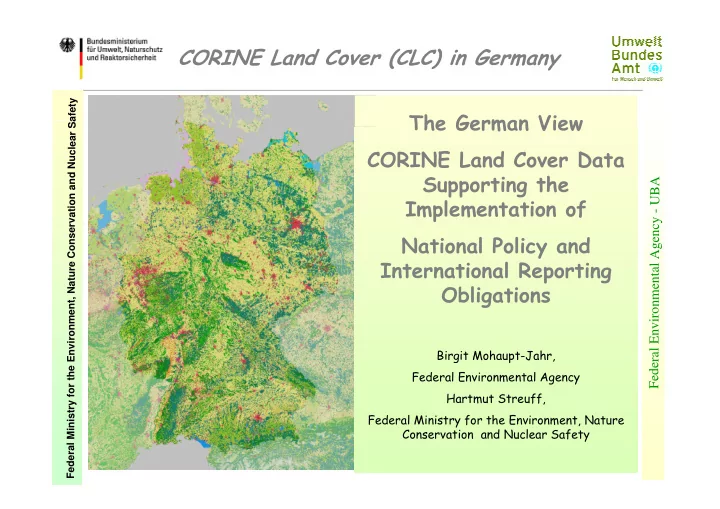
CORINE Land Cover (CLC) in Germany Federal Ministry for the Environment, Nature Conservation and Nuclear Safety The German View CORINE Land Cover Data Supporting the A B Implementation of U - y c n National Policy and e g A


slide-1
SLIDE 1

F e d e r a l E n v i r

  • n

m e n t a l A g e n c y

  • U

B A

Federal Ministry for the Environment, Nature Conservation and Nuclear Safety

The German View CORINE Land Cover Data Supporting the Implementation of National Policy and International Reporting Obligations

Birgit Mohaupt-Jahr, Federal Environmental Agency Hartmut Streuff, Federal Ministry for the Environment, Nature Conservation and Nuclear Safety

CORINE Land Cover (CLC) in Germany

slide-2
SLIDE 2

F e d e r a l E n v i r

  • n

m e n t a l A g e n c y

  • U

B A

Federal Ministry for the Environment, Nature Conservation and Nuclear Safety

geo-referenced data of land use and land use change driving forces, pressures, state

Land Cover Information Basis for Environmental Assessments

slide-3
SLIDE 3

F e d e r a l E n v i r

  • n

m e n t a l A g e n c y

  • U

B A

Federal Ministry for the Environment, Nature Conservation and Nuclear Safety

international regulations national implementation Germany federal level, state level (16 Länder) there is a need for

  • harmonised data

comparability

  • suitable spatial resolution

consistency

  • reliable methodology

continuity

Why CLC?

slide-4
SLIDE 4

F e d e r a l E n v i r

  • n

m e n t a l A g e n c y

  • U

B A

Federal Ministry for the Environment, Nature Conservation and Nuclear Safety

  • public and private planning offices
  • weather services
  • environment protection bodies
  • forest and agricultural institutions
  • traffic and tourism consultants
  • universities
  • private enterprises

CLC Users in Germany

slide-5
SLIDE 5

F e d e r a l E n v i r

  • n

m e n t a l A g e n c y

  • U

B A

Federal Ministry for the Environment, Nature Conservation and Nuclear Safety

UNECE Long-Range Transboundary Air Pollution (LRTAP) EU Water Framework Directive (WFD) European Soil Thematic Strategy (STS) regional planning environmental monitoring programmes development of environmental indicators 3 examples

CLC Applications for Environmental Policy

slide-6
SLIDE 6

F e d e r a l E n v i r

  • n

m e n t a l A g e n c y

  • U

B A

Federal Ministry for the Environment, Nature Conservation and Nuclear Safety

Objectives

  • agreement on emission reduction ceilings
  • limit air pollution
  • effect-based approach

critical loads, critical levels = estimated threshold for exposure

UNECE Geneva Convention

Long-Range Transboundary Air Pollution

slide-7
SLIDE 7

F e d e r a l E n v i r

  • n

m e n t a l A g e n c y

  • U

B A

Federal Ministry for the Environment, Nature Conservation and Nuclear Safety

UNECE Geneva Convention

Long-Range Transboundary Air Pollution

Products

  • models and maps of critical loads/levels and their exceedances
  • integrated maps on UNECE level, based on national maps
  • land use specific deposition rates

harmonised data and procedures

slide-8
SLIDE 8

F e d e r a l E n v i r

  • n

m e n t a l A g e n c y

  • U

B A

Federal Ministry for the Environment, Nature Conservation and Nuclear Safety

agreed harmonisation procedure!

LRTAP: Application of CLC

  • location of ecosystems which countries would like to protect
  • description of these ecosystems
  • deposition rates based on substance transport and impact models
slide-9
SLIDE 9

F e d e r a l E n v i r

  • n

m e n t a l A g e n c y

  • U

B A

Federal Ministry for the Environment, Nature Conservation and Nuclear Safety

Critical Load for Nitrogen

Nitrogen (kg/ha/year)

< 5 1,9 % 5 - 10 32,6 % 10 – 15 47,5 % 15 - 20 17,2 % >= 20 0,8 %

Percentage of receptor area (%)

LRTAP: Example

slide-10
SLIDE 10

F e d e r a l E n v i r

  • n

m e n t a l A g e n c y

  • U

B A

Federal Ministry for the Environment, Nature Conservation and Nuclear Safety

Objectives

  • good status of water bodies in the EU by 2015
  • no deterioration

Reporting Obligations

  • analysis of pressures, impact, and risk of failing the objectives (2004)
  • measuring programmes, river basin management plans (2009, 2015,

2021)

  • compliance with the objectives (2015, 2021, 2027)
  • common river basin district reports

harmonised data and procedures needed! Germany: federal level, state level (16 Länder) Europe: cross boarder water catchment areas and river basins

Water Protection

Water Framework Directive

slide-11
SLIDE 11

F e d e r a l E n v i r

  • n

m e n t a l A g e n c y

  • U

B A

Federal Ministry for the Environment, Nature Conservation and Nuclear Safety

WFD: Application of CLC

agreed harmonisation procedure

  • LAWA recommends to report based on CLC
  • 2 implementation guidelines recommend to use CLC

(IMPRESS and draft reporting)

  • location of driving forces (industry, agriculture, …)
  • derivation of substance information (what, how much, where)
  • estimation of model input parameters (evapotranspiration, leaching,

runoff, …)

slide-12
SLIDE 12

F e d e r a l E n v i r

  • n

m e n t a l A g e n c y

  • U

B A

Federal Ministry for the Environment, Nature Conservation and Nuclear Safety

substance input modelling into waters

Example:

pesticides runoff potential

the spatial distribution depends on parameters of

4

the substances

4

the soil

4

the water body

4

land use runoff potential is high in

4

vineyards,

4

loess and marsh land

4

sugar beat, potatoes, corn fields

4

sloppy arable land Source: Bach et al.

WFD: Example

slide-13
SLIDE 13

F e d e r a l E n v i r

  • n

m e n t a l A g e n c y

  • U

B A

Federal Ministry for the Environment, Nature Conservation and Nuclear Safety

Objectives: protection of soil from

  • erosion
  • soil compaction
  • decrease of organic material
  • decrease of soil biodiversity
  • soil contamination
  • salinisation
  • sealing
  • flats and land slides

Products e.g. for erosion risk assessment

  • national maps
  • exploration of management methods for erosion reduction
  • development of agri-environmental indicators (good agricultural

practice)

  • EU indicators on actual erosion and erosion risk

harmonised data and procedures needed!

European Soil Thematic Strategy

slide-14
SLIDE 14

F e d e r a l E n v i r

  • n

m e n t a l A g e n c y

  • U

B A

Federal Ministry for the Environment, Nature Conservation and Nuclear Safety

  • location of areas
  • location of driving forces
  • cultivation index

harmonisation leads to

  • national/EU-wide maps
  • development of agri-environmental indicators

STS: Application of CLC

slide-15
SLIDE 15

F e d e r a l E n v i r

  • n

m e n t a l A g e n c y

  • U

B A

Federal Ministry for the Environment, Nature Conservation and Nuclear Safety

actual erosion: erosion potential risk + land use from CLC

STS: Example

slide-16
SLIDE 16

F e d e r a l E n v i r

  • n

m e n t a l A g e n c y

  • U

B A

Federal Ministry for the Environment, Nature Conservation and Nuclear Safety

Climate Change

  • UN Framework Convention on Climate Change (UNFCC)

changes of forest, agricultural areas, grassland, wetlands, settlements

  • Kyoto Protocol (LU/LUCF)

carbon sinks, ARD, etc.

Nature Conservation

description of ecosystems based on CLC and additional data on soil and climate EUNIS classification of the EU habitat guidance

CLC - Future Perspectives

slide-17
SLIDE 17

F e d e r a l E n v i r

  • n

m e n t a l A g e n c y

  • U

B A

Federal Ministry for the Environment, Nature Conservation and Nuclear Safety

CLC - Future Perspectives – Prerequisites

  • long term comparability of data
  • continuity of data supply
  • consistency and coherence of data

integration in GMES?