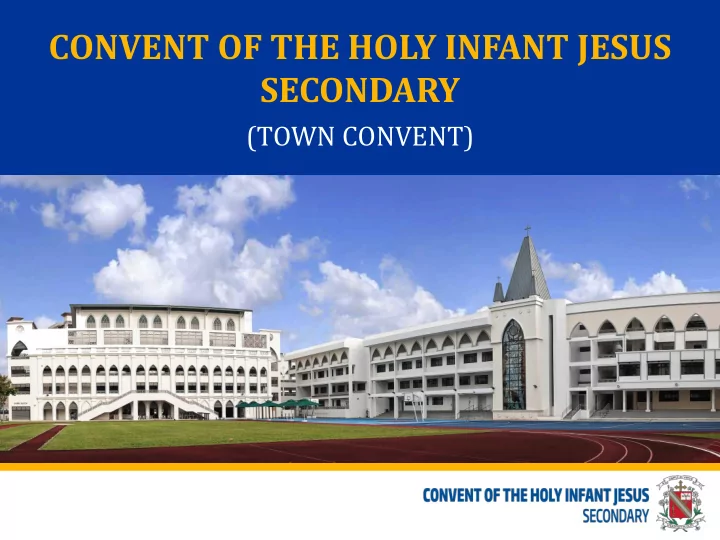
SLIDE 1 CONVENT OF THE HOLY INFANT JESUS SECONDARY
(TOWN CONVENT)
SLIDE 2 School Leaders
Principal Mrs Karen Tay Vice-Principals Academic: Ms Candice Seet Admin: Mr Mark Hong Dean Mrs Mathews Shu Quo
SLIDE 3
CHIJ STAFF
Year Head & Assistant Year Heads Key Personnel School Counsellors Form Teachers & Co-Form Teachers
SLIDE 4 WHO WE ARE
Established in 1854 at Victoria Street Formerly known as Town Convent Mother school of the CHIJ family ( 11 IJ Schools in Singapore) 2nd oldest girls’ school in Singapore
SLIDE 5 OUR MISSION
A CHIJ school is a Christ-centred school community where all work together for the promotion
- f truth, justice, freedom and love,
with special reference to the needs of persons who are disadvantaged in any way.
Blessed Nicolas Barré Founder of the IJ Sisters
SLIDE 6
SCHOOL MOTTO Simple in Virtue Steadfast in Duty
SLIDE 7
OUR VISION
SLIDE 8
AN IJ GIRL is...
a THINKER, LEADER and COMMUNICATOR who is confident with humility, principled with compassion, and cultured with grace.
SLIDE 9
School Values Compassion Humility Integrity Perseverance Faith
SLIDE 10 Programme
Time Programme 7.30am Breakfast 7.45am Principal’s Address 8.00am Address by Year Head 8.10am Sharing by Academic Heads
- Mother Tongue
- Mathematics
- Science
- Humanities
- Design & Technology
- Art
- Drama
- CCA
8.50am Welcome by CHIJ Sec PSG 9.00am Q & A
SLIDE 11
A HOLISTIC EDUCATION
Twin emphasis on ACADEMIC EXCELLENCE CHARACTER DEVELOPMENT
SLIDE 12
A HOLISTIC EDUCATION
3Ls@IJ LEARN LIVE LEAD
SLIDE 13 CHIJ EDUCATION & EXPERIENCE
Level Learning Events / Experience
Sec 1
Orientation and Campfire Learning Journey to CHIJMES General Leadership Programme (Hike) VIA (My School , A Litter-free Environment) Inter-class Drama Competition Story-telling Workshop Study Skills Workshop IJ FLAIR Financial Literacy IJ Spirit Day & IJ Fiesta Cross Country Retreat
Sec 2
General Leadership Programme (Outdoor Adventure Camp) VIA (Recycling Outreach Project) Specific Leaders Camp Overseas Learning Journey Financial Literacy
SLIDE 14 CHIJ EDUCATION & EXPERIENCE
Level Learning Events / Experience
Sec 3
General Leadership Programme (Outward Bound Singapore) Student Leaders Camp VIA (Raising Funds for Needy & Befriending the Elderly) Work Attachment Learning Journey to SAFTI Mission Trips
Sec 4
Self-Awareness Camp VIA (Befriending the Elderly) Educational Fair & Career Seminar Graduation Ceremony & Graduation Night
SLIDE 15 ACADEMIC CORE
- English Language
- Mother Tongue or Higher Mother Tongue
- General Science
- Mathematics
- History
- Geography
- Literature
- Drama
- General Art Programme
- Food & Consumer Education
SLIDE 16
SLIDE 17 COMPUTATION OF L1R5
L1
First Language English / Higher Mother Tongue
R5
Relevant Subject 1 Humanities / Higher Art / Higher Music Relevant Subject 2 Mathematics / Science Relevant Subject 3 Humanities / Higher Art / Higher Music / Mathematics / Science Relevant Subject 4 Any GCE ‘O’ Level subjects excluding CCA and Religious Knowledge Relevant Subject 5 Any GCE ‘O’ Level subjects excluding CCA and Religious Knowledge
SLIDE 18 COMPUTATION OF L1R4
L1
First Language English / Higher Mother Tongue
R4
Relevant Subject 1 Humanities / Higher Art / Higher Music / Mathematics / Science Relevant Subject 2 Humanities / Higher Art / Higher Music / Mathematics / Science Relevant Subject 3 Any GCE ‘O’ Level subjects excluding CCA and Religious Knowledge Relevant Subject 4 Any GCE ‘O’ Level subjects excluding CCA and Religious Knowledge
SLIDE 19 COMPUTATION OF ELR2B2
EL
English Language English Language
R2
Two Relevant Subjects Two group of relevant subjects from four categories of courses: ELR2B2-A ELR2B2-B ELR2B2-C ELR2B2-D (applied sciences, business management, engineering, media design)
B2
Two Best Other Subjects Best 2 other subjects excluding CCA
SLIDE 20
MOE - Joint Admissions Exercise (JAE)
http://www.moe.gov.sg/education/ admissions/jae/
SLIDE 21 CHARACTER DEVELOPMENT
CCE@IJ STRENGTHS OF CHARACTER
Lifelong learner and critical thinker Diligent and capable performer Socially and emotionally skilled leader Responsible and self-disciplined person Contributing community member Spiritual person crafting a purposeful life
SLIDE 22 CHARACTER DEVELOPMENT
Milestone Checklist of an IJ Girl
The CCE Competency Map is supported by the Milestone Checklist for an IJ
- Girl. This checklist is a developmental tool which enables the teachers to
support the student’s growth and development in the key competencies identified, and support her attainment of the Outcomes of the IJ Girl.
SLIDE 23 LEAPS 2.0
.
Co-Curricular Attainment Details Excellent (2 bonus points) Student who attains a minimum Level 3 in all four domains with at least a Level 4 in one domain. Good (1 bonus point) Student who attains a minimum Level 1 in all four domains with any
a) At least Level 2 in three domains; b) At least Level 2 in one domain and at least Level 3 in another domain; or c) At least Level 4 in one domain. Fair Student’s attainment in co-curricular will not translate into any bonus points.
Recognition of Students’ Level of Attainment
SLIDE 24 ASSESSMENT
- Formative Assessment
- Summative Assessment
SLIDE 25 Partnership with Parents
- Conversations with School
Leaders and Teachers
SLIDE 26
Address by Year Head
Mr Francis Yap
SLIDE 27
Sharing by HoD/ Mother Tongue Mrs Shirley Yeung
SLIDE 28 Main Syllabus Focus & Skills
- Oral Competency
- Reading Competency
- Writing Competency
- Creative Thinking
SLIDE 29 Learning MT @ IJ
- Discussion of Current Affairs
- Flipped Classroom
- Customised mind mapping tools
- MT Fortnight: Culture and Heritage
- Attitude towards learning
SLIDE 30 Curriculum Focus
Language Skills MT (NA) MT (Exp) HMT Listening and Oral 40% 35% 25% Reading 30% 35% 30% Writing 30% 30% 45% Total 100% 100% 100%
SLIDE 31 Assessment
Formative Assessment Summative Assessment Written component
- Unit test
- Email writing
- Composition writing
Paper 1 Email and Composition Writing Paper 2 Vocabulary & Comprehension Oral Component
- Oral report/ Presentation
Paper 3 Oral & Listening Comprehension Reading Project
SLIDE 32 HCL, HTL, HML
– Conducted at language centres
- Strong foundation in language
- 2 bonus points with minimum C6
- Entrance test for HCL;
Sec 1 EOY (top 10% for CL and 75% overall)
SLIDE 33
Sharing by HoD/ Mathematics Ms Sharon Khoo
SLIDE 34 Mathematics provides the ideal domain to:
- Learn how to think and problem-solve
- Develop 21st century competencies
SLIDE 35
Thinking and Communicating with Clarity and Precision
SLIDE 36
Working for Primary Level 1800 5 = 360 1800 – 360 = 1440 1440 96 = 15 Jane paid for 15 months.
SLIDE 37
Working for Secondary Level Deposit paid = 1800 5 = $360 Amount left to be paid = 1800 – 360 = $1440 Number of monthly payments = 1440 96 = 15 months
SLIDE 38 Homework & Reflective Review
Homework (Cognition) Reflective review (Metacognition)
- What did I learn?
- What mistake did I make?
- What must I do so that I will not make that
mistake again?
- What competency did I practise?
SLIDE 39
What did I learn ?
“I learnt to simplify algebraic expressions by adding and subtracting of like terms.” “I learnt to solve real world problems by translating them into algebraic equations.”
SLIDE 40
What competency did I practise?
“I was striving for accuracy.” “I connected information to arrive at the solution.” “I applied past knowledge to a new situation.”
SLIDE 41 Syllabus Overview
- Syllabus assumes knowledge of Standard/
Foundation Mathematics
Number and Algebra Geometry and Measurement Statistics and Probability Mathematical Processes
SLIDE 42
Sharing by HoD/ Science Mr Alvin Tang
SLIDE 43
SLIDE 44 Lower Secondary Science
Termed as General Science but is divided into 3 domains
- Biology
- Chemistry
- Physics
SLIDE 45
SLIDE 46 Assessment
- 10% Science Practical Assessment
(Individual)
- 10% Problem Based Assessment (Group)
- 80% Written assessment
SLIDE 47
Sharing by HoD/ Humanities Ms Jasmine Ong
SLIDE 48
The Changing World
SLIDE 49 Geography
THE STUDY OF ...
- Interconnectedness and interdependence of people, economies and
environments
- Environmental and social issues in different places and cultures
- Different cultures and ways of living
THROUGH ...
- Geographical Inquiry
- Active questioning
- Analysis of data and trends
- Making reasoned judgments
OUTCOMES:
- Appreciation of the sustainability of resources, people, country and planet
- Confident person, self-directed learner, active contributor, concerned
citizen
SLIDE 50
Example: Data Analysis & Map Reading
SLIDE 51 History
THE STUDY OF ...
- Connections between the past and present
- Ourselves and others
- Relevance of Singapore’s past to Singapore today
- Vulnerabilities of nation-state in relation to world
THROUGH ...
- Historical Investigation
- Active questioning
- Taking on perspectives
- Making reasoned judgments
- Understanding cause and consequence
OUTCOMES:
- Empathy, understanding context, making connections
- Confident person, self-directed learner, active contributor, concerned
citizen
SLIDE 52 Geographical Investigation
Investigation Question: What is the quality of water in a waterway or water body? How do human activities affect the quality of water in a waterway or water body?
SLIDE 53 Example: Source Analysis
Inquiry: Was life difficult for immigrants in 19th Century Singapore?
Study Source A. What can you learn from this photograph about the life of the coolies in early Singapore? Use details from the source to explain your answer
Source A: A photograph of coolies unloading sacks of rice at Boat Quay in 19th century Singapore.
SLIDE 54 Historical Investigation
Investigation Question: What should be remembered in Singapore in the 1960s and the 1970s?
SLIDE 55 Literature
THE STUDY OF ...
- Poetry, set text, unseen prose
- Role of language to create meaning
- Connections among texts, lives and the world
THROUGH ...
- Critical analysis of texts
- Making connections
- Active reading, Critical response, Questioning
- Character Analysis
OUTCOMES:
- Develop a questioning mind, manage ambiguities
- Appreciation of language, texts and the world
SLIDE 56
Areas of Study
SLIDE 57 Examples of Literature Programmes
Literature Reading Programme
- Read 3 books during the course of the year
- Encourages the habit of reading and responding creatively to texts
- Class discussions
Inter-Class Drama Competition
- Held in July
- Students convert one short story into a play
Poetry Slam Competition
- Competitive art of performing poetry
- Self-expression
- Collaborative
SLIDE 58 Importance of Humanities
“Collectively, the Humanities provide multiple lenses to help students understand our world. They equip students with critical thinking and communication skills as well as global perspectives to become confident persons, active contributors and concerned citizens. Indeed, these skills are crucial in enabling our students to navigate the complexities of a rapidly changing world.”
Mr Heng Swee Keat, Minister for Education
Humanities Educators’ Conference, 2012
SLIDE 59
Sharing by HoD/ Lifeskils Mrs Eugenia Tan
SLIDE 60 Subjects Sec One 2016 Sec Two 2017 Design & Technology (D&T) One Year programme NIL Food and Consumer Education (FCE)
Previously known as Home Economics
NIL One Year programme
SLIDE 61 AIMS OF D&T
Develop : an awareness of design in products an appreciation of function, aesthetics and technology in design basic design thinking and communication skills
- Experience the process of realising
design through making of products
SLIDE 62 D&T – Core Areas of Study in IJ
- 1. Product design
- 2. Interior design
SLIDE 63 3-STEP PROCESSES
- Design Appreciation
- Designing
- Making
SLIDE 64
DESIGN APPRECIATION
Exposes pupils to : product awareness, product functions, aesthetics
SLIDE 65
DESIGNING
Pupils learn and practise basic strategies and skills in: Analysing task problem Researching Ideation (sketch possible design ideas) Evaluation Design communication (free-hand sketching)
SLIDE 66
MAKING
Pupils acquire basic making skills and related knowledge through the : simple modelling (making template) basic technology (tools, machines & Google sketch-up) execution of appropriate techniques and processes to make their product.
SLIDE 67 PRODUCT DESIGN
Refrigerator Magnets Torch light Key chain
SLIDE 68 INTERIOR DESIGN
Goggle Sketch-up (Bedroom) Cardboard models
SLIDE 69 ASSESSMENT
Subject Sec One 2016 Sec Two 2017 Design & Technology (D&T) No MY & EOY Exam
Assessment is carried
year (pg 25)
Food and Consumer Education (FCE) NIL MY & EOY Exam
Coursework and written paper
SLIDE 70
FOOD & CONSUMER EDUCATION in 2017
SLIDE 71 STRUCTURE OF FCE SYLLABUS
Core Areas of Study Elective Modules
- 1. Food Studies
- Diet & Health
- Food Management
- 1. Nutrition & Food
Science
- 2. FCE & the Community
- 2. Consumer Education
(Financial Literacy Programme)
- Resource management
- Consumer awareness
SLIDE 72 FCE PRACTICAL EXAM
Cook ONE dish they have decided
Individual work 1 hour to prepare, cook & serve
SLIDE 73 FCE PRACTICAL EXAM
- Main ingredients and condiments will be provided.
For e.g. meat, milk, vegetable, butter, oil, salt, sugar, soya sauce, plain flour
- Students will need to purchase and bring other
ingredients (e.g. garnishes which are needed in small quantity) required for their chosen dish
Shopping & Budget plan for effective management of resources
SLIDE 74
Sharing by HoD/ Aesthetics Ms Jo Teo
SLIDE 75
Sharing by SH/ Drama Mr Gary Tang
SLIDE 76
Sharing by HoD/ CCA & PE Mr Balbinder Singh
SLIDE 77
Welcome by CHIJ Sec PSG Mrs Geraldine Koh Chairperson
SLIDE 78