Contents Motivation Exploiting Routing Redundancy via Resilient - - PowerPoint PPT Presentation

contents
SMART_READER_LITE
LIVE PREVIEW

Contents Motivation Exploiting Routing Redundancy via Resilient - - PowerPoint PPT Presentation

Contents Motivation Exploiting Routing Redundancy via Resilient Overlay Routing Structured Peer-to-Peer Overlays Interface with legacy applications Evaluation Sep. 17, 2003 Comparison Byung-Gon Chun 1 2 Motivation


slide-1
SLIDE 1

1

Exploiting Routing Redundancy via Structured Peer-to-Peer Overlays

  • Sep. 17, 2003

Byung-Gon Chun

2

Contents

  • Motivation
  • Resilient Overlay Routing
  • Interface with legacy applications
  • Evaluation
  • Comparison

3

Motivation

  • Frequent disconnection and high packet loss

in the Internet

  • Network layer protocol’s response to

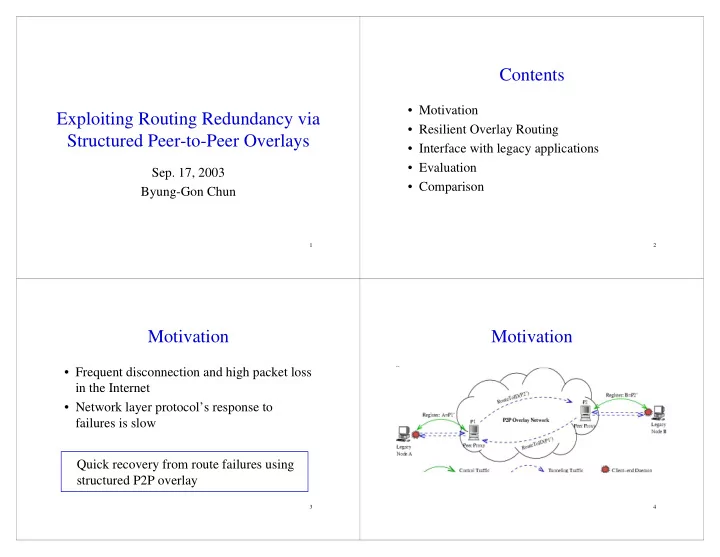
failures is slow Quick recovery from route failures using structured P2P overlay

4

Motivation

slide-2
SLIDE 2

5

Resilient Overlay Routing

  • Basics
  • Route failure detection
  • Route failure recovery
  • Routing redundancy maintenance

6

Basics

  • Use the KBR of structured P2P overlays

[API]

  • Backup links maintained for fast failover
  • Proximity-based neighbor selection
  • Proximity routing with constraints
  • Note that all packets go through multiple
  • verlay hops.

7

Failure Detection

  • Failure recovery time ~ failure detection time

when backup paths are precomputed

  • Periodic beaconing

– Backup link probe interval = Primary link probe interval*2

  • Number of beacons per period per node - log(N)
  • vs. O(<D>) for unstructured overlay
  • Routing state updates – log2N
  • vs. O(E) for link state protocol

8

Failure Detection

  • Link quality estimation using loss rate

– Ln = (1-alpha) Ln-1 + alpha Lp

  • TBC - metric to capture the impact on the

physical network

– TBC = beacons/sec * bytes/beacon * IP hops

  • PNS incurs a lower TBC

Structured overlays can do frequent beaconing for fast failure detection ?

slide-3
SLIDE 3

9

How many paths?

  • Recall the geometry paper

– Ring - (log N)! Tree – 1

  • Tree with backup links

10

Failure Recovery

  • Exploit backup links
  • Two polices presented in [Bayeux]
  • First reachable link selection (FRLS)

– First route whose link quality is above a defined threshold

11

Failure Recovery

  • Constrained multicast (CM)

– Duplicate messages to multiple outgoing links – Complementary to FRLS. Triggered when no link meets the threshold – Duplicate message drop at the path-converged nodes

  • Path convergence !

12

slide-4
SLIDE 4

13

Routing Redundancy Maintenance

  • Replace the failed route and restore the pre-failure

level of path redundancy

  • Find additional nodes with a prefix constraint
  • When to repair?

– After certain number of probes failed – Compare with the lazy repair in Pastry

  • Thermodynamics analogy –

active entropy reduction [K03]

14

Interface with legacy applications

  • Transparent tunneling via structured
  • verlays

15

Tunneling

  • Legacy node A, B, Proxy P
  • Registration

– Register an ID - P(A) (e.g. P-1) – Establish a mapping from A’s IP to P(A)

  • Name resolution and Routing

– DNS query – Source daemon diverts traffic with destination IP reachable by overlay – Source proxy locates the destination overlay ID – Route through overlay – Destination proxy forwards to the destination daemon

16

Redundant Proxy Management

  • Register with multiple proxies
  • Iterative routing between the source proxy

and a set of destination proxies

  • Path diversity
slide-5
SLIDE 5

17

Deployment

  • What’s the incentive of ISPs?

– Resilient routing as a value-added service

  • Cross-domain deployment

– Merge overlays – Peering points between ISP’s overlays

  • Hierarchy - Brocade

18

Simulation Result Summary

  • 2 backup links
  • PNS reduces TBC (up to 50%)
  • Latency cost of backup paths is small (mostly less

than 20%)

  • Bandwidth overhead of constrained multicast is

low (mostly less than 20%)

  • Failures close to destination are costly.
  • Tapestry finds different routes when the physical

link fails.

19

Small gap with 2 backup links

?

20

Microbenchmark Summary

  • 200 nodes on PlanetLab
  • Alpha ~ between 0.2 and 0.4
  • Route switch time

– Around 600ms when the beaconing period is 300ms

  • Latency cost ~ 0

– Sometimes reduced latency in the backup paths – artifacts of small network

  • CM

– Bandwidth*Delay increases less than 30%

  • Beaconing overhead

– Less than 7KB/s for beacon period of 300ms

slide-6
SLIDE 6

21

Self Repair

22

Comparison

  • RON

– Use one overlay hop (IP) for normal op. and one indirect hop for failover – Endpoints choose routes – O(<D>) probes D=O(N) – O(E) messages E=O(N2) – Average of k samples – Probe interval 12s – Failure detection 19s – 33Kbps probe overhead for 50 nodes (extrapolation: 56kbps around 70 nodes)

  • Tapestry ( L=3 )

– Use (multiple) overlay hops for all packet routing – Prefixed routes – O(logN) probes – O(log2N) messages – EWMA – Probe interval 300ms – Failure detection 600ms – < 56Kbps probe overhead for 200 nodes