Contents Issues Evaluation criteria Deliverables Evaluation - - PowerPoint PPT Presentation

contents
SMART_READER_LITE
LIVE PREVIEW

Contents Issues Evaluation criteria Deliverables Evaluation - - PowerPoint PPT Presentation

C AMPUS A RCHIZINC Increasing urban density : The city on the city, building upwards 29/09/14 Contents Issues Evaluation criteria Deliverables Evaluation process 2 Issues 3 Issues Increasing urban density : the city


slide-1
SLIDE 1

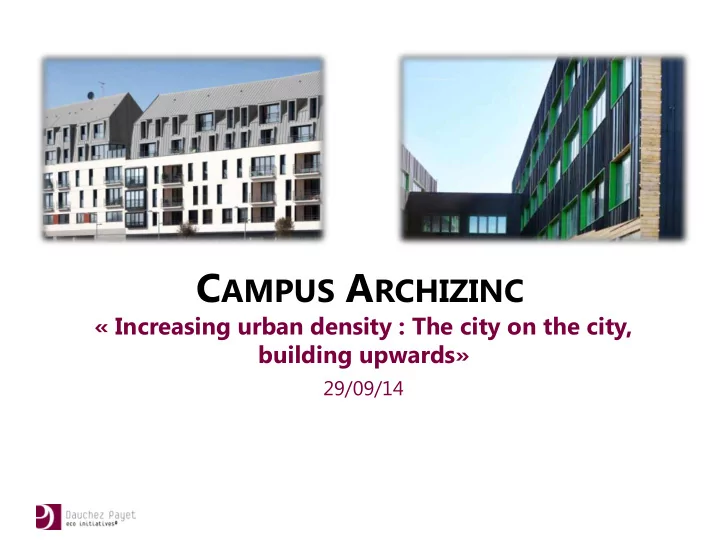
CAMPUS ARCHIZINC

« Increasing urban density : The city on the city, building upwards»

29/09/14

slide-2
SLIDE 2

Contents

 Issues  Evaluation criteria  Deliverables  Evaluation process

2

slide-3
SLIDE 3

Issues

3

slide-4
SLIDE 4

Issues

4

Theme

Issues

Challenges and expectation

Increasing urban density : the city

  • n the city, building upwards

Reduce urban sprawl Increase housing density while preserving existing buildings Encouraging architectural and social diversity

Quality of architecture

Building sustainability

Concrete and measurable elements demonstrating the sustainability

  • f the project
slide-5
SLIDE 5

Evaluation criteria

5

slide-6
SLIDE 6

Evaluation criteria

6

ARCHIZINC sustainable criteria

Currently sustainable issues VMZINC Environmental policy Environmental building certification

slide-7
SLIDE 7

Evaluation criteria

7

Ecology Energy and maintenance Water management Materials Comfort of

  • ccupants

Transport and social issues

slide-8
SLIDE 8

Deliverables

8

slide-9
SLIDE 9

Deliverables

9

 Material for environmental section

Site plan identifying the advantages and constraints of the site Analysis of the environment and reasons for choosing the site Ranking of issues according to the site context Description of how each sustainable building theme was dealt with Bioclimatic section illustrating heat strategy Bioclimatic section illustrating cold strategy Bioclimatic section illustrating natural light strategy Plan depicting the composition of the wall structures The completed Excel eco-design tool

slide-10
SLIDE 10

Deliverables

1

 Potential advantages of a site examples :

 Bus stop  Train station  Cycle network…

 Potential constraints of a site examples :

 High traffic avenue/road  Noise source…

Site plan identifying the advantages and constraints of the site

slide-11
SLIDE 11

Deliverables

11

 Written analysis and conclusion about :

 Advantages and constraints of site  Why the site is important and chosen  Association between identified advantages/constraints and sustainable building theme Analysis of the environment and reasons for choosing the site

slide-12
SLIDE 12

Deliverables

12

 Written description about how the chosen strategy is dealing with each theme  Expected precision will vary based

  • n

your environmental issues hierarchy  For main issues : concrete elements, measurable calculation notes should be included

Description of how each sustainable building theme was dealt with

slide-13
SLIDE 13

Deliverables

13

Ranking of issues according to the site context

Site A

Ecology Energy and maintenance Water management Materials Comfort of occupants Transport and social issues

slide-14
SLIDE 14

Deliverables

14

 Example :

Description of how each sustainable building theme was dealt with

Project A

Ecology Energy and maintenance Water management Materials Comfort of occupants Transport and social issues

Ecology is our project sustainable theme top priority because it is located in a polluted city center where heat islands are a problem. To increase neighborhood sustainable value, our project will include :

  • Vegetated roof (more than 70% of project roof surface)
  • Species with low allergenic potential
  • Vegetated walls (about 30% of total project wall surface)
  • High reflectance external soil …
slide-15
SLIDE 15

Deliverables

15

Bioclimatic sections

Capturing Conserving Distributing

Storing

Minimize Protect Avoid Refresh Disperse

Capture Distribute

Protect

Heat strategy Cold strategy Natural light strategy

slide-16
SLIDE 16

Deliverables

16

Plan depicting the composition of the wall structures

 This plan should illustrate :

 Structural elements  Insulation thickness  Windows and doors

slide-17
SLIDE 17

Deliverables

17

The completed Excel eco-design tool  The eco-design tool allows you to assess your project through 7 bioclimatic quantitative criteria  You should sort these quantitative criteria like the environmental issues to optimise the most pertinent for your project based on your project site analysis  To guide you some values are proposed in the tool to help you estimate if your project is closer to a low or a good value  You should try to enter your project datas several times to

  • ptimize it through bioclimatic quantitative criteria.
slide-18
SLIDE 18

Deliverables

18

The completed Excel eco-design tool

 The eco-design tool allows you to assess your project through 7 bioclimatic indexes :

 Compactness  Opening surfaces  Level of insulation  Level of thermal loss  Solar gains in summer  Solar gains in winter  CO2 index of materials

slide-19
SLIDE 19

Deliverables

19

The completed Excel eco-design tool

 The 5 bioclimatic indexes :

  • 1. Compactness =

∑(𝑥𝑏𝑚𝑚,𝑠𝑝𝑝𝑔,𝑚𝑝𝑥𝑓𝑠 𝑔𝑚𝑝𝑝𝑠 𝑏𝑠𝑓𝑏𝑡) 𝑈𝑝𝑢𝑏𝑚 𝑜𝑓𝑢 𝑔𝑚𝑝𝑝𝑠 𝑏𝑠𝑓𝑏

Low

3 ,3 2 ,6 2

good

The lower compactness is the lower thermal loss will be important. Reference values

slide-20
SLIDE 20

Deliverables

20

The completed Excel eco-design tool

 The 5 bioclimatic indexes :

  • 2. Opening surfaces =

∑(𝑕𝑚𝑏𝑨𝑓𝑒 𝑏𝑠𝑓𝑏) 𝑈𝑝𝑢𝑏𝑚 𝑥𝑏𝑚𝑚 𝑏𝑠𝑓𝑏 Low

,1 3 ,1 7 ,2

good

The higher the glazed surface will be the higher visual comfort and sun thermal gain will be. Reference values

slide-21
SLIDE 21

Deliverables

21

The completed Excel eco-design tool

 The 5 bioclimatic indexes :

  • 3. Level of thermal loss en W/(m².K) =

∑(𝑡𝑣𝑠𝑔𝑏𝑑𝑓∗𝑁𝑏𝑢𝑓𝑠𝑏𝑗𝑚𝑡 𝑢ℎ𝑓𝑠𝑛𝑏𝑚 𝑢𝑠𝑏𝑜𝑡𝑛𝑗𝑡𝑗𝑡𝑝𝑜) 𝑈𝑝𝑢𝑏𝑚 𝑥𝑏𝑚𝑚 𝑏𝑠𝑓𝑏

Outside Inside Heat transfert Outside cladding Structural elements Insulation Structure

Thermal resistance (R) = thickness (e)/Thermal conductivity (ʎ)  Thermal loss (U) = 1/Thermal resistance (R)

Reference values

Low 0

,4 5 ,4 ,3 6 good

slide-22
SLIDE 22

Deliverables

22

The completed Excel eco-design tool

 The 5 bioclimatic indexes :

  • 4. Level of insulation en W/(net floor m².K)

Unlike the level of thermal loss (Ubdg), the level of insulation is brought down to the net floor area and therefore penalizes building that have heights.

Low

,7 ,6 ,3

good

Reference values

slide-23
SLIDE 23

Deliverables

23

The completed Excel eco-design tool

 The 5 bioclimatic indexes :

5 and 6. Solar gains in summer and winter

Solar gains are approached by calculating an equivalent south window surface. Building project plan Equivalent south window N

Solar gains

ISE summer ISE winter Reference values

slide-24
SLIDE 24

Deliverables

24

The completed Excel eco-design tool

 The 5 bioclimatic indexes :

  • 7. CO2 index of materials (kg CO2/m²) =

∑𝑡𝑣𝑠𝑔𝑏𝑑𝑓∗𝑛𝑏𝑢𝑓𝑠𝑗𝑏𝑚 𝑕𝑠𝑓𝑧 𝑓𝑜𝑓𝑠𝑕𝑧 𝑡𝑣𝑠𝑔𝑏𝑑𝑓

Energy  CO2 CO2 CO2 index

slide-25
SLIDE 25

Deliverables

25

The completed Excel eco-design tool

2 sheets :

  • 1 to show your results
  • 1 to fulfill with your project datas
slide-26
SLIDE 26

Deliverables

26

The completed Excel eco-design tool

  • 1. On the first sheet , complete
  • range cells with the name of your

team/project

slide-27
SLIDE 27

Deliverables

27

The completed Excel eco-design tool

You can use violet cells to get more information about bioclimatic indexes

slide-28
SLIDE 28

Deliverables

28

The completed Excel eco-design tool

  • 2. On the second sheet , complete
  • range cells with your project data

You can find further information about materials that you can use in violet cells. A list will help you to choose materials

slide-29
SLIDE 29

Evaluation process

29

slide-30
SLIDE 30

Evaluation process

30

Site plan identifying the advantages and constraints of the site Analysis of the environment and reasons for choosing the site Ranking of issues according to the site context Description of how each sustainable building theme was dealt with Bioclimatic section illustrating heat strategy Bioclimatic section illustrating cold strategy Bioclimatic section illustrating natural light strategy Plan depicting the composition of the wall structures The completed Excel eco-design tool 10% 15% 10% 15% 10% 10% 10% 10% 10% 3/5 2/5 4/5 5/5 1/5 3/5 3/5 5/5 5/5 Global Environmental Socre of the project

  • 3,45

Deliverables

Ponderation*

Score

* The ponderation will be discussed with members of the jury and may change