Contents Introduction 1 Graphical Models and the PC Algorithm - - PDF document

contents
SMART_READER_LITE
LIVE PREVIEW

Contents Introduction 1 Graphical Models and the PC Algorithm - - PDF document

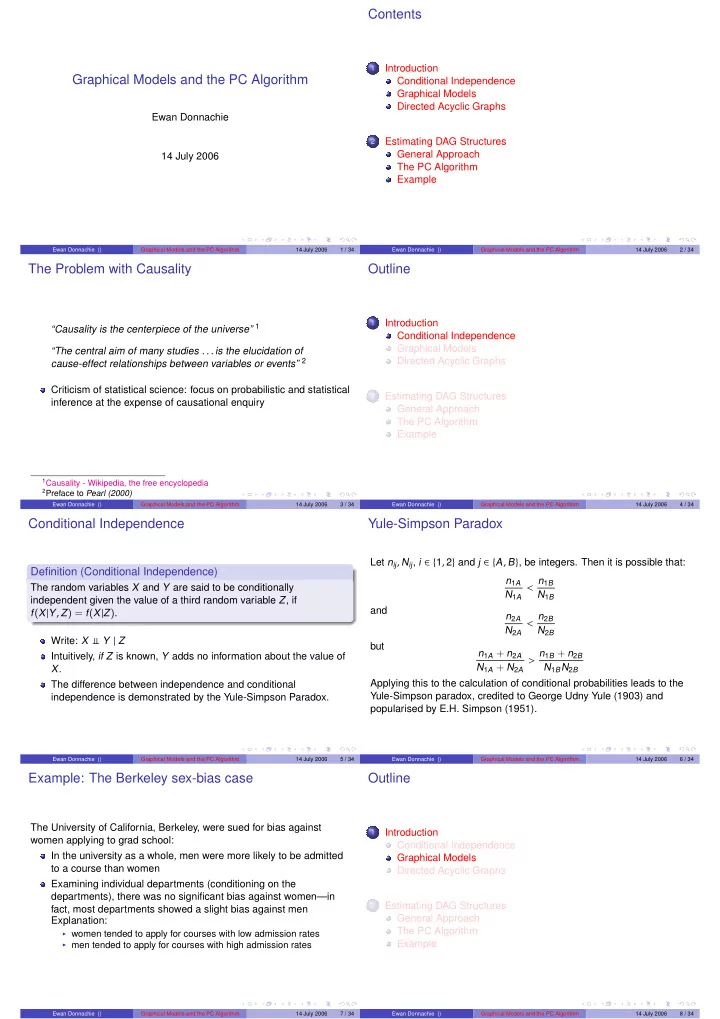
Contents Introduction 1 Graphical Models and the PC Algorithm Conditional Independence Graphical Models Directed Acyclic Graphs Ewan Donnachie Estimating DAG Structures 2 General Approach 14 July 2006 The PC Algorithm Example Ewan


slide-1
SLIDE 1

Graphical Models and the PC Algorithm

Ewan Donnachie 14 July 2006

Ewan Donnachie () Graphical Models and the PC Algorithm 14 July 2006 1 / 34

Contents

1

Introduction Conditional Independence Graphical Models Directed Acyclic Graphs

2

Estimating DAG Structures General Approach The PC Algorithm Example

Ewan Donnachie () Graphical Models and the PC Algorithm 14 July 2006 2 / 34

The Problem with Causality

“Causality is the centerpiece of the universe” 1 “The central aim of many studies . . . is the elucidation of cause-effect relationships between variables or events” 2 Criticism of statistical science: focus on probabilistic and statistical inference at the expense of causational enquiry

1Causality - Wikipedia, the free encyclopedia 2Preface to Pearl (2000) Ewan Donnachie () Graphical Models and the PC Algorithm 14 July 2006 3 / 34

Outline

1

Introduction Conditional Independence Graphical Models Directed Acyclic Graphs

2

Estimating DAG Structures General Approach The PC Algorithm Example

Ewan Donnachie () Graphical Models and the PC Algorithm 14 July 2006 4 / 34

Conditional Independence

Definition (Conditional Independence)

The random variables X and Y are said to be conditionally independent given the value of a third random variable Z, if f(X|Y, Z) = f(X|Z). Write: X Y | Z Intuitively, if Z is known, Y adds no information about the value of X. The difference between independence and conditional independence is demonstrated by the Yule-Simpson Paradox.

Ewan Donnachie () Graphical Models and the PC Algorithm 14 July 2006 5 / 34

Yule-Simpson Paradox

Let nij, Nij, i ∈ {1, 2} and j ∈ {A, B}, be integers. Then it is possible that: n1A N1A < n1B N1B and n2A N2A < n2B N2B but n1A + n2A N1A + N2A > n1B + n2B N1BN2B Applying this to the calculation of conditional probabilities leads to the Yule-Simpson paradox, credited to George Udny Yule (1903) and popularised by E.H. Simpson (1951).

Ewan Donnachie () Graphical Models and the PC Algorithm 14 July 2006 6 / 34

Example: The Berkeley sex-bias case

The University of California, Berkeley, were sued for bias against women applying to grad school: In the university as a whole, men were more likely to be admitted to a course than women Examining individual departments (conditioning on the departments), there was no significant bias against women—in fact, most departments showed a slight bias against men Explanation:

◮ women tended to apply for courses with low admission rates ◮ men tended to apply for courses with high admission rates Ewan Donnachie () Graphical Models and the PC Algorithm 14 July 2006 7 / 34

Outline

1

Introduction Conditional Independence Graphical Models Directed Acyclic Graphs

2

Estimating DAG Structures General Approach The PC Algorithm Example

Ewan Donnachie () Graphical Models and the PC Algorithm 14 July 2006 8 / 34

slide-2
SLIDE 2

Graphical Models

Nodes: The vertices (i ∈ V) of the graph (Nodes and vertices used interchangeably) Edges: Connections ((i, j) ∈ E) between vertices Path: A route along (directed) edges from one node to another (e.g. i → j → k → l)

Definition (Graphical Model)

A graphical model G is a system of nodes and connecting edges: G = (V, E)

Ewan Donnachie () Graphical Models and the PC Algorithm 14 July 2006 9 / 34

Why Graphical Models?

The role of graphs in probabilistic and statistical modeling is threefold:

1

to provide convenient means of expressing substantive assumptions;

2

to facilitate economical representation of joint probability functions; and

3

to facilitate efficient inferences from observations.

Ewan Donnachie () Graphical Models and the PC Algorithm 14 July 2006 10 / 34

Conditional Independence Graph

Definition (Conditional Independence Graph)

The conditional independence graph of X is the undirected graph G = (V, E) where V = {1, 2, . . . v} and (i, j) is not in the edge set E iff Xi Xj | XV{i,j}. More informally: Start with the complete graph, where each node is connected to all other nodes Remove the edge between Xi and Xj if Xi Xj | rest N.B.: The conditional dependencies do not represent causal or directed relationships between variables.

Ewan Donnachie () Graphical Models and the PC Algorithm 14 July 2006 11 / 34

The Pairwise Markov Property

A graph has the pairwise Markov property if, for all non-adjacent (not directly connected) vertices i and j, Xi Xj | XV{i,j} Undirected conditional independence graphs are formed using this definition Therefore, if Xi and Xj are non-adjacent vertices: they are independent conditional on the remaining nodes Xj is irrelevant for the prediction of Xi, and vice-versa Separation Theorem: Xi Xj | rest ⇒ Xi Xj | Xa, where Xa are the vertices separating Xi and Xj.

Ewan Donnachie () Graphical Models and the PC Algorithm 14 July 2006 12 / 34

The Local Markov Property

A graph has the local Markov property if, for every vertix i, with boundary a = bd(i) and b the set of remaining verties, Xi Xb | Xa More informally, if: Xi rest | boundary Closely related to prediction—conditioned only on adjacent variables

Ewan Donnachie () Graphical Models and the PC Algorithm 14 July 2006 13 / 34

The Global Markov Property

Let a, b and c be disjoint subsets of V. Then, a graph has the global Markov property if, whenever b and c are separated by a in the graph, then: Xb Xc | Xa Global in the sense that the subsets are potentially arbitrary

Ewan Donnachie () Graphical Models and the PC Algorithm 14 July 2006 14 / 34

Equivalence of Markov Properties

The three Markov properties: pairwise Markov, local Markov and global Markov, are equivalent. As the boundary set is always a separating set, global Markov =⇒ local Markov Local Markov =⇒ pairwise Markov By separation theorem, pairwise Markov =⇒ global Markov

Ewan Donnachie () Graphical Models and the PC Algorithm 14 July 2006 15 / 34

Outline

1

Introduction Conditional Independence Graphical Models Directed Acyclic Graphs

2

Estimating DAG Structures General Approach The PC Algorithm Example

Ewan Donnachie () Graphical Models and the PC Algorithm 14 July 2006 16 / 34

slide-3
SLIDE 3

Directed Acyclic Graphs

Definition (Directed Acyclic Graph)

A graph G = (V, E) is called a directed acyclic graph if all edges are directed and there are no cycles (i.e. it is impossible to return to any point). X → Y =⇒ X “causes” Y Various theorems—and background information—can be used to identify which conditional dependencies are causal in nature. Independent variables (i.e. no directed edge) may be dependent conditional on the remaining variables (Berkson’s Paradox)

Ewan Donnachie () Graphical Models and the PC Algorithm 14 July 2006 17 / 34

Types of Connection and d−separation

1

Serial Connection A series of nodes: i → j → k

2

Diverging Connection One node leads to several: j ← i → k

3

Converging Connection Several nodes lead to one path: j → i ← k

Definition (d−separation)

A set Z is said to d−separate (directionally separate) X from Y iff Y blocks every path from a node in X to a node in Y

Ewan Donnachie () Graphical Models and the PC Algorithm 14 July 2006 18 / 34

Properties of a DAG

Definition (Faithfulness)

A distribution P is faithful to a DAG D if the all conditional independence relations for P can be derived from d−separation. Faithful graphs can be estimated using conditional independence relations Direction means that the graph is conditioned only on previous nodes Directed independence graphs are therefore based on the local and not pairwise Markov property

Definition (Skeleton of a DAG)

The graph generated by replacing all directed edges of a DAG with undirected edges is called a skeleton.

Ewan Donnachie () Graphical Models and the PC Algorithm 14 July 2006 19 / 34

Outline

1

Introduction Conditional Independence Graphical Models Directed Acyclic Graphs

2

Estimating DAG Structures General Approach The PC Algorithm Example

Ewan Donnachie () Graphical Models and the PC Algorithm 14 July 2006 20 / 34

Estimating DAG Structures

Suppose we have a multivariate data sample and assume: p variables and sample size n X ∼ Np(µ, Σ) This multivariate normal distribution is faithful The underlying graph is sparse (i.e. not too many edges) Then, the structure of a DAG can be recovered using conditional independence relations.

Ewan Donnachie () Graphical Models and the PC Algorithm 14 July 2006 21 / 34

Pairwise vs. Local Markov Property

Estimate the skeleton using the pairwise Markov, not the local Markov property: For any given vertex, there are 2p−1 ways of partitioning the remaining vertices into “boundary” and “rest” groups If p is large (or p > n), this is both computationally and statistically infeasible In contrast, the pairwise property has only (k − 1) ways of partitioning the remaining vertices

Ewan Donnachie () Graphical Models and the PC Algorithm 14 July 2006 22 / 34

Conditional Independence

Definition (Partial Correlation)

For i j ∈ 1, . . . , p, k ∈ rest, let ρi,j|k be the partial correlation between Xi and Xj given Xr; r ∈ k. As the distribution is multivariate normal, Xi Xj | Xr ⇔ ρi,j|k A test for conditional independence is therefore a test for partial correlation between the variables The partial correlations can be estimated, for example, via regression

Ewan Donnachie () Graphical Models and the PC Algorithm 14 July 2006 23 / 34

Test for Conditional Independence

Definition (Fisher’s Z-Transform)

Let: Z(i, j|k) = 1 2 1 + ˆ ρi,j|k 1 − ˆ ρi,j|k

  • Then:
  • n − |k| − 3 |Z(i, j|k)| ∼ N(0, 1)

Test for independence using classical test at significance level α Kalisch and B¨ uhlmann show that the choice of α is not too important Various other tests are available, using different approaches and for different distributions

Ewan Donnachie () Graphical Models and the PC Algorithm 14 July 2006 24 / 34

slide-4
SLIDE 4

Outline

1

Introduction Conditional Independence Graphical Models Directed Acyclic Graphs

2

Estimating DAG Structures General Approach The PC Algorithm Example

Ewan Donnachie () Graphical Models and the PC Algorithm 14 July 2006 25 / 34

The PC Algorithm

Start with the complete undirected graph, ˜ C with vertices V = X1, . . . , Xp. Then:

1

Set ℓ = −1 and C = ˜ C

2

Increase ℓ by one. For all pairs of adjacent nodes:

◮ Check for conditional independence ◮ Remove edge (Xi, Xj)

if Xi Xj | rest

3

Repeat step 2 until ℓ = m or until each node has fewer than ℓ − 1 neighbours

Ewan Donnachie () Graphical Models and the PC Algorithm 14 July 2006 26 / 34

Stopping level m

Let mreach ∈ max ℓ, m denote the stopping level of the algorithm and q be the maximum number of neighbours. It can be shown that:

1

The PC Algorithm constructs the true skeleton of the DAG

2

The stopping level is mreach ∈ q − 1, 1

Ewan Donnachie () Graphical Models and the PC Algorithm 14 July 2006 27 / 34

Consistency of the PC Algorithm I

Let G be a DAG with probability distribution P. The following assumptions are made:

1

The distribution is multivariate normal and is faithful w.r.t. G

2

The dimension is pn = O(na), a ≥ ∞ → high dimensionality

3

The maximum number of neighbours, qn = O(n1−b), 0 < b ≤ 1 → the graph is sparse

4

The partial correlations (absolute values) are bounded from above and below: → a regularity condition

Ewan Donnachie () Graphical Models and the PC Algorithm 14 July 2006 28 / 34

Consistency of the PC Algorithm II

Denote by Gskel the true skeleton of a DAG G, and let the estimate from the PC Algorithm be ˆ Gskel. Then, under the above assumptions, it can be shown that, for some C ≥ 0: P( ˆ Gskel = Gskel) = 1 − O(exp

  • −Cn1−2d

) → 1, n → ∞ Additionally, the stopping level is data dependent,

Ewan Donnachie () Graphical Models and the PC Algorithm 14 July 2006 29 / 34

Outline

1

Introduction Conditional Independence Graphical Models Directed Acyclic Graphs

2

Estimating DAG Structures General Approach The PC Algorithm Example

Ewan Donnachie () Graphical Models and the PC Algorithm 14 July 2006 30 / 34

Example using Simulated Data

Construct an adjacency matrix describing the conditional independence relations contained in a randomly generated graph of dimension p. Begin with a matrix of zeroes (i.e. no edges) Independent realisations of a Bernoulli random variable with parameter s determine which edges are connected. Call s the sparseness of the model For the edges in the graph (ones in the adjacency matrix), independent realisations of a Uniform[0.1, 1] distribution are used to model the partial correlations Then, X1 = ǫ1 ∼ N(0, 1), and the remaining nodes are calculated recursively as follows: Xi =

i−1

  • k−1

AikXk + ǫi i = 2, . . . , p

Ewan Donnachie () Graphical Models and the PC Algorithm 14 July 2006 31 / 34

Summary Statistics

The PC algorithm is to be compared with two alternative methods: Greedy Equivalent Search (GES) Maximum Weight Spanning Trees (MWST) The following statistics allow their characteristics to be compared: TDR True discovery rate, the proportion of edges in the esti- mated model that are edges in the true model FPR False positive rate, the proportion of edges in the esti- mated model that have been falsely identified TPR True positive rate, the proportion of true edges that have been identified by the model

Ewan Donnachie () Graphical Models and the PC Algorithm 14 July 2006 32 / 34

slide-5
SLIDE 5

Results

The PC algorithm: achieves much higher TDR than GES or MWST identifies a lower proportion of the true nodes, but also has fewer false positives

Ewan Donnachie () Graphical Models and the PC Algorithm 14 July 2006 33 / 34

Bibliography

Kalisch, M and B¨ uhlmann, B (2006). Estimating high-dimensional directed acyclic graphs with the PC-Algorithm. Pearl, J (2000). Causality: Models, Reasoning, and Inference. Cambridge University Press Whittaker, J. (1990). Graphical Models in Applied Multivariate

  • Statistics. Wiley, Chicester.

Lauritzen, S (2005). Graphical Models and Inference. Lecture notes from a course given at Oxford University.

Ewan Donnachie () Graphical Models and the PC Algorithm 14 July 2006 34 / 34