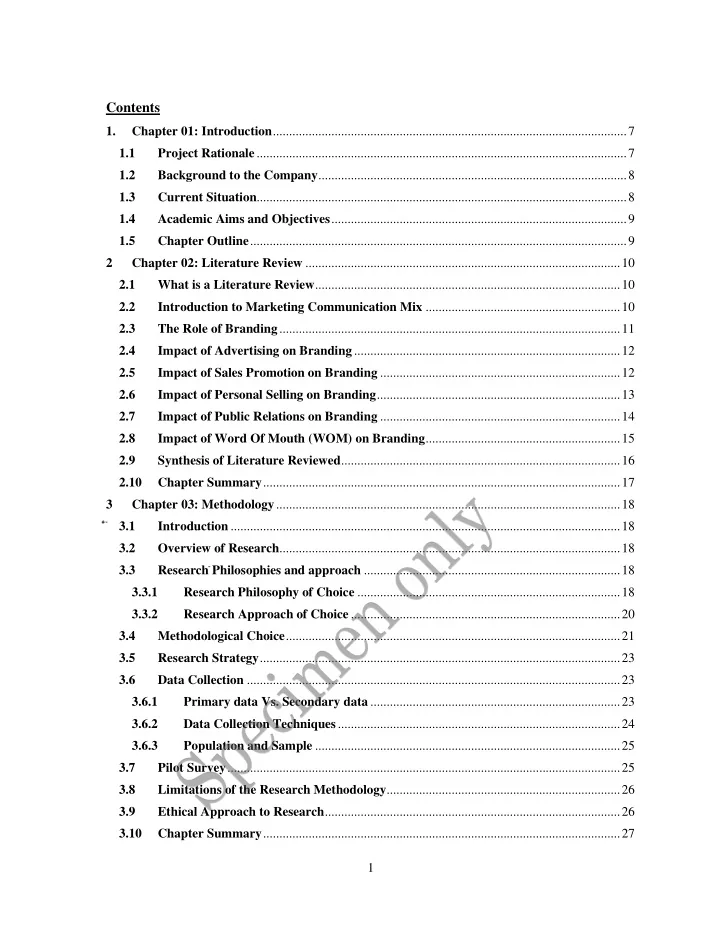
SLIDE 1
1
Contents
1. Chapter 01: Introduction ............................................................................................................. 7 1.1 Project Rationale .................................................................................................................. 7 1.2 Background to the Company ............................................................................................... 8 1.3 Current Situation.................................................................................................................. 8 1.4 Academic Aims and Objectives ........................................................................................... 9 1.5 Chapter Outline .................................................................................................................... 9 2 Chapter 02: Literature Review ................................................................................................. 10 2.1 What is a Literature Review .............................................................................................. 10 2.2 Introduction to Marketing Communication Mix ............................................................ 10 2.3 The Role of Branding ......................................................................................................... 11 2.4 Impact of Advertising on Branding .................................................................................. 12 2.5 Impact of Sales Promotion on Branding .......................................................................... 12 2.6 Impact of Personal Selling on Branding ........................................................................... 13 2.7 Impact of Public Relations on Branding .......................................................................... 14 2.8 Impact of Word Of Mouth (WOM) on Branding ............................................................ 15 2.9 Synthesis of Literature Reviewed ...................................................................................... 16 2.10 Chapter Summary .............................................................................................................. 17 3 Chapter 03: Methodology .......................................................................................................... 18 3.1 Introduction ........................................................................................................................ 18 3.2 Overview of Research ......................................................................................................... 18 3.3 Research Philosophies and approach ............................................................................... 18 3.3.1 Research Philosophy of Choice ................................................................................. 18 3.3.2 Research Approach of Choice ................................................................................... 20 3.4 Methodological Choice ....................................................................................................... 21 3.5 Research Strategy ............................................................................................................... 23 3.6 Data Collection ................................................................................................................... 23 3.6.1 Primary data Vs. Secondary data ............................................................................. 23 3.6.2 Data Collection Techniques ....................................................................................... 24 3.6.3 Population and Sample .............................................................................................. 25 3.7 Pilot Survey ......................................................................................................................... 25 3.8 Limitations of the Research Methodology ........................................................................ 26 3.9 Ethical Approach to Research ........................................................................................... 26 3.10 Chapter Summary .............................................................................................................. 27
SLIDE 2
2 4 Chapter 04: Findings and Analysis ........................................................................................... 27 4.1 Introduction ........................................................................................................................ 27 4.1.1 Question 1 – Analysis of Age ..................................................................................... 27 4.1.2 Question 2 – Gender Analysis ................................................................................... 29 4.1.3 Question 3 - Current Qualification Related to BMS? ............................................. 30 4.1.4 Question 4 .................................................................................................................... 30 4.1.5 Question 5 .................................................................................................................... 31 4.1.6 Question 6 .................................................................................................................... 33 4.1.7 Question 7 .................................................................................................................... 34 4.1.8 Question 8 .................................................................................................................... 35 4.1.9 Question 9 .................................................................................................................... 36 4.1.10 Question 10 .................................................................................................................. 38 4.1.11 Question 11 .................................................................................................................. 40 4.1.12 Question 12 .................................................................................................................. 42 4.1.13 Question 13 .................................................................................................................. 43 4.1.14 Question 14 .................................................................................................................. 44 4.1.15 Question 15 .................................................................................................................. 46 4.1.16 Question 16 .................................................................................................................. 47 4.1.17 Question 17 .................................................................................................................. 48 4.1.18 Question 18 .................................................................................................................. 49 4.1.19 Question 19 .................................................................................................................. 50 4.1.20 Question 20 .................................................................................................................. 52 4.1.21 Question 21 .................................................................................................................. 53 4.1.22 Question 22 .................................................................................................................. 54 4.1.23 Question 23 .................................................................................................................. 56 4.1.24 Chapter Summary ...................................................................................................... 57 5 Chapter 05: Conclusions and Recommendations .................................................................... 57 5.1 Review of Research Objectives .......................................................................................... 58 5.2 Synthesis of Literature and Findings ................................................................................ 58 5.3 Limitations of the Research ............................................................................................... 60 5.4 Further Developments for Future Research .................................................................... 60 5.5 Recommendations............................................................................................................... 60 6 List of References ....................................................................................................................... 62 7 Appendix 1- Questionnaire ........................................................................................................ 78 8 Appendix 2 – Pilot Survey Changes .......................................................................................... 81
SLIDE 3
3 9 Appendix 3 – Literature Rationale Table................................................................................. 82 10 Appendix 4 – Project Timeline .............................................................................................. 87 11 Appendix 5 – Letter of Consent ............................................................................................ 88
List of Tables Table 1 Positivism Vs Interpretivism ..................................................................................... 19 Table 2 Deductive Vs. Inductive ............................................................................................ 20 Table 3 Quantitative Vs. Qualitative ...................................................................................... 22 Table 4 Primary vs. Secondary ............................................................................................... 23 Table 5 Benefits and Drawbacks of questionnaires ................................................................ 24 Table 6- Age Distribution (author developed) ........................................................................ 28 Table 7 Perception Towards BMS .......................................................................................... 30 Table 8 BMS and Its Services Among Competition ................................................................ 31 Table 9 Satisfaction of Studying at BMS................................................................................. 33 Table 10 Spreading Awareness to Friends and Family .......................................................... 34 Table 11 Brand Preference ..................................................................................................... 35 Table 12 Advertising at BMS .................................................................................................. 36 Table 13 Influence of Advertising Towards Customers .......................................................... 38 Table 14 Mostly Seen Advertising Method of BMS ................................................................ 40 Table 15 Customers Comparing BMS with Rival Firms ........................................................ 42 Table 16 Impact of Discounts on Customers .......................................................................... 43 Table 17 Personal Selling Impact ........................................................................................... 44 Table 18 Impact of Staff Behavior on Student’s Decision of Joining BMS ............................ 46 Table 19 Analysis of Information Provided Through Personal Selling .................................. 47 Table 20 Effectiveness of Public Relations ............................................................................. 48 Table 21 How the Respondent Found Out About BMS ........................................................... 49 Table 22 Quality of Service at BMS ........................................................................................ 50 Table 23 Impact of Promotional Offers for Customers .......................................................... 52 Table 24 Negative Effect of Personal Selling Different Brand Messages .............................. 53 Table 25 Affect of Negative WOM .......................................................................................... 54 Table 26 Usage of Marketing Communication Mix ............................................................... 56
SLIDE 4 4
Table 27 Recommendations .................................................................................................... 61 List of Figures Figure 1 the Six Markets Model (Buttle, 1998) ...................................................................... 16 Figure 2 Deductive vs. Inductive ............................................................................................ 20 Figure 3 Age of Respondent ................................................................................................... 27 Figure 4 Gender of Respondent .............................................................................................. 29 Figure 5 Qualification of Respondent ..................................................................................... 30 List of Abbreviations
- 1. BMS –Business Management School
- 2. PR – Public Relations
- 3. WOM – Word Of Mouth
SLIDE 5
5
Declaration I hereby declare that this professional project is my original work, carried out under the supervision of Ms.Himashi De Mel, Module tutor and submitted for the award of fulfilment of International Advanced Diploma in Business Management. Date……………….
SLIDE 6 6
Abstract The higher education industry in Sri Lanka is one of the developing service industries. Currently, a big competition can be seen in this industry due to the increasing number of higher education institutes. As a result, students and parents are concerned about selecting the best institute to invest in higher education. Therefore, it is very important for higher education institutes to use marketing communication appropriately to address the concerns of
- stakeholders. This involves understanding the marketing communication mix elements and
using them effectively. Consequently, this study will analyse the marketing communication mix elements and the branding aspect of Business Management School (BMS). Furthermore, the study will elaborate the relationship between communication mix elements and branding. Initially, after a brief introduction to the project and its objectives, literature is discussed related to both the marketing communication mix and also branding. This helps the author to identify relationships between elements. Furthermore, a chapter summary is provided along with the key literature discussed. Additionally, a methodology chapter is included which describes the research strategies and approaches that are used in this study. Accordingly, a quantitative primary research is conducted collecting primary data by means of questionnaires. Secondary data is gathered by peer-viewed journals, articles and books. Moreover, this study focuses on a sample of 100 students of BMS with the help of stratified random sampling method. According to the findings of the study it is understood that marketing communication activities are not as successful as expected in BMS. Moreover, it is understood that BMS advertising is not noticed by many students and that they were not influenced by advertisements to join. In addition, it could also be said that word of mouth is the most powerful tool in the marketing
SLIDE 7 7
communication mix for BMS. Nevertheless, the study also includes a review of the objectives that were expressed earlier. Furthermore, the project concludes by giving few recommendations based on the findings such as adapting a new marketing strategy to focus on word of mouth marketing, to develop advertisements that are more influential, to improve personal selling by staff. Key words: Marketing Communication Mix, Branding, Advertising, Word of Mouth (WOM), Sales Promotion, Personal selling, Direct Marketing
- 1. Chapter 01: Introduction
1.1 Project Rationale In Sri Lanka, there seem to be a trend of students going to foreign countries for better higher education (Nanayakkara, 2013). Thus, Nanayakkara (2013) zstates that there are over 70 foreign education institutions in Sri Lanka which provides the opportunity to pursue the same qualifications locally. Further, he explains these foreign universities vary from direct campus branches to franchises to satellite programmes. Therefore, it is important for higher education institutes to communicate the availability and quality of their services to win the local market (Koekemoer and Bird, 2004). Furthermore, Krkljes (2011) illustrates that since the higher education market is becoming more competitive, it is essential for institutes to secure and expand the market share. Consequently, the focus of this project is to analyse the impact of the marketing communication mix elements on branding for the Business Management School (BMS). Although, there seem to be past research studies about the impact of the marketing mix elements on branding (Ramos and Franco, 2005; Guizani, Florence and Becheur, 2009), there is only a few research studies done for higher education institutions in particular. In addition, Ahmed et al. (2014) explain in their research that it is important to understand the impact of the communication mix elements as there are certain restrictions in promoting products. Accordingly, this study aims at understanding the impact of the marketing communication mix elements on branding to utilise the communication mix elements better.
SLIDE 8 8
1.2 Background to the Company Business Management School (2015) is a higher education institution which provides British higher education in Sri Lanka. Moreover, BMS (2015, para.1) state that BMS operates with the vision of ‘Transforming lives and influencing the future through transmission of knowledge’. Accordingly, their mission appears ‘to be committed to creating an intellectually stimulating learning environment through inspirational teaching and research within an inclusive academic culture that benefits the learner, community, country, and the region’ (BMS, 2015, para.2). Furthermore, BMS (2015) offers undergraduate and postgraduate qualifications in business management and science. Moreover, Krkljes (2011) cited in Conway, Mackay and Yorke (1994) indicates that the main stakeholders of a higher education institute would be the government, administration staff, academic staff and students. 1.3 Current Situation BMS has been recognised for their 15 years of service affiliated to foreign universities (Lankauniversity-news, 2009). Moreover, according to Lankauniversity-news (2015) BMS has been listed among the best 40 higher education institutions in Sri Lanka which signifies its recognised service. In addition, the above awards and recognition has created a positive influence towards BMS stakeholders. However, regardless of the recognition, the survival in the higher education industry is hard as a result of the tough competition (Nanayakkara, 2013). This situation, has created the need for institutions like BMS to use the marketing communication mix elements efficiently to survive in the market (Hosseini and Navaie, 2011). Adding to that, BMS currently uses advertising, sales promotions, direct marketing, personal selling and also most importantly word of mouth marketing (Mendis, 2015). Furthermore, Radio advertising, newspaper advertising, social media advertising and other forms like sponsoring events is currently conducted under the marketing function. Consequently, Mendis (2015) states that a significant amount is allocated from the annual budget for all marketing
- activities. Moreover, all marketing related activities of BMS is currently done through the
student development department (Mendis, 2015).
SLIDE 9 9
It is vital that higher education institutions satisfy their main stakeholder, the students (Krkljes, 2011). For example, Vidal and Ballester (2005, p.182) state that if an organisation does sales promotion, it results in providing positive expressions and better self-perceptions for customers through the brand message carried. Therefore, it is important for BMS to understand the impact
- f marketing communication mix on branding in order to survive in the industry.
1.4 Academic Aims and Objectives The aim of conducting this research is to identify, understand and utilise the marketing communication mix elements to improve the brand image of Business Management School.
- To review literature to understand the concept of marketing communication mix and its
elements;
- to review literature to identify the relationship between the marketing communication mix
elements and branding;
- to conduct a quantitative primary research by means of questionnaires to understand the
impact of the marketing communication mix elements on branding;
- to draw conclusions and establish recommendations to utilise elements of the marketing
communication mix more effectively for the purpose of better branding which will ensure sustainability of the company. 1.5 Chapter Outline The next chapter includes the key literature that needs to be understood regarding the marketing communication mix and branding. Next, the methodology chapter will highlight on the adapted method to conduct the research which includes data collection, research strategy and sampling. After, the findings of the survey will be analysed. Finally the recommendations and conclusions will be drawn.
SLIDE 10
10
2 Chapter 02: Literature Review
2.1 What is a Literature Review Ridley (2008) cited in Bruce (1994) states that a literature review provides a clear background to the justifications of the research undertaken. Moreover, Jesson (2011) indicates that a traditional literature review is done to appraise what is already written regarding a certain topic. Further, he suggests that a literature review is also a systematic approach as it includes a clear purpose of research, a question, a defined search approach and an appraisal of related articles and books. Furthermore, Randolph (2009, p.2) illustrates that a literature review demonstrates the peer-viewed knowledge of the author regarding theories related to the study area. Firstly, the concept of marketing communication mix will be discussed in this chapter. Secondly, the role of branding will be elaborated. Next, the different tools of the marketing communication mix will be discussed. Finally, the impact of branding will be discussed with regard to each tool of the marketing communication mix. 2.2 Introduction to Marketing Communication Mix
SLIDE 11
11
Sunday and Bayode (2011) cited in Cole (1996) illustrate that marketing communication mix is a tool that provides information to bring a customer to the state of purchasing a product. Moreover, Onditi (2012) cited in Berkowitz (1997) elaborates that marketing communication mix is used as a communication mode between buyer and seller. Further, he states that there are five such promotional alternatives as advertising, sales promotion, personal selling public relations and word of mouth. On the other hand, Matei (2014) indicates promotional mix as a tool used to secure the market position and market share of a company. Further, he states that although promotional activities are costly for a company, it will have a positive impact on the return on investment. However, Koekemoer and Bird (2004) state that marketing communication mix is a tool where the marketers indicate their sensitivity towards consumers needs and wants. 2.3 The Role of Branding Merrilees and Wong (2007) defines branding as the positive image created in the mind of the customer with regard to a product or service which gains a competitive advantage. Similarly, Cuia (2003) states that branding is the customers’ perception towards a product or service which creates a connection between the company and customers. On the other hand, Millman (2011) suggests that branding is a process which attracts some idea to some object, or to a service or organisation. In addition, branding is differentiating a product to secure the future earnings which builds long term value for the company (Gallagher and Savard, 2009; European Commission, 2013). Contrastingly, Kumar (2007, p.13) elaborates that branding is associated with reassuring consumers the purpose of the product or service. Further, he states that branding creates brand preference for customers based on their experience. Moreover, Pike (2011) cited in Blundstone (2010) suggests that branding is important because it signifies the material effect on people’s livelihood rather than just giving a symbolic effect. Adding to that, Phillips (2006) indicates that branding is important for an organisation to maintain their customer base. Consequently, if the perception and brand loyalty of the customer is high, they will not move to other rival products (Phillips, 2006; Pedersen, 2004).
SLIDE 12 12
2.4 Impact of Advertising on Branding Green (2011) illustrates that advertising is a form of communication used to influence individuals or organisations by providing information. Further, he states that advertising is done mostly to sell existing products than to promote new products. Moreover, advertising is a paid communication effort where the financially supporting party can be identified and the message delivered is non-personal (Nichifor, 2014; Smith, Dixon and Sherratt, 2012). Nevertheless, Lorek et al. (2004, p.6) indicate that advertising increases the market share of
- rganisations by establishing entry barriers to rival organisations. On the contrary, Nichifor
(2014, p.181) cited in Propescu (2004) argues that advertising is a persuasive process which causes psychological pressure on the concerned publics to set a good image. In addition, Marcincin, Modrak and Okwiet (2012) inform that there are two types of advertising called ‘above the line’ which includes television and similar media and ‘below the line’ which involves all other media such as posters, banners and hoardings. Franses and Vriens (2004) cited in Wakratsas and Ambler (1999) states that there is a relationship between advertising and branding as advertising leads to brand choice of
- customers. In addition, Patil (2012, p.56) illustrates that adverting is an inevitable aspect of a
consumer’s life and it creates brand awareness through positive attitudes. In contrast, Zinkan (2012, p.138) indicates that advertising deals with forced consumption of products and therefore, it also creates a negative perception regarding the product on the customers mind as they feel that they are forced. Nevertheless, advertising is what creates a unique perception for a brand, providing a variety of ways to distinguish a brand among competitors (Karadeniz, 2013, p.197; Terken, 2014, p. 240). 2.5 Impact of Sales Promotion on Branding Chaharsough and Yasori (2012) argue that sales promotions are marketing activities that are conducted with the intention of having a direct impact on the behavior of target consumers. In contrast, Troop, Elliott and Choudhury (1991, p. 2) indicate that sales promotion is a tool of
SLIDE 13
13
communication which offers additional short-term benefits to increase the value of a product. Furthermore , Williams, Babatunde and Jeleel (2012, p.125) cited in Aham (2008) share a different view stating that sales promotions are used as a short term solution to create a demand for the stocks that are stagnated in warehouses. On the contrary, Andersson and Hailmariam (2007) cited in Jobber and Lancaster (2006) imply that sales promotion is considered as an activity which is less important compared to other communication mix elements. Moreoever, Park and Lennon (2008, p. 150) cited in Honea and Dahl (2005) state that ‘a promotion serves as an immediate economic incentive to purchase a product’. Vidal and Ballester (2005, p.182) state that sales promotion improves the brand image as it provides positive expressions to customers which results in better self-perceptions. Similarly, Florence, Guizani and Merunka (2011) cited in Kirmani and Wright (1989) indicate that sales promotions provides strong factors for consumers to choose between brands and leads directly to their personal perceptions. Furthermore, Alam and Faruqui (2009) elaborate that consumers compare alternative brands to select which brand provides the most benefits. As a result, sales promotion creates brand familiarity rather than creating brand confidence (Alam and Faruqui, 2009). In addition, brand message is carried to the consumer by sales promotion which creates a positive brand value and perception which influences the purchasing decision (Mullin, 2010; Park and Lennon, 2008). On the contrary, Rahmani, Mojaveri and Allahbahkhsh (2012, p. 69) cited in Winer (1986) argue that sales promotion effects a brand negatively as a result of the fluctuations in price which will confuse customers about the quality of product. However Buil, Chernatony and Martinez (2010) state that sales promotions do not last long enough to create a long term image on consumers mind which might create brand uncertainty. 2.6 Impact of Personal Selling on Branding Bubnjevic (2011) cited in Maninng and Reece (2008) implies that personal selling refers to direct communication with potential buyers for the purpose of providing data about benefits to remind and convince them. Moreover, personal selling creates relationships and identifies the needs of consumers to adjust products accordingly (Bubnjevic, 2011; Okonkwo, 2007). Furthermore, personal selling is the face to face communication done, to one or more
SLIDE 14 14
individuals to close a deal (Backstrom, 2008; Cant and Heerden, 2005). On the other hand, Backstrom (2008) cited in Persson (1999) argues that personal selling is the art of successfully persuading customers to purchase products from which the company will benefit. However, Renfors (2013) states that personal selling is an interaction between buyers and salespeople where the salespeople’s behavior influences the consumers to make a purchasing decision. Hocking (2012) cited in Attaway (1996) elaborates that personal selling directly affects branding as the sales force of a company, establishes a positive perception in the consumers mind through interaction. In contrast, Bubnjevic (2011, p.372) argues that personal selling promotes a negative brand image due to different messages carried out by different sales individuals of the same organisation. However, Cant and Heerden (2005) discuss that salespeople force buyers and make unrealistic statements about the products providing improbable guarantees. Therefore, they state that personal selling creates a negative image on the consumers mind regarding a brand. 2.7 Impact of Public Relations on Branding Okonkwo (2007) states that public relations is associated with building and maintaining a goodwill and a mutual understanding with the company and its target audience. Similarly, Public relations is the tool used in marketing to build and maintain a good relationship with the various publics (Satewedin, 2005; Armstrong and Kotler, 2007). On the contrary, Smith (2005, p.15) indicates that PR only focuses on three areas to build relationships namely marketing, branding and reputation and that it does not help the financial performance of the firm directly. Moreover, Armstrong and Kotler (2007) state that public relations can provide a stronger impact in creating public awareness than other promotional tools. Nevertheless, Bernays (2013) indicate that public relations is a tool which creates competition among
- rganisations with the help of the public’s interests.
Levine (2003) illustrates that the responsibility of public relations is to create a positive image about the brand in the minds of the consumers in various publics. Further, he elaborates that the public identity of a company has to be placed close to the brand as there is a strong
SLIDE 15 15
relationship between public relations and branding. On the other hand, Percy and Elliot (2012,
- p. 340) state that there is a close relationship between consumers and organisaitons. As a result,
it is hard for the consumers to identify the link between sales messages and the brand clearly. In addition, Muller (2011) states that public relations can spread favorable ideas about a product with more credibility than tools such as advertising which will directly impact the brand image. However, Yuanzhong (2005, p.32-34) suggests that public relations helps each stage of the branding process as it identifies the exact need of the customer. Moreover, public relations is not just about selling a product to a consumer, it creates a positive perception in the minds of the consumers (Sandell, 2012; Levine, 2003). Therefore, public relations is significantly important for branding in organisations. 2.8 Impact of Word Of Mouth (WOM) on Branding Raluca (2012) indicates that word of mouth is consumer to consumer communication which strongly influences the buying behavior of consumers. In contrast, Buttle (1998) states that WOM is a tool of communication which directly affects sales as it deals with feelings of
- customers. Furthermore, WOM has a higher capability to influence consumers than other
promotional tools such as advertising, sales promotions and personal selling (Reluca, 2012; Buttle, 1998). Nevertheless, Trusov , Bucklin and Pauwels (2009) cited in Minnser (1999) argue that WOM is the world’s most effective communication tool in terms of marketing, although it is the least understood marketing strategy. Further, they elaborate that WOM is also a tool that reduces the resistance of consumers by spreading the word through internet with a noticeably lower cost and less time. Moreover, Sernovitz (2012) defines WOM as “Giving people a reason to talk about your stuff, and making it easier for that conversation to take place”. He goes on to say that WOM will only be successful if you have good products and services. The perception of a customer towards a brand, is heavily influenced by the impression of previous users of the respective brand (Sylvia, 2009 cited in Alba and Hutchinson, 1987). In addition, Jalilvand and Samiei (2012) cited in ACNielson (2007) argue in their study that consumers believe WOM is the most reliable opinion regarding a product or service as it
SLIDE 16
16
expresses experience. Therefore, branding is highly affected by WOM. In Contrast, Dahlen, Lange and Smith (2010, p.404) express that WOM can spread wrong messages regarding a brand through gossip which will be a negative impact on the brand image. Similarly, Buttle (1998) cited in Arndt (1967) contrastingly states that a negative WOM can affect a brand more than a positive WOM as it influences consumers to not purchase the product. On the other hand, Buttle (1998) suggests that WOM does not only take place between consumers, it could also take place in several other groups of people. In Addition, he provides the below model for further understanding. Figure 1 the Six Markets Model (Buttle, 1998) 2.9 Synthesis of Literature Reviewed According to the reviewed literature, there is a significant amount of definitions for the marketing communication mix. However, considering the different views, the marketing communication mix can be defined as the mixture of tools that are used to communicate with customers regarding a product or service (Sunday and Bayode, 2012; Onditi, 2011; Matei, 2014; Koekemoer and Bird, 2004). Furthermore, the marketing communication mix consists
Supplier referrel Recruitment influencer Internal
Customer
SLIDE 17 17
- f five different tools such as advertising, sales promotion, personal selling, public relations
and word of mouth (Matei, 2014). The term branding has been widely spoken by many authors. Accordingly, branding can be defined as the perception created in the minds of customers with regard to a product or service (Merrilees and Wong, 2007; Cuia, 2003; Gallagher and Savard, 2009; European Commission, 2013). Therefore, it is important for organisations to keep the customers interested in their brand using different tools (Phillips, 2006; Pedersen, 2004). Advertising is one tool that helps organisations build their brand image by leading to brand choice, providing positive attitudes and unique perceptions (Franses and Vriens, 2004; Patil, 2012; Karadeniz, 2013, p.197; Terken, 2014, p. 240). Moreover, sales promotion is a tool that provides additional short term benefits to customers in order to influence purchase (Chaharsough and Yasori, 2012; Troop, Elliott and Choudhury, 1991). Additionally, personal selling creates a positive perception in the customer’s mind which affects the brand image positively (Hocking, 2012). Furthermore, public relations is what creates a favorable image in the consumers mind based on the brand relationship (Levine, 2003; Muller, 2011). Moreover, WOM is the perception of the consumers which will strongly affect the brands choice (Sylvia, 2009; Jalilvand and Samiei, 2012). However, in all of the above mentioned tools there seem to be negative impacts which negatively effects branding (Zinkan, 2012; Allahbahkhsh, 2012; Bubnjevic, 2011; Percy and Elliot, 2012; Buttle, 1998). 2.10 Chapter Summary Firstly the concept of the marketing communication was defined. Secondly, the role of branding was elaborated. Thirdly, the five tools of the marketing communication mix were broadly discussed. Moving on the impact of each tool towards branding was clarified. Finally, the relationships of the concepts were summarised with reference to the literature discussed.
SLIDE 18 18
3 Chapter 03: Methodology
3.1 Introduction In this chapter the author intends to discuss the overview of adapted research methodology and justify the selected methodology. Therefore, the research philosophy and the approach of choice will be discussed first. Also, this chapter focuses on discussing the methodological choice and emphasises on primary data collection tool along with population selected. 3.2 Overview of Research Connoway and Powell (2010, p.1) illustrate that business research is a method of study that carefully analyses problems to investigate the available evidence to generate appropriate
- solutions. Moreover, research is a logical and systematic search for new and useful information
- n a particular topic (Rajasekar, Philominthan and Chinnathambi, 2013, p.2: Kothari, 2004, p.
1). However, Kumar (2008, p.2) states that research is just an addition of knowledge to the existing knowledge stock of a researcher. Further, he states that research is a scientific activity that establishes a theory, a principle, a fact or an application to solve a problem. 3.3 Research Philosophies and approach 3.3.1 Research Philosophy of Choice Saunders, Lewis and Thornhill (2003, p.101) suggest that research philosophy is the development of knowledge needed to conduct a research and the way that it is conducted. Furthermore, Goddard and Melville (2004) argue that research philosophies can be differentiated based on the goals and objectives of research and on the respective approach
SLIDE 19 19
- selected. In addition, there are various paradigms of research philosophy such as epistemology
and ontology which consists positivism, interpretivism, realism, objectivism, subjectivism and pragmatism (Bryman and Bell, 2015; Saunders, Lewis and Thornhill, 2003). Nevertheless, Bryman and Bell (2011) illustrate that epistemology includes positivism, interpretivism and
- realism. Furthermore, Wilson (2010, p.10) states that positivism considers an objective view
in conducting a research which, reduces the interaction of the researcher with the research. On the other hand, Ritchie and Lewis (2013, p.11) explain interpretivism as the human interpretation of the social world and understanding of the phenomenon that is being studied. In addition, Wilson (2010, p.10) states that the difference between positivism and interpretivism is what constitutes knowledge in each philosophy. Table 1 Positivism Vs Interpretivism Positivism Interpretivism
- Focuses on what is general, average and
representative
- Focuses on what is specific unique
and deviant
- Single reality , tangible and objective
- Multiple reality, socially conducted
- Goal of research is to strongly predict and
explain
- Goal of research is to weakly predict
and understand
- Hypothetical deductive methodological
approach ( experimental design)
- Holistic inductive methodological
approach ( naturalistic design )
- Desired information – how many people
have a specific problem? How many people do a specific thing?
- Desired information- What do some
people think and do what kind of problems are they confronted with and how do they deal with it?
- Subject and researchers doesn’t have any
relationship
and researcher are interactive, corporative and participative Source: - Decrop, A. (2006). Vacation decision making. CABI publications, p.47
SLIDE 20 20
Considering the above differences of the two philosophies the author used positivism philosophy in this study of understanding the impact of marketing communication mix elements of branding. This, is in line with the view of Collis and Hussey (2013) who state that positivism studies the relationship between variables in a research. Furthermore, the author believes an interpretive approach would not be suitable because the study will not consider multiple realities (Ritchie and Lewis, 2013; Decrop, 2006). 3.3.2 Research Approach of Choice Wilson (2010, p.7) indicates that there are two approaches in research, namely deductive and
- inductive. Adding to that, Wilson (2010, p.7) cited in Hyde (2000, p.83) elaborates that
inductive approach refers to a theory building process which starts with observation of specific existing instances to establish new theory. On the other hand, Collins (2010) describes deductive approach as a process that uses theory to develop a preposition which will be tested with the help of a designed research framework. Figure 2 Deductive vs. Inductive Source: - Wilson, J. (2010) Essentials of Business Research: A Guide to Doing Your Research Project. Table 2 Deductive Vs. Inductive
Observation Theoretical application Theory as
Observation/ findings
Inductive Approach Deductive Approach
SLIDE 21 21
Deductive Inductive
- Uses theory to develop a preposition
(Collins, 2010)
- Theory is developed as a result of
data analysis (Collins, 2010)
- Often associated with quantitative
data (Wilson, 2010)
- Often associated with qualitative data
(Wilson, 2010)
- Necessary to select samples of
sufficient size to genaralise the conclusions (Saunders, Lewis and Thornhill, 2003)
- Does not focus much on genaralising
conclusions (Saunders, Lewis and Thornhill, 2003)
- A simple method as it simplifies
complex problems by dividing them into smaller parts (Chand, 2015)
- A dynamic method as it can be
adjusted to the changing economic phenomena (Chand, 2015)
within the scientific framework (Bryman and Bell , 2003)
- Considers meaning and perceptions
(Collins, 2010) Source: - Author developed (2015) The author followed a deductive approach and gathered data, applied theory to design a framework of research to finally draw conclusions (Aderson, 2004). Moreover, the deductive method was selected as it is simple and simplifies the complex problems of research (Chand, 2015). Also, another reason was that theory discussed in the literature review chapter, can be used to develop prepositions in this study (Collins, 2010). Moreover, the author intends to generalise conclusions and the deductive approach is what supports the intention. 3.4 Methodological Choice Rajasekar, Philominathan and Chinnathambi (2013, p.5) indicate that research methodology is the systematic approach used by researchers to identify problems and plan solutions. Additionally, Mkansi and Acheampong (2012, p. 133) explain that there are three methodological choices for a researcher such as qualitative method, quantitative method and
SLIDE 22 22
mixed method. Nevertheless, Meurer et al. (2007) state that qualitative research is a tool which is frequently used in social science for a small group of respondents to understand their social
- phenomena. However, Newman and Benz (1998, p.2) illustrate that quantitative research
approach emphasizes that there is a common reality regardless of theoretical aspects. Table 3 Quantitative Vs. Qualitative Quantitative Qualitative
identifying similar
identifying distinctive
is well defined and unambiguous
- Problem is not defined, complex and
ambiguous
- Closed ended questionnaires
- Open ended questionnaires
- Interaction between a limited number
- f categories
- Interaction between a large number of
categories
- Objective is to identify and define the
standard categories by the study
- Objective is to identify and define
standards categories that may evolve during the research process
- The researcher does not influence the
research process and particular skills are not needed to collect data
- The research influences the research
process and needs particular skills to collect data Source: - Decrop, A. (2006). Vacation decision making. CABI publications, p. 49 Accordingly, the author employed a quantitative research method as the study emphasises on understanding the impact of marketing communication mix elements on branding which, is a limited category. Furthermore, in quantitative method the problem is well defined while the researcher is unbiased and believes there is a common reality (Decrop, 2006; Newman and Benz, 1998). Therefore, the author believes that the methodological choice would help to produce an effective research.
SLIDE 23 23
3.5 Research Strategy Singh and Nath (2007, p. 188) define research strategy as a generalised plan for a certain problem which includes a structure, a desired solution with regard to objectives and the devices that are needed to implement the respective strategy. Furthermore, Wedawatte, Ingirige and Amaratunga (2011) elaborate that research strategy is the overall direction for the research which includes the process that the research is conducted. Additionally, Case studies, action based researches, grounded researches and surveys are methods that can be used to conduct a research (Groves at el, 2008; Whitehead and McNiff, 2006; Locke, 2001). Surveys are mostly involved in small-scale research projects that identify the relationship between variables (Punch, 2003; Collins, 2010). Consequently, as the project to understand the impact of marketing communication mix elements on branding falls under small-scale researches, the author has decided to carry out the research in the form of a survey. Furthermore, Collins (2010) signifies that surveys can be conducted as questionnaires or interviews. 3.6 Data Collection 3.6.1 Primary data Vs. Secondary data Driscoll (2011) states that primary research is based on scientific methods, principles and
- theories. Further, he elaborates that questionnaires and interviews are some primary research
- methods. On the other hand, Sutehall, Sque and Hall (2010) identify that secondary research
involves analysing existing data. The below table illustrates the characteristics of primary data and secondary data. Table 4 Primary vs. Secondary Primary data Secondary data Directly collected for the purpose of the research (Goodwin, 2012) Exploits already existing data (Goodwin, 2012)
SLIDE 24
24
Wegner (2007, p.3) states that opinion, awareness and knowledge could be captured by questionnaires and accordingly, in this research the author used closed-ended questionnaires as the primary data collection method Furthermore, the author intends to conduct the secondary research with use of peer reviewed journals and published books on marketing communication mix elements and branding. 3.6.2 Data Collection Techniques Data collection tools are used to collect data in order to understand the underlying patterns regarding a problem (Joint commission resource, 2008). Moreover, Pawar (2004) explains that there are several data collection techniques available which include case study, observation, interviews, questionnaire, semi structured interview, telephone interviews or experiments. Furthermore, as mentioned above, this survey used questionnaires. Table 5 Benefits and Drawbacks of questionnaires Benefits Drawbacks Can reach a larger population Information is limited to the written response Requires less skills to administer The validity of information depends on the characteristics of the respondents Takes less time as questionnaires could be formulated simultaneously Requires certain level of education (reading skills) Access is not cheap (Goodwin, 2012) Access is cheaper compared to primary (Goodwin, 2012) Evaluation responsibility and control is with the researcher (Goodwin, 2012) Evaluation of data provided by someone else (Goodwin, 2012)
SLIDE 25 25
Uniform results gives better validity Emphasises on scope rather than depth Useful when behavior cannot be directly
Low responsive rate Encourages openness to certain sensitive topic areas Large amount of data collected in short time Low cost Source: - Cargan, L (2007) Doing Social Research. Rowman & Littlefield. P.116-117 3.6.3 Population and Sample Burns (2007) defines the word ‘population’ as the collection of individuals specified by a research project. Thus, in this study,the author identifies students of higher education institutions of Sri Lanka as the population. Furthermore, Burns (2007) states that sample is a subset of the population and there are several types of samples. Similarly, Connoway and Powell (2010) argue that a selection from the total population of the study is referred to as sampling therefore the author selected foundation level, undergraduates and recent graduates
- f BMS as the sample. Furthermore, Connoway and Powell (2010) state stratified random
sampling is a mixture of simple and systematic random sampling which divides the whole population into groups and allows random chances for individuals to be included. Consequently, the author intends to use this method as the sample can be further divided into groups based on courses followed and batches. For example, Advanced Diploma in Business Management- batch 01. Moreover, after grouping, 100 questionnaires were circulated expecting responses from 70-80 individuals. 3.7 Pilot Survey
SLIDE 26 26
Collins (2010) states that a pilot survey is a small scale survey conducted prior to the main survey and it as similar to a feasibility study. Similarly, Taylor, Sinha and Ghoshal (2006) indicate that a pilot survey is a survey conducted before the actual survey and that it important for researchers to conduct one. Further, they state that it is surprising how much a researcher would learn by conducting a pilot survey. Therefore, the author conducted a pilot survey by circulating the questionnaire to 5 individuals. Accordingly, the suggestions of respondents were taken into consideration (appendix 2). Although they suggested several changes few were taken into consideration such as mentioning the answers of the influential advertising forms rather than keeping it as a scale. 3.8 Limitations of the Research Methodology Simon (2011) states that limitations are weaknesses in a study that cannot be controlled by the
- researcher. One such limitation is the time factor as the research was conducted within a time
span of 10 weeks and during the period between data collection and conclusions, conditions might have changed. As a solution the slack time could be reduced as much as possible. Another limitation is that the type of questionnaires used, since only closed ended questions were given the answers may have not been as true as in the respondent’s perspective. Adding to that, another such limitation was the sampling method used. As it was stratified random sampling, every individual in the sample did not get the opportunity to be included. 3.9 Ethical Approach to Research Resnik (2013) argues that an ethical research should not force participants to fill questionnaires
- r forms of any sort. Likewise, Smith (2003) illustrates that participants should be informed of
the purpose of research and the analysed information should only be used for the mentioned
- purpose. Furthermore, Tendler (2010) elaborates that an ethical researcher should be
responsible for the findings of the respective research. Accordingly, the author conducted the
SLIDE 27 27
research giving consideration to the ethical framework by avoiding false information and giving consideration to the research objectives derived in the introduction chapter. Moreover, the author also informed the participants about the purpose of this study (Smith, 2003). In addition, to be responsible for the research findings the author has taken consent from the company beforehand (Tendler, 2010), the author took consent from the organisation before conducting the research (appendix 5). Also, the author did not manipulate the results of the survey conducted. 3.10 Chapter Summary Firstly, the chapter was commenced by giving a brief introduction to methodology followed by an overview of research. Thirdly, the research philosophies and approach was discussed and justified. Thereafter, the methodological choice, research strategy and data collection was elaborated respectively. Then, the pilot survey was explained and the data analysis was
- described. Next the limitations were discussed and finally the ethical approach followed by the
author was illustrated.
4 Chapter 04: Findings and Analysis
4.1 Introduction This chapter focuses on analysing the findings of the questionnaire which was circulated with the use of methods discussed in chapter three by relating all the findings to key literature explained in chapter two. 4.1.1 Question 1 – Analysis of Age This question was included with the aim of finding out the age group that needs to be targeted by BMS for branding. Figure 3 Age of Respondent
SLIDE 28
28
Age category Percentage Number of respondents 16- 20 years 40% 29 21 - 25 years 55% 40 26- 30 years 4% 3 31 and above 1% 1 Total 100% 73 Table 6- Age Distribution (author developed) Looking at the graph and the table above it is understood that 55% of the respondents were in the age group of 21- 25 years which, is the maximum. Secondly, the 16-20 year age group shows a response rate of 40% which is the second highest. On the other hand, only 1% of the respondents were above the age of 31 years. Therefore, the ideal target group of BMS would be the range from 16- 25 year of age according to the responses generated. Furthermore, a possible explanation for this might be that most of the higher education students are in the age category of 16-25 years generally.
16-20 40% 21-25 55% 26-30 4% 31 and + 1% 16-20 21-25 26-30 31 and +
SLIDE 29
29
4.1.2 Question 2 – Gender Analysis This question was included to make sure that both genders participate in the survey as Chisholm (2010) gender affects advertising of firms and therefore it’s important to understand choices. Figure 4 Gender of Respondent The above pie chart indicates that 58% of the respondents were females and 42% were males. Further, in numbers it is 42 females and 31 males.
42 31 5 10 15 20 25 30 35 40 45
Number of Respondents Gender of respondent
Series1 Series2
Females 58% Males 42%
SLIDE 30
30
4.1.3 Question 3 - Current Qualification Related to BMS? Figure 5 Qualification of Respondent The aim of this question was to find out which group of students were more responsive in filling the questionnaire. Looking at the above pie chart it can be said that 86% of the total responses were from BMS undergraduates, 11% was from BMS graduates and 3% was from BMS foundation level. Accordingly, it can be derived that the current undergraduates of BMS are the most responsive and interested group out of the sample. It is important for BMS to know the most interested stakeholders for future studies. 4.1.4 Question 4 Table 7 Perception Towards BMS Main aim This question intends to find out if the impression of the respondent towards BMS, is positive or negative. Question Rationale
1 3% 2 86% 3 11%
Qualification Analysis
1 2 3
Foundation Undergraduate Graduate
SLIDE 31 31
I have a positive perception towards BMS? ( 1= strongly disagree , 5= strongly agree) A good brand , creates a positive image for the overall organisation (Merrilees and Wong, 2007) As shown in the pie chart above, 40% had agreed to the question while 27% has strongly
- agreed. 25% of respondents had stated neither agree nor disagree while a minority of 7%
had disagreed. Therefore, the most obvious finding of this study is that the majority (67%)
- f the respondents have positive perception towards BMS. Furthermore, these results are in
line with the findings of Merrilees and Wong (2007) which indicates that a good brand image would lead to a positive perception. The above results confirm the suggestions of Merrilees and Wong (2007). 4.1.5 Question 5 Table 8 BMS and Its Services Among Competition Main Aim This questions aims to find out if BMS is offering a better service than its competitors to the students.
1 7% 2 1% 3 25% 4 40% 5 27% 1 2 3 4 5
1= Strongly Disagree 2= Disagree 3= Neither agree nor disagree 4= Agree 5= Strongly Agree
SLIDE 32
32
Question Rationale I feel BMS and its services are better compared to other higher education institutions? ( 1= strongly disagree , 5= strongly agree) Branding is associated with differentiating a product from those of competitors (Gallagher and Savard, 2009). Future earnings could also be secured if the brand is differentiated from competition ( European Commission, 2013) Out of the 73 respondents, 30 had agreed that BMS offers a better service than other institutes which is 41% of the total. Furthermore, 20% of the respondents strongly agree while only 5% had strongly disagreed. Moreover, it can be said that majority of respondents had agreed (61%) as BMS had differentiated their services. Also, this finding confirms the idea of Gallagher and Savard (2009) which describes that differentiation leads to brand recognition. Another, important finding is that these results are consistent with those European Commission (2013) which state that a unique brand with differentiated products would be able to secure future earnings. Furthermore, there are also possible implications according to the study that BMS branding would lead to brand preference which supports the idea of Kumara (2007).
4 3 20 30 16 5 10 15 20 25 30 35 1 2 3 4 5
number of respondents Response 1= Strongly Disagree 2= Disagree 3= Neither agree nor disagree 4= Agree 5= Strongly Agree
6% 22% 41% 27% 4%
SLIDE 33 33
4.1.6 Question 6 Table 9 Satisfaction of Studying at BMS Main Aim The main aim of directing this question was to identify if the customers are satisfied with the service that BMS offers and how it has affected their experience. Question Rationale I enjoy studying at BMS? ( 1= strongly disagree , 5= strongly agree) Branding creates brand preference for customers based on their experience with the organisations product or service (Kumar, 2007). Satisfied customers have brand loyalty (Phillips, 2006; Pederson, 2004) Looking at the above chart it is understood that 67% together had either strongly or normally agreed that they enjoy studying at BMS. However, 11% together had either strongly or slightly disagreed to the question. These findings are in line with the suggestion
- f Kumar (2007) which illustrates that organisations must provide a good experience for
1 6% 2 5% 3 22% 4 26% 5 41%
1 2 3 4 5
1= Strongly Disagree 2= Disagree 3= Neither agree nor disagree 4= Agree 5= Strongly Agree
SLIDE 34
34
customers in order to create brand preference. Considering the results generated it could be said that BMS has provided a good environment and an experience for the students as the majority had agreed that they enjoy studying at BMS. Furthermore, this study also shows significance to studies of Phillip (2006) and Pedersen (2004). They state that if customers are happy they would not switch to rival firms. Confirming the idea, this study indicates that customers of BMS are satisfied and they would not move to rival institutes. 4.1.7 Question 7 Table 10 Spreading Awareness to Friends and Family Main Aim The aim of this question was to identify if the customers would spread awareness among the target market. Question Rationale I would recommend BMS to my friends and family? ( 1= strongly disagree , 5= strongly agree) Branding creates brand preference for customers based on their experience (Kumar, 2007). If the brand loyalty is high, they will not move to other rival products but bring more customers (Phillips, 2006; Pedersen, 2004).
SLIDE 35 35
As expected, 74% of the respondents had agreed that they would recommend BMS to their friends and family. Futhermore, these results match those observed in earlier studies by Phillips (2006), which elaborates that if the brand loyalty is high, the customers will spread
- awareness. In this case, the majority of respondents had agreed that they will spread
awareness which signifies they are loyal BMS. Additing to that, the above results are also in line with the idea that expansion of a busines heavily depends on the recommendation of users to new users (Sylvia, 2009). 4.1.8 Question 8 Table 11 Brand Preference Main Aim This question was included to find out whether BMS students are loyal to the brand or if they would consider moving to another institute now. Question Rationale
1 6% 2 4% 3 16% 4 40% 5 34% 1 2 3 4 5
1= Strongly Disagree 2= Disagree 3= Neither agree nor disagree 4= Agree 5= Strongly Agree
SLIDE 36
36
I wouldn’t consider moving to another institution from BMS now? ( 1= strongly disagree , 5= strongly agree) If brand loyalty is high customers will not move to rival products (Phillips, 2006; Pedersen, 2004). As for the results, it can be derived that 66% of the responses confirm the statement of Phillips (2006) as they had agreed they would not consider moving now. Moreover these results are also in line with Pedersen’s (2004) indication which is similar to Phillips. Nevertheless, these results also match the studies of Pike (2011) which elaborates that customers would be loyal to good brands as they have an impact on the livelihood rather than the symbolic impact. Therefore, it can be derived that BMS has high brand loyalty among the current students which, is a positive indication. 4.1.9 Question 9 Table 12 Advertising at BMS
1 8% 2 10% 3 16% 4 36% 5 30% 1 2 3 4 5
1= Strongly Disagree 2= Disagree 3= Neither agree nor disagree 4= Agree 5= Strongly Agree
SLIDE 37 37
Main Aim The aim of this question is to identify whether BMS advertisements are noticeable and if they appear to influence the customers. Question Rationale I have seen BMS advertisements often? ( 1= strongly disagree , 5= strongly agree) Advertising is done to influence people by providing information regarding a product or service (Green, 2011). Moreover, Patil (2012, p.56) illustrates that adverting is an inevitable aspect of a consumer’s life and it creates brand awareness through positive
- attitudes. Furthermore, advertising is what
creates a unique perception for a brand, providing a variety of ways to distinguish a brand among competitors (Karadeniz, 2013, p.197; Terken, 2014, p. 240).
1 4% 2 20% 3 21% 4 34% 5 21%
1 2 3 4 5
1= Strongly Disagree 2= Disagree 3= Neither agree nor disagree 4= Agree 5= Strongly Agree
SLIDE 38
38
Considering the above chart it can be said that 34% had agreed while 21% had strongly agreed that they often see BMS advertisements. In total, 55% had agreed while 21% remained with answer 3 which says ‘neither agree nor disagree’. Also, 24% disagreed to the question. Surprisingly, this indicates that BMS advertisements are not as noticed as expected. However, a simple majority of 55% shows that the results are in line with the suggestion of Green (2011) which derives that the noticeable advertisements would have influenced the customers to select BMS among rivalry. Although Patil (2012, p.56) illustrates that adverting is an inevitable aspect of a consumer’s life, this study has been unable to prove that statement with regard to BMS as 24% had disagreed that they notice BMS advertisements often. Additionally, this also leads to question the findings of Karadeniz (2013) which state that advertising impacts the brand awareness. Furthermore, note of caution is due here since 24% had not noticed the advertisements and it can thus be suggested that BMS focus on improving the reach of advertising. 4.1.10 Question 10 Table 13 Influence of Advertising Towards Customers Main Aim The purpose of this question is to understand to which extent BMS advertisements are actually influential. Question Rationale I was influenced by advertisements to join BMS? ( 1= strongly disagree , 5= strongly agree) Advertising is what creates a unique perception for a brand, providing a variety of ways to distinguish a brand among competitors (Karadeniz, 2013, p.197; Terken, 2014, p. 240). Moreover, advertising
SLIDE 39 39
leads to brand choice of customers (Franses and Vriens, 2004 cited in Wakratsas and Ambler, 1999). In this question, a majority of 33% and 25% had disagreed to the fact that advertisements influenced them to join BMS. While 15% stands neutral, a total of 27% had agreed that advertisements influenced them to join. In addition, these results contradict with Franses and Vriens (2004) cited in Wakratsas and Ambler (1999) indication which expresses that advertising leads to the choice of brand of the customers. However, in this case, advertising has only influenced a minority of 20 respondents (27%) out of the 73. Since the majority had not been influenced by advertising, it could be said that BMS has not utilised the tool
- appropriately. Accordingly, one of the issues that emerges from these findings is the question
‘if BMS is utilising their advertising tool efficiently’. Also, these results are in line with the previous studies of Karadeniz (2013) and Terken (2014) which signify that advertising has not helped BMS to distinguish its brand among competition to build a unique perception.
1 33% 2 25% 3 15% 4 18% 5 9% 1 2 3 4 5
1= Strongly Disagree 2= Disagree 3= Neither agree nor disagree 4= Agree 5= Strongly Agree
SLIDE 40 40
4.1.11 Question 11 Table 14 Mostly Seen Advertising Method of BMS Main Aim The main aim of this question is to find out which source of advertising is most effective and which source has reached most of the target customers. Furthermore, this question also aims at finding out if BMS is using ‘below the line’ or ‘above the line’ advertising and which is the most effective. Question Rationale I have seen BMS advertisements mostly in the form of?
- Television advertisements
- Radio advertisements
- Banners
- Hoardings/ Bill boards
- Social media
There are two types of advertising called ‘above the line’ which includes television and similar medias and ‘below the line’ which involves all other media like posters, banners and hoardings (Marcincin, Modrak and Okwiet, 2012). Moreover, Patil (2012, p.56) illustrates that advertising is an inevitable aspect of a consumer’s life and it creates brand awareness through positive attitudes.
SLIDE 41 41
Considering the above chart, it can be derived that social media is the most commonly and widely used form of advertising in BMS as the responsive rate is 41% (30 respondents) of the total respondents. A possible explanation for this result may be the development of technology and social media among the youth. Secondly, the highest choice percentage seems to be for radio which is 29% (21 respondents). Furthermore, the third most identified form of advertising was banners (17%). These results are in agreement with those obtained by Marcincin, Modrak and Okwiet (2012), they state that there are two types of advertising and the first one is ‘above the line’ advertising which, in this case, would include social media, the highest percentage. Further, they state the second type is ‘below the line’ which in BMS would include banners, hoardings and billboards. However, only one of the respondents had selected television
- advertisements. Nevertheless, BMS has created a positive perception through social media,
banners, hoardings and radio advertisements as indicated by the results. Also, the current study is line with the suggestion of Patil (2012) which says advertising is an inevitable part
- f a human’s life. This observation may support the hypothesis that, BMS is using both
advertising methods mentioned by Marcincin, Modrak and Okwiet (2012).
1 1% 2 29% 3 12% 4 17% 5 41%
1 2 3 4 5
- Television
- Radio
- Hoardings/billboards
- Banners
- Social media
SLIDE 42 42
4.1.12 Question 12 Table 15 Customers Comparing BMS with Rival Firms Main Aim The aim of this question is to identify if the customers first was BMS or if they considered and compared BMS with the rival firms. Question Rationale I considered joining other education institutions before joining BMS? ( 1= strongly disagree , 5= strongly agree) Consumers generally compare alternative brands to select which brand provides the most benefits for them (Alam and Faruqui, 2009). Consequently, Phillips (2006) indicates that branding is important for an
- rganisation to maintain their customer base.
1 4% 2 20% 3 36% 4 22% 5 18%
1 2 3 4 5
1= Strongly Disagree 2= Disagree 3= Neither agree nor disagree 4= Agree 5= Strongly Agree
SLIDE 43
43
Out of the generated responses 36% had neither agreed nor disagreed to the fact if they considered joining other institutes before joining BMS. Furthermore, 40% together had said that they did consider other options before joining BMS while the remaining 24% said they did not consider alternatives. Moreover, this study matches the previous study of Alam and Faruqui (2009) which elaborates that customers consider and compare alternative brands. It is further confirmed by the 29 respondents (40%) who had compared alternative brands. However, this study also shows a relationship towards the earlier discussed question five, in which 41% agreed that services at BMS is better compared to rival firms. Accordingly, due to the brand image created by better service at BMS, they have maintained a good customer base regardless of the comparisons of customers (Phillips, 2006). 4.1.13 Question 13 Table 16 Impact of Discounts on Customers Main Aim The aim of this question was to find out if discounts at BMS offers Question Rationale Discounts and promotions at BMS influenced me to join? ( 1= strongly disagree , 5= strongly agree) Promotions serve as an immediate economic incentive to purchase a product (Park and Lennon, 2008). Furthermore, Guizani and Merunka (2011) cited in Kirmani and Wright (1989) indicate that sales promotions provides strong factors for consumers to choose between brands and leads directly to their personal perceptions.
SLIDE 44
44
Looking at the above chart, it could be said that 40 respondents (55%) had disagreed that they were influenced by discounts offered by BMS. This situation indicates that either the discounts at BMS are not attractive and not communicated or there are other factors that influence customers. Furthermore, the current study contradicts with the idea of Park and Lennon (2008) which states promotions and discounts are immediate economic incentives to purchase a product. Adding to that, in BMS discounts has not been successful as an immediate incentive according to the study. Although, sales promotions generally provides strong factors for consumers to choose between brands and leads directly to their personal perception, these results prove the findings of Guizani and Merunka (2011) cited in Kirmani and Wright (1989) wrong, as BMS promotions had not influenced customers to join. 4.1.14 Question 14 Table 17 Personal Selling Impact Main Aim The main aim is to find out if the personal selling of BMS is effective and if it supports the decision of the customers
33% 22% 23% 14% 8%
5 10 15 20 25 30 1 2 3 4 5 Number of respondents Response
1= Strongly Disagree 2= Disagree 3= Neither Agree nor Disagree 4= Agree 5= Strongly Agree
SLIDE 45
45
Question Rationale An individual from the institute directly convinced me to join BMS by providing information regarding benefits? ( 1= strongly disagree , 5= strongly agree) Personal selling refers to direct communication with potential buyers for the purpose of providing data about benefits to remind and convince them (Bubnjevic, 2011). Moreover, Hocking (2012) cited in Attaway (1996) sates that personal selling establishes a positive perception in the consumers mind through interaction Considering the figures generated, 48% (35 respondents) in total had agreed that an individual from BMS influenced their decision of joining BMS. This indicates that a student recruitment officer or another individual in BMS provided benefits which supported the decision of selecting BMS. Also, these results are in accordance to prior studies of Bubnjevic (2011). In addition, BMS personal selling has established a positive perception in the consumers mind through interaction as mentioned in the literature review by Hocking (2012 cited in Attaway (1996). Furthermore the positive perception can be confirmed by the answers of question number four in which 67% in total agreed that they have a positive perception towards BMS. However, 33% disagreed that they were influenced by an individual in BMS which, contradicts to to Bubnjevic (2011)’s studies.
1 12% 2 21% 3 19% 4 22% 5 26%
1 2 3 4 5
1= Strongly Disagree 2= Disagree 3= Neither Agree nor Disagree 4= Agree 5= Strongly Agree
SLIDE 46 46
1 10% 2 12% 3 26% 4 37% 5 15%
1 2 3 4 5
4.1.15 Question 15 Table 18 Impact of Staff Behavior on Student’s Decision of Joining BMS Main Aim This question was included to identify is there is an impact from the behavior of BMS staff towards students decision of joining BMS Question Rationale When I decided to join BMS, the behavior
- f the staff influenced me? ( 1= strongly
disagree , 5= strongly agree) Personal selling is an interaction between buyers and salespeople where the salespeople’s behavior influences the buyers to make a purchase decision (Renfors, 2013). As expected, these results show that a majority of 52% together had either strongly or slightly agreed that they were influenced by the behavior of BMS staff. Therefore, it could be said that these results demonstrate the earlier studies of Renfors (2013) where he states that the behavior of salespeople heavily influence the buyers decision. Furthermore, these findings imply that BMS should focus on improving the behavior of staff.
1= Strongly Disagree 2= Disagree 3= Neither Agree nor Disagree 4= Agree 5= Strongly Agree
SLIDE 47
47
1 45% 2 19% 3 19% 4 13% 5 4%
1 2 3 4 5
4.1.16 Question 16 Table 19 Analysis of Information Provided Through Personal Selling Main Aim This question aims to identify whether the BMS staff provides unrealistic information to motivate and influence customers to join BMS. Question Rationale BMS staff provided unrealistic information to persuade me to join? ( 1= strongly disagree , 5= strongly agree) Salespeople force buyers and make unrealistic statements about the products providing improbable guarantees to persuade customers (Cant and Heerden, 2005).
1= Strongly Disagree 2= Disagree 3= Neither Agree nor Disagree 4= Agree 5= Strongly Agree
SLIDE 48
48
According to the generated results 64 % of the total respondents had disagreed and indicated that they were not provided with unrealistic information to join. This question was aimed at finding out if BMS staff provides unrealistic information to persuade (Cant and Heerden, 2005). However, this does not appear to be the case according to the answers. It is understood that BMS does not provide unrealistic information. Therefore, BMS is ethical in providing information according to the majority. 4.1.17 Question 17 Table 20 Effectiveness of Public Relations Main Aim This question aims to identify if the PR tool is used properly in BMS. Further, it aims to improve the PR tool. Question Rationale I am contacted by BMS often and I get notified about promotions? ( 1= strongly disagree , 5= strongly agree) public relations is associated with building and maintaining a goodwill and a mutual understanding with the company and its target audience (Okonkwo, 2007)
12% 23%
32%
26% 7%
5 10 15 20 25 1 2 3 4 5
Number of respondents Response
1= Strongly Disagree 2= Disagree 3= Neither Agree nor Disagree 4= Agree 5= Strongly Agree
32%
SLIDE 49 49
Out of the 73 respondents, 23 respondents (32%) had neither agreed nor disagreed that they get notified about BMS promotions often. Also 26 respondents (9+17) had disagreed that they get notified. This contradicts with the studies of Okonkwo (2007) which explains that PR is associated with building and maintaining goodwill and a mutual understanding with the company and its target audience. Accordingly, in this case, BMS does not their PR tool
- effectively. In contrast, 23 respondents had agreed that they are notified often by BMS which
would build a good relationship with the target audience which confirms Okonkwo (2007)’s idea to a certain extent. 4.1.18 Question 18 Table 21 How the Respondent Found Out About BMS Main Aim This question intends to find out whether BMS WOM is powerful or not. Question Rationale I found out about BMS through a friend
- r family member? ( 1= strongly disagree ,
5= strongly agree) word of mouth is consumer to consumer communication which strongly influences the buying behavior of consumers (Reluca, 2012)
SLIDE 50 50
15% 10% 3% 27%
33 5 10 15 20 25 30 35 1 2 3 4 5
Numebr of Respondents Response
The above results are in line with the idea of Reluca (2012) which states that the most influential communication method is WOM as it flows from a consumer to another
- consumer. Looking at the results 53 respondents (73%) had agreed that they were informed
about BMS by friends or family members. Accordingly, it can thus be suggested that the most effective tool of communication for BMS is WOM based on the data in the above chart. Therefore, BMS may focus on improving this tool. Also, these findings support the idea of Jalilvand and Samiei (2012) which indicates that WOM is the most reliable source of marketing communication as the respondents had joined BMS based on the friends/ family members word. 4.1.19 Question 19 Table 22 Quality of Service at BMS Main Aim The aim is to identify if the quality of the services at BMS is up to the expected level of
- customers. Also, to understand how effective WOM is at BMS.
1= Strongly Disagree 2= Disagree 3= Neither Agree nor Disagree 4= Agree 5= Strongly Agree
45%
SLIDE 51 51
3% 9% 24% 35% 29%
5 10 15 20 25 30 1 2 3 4 5
Number of Respondents Response
Question Rationale BMS is up to the standard mentioned to me by my friend/family member? (Only answer if relatable). ( 1= strongly disagree , 5= strongly agree) WOM will only be successful if you have good products and services (Sernovitz, 2012). Jalilvand and Samiei (2012) cited in ACNielson (2007) argue in their study that consumers believe WOM is the most reliable
- pinion regarding a product or service as it
expresses experience. This question was not a mandatory one where the respondents had to answer it only if it was
- relatable. Accordingly, 69 respondents out of 73 had answered the above question. Out of
the total respondents 63% (44 respondents) had agreed that the quality of service at BMS was up to the level that was mentioned to them by their friend or family member. In addition, it can be said that these results confirm those of Jalilvand and Samiei (2012) in ACNielson, 2007) as the customers have believed the word of mouth and joined as it is the most reliable
- tool. Also, the above results are consistent with those of Sernovitz (2012) as 63 % had
realised that the services at BMS is good, unless they would have not agreed to the question. However, a minority of 8 respondents had disagreed and stated that the service was not up to the expected level. Furthermore, the reason for the disagreement of the minority could be
1= Strongly Disagree 2= Disagree 3= Neither Agree nor Disagree 4= Agree 5= Strongly Agree
SLIDE 52 52
1 25% 2 34% 3 26% 4 14% 5 1%
1 2 3 4 5
a wrongly spread message or an unrealistic level communicated by the friend or family member which supports the studies of Dahlen, Lange and Smith (2010). 4.1.20 Question 20 Table 23 Impact of Promotional Offers for Customers Main aim This questions aims to identify if the there is an impact from promotional offers for customers to choose BMS. Question Rationale It was hard for me to choose between BMS and other institutions due promotional
- ffers at BMS? ( 1= strongly disagree , 5=
strongly agree) Sales promotions provides strong factors for consumers to choose between brands and leads directly to their personal perceptions (Guizani and Merunka, 2011)
1= Strongly Disagree 2= Disagree 3= Neither Agree nor Disagree 4= Agree 5= Strongly Agree
SLIDE 53 53
Looking at the generated results, 59% of the total respondents had disagreed that their decision of joining BMS was influenced by promotional offers at BMS. This implies that either BMS promotional offers are not attractive and motivating or that customers are not aware of the offers. However, 15% had agreed that their decision was influenced by the promotional offers. Furthermore, the minority in these results match the studies of Guizani and Merunka (2011) as they have found strong factors that had differentiated BMS brand which led to their personal positive perception of joining BMS. Hence, it could be said that BMS need to focus on improving the promotional offers as the studies of Vidal and Ballester (2005) suggest that promotional offers are what creates a positive brand perception. 4.1.21 Question 21 Table 24 Negative Effect of Personal Selling Different Brand Messages Main Aim This question aims to find out whether BMS staff carries out different messages to the customers as it would affect BMS negatively. Question Rationale I was given different impressions by different employees of BMS at several
- ccasions? ( 1= strongly disagree , 5=
strongly agree) Personal selling promotes a negative brand image due to different messages carried out by different sales individuals of the same
- rganisation (Bubnjevic, 2011).
SLIDE 54 54
1 11% 2 24% 3 34% 4 23% 5 8%
1 2 3 4 5
Looking at the above graph it is understood that 25 respondents (34%) had neither agreed nor disagreed to the fact that they were given different impressions about BMS at different
- ccasion. A similar number of respondents had disagreed to the question while 23
respondents had said that they were given different impressions. According to the majority, BMS employees does not carry out different impressions to customers which proves Bubnjevic’s (2011) statement ‘personal selling promotes negative brand image’ wrong. Therefore, personal selling of BMS does not affect the brand negatively. 4.1.22 Question 22 Table 25 Affect of Negative WOM Main aim This question aims to find out if word of mouth is spreading wrong messages about BMS which would affect the good brand image.
1= Strongly Disagree 2= Disagree 3= Neither Agree nor Disagree 4= Agree 5= Strongly Agree
SLIDE 55 55
Question Rationale I have heard negative stories about BMS through friends/ family? ( 1= strongly disagree , 5= strongly agree) WOM can spread wrong messages regarding a brand through gossip which will be a negative impact on the brand image (Dahlen, Lange and Smith, 2010). The above chart shows that 12 respondents (16%) remained in answer 3 which says neither agree nor disagree. Furthermore, in contrast to earlier findings of Dahlen, Lange and Smith (2010) a total 47 respondents (65%) had selected answer 1 or 2 which indicates that they had disagreed to the question. Therefore, these results prove that there is no negative word
- f mouth spreading about BMS. Nevertheless, the results also contradicts with the studies
- f Dahlen, Lange and Smith (2010) that illustrated negative WOM would affect a brand
image negatively which, in this case does not seem to present.
33% 32%
16%
15%
4% 5 10 15 20 25 30 1 2 3 4 5
Number of Respondents Response
SLIDE 56
56
4.1.23 Question 23 Table 26 Usage of Marketing Communication Mix Main aim The aim of this question is to identify if, in the perception of students, BMS uses their marketing communication mix elements effectively. Question Rationale I feel BMS occupies their marketing communication mix elements effectively? ( 1= strongly disagree , 5= strongly agree) Promotional activities are costly for a company, it will have a positive impact on the return on investment (Matei, 2014)
1 3% 2 9% 3 41% 4 40% 5 7% 1 2 3 4 5
1= Strongly Disagree 2= Disagree 3= Neither Agree nor Disagree 4= Agree 5= Strongly Agree
SLIDE 57 57
Looking at the generated results it can be said that the majority of respondents had neither agreed nor disagreed. However, 47% of respondents had agreed to the question. In addition, since there is a 41% who are indecisive whether to agree or disagree, it can be said that although BMS uses the marketing communication mix elements, they do not make full use
- f it. These results, confirm the relationship between good marketing communication and
ROI as suggested by Matei (2014). Further, he indicates that promotional activities are costly and therefore they would make a positive impact on the return on investment. Considering the current study, it can thus be suggested that BMS should focus on improving the use of communication mix for further improvement of ROI. Also, these results lead to match the findings of Matei (2014) which elaborate that the market share and position can be affected by the use of communication mix elements. 4.1.24 Chapter Summary First an introduction was given to the chapter. Thereafter, each question of the distributed questionnaire was analysed one by one to discuss the findings of each. Moreover, each finding was related to the literature discussed in chapter 02 in order to draw conclusions in the next
- chapter. According to the responses, several facts were found such as, the respondent’s
perception towards BMS is positive, social media is the mostly noticed form of advertising… etc.
5 Chapter 05: Conclusions and Recommendations
This chapter is based on reviewing the objectives of the project to understand whether they were achieved with regard to the literature, methodology and findings discussed in the earlier chapters.
SLIDE 58 58
5.1 Review of Research Objectives
- To review literature to understand the concept of marketing communication mix and
its elements;
- to review literature to identify the relationship between the marketing communication
mix elements and branding;
- to conduct a quantitative primary research by means of questionnaires to understand
the impact of the marketing communication mix elements on branding;
- to draw conclusions and establish recommendations to utilise elements of the marketing
communication mix more effectively for the purpose of better branding which will ensure sustainability of the company. The objectives stated above have been successfully achieved in this project. Accordingly, literature related to the marketing communication mix and the main elements were discussed (Sunday and Bayode, 2011; Koekemoer and Bird, 2004). Furthermore, the author was able to identify and understand the relationship between the marketing communication mix elements and branding with the help of discussed literature. Additionally, the quantitative primary research was conducted by distributing questionnaires to the sample. Moreover, based on the findings, the author was able to draw conclusions and recommendations to use the marketing communication mix elements more effectively. 5.2 Synthesis of Literature and Findings Marketing communications is vital part for any organisation regardless of its type. Therefore, it is important for organisations to understand the marketing communication mix which is a tool that can be used to communicate with customers (Sunday and Bayode, 2012; Onditi, 2011; Matei, 2014; Koekemoer and Bird, 2004). According to the findings, 47% of respondents
SLIDE 59 59
confirmed that in their perception BMS uses their communication mix elements effectively but, it needs improvements as 41% neither agreed nor disagreed. Considering the findings, it was clear that 67% of the respondents already had a positive perception towards BMS as a result of the good brand image (Merrilees and Wong, 2007). Moreover, it was understood that BMS has differentiated its services from the competitors (Gallagher and Savard, 2009) as a result of 61% of the total 73 respondents view. In addition, a majority of 67% of the total respondents had agreed that they enjoy studying at BMS which leads to brand preference (Kumar, 2007). Furthermore, this situation will make the satisfied customers spread awareness which is referred to as word of mouth. Considering WOM, a majority of 63% agreed that BMS had the level of services that they were expecting based on the words of their informer (friend/ family member). Adding to that, Sernovitz (2012) elaborates that WOM will only be successful if the service of the organisation is actually up to the expected level. In addition, 65% of the respondents said that they have not heard any negative stories spreading related to BMS which signifies that negative WOM is not to be seen in BMS. Adding to that Dahlen, Lange and Smith (2010) elaborate in their study that negative WOM promotes a negative brand image which does not apply to BMS currently. Therefore, BMS may emphasise more on improving WOM as it seems to be the most powerful tool. Nevertheless, in terms of advertising it was found that the most recongised forms of BMS advertising is social media, banners, hoardings and billboards (Marcincin, Modrak and Okwiet, 2012). Also, a majority of 58% of the respondents indicated that they were not influenced by any advertisement to join BMS. Moreover, Guizani and Merunka (2011) cited in Kirmani and Wright (1989) illustrate that generally, sales promotions influence customers to buy a product
- r service which builds the brand image as well. However, in BMS promotions have not
influenced customers to join or it has not improved the brand image. Additionally, a simple majority of 35% stated that they were not given different impressions about BMS by its staff while 31% disagreed to the fact. This derives that personal selling does not carry out the same message which lead to the findings of Bubnjevic (2011) which explains that different massages carried out by staff of a company would affect the brand image negatively. Therefore, BMS needs to consider improving the personal selling tool.
SLIDE 60 60
5.3 Limitations of the Research While conducting this research the author was able to find out few limitations associated. The main limitation was the quantitative closed ended method which does not support descriptive
- pen ended responses. Another limitation was that some of the respondents had misunderstood
question 11 where they had to select the ‘mostly’ seen form of advertising of BMS. Furthermore, few of the respondents had selected all of the answers. Additionally, another limitation was that 86% of the respondents were undergraduates of BMS while only a minority
- f foundation and graduate level students (14%) had responded. This will only allow the author
to consider the views of undergraduates mostly. The final limitation that the author identified is that this research was conducted only for BMS which would be more effective if the higher education industry as a whole could be considered. 5.4 Further Developments for Future Research This research was conducted to identify the impact of marketing communication mix elements
- n branding for BMS. Furthermore, this study can be extended to the higher education industry
as a whole considering all the private universities and colleges. Moreover, this study focuses
- n the impact on branding which can be directed towards consumer buying behavior in the
future to improve the services of the higher education industry. 5.5 Recommendations According to the survey conducted, BMS is known for their quality services and is recognised among competitors (question 4, question 5). In addition, it was found by question 23 that BMS uses their marketing communication mix elements effectively regardless of the fact that improvements should be made for advertising and sales promotions. Moreover, it is important to develop strong advertising and sales promotions (Patil, 2012; Park and Lennon, 2008). Sales promotions can improved by better promotions and sponsoring events more frequently. However, the most powerful tool was word of mouth in BMS according to findings which can
SLIDE 61 61
be further improved as it’s the most reliable tool (Jalilvand and Samiei, 2012). Furthermore, another highlight of the findings was that BMS advertising is not noticed by many. Consequently, this issue has to be addressed as advertisements are an inevitable part of a human’s life which creates brand awareness (Patil, 2012). Accordingly, the below recommendations were established. Table 27 Recommendations Recommendations
- Focus on making advertisements more influential
- Can communicate sales promotions more clearly
- Can focus on improving personal selling as it is already effective
- Encouraging WOM by providing a better service and friendly environment
- Adapt a marketing strategy which mainly focuses on WOM
- Can carry out a campaign to increase the promotional offer awareness
- Giving rewards for WOM marketing
- Giving concession rates to students who recommend BMS to others (creating a
concession rate scheme )
- Invest more on sponsoring events to improve awareness of the majority
Source: - Author developed
SLIDE 62
62
6 List of References
Armstrong, G. and Kotler, P. (2007) Marketing: an Introduction. Pearson Education India. Available at : https://books.google.lk/books?id=yr4OsLe7oFEC&dq=public+relations+promotional+tool& source=gbs_navlinks_s (Accessed : 15th December 2015) Alam, S. and Faruqui, F. (2009) ‘Effect of Sales Promotion on Consumer Brand Preference: A Case Study Of Laundry Detergent in Dhaka City Consumers’ [online]. Available at: http://www.asaub.edu.bd/data/asaubreview/v3n2sl5.pdf (Accessed: 14th December 2015) Anderson, V. (2004). Research methods in human resource management. London: Chartered Institute of Personnel and Development. CPID publishing. [online]. Available at: https://books.google.lk/books?id=heUKmbpfpL4C&dq=Anderson,+V.+(2004).+Research+m ethods+in+human+resource+management.+London:+Chartered+Institute+of+Personnel+and +Development.&source=gbs_navlinks_s (Accessed : 25th January 2016) Andersson, B. and Hailmariam, A. (2007) ‘Sales Promotion’ [online]. Available at: http://epubl.ltu.se/1402-1773/2007/202/LTU-CUPP-07202-SE.pdf (Accessed: 06th December 2015) Backstrom, L. (2008) ‘Personal Selling and Relationships’ p.3, [online]. Available at: http://epubl.ltu.se/1402-1544/2008/64/LTU-DT-0864-SE.pdf (Accessed: 02nd December 2015) Bernays, E. (2013) Public Relations. University of Oklahoma Press. Available at: https://books.google.lk/books?id=0NpSb5nmn5sC&dq=public+relations+and+branding&sou rce=gbs_navlinks_s (Accessed: 14th December 2015)
SLIDE 63 63
Bryman, A. and Bell, E. (2015) Business Research Methods. Oxford University Press. [online]. Available at: https://books.google.lk/books?id=l7u6BwAAQBAJ&dq=bryman+and+bell&source=gbs_nav links_s (Accessed: 25th January 2016) Bubnjevic, D. (2011) ‘Position and Role of Personal Selling in Contemporary Marketing Management’ [online]. Available at: http://www.tfzr.uns.ac.rs/emc/emc2011/Files/E%2007.pdf (Accessed: 02nd October 2015) Buil, I. Chernatony, L. and Martinez, S. (2010) ‘The Effect of Advertising and Sales Promotions
Brand Equity’ [online]. Available at: http://www.brand- management.usi.ch/Abstracts/Tuesday/BrandsandcommunicationII/Tuesday_Brandsandcom municationII_Buil.pdf (Accessed: 14th December 2015) Buttle, A. (1998) ‘Word of mouth: understanding and managing referral marketing’ [online]. Available at: http://d3.infragistics.com/wp-content/uploads/2013/08/Word-Of-Mouth- JSM1.pdf (Accessed: 03rd December 2015) Burns, A. (2007) Marketing Research. Pearson Education India. Available at: https://books.google.lk/books?id=BJil19CAGQwC&dq=definition+of+population+in+resear ch&source=gbs_navlinks_s (Accessed: 25th January 2016) Cant, M. and Heerden, C. (2005) Personal Selling. Juta and Company Ltd. Available at: https://books.google.lk/books?id=gy4K3muCsmsC&dq=personal+selling&source=gbs_navli nks_s (Accessed: 14th December 2015)
SLIDE 64 64
Cargan, L (2007) Doing Social Research. Rowman & Littlefield. [online]. Available at: https://books.google.lk/books?id=Ar2ZFrwYNVsC&dq=advantages+and+disadvantages+of +questionnaires&source=gbs_navlinks_s (Accessed: 25th January 2016) Chaharsough S. and Yasori, T. (2012) ‘Effect of sales promotion on consumer behavior based
culture’ [online]. Available at: http://citeseerx.ist.psu.edu/viewdoc/download?doi=10.1.1.477.7682&rep=rep1&type=pdf (Accessed: 06th December 2015) Chand, S. (2015) Deductive and inductive method of economics. Available at: http://www.yourarticlelibrary.com/economics/deductive-and-inductive-methods-of- economics-merits-and-demerits/10506/ (Accessed: 19 October 2015). Chisholm, S. (2010) ‘Gender and Advertising’ [online]. Available at: https://us.sagepub.com/sites/default/files/upm-binaries/57153_Chapter_7.pdf (Accessed: 29th November 2015) Collins, H. (2010) Creative Research: The Theory and Practice of Research for the Creative Industries. AVA publishing. [online]. Available at: https://books.google.lk/books?id=oyAwg8qSyJYC&dq=differences+between+positivism+an d+interpretivism&source=gbs_navlinks_s (Accessed : 25th January 2016) Connaway, L.S. and Powel, R.R. (2010) Basic research methods, fifth edition. Google books [Online]. Available at: https://books.google.lk/books?id=ii8Y6GPMudkC&dq=research+definition&source=gbs_na vlinks_s (Accessed: 21st January 2016)
SLIDE 65 65
Cuia, N. (2003) ‘ Understanding the Meaning of Branding: Back to Basics’ [online]. Available at: http://professionalmarketer.org/Portals/0/Careers/Di%20Cuia%20Branding.pdf (Accessed: 29th November 2015) Dahlen, M. Lange, F. and Smith, T. (2010) Marketing Communications: A Brand Narrative Approach. John Wiley & Sons. [online] . Available at: https://books.google.lk/books?id=rLt48XwnW1cC&redir_esc=y (Accessed: 15th December 2015) Decrop, A. (2006) Vacation decision making .CABI. [online]. Available at: https://books.google.lk/books?id=gYxXuwWoss4C&dq=differences+between+positivism+a nd+interpretivism&source=gbs_navlinks_s (Accessed: 25th January 2016) Driscoll, D. (2011) ‘Introduction to Primary Research: Observations, Surveys, and Interviews’ [online].available at: http://www.parlorpress.com/pdf/driscoll--introduction-to-primary- research.pdf (Accessed: 25th January 2016) European Commision (2013) ‘Cluster Marketing and Branding’ [online]. Available at: http://abclusters.org/wp-content/uploads/2013/12/Cluster-marketing-and-branding.pdf (Accessed: 03rd December 2015) Florence, P. Guizani, H. and Merunka, D. (2011) ‘The Impact of Brand Personality and Sales Promotions
Brand Equity’ [online]. Available at: https://www.researchgate.net/publication/227418268_The_impact_of_brand_personality_and _sales_promotions_on_brand_equity (Accessed: 03rd December 2015) Franses, P. and Vriens, M. (2004) ‘Advertising effects on awareness, consideration and brand choice using tracking data’ [online]. Available at:
SLIDE 66 66
file:///C:/Users/Asus%20User/Downloads/ERS%202004%20028%20MKT.pdf (Accessed: 03rd December 2015) Gallagher, M. and Savard, L. (2009) ‘What is Branding’ [online]. Available at: http://www.blackcoffee.com/assets/pdfs/What-is-Branding.pdf (Accessed: 02nd December)
- Goddard. W. and Melville, S. (2004) Research methodology: an introduction. Google Books
[Online]. Available at: https://books.google.lk/books?id=bJQJpsU2a10C&dq=research+methodology+definition&so urce=gbs_navlinks_s (Accessed: 28 September 2015) Goodwin, J. (2012) SAGE Secondary Data Analysis. SAGE .Available at: https://books.google.lk/books?id=TamHAwAAQBAJ&dq=characteristics+of+primary+and+ secondary+data&source=gbs_navlinks_s (Accessed: 12th February 2016) Green, J. (2011) Advertising. The Rosen Publishing Group. Available at: https://books.google.lk/books?id=f6sOrQXtuAoC&dq=advertising&source=gbs_navlinks_s( Accessed: 30th November 2015) Groves, R. Fowler, F. Couper, M. Lepkowski, J. Singer, E. and Tourangeau, R. (2009) Survey Methodology. Available at: https://books.google.lk/books?id=HXoSpXvo3s4C&dq=data+collection+tool&source=gbs_n avlinks_s (Accessed: 25th January 2016) Guizani, H. Florence, P. and Becheur, I (2009) ‘The Impact of Brand Personality and Marketing Communications on Brand Equity: An Exploratory Segmentation Approach’
SLIDE 67 67
[online]. Available at: http://www.duplication.net.au/ANZMAC09/papers/ANZMAC2009- 668.pdf (Accessed: 16th January 2016) Hocking, B. (2012) ‘The Relationship between Personal Selling and Building Consumer Based Brand Equity: A Case Study on the Cookie Time Christmas Cookies Brand’ [online]. Available at:https://ourarchive.otago.ac.nz/bitstream/handle/10523/3780/HockingBriarM2013MBus.pd f?sequence=1 (Accessed: 30th November 2015) Hosseini, M. and Navaie, M. (2011) ‘Analyzing The Influence of Promotion Mix on Increase
Sale’ volume 1, [online]. Available at: http://www.ajbms.org/articlepdf/ajbms_2011_1408.pdf (Accessed: 15th January 2016) Jalilvand, M. Samiei, N. (2012) ‘The Effect of Electronic Word of Mouth on Brand Image and purchase intention’ [online]. Available at: http://www.emeraldinsight.com/doi/full/10.1108/02634501211231946 (Accessed: 15th December 2015) Jesson, J. (2011) Doing Your Literature Review: Traditional and Systematic Techniques. SAGE. Available at:- https://books.google.lk/books?id=tBVaH8ckqukC&dq=what+is+a+literature+review.%2Bpd f&source=gbs_navlinks_s (Accessed : 30th November 2015) Joint commission resources (2008) Tools for Performance Measurement in Health Care: A Quick Reference Guide. Available at: https://books.google.lk/books?id=j_-4Z-9- ZUoC&dq=data+collection+tool&source=gbs_navlinks_s (Accessed: 25th January 2016)
SLIDE 68
68
Jonker, J. and Pennink, B (2010) The Essence of Research Methodology: A Concise Guide for Master and PhD Students in Management Science. Springer Science & Business Media. Available at: https://books.google.lk/books?id=1ogIADAkWtoC&dq=what+is+research+methodology.%2 Bpdf&source=gbs_navlinks_s (Accessed: 20th January 2016) Karadeniz, M. (2013) ‘The Effects of Advertisements on the Consumers Brand Preference of White Goods’ [online]. Available at: http://dosya.marmara.edu.tr/ikf/iib-dergi/2013-1/191.pdf (Accessed: 6th December 2015) Kitchen, P. (1999) Marketing Communications: Principles and Practice. Cengage Learning EMEA. Available at:https://books.google.lk/books?id=JEzPcrZhjH8C&dq=marketing+communications+mix+e lements&source=gbs_navlinks_s (Accessed: 02nd February 2016) Koekemoer, L. and Bird, S. (2004) Marketing Communications. Juta and Company Ltd. https://books.google.lk/books?id=T3UUfNBE1DcC&dq=marketing+communications+mix+ elements&source=gbs_navlinks_s (Accessed: 25th November 2015) Krkljes, O. (2011) ‘University Education Branding ; The Case Study on University of Novi Sad Faculty of Science’ [online]. Available at: http://www.cek.ef.uni-lj.si/magister/krkljes523- B.pdf (Accessed : 04th February 2016) Kumar. C (2008) ‘Research Methodology’ [online]. Available at: https://books.google.lk/books?id=7btTlFXBRnoC&dq=what+is+research+definition&source =gbs_navlinks_s (Accessed: 21st January 2016)
SLIDE 69 69
Kumar, S. (2007) Marketing and Branding: The Indian Scenario. Pearson Education India. Available at: https://books.google.lk/books?id=WTdGMhl7N1cC&dq=branding&source=gbs_navlinks_s (Accessed: 25th November 2015) Lankauniversity-news (2015) Sri Lanka University Ranking and Higher Education Institute Ranking. Available at: http://www.lankauniversity-news.com/p/sri-lanka-university- ranking.html (Accessed: 02nd February 2016) Levine, M. (2003) A Branded World: Adventures in Public Relations and the Creation of Superbrands. John Wiley & Sons. Available at: https://books.google.lk/books?id=kva5X4DhntsC&dq=public+relations+and+branding&sour ce=gbs_navlinks_s (Accessed : 15th December 2015) Locke, K. (2001) Grounded Theory in Management Research. Available at : https://books.google.lk/books?id=OcDWB- rWvWUC&dq=grounded+research&source=gbs_navlinks_s (Accessed: 25th January 2016) Lorek, A. Fernandez, C. Schulte, B. Havadi-Nagy, A. and Gauthier,V (2004) Industrial Economics
Advertising Debate. GRIN Verlag https://books.google.lk/books?id=ky6_2iA9YggC&dq=different+view+about+advertising&s
- urce=gbs_navlinks_s (Accessed: 8th November 2015)
Matei, S. (2014) ‘The Promotional Mix In A Marketing-Oriented Winy Company’ volume-2 , issue 3, [online]. Available at: http://sea.bxb.ro/Article/SEA_5_62.pdf (Accessed: 30th November 2015)
SLIDE 70
70
Millman, D. (2011) Brand Thinking and Other Noble Pursuits. Skyhorse Publishing Inc. https://books.google.lk/books?id=3SRsCgAAQBAJ&dq=different+view+on+branding.&sou rce=gbs_navlinks_s (Accessed: 25th November 2015) Mouton, J. and Marais, H. C. (1988) Basic concepts in the methodology of the social sciences. Google Books. [Online]. Available at: https://books.google.lk/books/about/Basic_Concepts_in_the_Methodology_of_the.html?id= VO2THQaF6oIC&redir_esc=y (Accessed: 20th January 2016). Meurer, W. Frederiksen, S. Majersik, J. Zhang, L. Sandretto, A. And Scott. P. (2007) ‘Qualitative Data Collection and Analysis Methods: The INSTINCT Trial’ [online]. Available at: http://deepblue.lib.umich.edu/bitstream/handle/2027.42/71497/j.15532712.2007.tb02390.x.p df?sequence=1 (Accessed: 21st january 2016) Muller, R. (2011). A Branded World -The Importance of Public Relations Over Advertising in Brand Building. GRIN Verlag. Available at: https://books.google.lk/books?id=p_biuHCkmc4C&dq=public+relations+and+branding&sou rce=gbs_navlinks_s (Accessed: 25th November 2015) Nanayakkara, G. (2013). Developing Sri Lanka as a knowledge hub in Asia: The role of public- private partnership. Daily FT. [online] Available at: http://www.ft.lk/2013/10/21/developing- sri-lanka-as-a-knowledge-hub-in-asiathe-role-of-public-private-partnership/ (Accessed: 25th November 2015)
SLIDE 71
71
Needham, D. and Dranssfield, R. (2000) Advanced Business. Heinemann. https://books.google.lk/books?id=7MF9Tc1snxEC&dq=contrasting+view+about+promotion al+mix&source=gbs_navlinks_s (Accessed: 03rd February 2016) Newman, I. and Benz, C. (1998) Qualitative-quantitative Research Methodology: Exploring the Interactive Continuum. SIU Press. Available at: https://books.google.lk/books?id=xumf1ABFz8cC&dq=quantitative+research&source=gbs_ navlinks_s (Accessed: 16th January 2016) Nichifor, B. (2014) ‘Theoretical Framework Of Advertising – Some Insights’.[online]. Available at: ftp://ftp.repec.org/opt/ReDIF/RePEc/bac/pdf/2014/20141921.pdf (Accessed: 25th November 2015) Okonkwo, U. (2007) Luxury Fashion Branding: Trends, Tactics, Techniques. Palgrave Macmillan. Available at: https://books.google.lk/books?id=a_6CublRtYwC&dq=personal+selling+and+branding&sou rce=gbs_navlinks_s (Accessed: 15th December 2015) Onditi, A. (2012) ‘An Evaluation of Promotional Elements Influencing Sales of an Organization’ volume 3, p.298, [online]. Available at: http://ijbssnet.com/journals/Vol_3_No_5_March_2012/33.pdf (Accessed: 01st November) Park, M. and Lennon, S. (2008) ‘Brand name and promotion inonline shopping contexts’ [online]. Available at: https://www.researchgate.net/publication/235275943_Brand_name_and_promotion_in_onlin e_shopping_contexts (Accessed: 14th December)
SLIDE 72
72
Patil, D. (2012) ‘Impact of Advertising on Brand Awareness and Consumer Preference (With Special Reference to Men`S Wear)’ vol-5, issue 6, [online]. Available at: http://iosrjournals.org/iosr-jbm/papers/Vol5-issue6/F0565461.pdf (Accessed: 6th December 2014) Pawar, M. (2004). Data collecting methods and experiences. Elgin, IL: New Dawn Press. Available at: https://books.google.lk/books?id=vJE1lGovaMgC&dq=Pawar,+M.+(2004).+Data+collecting +methods+and+experiences&source=gbs_navlinks_s (Accessed: 6th December 2014) Pedersen, L. (2004) ‘ Why Is Marketing so Important ?’. [online]. Available at: http://www.fiba.com/asp_includes/download.asp?file_id=406 (Accessed: 02nd December) Percy, L. and Elliot, R. (2012) Strategic Advertising Management. OUP Oxford. https://books.google.lk/books?id=APuFBqYAXr0C&dq=disadvantages+of+public+relations +on+branding&source=gbs_navlinks_s (Accessed: 14th December 2015) Phillips, P. (2006) ‘Business Corner Strategies & Analysis’. [online]. Available at: http://www.chemarkconsulting.net/docs/articles/03biz_corner_MAR06.pdf (Accessed: 02nd December) Pike, A. (2011) Brands and Branding Geographies. Edward Elgar Publishing. Available at: https://books.google.lk/books?id=F06g3OI2eq4C&dq=branding&source=gbs_navlinks_s (Accessed: 02nd December) Punch, K. (2003) Survey Research –the basics. SAGE. [online]. Available at : https://books.google.lk/books?id=QGFSrFVkvvUC&dq=surveys+in+research&source=gbs_ navlinks_s (Accessed : 25th January 2016)
SLIDE 73 73
Rahmani, Z. Mojaveri, H and Allahkhsh, A. (2012) ‘Review the Impact of Advertising and Sale Promotion on Brand Equity’ Vol. 4, No. 1, pp. 64-73. [Online]. Available at: http://jbsq.org/wp-content/uploads/2012/09/JBSQ_Sept2012-5.pdf (Accessed: 02nd December) Rajasekar, S. Philominathan, P. and Chinnathambi, V (2013) ‘Research Methodology’. [online]. Available at: http://arxiv.org/pdf/physics/0601009.pdf (Accessed: 10th January 2016 ) Ramos, A. and Franco, M (2005) ‘The impact of marketing communication and price promotion
brand equity’ [online]. Available at: http://www.palgrave- journals.com/bm/journal/v12/n6/abs/2540238a.html (Accessed: 16th January 2016) Randolph, J (2009) ‘Assessment, Research and Evaluation’ Vol, 14. [online]. Available at:- http://pareonline.net/pdf/v14n13.pdf (Accessed :13th November 2015 ) Reluca, G. (2012) ‘Word-Of-Mouth Communication: A Theoretical Review’ [online]. Available at: http://mmi.fem.sumdu.edu.ua/sites/default/files/mmi2012_1_132_139.pdf (Accessed: 14th December 2015) Renfors, S. ‘Buyers’ Perceptions Of Personal Selling Quality In Services Selling’ [online]. Available at: http://www.pac14.org/uploads/1/2/3/5/12353603/2013_nibs_journal_renfors.pdf (Accessed: 14th December 2015) Reinsik, D. (2013) ‘What is Ethics in Research & Why is it Important?’ [Online]. Available at:
SLIDE 74
74
http://courses.washington.edu/bethics/Homepage/What%20is%20Ethics%20in%20Research %20&%20Why%20is%20it%20Important_.pdf (Accessed: 14th December 2015 ) Ridley, D. (2008) The Literature Review: A Step-by-Step Guide for Students. SAGE. Available at:- https://books.google.lk/books?id=s0hgdSMqL5wC&dq=what+is+a+literature+review.%2Bp df&source=gbs_navlinks_s (Accessed : 13th November 2015) Ritchie, J. and Lewis, J. (2013) Qualitative Research Practice: A Guide for Social Science Students and Researchers. SAGE. [online]. Available at: https://books.google.lk/books?id=EQSIAwAAQBAJ&dq=what+is+Positivism+in+research. %2Bpdf&source=gbs_navlinks_s (Accessed: 25th January 2016) Sandell, C. (2012) ‘Public relations role in building strong brands Case: Minna, Hanna Sarén & Minna Parikkl Degree Thesis, International business’. Available at : https://www.theseus.fi/bitstream/handle/10024/48288/Sandell_Clara.pdf?sequence=1 (Accessed: 14th December 2015) Satawedin, P. (2005) ‘Marketing Public Relations (MPR): The Unbelievable Integrated Marketing Communication’ [online]. Available at: http://www.bu.ac.th/knowledgecenter/epaper/july_dec2005/patama.pdf (Accessed: 14th December) Saunders, M. Lewis, P. and Thornhill, A. (2003) Research Methods for Business students. Pearson Education India. [online]. Available at: https://books.google.lk/books?id=oXYWwI21IoEC&source=gbs_navlinks_s ( Accessed : 20th January 2016)
SLIDE 75 75
Sernovitz, A. (2012) ‘Word
Mouth Marketing’ [online]. Available at: http://wordofmouthbook.com/download/first-chapter.pdf (Accessed: 15th December) Simon, M. (2011) ‘Assumptions, Limitations and Delimitations’ [online]. Available at : http://dissertationrecipes.com/wpcontent/uploads/2011/04/Assumptionslimitationsdelimitatio nsX.pdf (Accessed :20th January 2016) Singh, Y. and Nath, R. (2010) Research Methodology. APH publishing. [online]. Available at : https://books.google.lk/books?id=Rk_JgCeW2xkC&dq=research+strategy+definition&sourc e=gbs_navlinks_s ( Accessed : 25th January 2016) Smith, A. Dixon, P. and Sherratt, A. (2012) The CIM Student's Practice and Revision Book. Routledge. https://books.google.lk/books?id=0- EvTtBgL6IC&dq=contrasting+view+about+promotional+mix&source=gbs_navlinks_s (Accessed: 05th November) Smith, D. (2003) Five principles for research ethics. Available at: http://www.apa.org/monitor/jan03/principles.aspx (Accessed: 25th January 2016) Smith, G (2005) ‘Representing PR in the Marketing Mix a Study on Public Relations Variables in Marketing Mix Modeling’ [online]. Available at: http://www.instituteforpr.org/wp- content/uploads/BG_SmithKetchum.pdf (Accessed: 03rd December)
SLIDE 76 76
Sunday, A. and Bayode, B. (2011) ‘Strategic Influence of Promotional Mix On Organisation Sale Turnover In The Face Of Strong Competitors’ volume 4, no 2, [online]. Availbale at: http://www.saycocorporativo.com/saycoUK/BIJ/journal/Vol4No2/Article_13.pdf(Accessed : 13th November ) Sylvia, N. (2009) ‘The Impact of Negative Word-of-Mouth in Web 2.0 on Brand Equity’ [online]. Available at: http://www.duplication.net.au/ANZMAC09/papers/ANZMAC2009- 207.pdf (Accessed: 10th December) Taylor, B. Sinha, G. and Ghoshal, T. (2006) Research Methodology: A Guide To For Reseachers In Management And Social Sciences. [online]. Available at : https://books.google.lk/books?id=Shvcimus4lIC&dq=pilot+survey+in+research&source=gbs _navlinks_s (Accessed : 25th January 2016) Tendler, S. (2010) ‘Code of Research Conduct and Research Ethics’ [Online]. Available at: http://www.nottingham.ac.uk/fabs/rgs/documents/code-of-research-conduct-and-research- ethics-approved-january-2010.pdf (Accessed: 25th January 2016) Terkan, R. (2014) ‘Importance Of Creative Advertising And Marketing According To University Students’ Perspective’ Vol. 4, No. 3, [online]. Available at: http://www.econjournals.com/index.php/irmm/article/viewFile/882/pdf (Accessed: 30th November) Treiman, D. J. (2009) Quantitative data analysis: Doing social research to test ideas. Google
- Books. [Online]. Available at:
https://books.google.lk/books?id=ybYMUgCHzC0C&dq=data+analysis+in+research&sourc e=gbs_navlinks_s (Accessed: 25th January 2016)
SLIDE 77 77
Troop, A. Elliot, R and Choudhury, P. (1991) Successful Sales Promotion. orient blackswan https://books.google.lk/books?id=- wuKvGH9TF4C&dq=what+is++sales+promotion&source=gbs_navlinks_s (Accessed: 02nd December) Trusov, M. Bucklin, R. and Pauwels, K. (2009) ‘Effects of Word-of-Mouth Versus Traditional Marketing: Findings from an Internet Social Networking Site’ [online]. Available at : http://bear.warrington.ufl.edu/weitz/mar7786/Articles/Trusov%20et%20al%202009%20socia l%20network.pdf (Accessed :14th December) Vidal, M. and Ballester, E. (2005) ‘Sales promotions effects on consumer based brand equity’ Vol. 47 Issue 2. [online]. Available at: http://bslab.hubu.edu.cn/jpkc/UploadFiles/BlogPic/201409081558120288.pdf b (Accessed : 08th December) Wedawatte, G., Ingirige, B. and Amaratunga, D. (2011) Case study as a research strategy: investigating extreme weather resilience of construction SME’s in the UK. Available at: http://usir.salford.ac.uk/18250/1/6_Wedawatta_Case_study_as_a_research_strategy_Investig ating_extreme_weather_resilience_of_construction_SMEs_in_the_UK.pdf (Accessed: 20th January 2016) Whitehead, J. and McNiff, J. (2006) Action Research: Living Theory. Available at: https://books.google.lk/books?id=QkGix0Z7YNYC&dq=action+based+research&source=gb s_navlinks_s (Accessed: 20th January 2016) Williams, O. Babatunde, A and Jeleel, S (2002) ‘The impact of sales promotion on
- rganization Effectiveness in Nigerian manufacturing industry’ vol-1, [online]. Available at:
SLIDE 78 78
http://universalresearchjournals.org/ujmbr/pdf/2012/October/Williams%20et%20al.pdf (Accessed: 06th December ) Wong, H. and Merrilees, B. (2007) ‘Multiple Roles For Branding In International Marketing’ volume
[online]. Available at:- https://jungkirbalik.files.wordpress.com/2008/05/multiple-role-of-branding-in-international- marketing1.pdf (Accessed: 30th November) Yuanzhong, X. (2005) ‘A Study on the Relationship Between Public Relations and Brand Strategy’ [online]. Available at: http://www.diva- portal.org/smash/get/diva2:229873/fulltext01.pdf (Accessed: 14th December) Zinkan, G. (2012) ‘Advertising Research: The Internet, Consumer Behavior, and Strategy’. Marketing Classics Press. https://books.google.lk/books?id=P6jnRr6CAYYC&dq=negative+impact+of+advertising+on +branding&source=gbs_navlinks_s (Accessed: 30th November)
7 Appendix 1- Questionnaire
Male Female
16-20 years 21-25 years 26-30 years 31 years and above
SLIDE 79 79
- 3. Currently my qualification is?
BMS Foundation Level BMS Undergraduate BMS Graduate The below table consists the questions that were given the answers of 1=strongly disagree, 2=disagree, 3= neither agree nor disagree, 4= agree, 5= strongly agree . Question 1 2 3 4 5
- 4. I have a positive perception towards BMS?
- 5. I feel BMS and its services are better compared to other higher
education institutions?
- 6. I enjoy studying at BMS?
- 7. I would recommend BMS to my friends and family?
- 8. I wouldn’t consider moving to another institution from BMS
now?
- 9. I have seen BMS advertisements often?
- 10. I was influenced by advertisements to join BMS?
- 11. Have seen BMS advertisements mostly in the form of?
- 1. Television Advertisements
- 2. Radio Advertisements
- 3. Banners
- 4. Hoardings/ Bill boards
- 5. Social Media
- 12. I considered joining other education institutions before
joining BMS?
SLIDE 80 80
- 13. Discounts and promotions at BMS influenced me to join
- 14. An individual from the institute directly convinced me to join
BMS by providing information regarding benefits?
- 15. When I decided to join BMS, the behavior of the staff
influenced me
- 16. BMS staff provided unrealistic information to persuade me to
join
- 17. I am contacted by BMS often and i get notified about
promotions
- 18. I found out about BMS through a friend or family member
- 19. BMS is up to the standard mentioned to me by my
friend/family member (only if relate-able)
- 20. It was hard for me to choose between BMS and other
institutions due promotional offers at BMS
- 21. I was given different impressions by different employees of
BMS at several occasions
- 22. I have heard negative stories about BMS through
friends/family
- 23. I feel BMS occupies their marketing communication mix
elements effectively *
- 24. The brand image of BMS reminds me of their quality service
SLIDE 81 81
8 Appendix 2 – Pilot Survey Changes
Original Question Adjusted Question Reason
Question 11 I have seen BMS advertisements mostly in the form of?
- 1. Television Advertisements
- 2. Radio Advertisements
- 3. Banners
- 4. Hoardings/ Bill boards
- 5. Social Media
Question 11 I have seen BMS advertisements mostly in the form of?
- 1. Television Advertisements
- 2. Radio Advertisements
- 3. Banners
- 4. Hoardings/ Bill boards
- 5. Social Media
The pilot survey identified that this multiple choice question was misunderstood by
‘mostly’ was not included initially some respondents selected all of the answers. Therefore, the question was adjusted adding the word ‘mostly’ Question 19 BMS is up to the standard mentioned to me by my friend/family member? Question 19 BMS is up to the standard mentioned to me by my friend/family member? (Only if relatable) According to the pilot survey it was identified that not all students got to know about BMS through friends or family members. Therefore, the clause ‘only if relatable’ was added.
SLIDE 82 82
9 Appendix 3 – Literature Rationale Table
The literature rational table Main aim Question Rational To identify whether the gender affects advertising
Male Female Gender affects advertising (Chisholm, 2010)
16-20 21-25 26-30 31 and above
Foundation student Undergraduate Graduate The aim of this question is to find if BMS creates a positive image on the customers mind.
perception towards BMS A brand , creates a positive image (Merrilees and Wong, 2007) To find out if BMS is offering a better service than competitors
services are better compared to other higher education institutes Branding is differentiating a product (Gallagher and Savard, 2009) To identify if the customers are satisfied with BMS
BMS branding creates brand preference for customers (Kumar, 2007)
SLIDE 83 83
To understand if the customers would spread awareness
BMS to my friends and family. branding creates brand preference for customers (Kumar, 2007) To identify the brand loyalty or the tendency of students to move to rival institutions
moving to another institution from BMS now If brand loyalty is high customers will not move to rival products (Phillips, 2006; Pedersen, 2004) To understand if BMS advertising is noticeable
advertisements often Advertising is done to influence people by providing information (Green,2011) To identify if BMS advertisements are influential
advertisements to join BMS Advertising is done to influence people by providing information (Green,2011) To clarify if ‘above the line advertisements’ or ‘below the line’ advertisements influence BMS customer base more
advertisements mostly in the form of Television advertisements Radio advertisements Banners Hoardings/ Bill boards Social media There are two types of advertising called ‘above the line’ and ‘below the line’ (Marcincin, Modrak and Okwiet, 2012) To find out if consumers have compared BMS with other institutions before joining
- 12. I considered joining
- ther education
institutions before joining BMS? consumers compare alternative brands to select which brand provides the most benefits (Alam and Faruqui, 2009) To identify whether promotions actually influenced the target consumers
promotions at BMS influenced me to join a promotion serves as an immediate economic incentive to purchase a product (Park and Lennon, 2008)
SLIDE 84 84
To identify if BMS is using personal selling effectively
the institute directly convinced me to join BMS by providing information regarding benefits? personal selling refers to direct communication with potential buyers for the purpose of providing data about benefits to remind and convince them (Bubnjevic, 2011) To identify whether the BMS staff is influencing customers by personal selling
join BMS, the behavior of the staff influenced me Personal selling is an interaction between buyers and salespeople where the salespeople’s behavior influences the buyers to make a purchase decision (Renfors, 2013). To find out whether BMS provides unrealistic information to persuade students to join which would harm the brand image.
unrealistic information to persuade me to join salespeople force buyers and make unrealistic statements about the products providing improbable guarantees ( Cant and Heerden, 2005) To understand if BMS maintains good public relations
contacts me
notified about promotions public relations is associated with building and maintaining a goodwill and a mutual understanding with the company and its target audience (Okonkwo, 2007) To identify whether word of mouth occurs for BMS.
BMS through a friend or family member word of mouth is consumer to consumer communication which strongly influences the buying behavior of consumers (Reluca, 2012)
SLIDE 85 85
To find out if WOM is spreading a good word and if BMS can focus more on WOM.
standard as mentioned to me by my friend/family member WOM will only be successful if you have good products and services (Sernovitz, 2012) To evaluate if BMS impacts the choice decision of customers by promotions
- 20. It was hard for me to
choose between BMS and other institutions due promotional
sales promotions provides strong factors for consumers to choose between brands and leads directly to their personal perceptions
(Guizani
and Merunka, 2011) To identify If BMS sales force carries different messages which would negatively effect
- 21. I was given different
impressions by different employees
- f BMS at several
- ccasions
personal selling promotes a negative brand image due to different messages carried out by different sales individuals of the same
(Bubnjevic, 2011) To identify if negative words have been spread regarding BMS
- 22. I have heard negative
stories about BMS through friends/family WOM can spread wrong messages regarding a brand through gossip which will be a negative impact on the brand image (Dahlen, Lange and Smith, 2010) To identify if BMS is using their promotional mix elements to improve their return on investment
their marketing communication mix elements effectively promotional activities are costly for a company, it will have a positive impact on the return on investment (Matei, 2014)
SLIDE 86 86
To identify if the quality service affects the brand image
BMS reminds me of their quality service Kumar (2007, p.13) elaborates that branding is associated with reassuring consumers the purpose of the product or service
SLIDE 87
87
10 Appendix 4 – Project Timeline
Task
Week 1 Week 2 Week 3 Week 4 Week 5 Week 6 Week 7 Week 8 Week 9 Week 10
Submit Proposal Build up introduction Find literature Prepare literature review Develop methodology chapter Prepare questionnaire based on literature review Begin gathering primary data Write up the findings from primary data collection Analyse and discuss the findings of primary research Prepare conclusions and recommendations chapter Submit project
SLIDE 88 88
11 Appendix 5 – Letter of Consent
The author requested a letter of consent from the management of BMS to conduct this research
- project. Accordingly, the below attached letter was sent by the Student development manager
through email. Jayani Mendis <jayani@bms. lk> wrote: Dear Kenneth, We would like to confirm BMS management consent to conduct this research. Furthermore clarifications, please feel free to contact me. Kind regards, Jayani _____________________________________________ Jayani Mendis Head of Student Development
SLIDE 89
89
.