Contents Protokolle zur internen Uhrensynchronisation in - - PDF document

contents
SMART_READER_LITE
LIVE PREVIEW

Contents Protokolle zur internen Uhrensynchronisation in - - PDF document

Contents Protokolle zur internen Uhrensynchronisation in sicherheitskritischen melody environment Echtzeitsystemen problem of clock synchronization measuring clock deviation Wolfgang Freund Informatik III Universitt Dortmund


slide-1
SLIDE 1

Protokolle zur internen Uhrensynchronisation in sicherheitskritischen Echtzeitsystemen

Wolfgang Freund Informatik III Universität Dortmund 44221 Dortmund

Contents

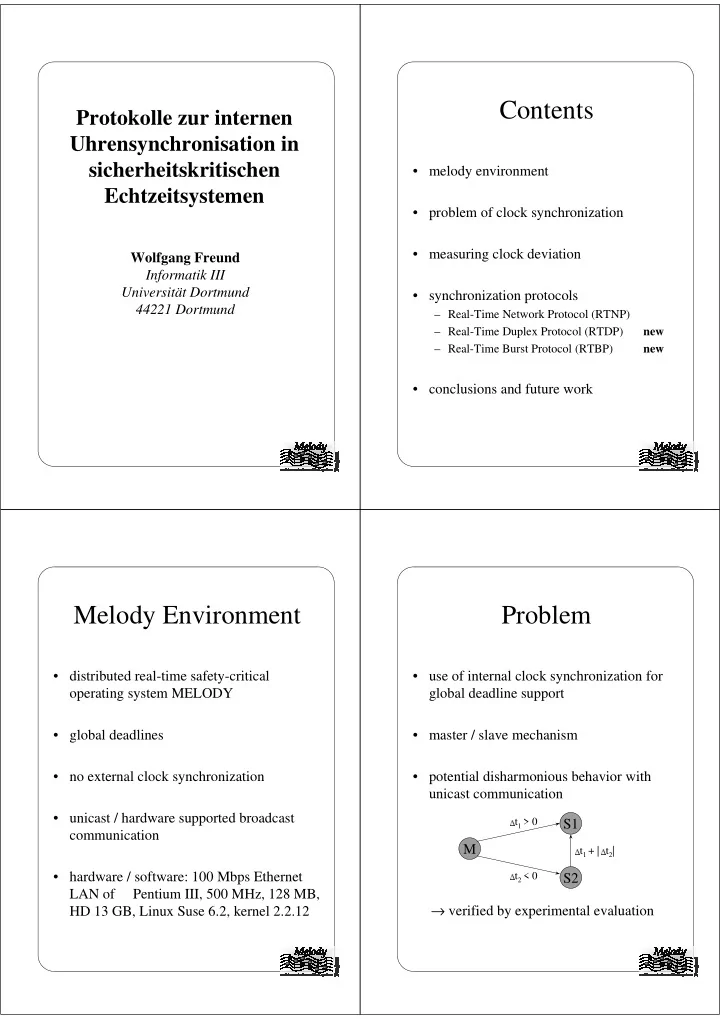
  • melody environment
  • problem of clock synchronization
  • measuring clock deviation
  • synchronization protocols

– Real-Time Network Protocol (RTNP) – Real-Time Duplex Protocol (RTDP) new – Real-Time Burst Protocol (RTBP) new

  • conclusions and future work

Melody Environment

  • distributed real-time safety-critical
  • perating system MELODY
  • global deadlines
  • no external clock synchronization
  • unicast / hardware supported broadcast

communication

  • hardware / software: 100 Mbps Ethernet

LAN of Pentium III, 500 MHz, 128 MB, HD 13 GB, Linux Suse 6.2, kernel 2.2.12

Problem

  • use of internal clock synchronization for

global deadline support

  • master / slave mechanism
  • potential disharmonious behavior with

unicast communication M S2 S1

t1 > 0 t2 < 0 t1 + | t2|

→ verified by experimental evaluation

slide-2
SLIDE 2
  • roundtrip message:

master → slave → master

  • communication delays (10.000 measurements)

1000 2000 3000 4000 5000 6000 100 101 102 103 104 105 106 107 108 109 110 111 112 113 114 115 Communication Delays [usec] Number of Arrivals UC-Node-S3 UC-Node-S5 UC-Node-S6 BC-Node-S3 BC-Node-S5 BC-Node-S6

Measuring Clock Deviations

Properties:

  • 1. standard communication delay
  • 2. standard / minimum com. delay differ at most 2 µsec
  • 3. unicast / broadcast messages differs at most 2 µsec
  • 4. symmetry
  • 5. time stamp overhead at most 200 nsec

Real-Time Network Protocol (RTNP)

  • Broadcast message from the master invokes

the slaves to start the synchronization procedure.

  • unicast roundtrip synchronization message
  • m2 includes master time stamp.
  • If m2 fails to fit into this window, it will be

ignored, and another attempt has to be made.

  • local update for clock drift correction

Master Slave t1 t2 t3 t4 t5 Standard Arrival Window (SAW) Standard Communication Delay m1 m2

Real-Time Duplex Protocol (RTDP)

  • start-master, synchronization-master
  • protocol timing
  • sync. phase (MELODY): cycle1, ..., cycle12

[1.5 ms]

  • m2 includes master time stamp.
  • If m2 fails to fit into one of the windows, it

will be ignored, and another cycle must be used.

  • local update for clock drift correction

Time Node S Node Mb Node Ma

1 2

t

1 3

t

1 1

t

1 6

t

1 7

t

cycle1

1 5

t

m1 m1 m2 m2

1 4

t

2 2

t

2 3

t

2 1

t

2 6

t

2 7

t

2 5

t

2 4

t

cycle2 SAW

  • std. com. delay

Real-Time Burst Protocol (RTBP)

  • protocol timing
  • sync. phase (MELODY): cycle1, cycle2, ...,

cycle12 [360 µs]

  • m includes master time stamp.
  • If m fails to fit into one of the windows, it will

be ignored, and another cycle must be used.

  • local update for clock drift correction

Time Node Sb Node Sa Node M

1 2

t

1 1

t

2 2

t

2 3

t

cycle1

2 1

t

m

1 3

t

  • Std. com. delay

SAW cycle2 m

3 1

t

cycle3

3 3

t

m

3 2

t

m init

slide-3
SLIDE 3

RTBP Evaluation

  • 1500
  • 1000
  • 500

500 1000 1500 60 120 180 240 300 360 420 480 Time [sec] clock deviation [nsec] M-S5 M-S6 S6-S5 Trend(S6-S5) Trend(M-S5) Trend(M-S6)

Accuracy of Master- Slave Synchronization

  • 2500
  • 2000
  • 1500
  • 1000
  • 500

500 1000 1500 60 120 180 240 300 360 420 480 Time [sec] clock deviation [nsec] RTNP RTDP RTBP Trend(RTBP) Trend(RTDP) Trend(RTNP)

Conclusions and Future Work

  • more details:

12th Euromicro Conference on Real-Time Systems, Stockholm, Sweden, June 19 - 21, 2000

  • disharmonious RTNP
  • novel broadcast protocols RTDP and RTBP

→ harmonious behavior → higher accuracy than unicast → higher fault tolerance capability

  • future work

→ installing the new protocols as MELODY functions → protocol overhead evaluation → fault tolerance studies