SLIDE 1 Constraint Satisfaction Problems
Robert Platt Northeastern University Some images and slides are used from:
- 1. CS188 UC Berkeley
- 2. RN, AIMA
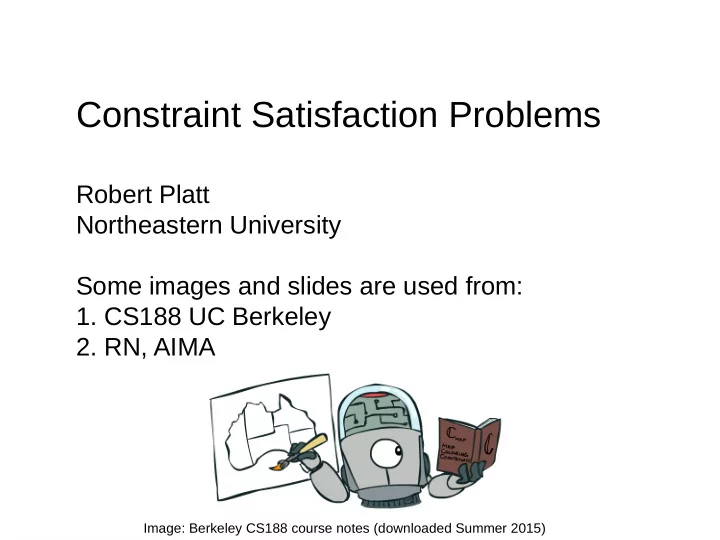
Image: Berkeley CS188 course notes (downloaded Summer 2015)
SLIDE 2 What is a CSP?
The space of all search problems
– states and actions are atomic – goals are arbitrary sets of states
CSPs All search problems The space of all CSPs
– states are defined in terms of variables – goals are defined in terms
A CSP is defined by:
- 1. a set of variables and their associated domains
- 2. a set of constraints that must be satisfied.
SLIDE 3 CSP example: map coloring
Problem: assign each territory a color such that no two adjacent territories have the same color Variables: Domain of variables: Constraints:
SLIDE 4 CSP example: n-queens
Problem: place n queens on an nxn chessboard such that no two queens threaten each other Variables: Domain of variables: Constraints:
SLIDE 5 CSP example: n-queens
Problem: place n queens on an nxn chessboard such that no two queens threaten each other Variables: Domain of variables: Constraints: One variable for every square Binary Enumeration of each possible disallowed configuration – why is this a bad way to encode the problem?
SLIDE 6 CSP example: n-queens
Problem: place n queens on an nxn chessboard such that no two queens threaten each other Variables: Domain of variables: Constraints: One variable for every square Binary Enumeration of each possible disallowed configuration – why is this a bad way to encode the problem?
Is there a better way?
SLIDE 7 CSP example: n-queens
Problem: place n queens on an nxn chessboard such that no two queens threaten each other Variables: Domain of variables: Constraints: One variable for each row A number between 1 and 8 Enumeration of disallowed configurations – why is this representation better? 1 2 3 4 5 6 7 8
SLIDE 8
The constraint graph
Variables represented as nodes (i.e. as circles) Constraint relations represented as edges – map coloring is a binary CSP, so it's easier to represent...
SLIDE 9 A harder CSP to represent: Cryptarithmetic
- Variables:
- Domains:
- Constraints:
Slide: Berkeley CS188 course notes (downloaded Summer 2015)
SLIDE 10 Another example: sudoku
Slide: Berkeley CS188 course notes (downloaded Summer 2015)
- Variables:
- Each (open) square
- Domains:
- {1,2,…,9}
- Constraints:
9-way alldifg for each row 9-way alldifg for each column 9-way alldifg for each region (or can have a bunch
constraints)
SLIDE 11
Naive solution: apply BFS, DFS, A*, ...
Which would be better: BFS, DFS, A*? – remember: it doesn't know if it reached a goal until all variables are assigned ...
SLIDE 12 Naive solution: apply BFS, DFS, A*, ... ...
_ _ _ _ _ _ _ R _ _ _ _ _ _ R G _ _ _ _ _ R G R _ _ _ _ R G R R R R R
...
How many leaf nodes are expanded in the worst case?
SLIDE 13 Naive solution: apply BFS, DFS, A*, ... ...
_ _ _ _ _ _ _ R _ _ _ _ _ _ R G _ _ _ _ _ R G R _ _ _ _ R G R R R R R
...
How many leaf nodes are expanded in the worst case?
SLIDE 14 Naive solution: apply BFS, DFS, A*, ... ...
_ _ _ _ _ _ _ R _ _ _ _ _ _ R G _ _ _ _ _ R G R _ _ _ _ R G R R R R R
...
How many leaf nodes are expanded in the worst case?
This sucks. How can we improve it?
SLIDE 15
Backtracking search
When a node is expanded, check that each successor state is consistent before adding it to the queue.
SLIDE 16 Backtracking search
When a node is expanded, check that each successor state is consistent before adding it to the queue.
Does this state have any valid successors?
SLIDE 17 Backtracking search
– backtracking enables us the ability to solve a problem as big as 25-queens
SLIDE 18
Forward checking
Sometimes, failure is inevitable: Can we detect this situation in advance?
SLIDE 19
Forward checking
Sometimes, failure is inevitable: Can we detect this situation in advance? Yes: keep track of viable variable assignments as you go
SLIDE 20
Forward checking
Track domain for each unassigned variable – initialize w/ domains from problem statement – each time you expand a node, update domains of all unassigned variables
SLIDE 21
Forward checking
Track domain for each unassigned variable – initialize w/ domains from problem statement – each time you expand a node, update domains of all unassigned variables
SLIDE 22
Forward checking
Track domain for each unassigned variable – initialize w/ domains from problem statement – each time you expand a node, update domains of all unassigned variables
SLIDE 23
Forward checking
Track domain for each unassigned variable – initialize w/ domains from problem statement – each time you expand a node, update domains of all unassigned variables
SLIDE 24
Forward checking
But, failure was inevitable here! – what did we miss?
SLIDE 25 Arc consistency
- An arc X → Y is consistent ifg for every x in the tail there is
some y in the head which could be assigned without violating a constraint
- Forward checking: Enforcing consistency of arcs pointing to
each new assignment
Delete from the tail!
WA SA NT Q
NSW
V
Slide: Berkeley CS188 course notes (downloaded Summer 2015)
SLIDE 26 Arc consistency
- An arc X → Y is consistent ifg for every x in the tail there is
some y in the head which could be assigned without violating a constraint
- Forward checking: Enforcing consistency of arcs pointing to
each new assignment
Delete from the tail!
WA SA NT Q
NSW
V
Slide: Berkeley CS188 course notes (downloaded Summer 2015)
SLIDE 27
Forward checking
But, failure was inevitable here! – what did we miss?
SLIDE 28 Arc consistency
Slide: Berkeley CS188 course notes (downloaded Summer 2015)
- A simple form of propagation makes sure all arcs are
consistent:
WA SA NT Q
NSW
V
Delete values from tail in order to make each arc consistent Consistent: for every value in the tail, there is some value in the head that could be assigned w/o violating a constraint.
SLIDE 29 Arc consistency
Slide: Berkeley CS188 course notes (downloaded Summer 2015)
- A simple form of propagation makes sure all arcs are
consistent:
WA SA NT Q
NSW
V
Delete values from tail in order to make each arc consistent Consistent: for every value in the tail, there is some value in the head that could be assigned w/o violating a constraint.
SLIDE 30 Arc consistency
Slide: Berkeley CS188 course notes (downloaded Summer 2015)
- A simple form of propagation makes sure all arcs are
consistent:
WA SA NT Q
NSW
V
Delete values from tail in order to make each arc consistent Consistent: for every value in the tail, there is some value in the head that could be assigned w/o violating a constraint.
SLIDE 31 Arc consistency
Slide: Berkeley CS188 course notes (downloaded Summer 2015)
- A simple form of propagation makes sure all arcs are
consistent:
WA SA NT Q
NSW
V
Delete values from tail in order to make each arc consistent Consistent: for every value in the tail, there is some value in the head that could be assigned w/o violating a constraint.
SLIDE 32 Arc consistency
Slide: Berkeley CS188 course notes (downloaded Summer 2015)
- A simple form of propagation makes sure all arcs are
consistent:
WA SA NT Q
NSW
V
Delete values from tail in order to make each arc consistent Consistent: for every value in the tail, there is some value in the head that could be assigned w/o violating a constraint.
SLIDE 33 Arc consistency
Slide: Berkeley CS188 course notes (downloaded Summer 2015)
- A simple form of propagation makes sure all arcs are
consistent:
WA SA NT Q
NSW
V
Conflict! Delete values from tail in order to make each arc consistent Consistent: for every value in the tail, there is some value in the head that could be assigned w/o violating a constraint.
SLIDE 34 Arc consistency
Slide: Berkeley CS188 course notes (downloaded Summer 2015)
- A simple form of propagation makes sure all arcs are
consistent:
- Important: If X loses a value, neighbors of X need to be
rechecked!
- Arc consistency detects failure earlier than forward
checking
- Can be run as a preprocessor or after each assignment
- What’s the downside of enforcing arc consistency?
WA SA NT Q
NSW
V
Conflict!
SLIDE 35
Arc consistency
Why does this algorithm converge?
SLIDE 36 Arc consistency does not detect all inconsistencies...
consistency:
- Can have one solution left
- Can have multiple solutions
left
- Can have no solutions left
(and not know it)
- Arc consistency still runs
inside a backtracking search!
What went wrong here?
Slide: Berkeley CS188 course notes (downloaded Summer 2015)
SLIDE 37
Heuristics for improving CSP performance
Minimum remaining values (MRV) heuristic: – expand variables w/ minimum size domain first
SLIDE 38
Heuristics for improving CSP performance
Minimum remaining values (MRV) heuristic: – expand variables w/ minimum size domain first
SLIDE 39
Heuristics for improving CSP performance
Minimum remaining values (MRV) heuristic: – expand variables w/ minimum size domain first
SLIDE 40
Heuristics for improving CSP performance
Least constraining value (LCV) heuristic: – consider how domains of neighbors would change under A.C. – choose value that contrains neighboring domains the least
SLIDE 41
Heuristics for improving CSP performance
Least constraining value (LCV) heuristic: – consider how domains of neighbors would change under A.C. – choose value that contrains neighboring domains the least
The combination of MRV and LCV w/ backtracking can solve the 1000-queens problem
SLIDE 42 Using structure to reduce problem complexity
In general, what is the complexity of solving a CSP using backtracking? (in terms of # variables, n, and max domain size, d) But, sometimes CSPs have special structure that makes them simpler!
SLIDE 43 When the constraint graph is a tree
This CSP is easier to solve than the general case...
SLIDE 44 When the constraint graph is a tree
– a partial ordering over variables
- i. choose any node as the root
- ii. list children after their parents
Image: Berkeley CS188 course notes (downloaded Summer 2015)
SLIDE 45 When the constraint graph is a tree
- 2. make the graph directed arc consistent
– start w/ the tail and make each variable arc consistent wrt its parents
Image: Berkeley CS188 course notes (downloaded Summer 2015)
SLIDE 46 When the constraint graph is a tree
- 2. make the graph directed arc consistent
– start w/ the tail and make each variable arc consistent wrt its parents
Image: Berkeley CS188 course notes (downloaded Summer 2015)
SLIDE 47 When the constraint graph is a tree
- 2. make the graph directed arc consistent
– start w/ the tail and make each variable arc consistent wrt its parents
Image: Berkeley CS188 course notes (downloaded Summer 2015)
SLIDE 48 When the constraint graph is a tree
- 2. make the graph directed arc consistent
– start w/ the tail and make each variable arc consistent wrt its parents
Image: Berkeley CS188 course notes (downloaded Summer 2015)
SLIDE 49 When the constraint graph is a tree
- 2. make the graph directed arc consistent
– start w/ the tail and make each variable arc consistent wrt its parents
Image: Berkeley CS188 course notes (downloaded Summer 2015)
SLIDE 50 When the constraint graph is a tree
- 2. make the graph directed arc consistent
– start w/ the tail and make each variable arc consistent wrt its parents
Image: Berkeley CS188 course notes (downloaded Summer 2015)
SLIDE 51 When the constraint graph is a tree
- 2. make the graph directed arc consistent
– start w/ the tail and make each variable arc consistent wrt its parents
Image: Berkeley CS188 course notes (downloaded Summer 2015)
SLIDE 52 When the constraint graph is a tree
- 3. Now, start at the root and do backtracking
– will backtracking ever actually backtrack?
Image: Berkeley CS188 course notes (downloaded Summer 2015)
So, what's the time complexity of this algorithm?
SLIDE 53 Using structure to reduce problem complexity
But, what if the constraint graph is not a tree? – is there anything we can do?
But, sometimes CSPs have special structure that makes them simpler!
SLIDE 54
Using structure to reduce problem complexity
But, what if the constraint graph is not a tree? – is there anything we can do? This is not a tree...
SLIDE 55 Cutset conditioning
SA SA SA SA
Instantiate the cutset (all possible ways) Compute residual CSP for each assignment Solve the residual CSPs (tree structured) Choose a cutset
- 1. Turn the graph into a tree by assigning values to a subset of
variables
- 2. For each assignment to the subset, prune domains of the rest
- f the variables and solve the sub-problem CSP.
– what does efficiency of this approach depend on?
Image: Berkeley CS188 course notes (downloaded Summer 2015)
SLIDE 56 Cutset conditioning
How many variables need to be assigned to turn this graph into a tree?
Image: Berkeley CS188 course notes (downloaded Summer 2015)