Contents List of Figures page xv List of Tables xvii Foreword - - PDF document

contents
SMART_READER_LITE
LIVE PREVIEW

Contents List of Figures page xv List of Tables xvii Foreword - - PDF document

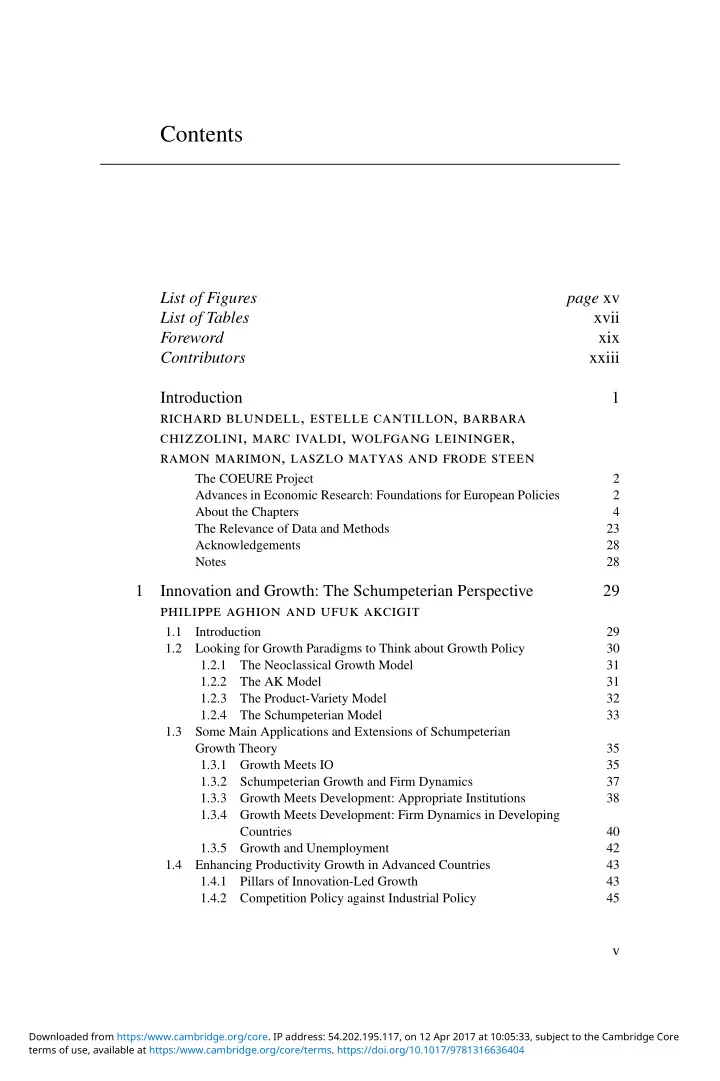
Contents List of Figures page xv List of Tables xvii Foreword xix xxiii Contributors Introduction 1 richard blundell, estelle cantillon, barbara chizzolini, marc ivaldi, wolfgang leininger, ramon marimon, laszlo matyas and frode steen


slide-1
SLIDE 1

Contents

List of Figures page xv List of Tables xvii Foreword xix Contributors xxiii Introduction 1 richard blundell, estelle cantillon, barbara chizzolini, marc ivaldi, wolfgang leininger, ramon marimon, laszlo matyas and frode steen

The COEURE Project 2 Advances in Economic Research: Foundations for European Policies 2 About the Chapters 4 The Relevance of Data and Methods 23 Acknowledgements 28 Notes 28

1 Innovation and Growth: The Schumpeterian Perspective 29 philippe aghion and ufuk akcigit

1.1 Introduction 29 1.2 Looking for Growth Paradigms to Think about Growth Policy 30 1.2.1 The Neoclassical Growth Model 31 1.2.2 The AK Model 31 1.2.3 The Product-Variety Model 32 1.2.4 The Schumpeterian Model 33 1.3 Some Main Applications and Extensions of Schumpeterian Growth Theory 35 1.3.1 Growth Meets IO 35 1.3.2 Schumpeterian Growth and Firm Dynamics 37 1.3.3 Growth Meets Development: Appropriate Institutions 38 1.3.4 Growth Meets Development: Firm Dynamics in Developing Countries 40 1.3.5 Growth and Unemployment 42 1.4 Enhancing Productivity Growth in Advanced Countries 43 1.4.1 Pillars of Innovation-Led Growth 43 1.4.2 Competition Policy against Industrial Policy 45

v

terms of use, available at https:/www.cambridge.org/core/terms. https://doi.org/10.1017/9781316636404 Downloaded from https:/www.cambridge.org/core. IP address: 54.202.195.117, on 12 Apr 2017 at 10:05:33, subject to the Cambridge Core

slide-2
SLIDE 2

vi Contents

1.4.3 Reforming the State 47 1.4.4 Macroeconomic Policy 48 1.4.5 Innovation, Inequality, and Social Mobility: Making Growth Inclusive 48 1.5 Technological Waves and the Debate on Secular Stagnation 51 1.5.1 The Debate 51 1.5.2 Historical Wave Patterns 52 1.6 Schumpeterian Insights into R&D Policy 54 1.6.1 R&D Policies and Firm Selection 55 1.6.2 Basic versus Applied R&D 56 1.7 The Role of Freedom and Openness in the Innovation Process 59 1.7.1 The ADS Framework and the Role of Academic Freedom 59 1.7.2 Freedom and Openness 61 1.7.3 Evidence on the Limits of IP and the Role of Openness and Freedom 61 1.8 Towards a New Growth Pact in Europe 62 1.8.1 Structural Reforms and the Role of Structural Funds 62 1.8.2 Rethinking Industrial Policy in the EU 64 1.8.3 More Flexible Macroeconomic Policies at EU Level 65 1.9 Conclusion 66 Acknowledgements 67 Notes 67 References 69

2 European Union Dual Labour Markets: Consequences and Potential Reforms 73 juan j. dolado

2.1 Introduction 73 2.2 The Emergence of Dual Labour Markets in Europe 74 2.3 Temporary Contracts: Stepping Stones or Dead Ends? 77 2.4 Dual Labour Markets Before and After the Great Recession 80 2.5 Lessons from Spain 84 2.6 Dual Labour Markets and Youth Unemployment 88 2.7 How to Dismantle Dual Employment Protection Legislation 91 2.7.1 Recent EPL Reforms 91 2.7.2 Single/Unifjed Contracts in Theory 93 2.7.3 Single/Unifjed Contracts in Practice 100 2.8 Conclusions 104 Acknowledgements 105 Appendix 105 Notes 108 References 109

3 Population, Migration, Ageing and Health: A Survey 113 christian dustmann, giovanni facchini and cora signorotto

3.1 Introduction 113 3.2 Main Stylized Facts 114 3.3 Migration and Demographic Developments 117 3.3.1 The Selection Hypothesis 120

terms of use, available at https:/www.cambridge.org/core/terms. https://doi.org/10.1017/9781316636404 Downloaded from https:/www.cambridge.org/core. IP address: 54.202.195.117, on 12 Apr 2017 at 10:05:33, subject to the Cambridge Core

slide-3
SLIDE 3

Contents vii

3.3.2 The Adaptation Hypothesis 121 3.3.3 The Disruption Hypothesis 123 3.4 Permanent versus Temporary Migration 124 3.4.1 Why Do Migrants Return? 125 3.4.2 Who Are the Return Migrants? 126 3.5 The Fiscal Effect of Immigration 128 3.5.1 Static Frameworks 129 3.5.2 Dynamic Models 130 3.6 Migration and Skill Shortages 132 3.7 International Migration and the Health Care Sector 136 3.7.1 International Migration of Health Care Professionals 136 3.7.2 International Migration of Old Age Carers 139 3.7.3 Immigrants’ Demand for Health Care 141 3.8 The Floridization of Europe: Old Age North–South Migration 143 3.8.1 Determinants of Old Age Migration 144 3.8.2 Effects on Host Country Economy 145 3.9 Conclusions 146 Acknowledgements 147 Appendix 147 Notes 148 References 149

4 Education Systems: Assignment, Admissions, Accountability and Autonomy 159 simon burgess

4.1 Introduction 159 4.1.1 What Can Economics Contribute to the Study of Education? 161 4.2 The Aims of Education: Rates of Return, Inequality and Social Mobility 161 4.3 Education Systems: Assignment, Admissions, Accountability and Autonomy 164 4.3.1 Assignment Mechanisms 164 4.3.2 Accountability, Autonomy and Regulation 175 4.3.3 Education Market Structure: Policy Summary 185 Acknowledgements 185 Notes 186 References 186

5 Competition and Regulation in Markets for Goods and Services: A Survey with Emphasis on Digital Markets 194 nikolaos vettas

5.1 Introduction 194 5.2 A View on Competition Policy Developments in Europe 199 5.2.1 Competition Policy: The General Context 199 5.2.2 Digital Trade and Online Markets 200 5.2.3 Some Recent Competition Cases 203 5.2.4 Online Travel Agencies and MFNs 207 5.2.5 The Digital Single Market Initiative 208 5.2.6 Distinguishing Features of Digital Markets 209

terms of use, available at https:/www.cambridge.org/core/terms. https://doi.org/10.1017/9781316636404 Downloaded from https:/www.cambridge.org/core. IP address: 54.202.195.117, on 12 Apr 2017 at 10:05:33, subject to the Cambridge Core

slide-4
SLIDE 4

viii Contents

5.3 Approaches in Industrial Organization 210 5.3.1 Pricing 211 5.3.2 Vertical Relations 213 5.4 Recent Research on Competition Issues Related to Digital Markets 216 5.5 Challenges for Research on Competition Issues in Digital Markets 223 5.6 Conclusion 227 Acknowledgements 228 Notes 228 References 232

6 Winners and Losers of Globalization: Sixteen Challenges for Measurement and Theory 238 cecília hornok and miklós koren

6.1 Introduction 238 6.2 Advances in Measurement and Data Challenges 240 6.2.1 Recent Advances in Measuring the Causes and Effects

  • f Globalization

240 6.2.2 Data Challenges 245 6.3 Insights from Theories of Globalization 247 6.3.1 Broad Lessons about the Causes and Effects of Globalization 247 6.3.2 Insights for Policy 256 6.3.3 Open Questions 257 6.4 Conclusion 263 Acknowledgements 263 Notes 264 References 264

7 Economic Approaches to Energy, Environment and Sustainability 274 paul ekins, paul drummond and jim watson

7.1 Introduction 274 7.2 Economic Approaches to the Environment 275 7.2.1 Environmental and Resource Economics 275 7.2.2 Ecological Economics 276 7.2.3 Institutional, Evolutionary, and Behavioural Economics 277 7.3 Sustainability and Sustainable Development 278 7.3.1 Sustainable Development 278 7.3.2 Environmental Sustainability 283 7.3.3 Measurement and Indicators of Sustainable Development and Sustainability 289 7.4 The Energy System and Climate Change Mitigation 292 7.4.1 Energy Security 292 7.4.2 Reducing CO2 Emissions 295 7.4.3 Financial Requirements and Affordability 295 7.5 Policies for Energy, Climate Change Mitigation and a Green Economy 298 7.5.1 Standards and Engagement 299 7.5.2 Information 299 7.5.3 Markets and Pricing 300

terms of use, available at https:/www.cambridge.org/core/terms. https://doi.org/10.1017/9781316636404 Downloaded from https:/www.cambridge.org/core. IP address: 54.202.195.117, on 12 Apr 2017 at 10:05:33, subject to the Cambridge Core

slide-5
SLIDE 5

Contents ix

7.5.4 Strategic Investment 302 7.5.5 EU Energy and Climate Change Policy: Lessons and Priorities for Research 305 7.6 The Science-Policy Interface 309 7.7 Conclusions and Research Priorities 312 Notes 316 References 316

8 Regional Disparities and Effjcient Transport Policies 324 stef proost and jacques-françois thisse

8.1 Introduction 324 8.2 What Is Spatial Economics About? 325 8.2.1 Location Does Matter 326 8.2.2 Moving Goods and People is Still Costly 327 8.3 The Drivers of Regional Agglomeration 330 8.3.1 The Home-Market Effect 332 8.3.2 Agglomeration Economies and the Emergence of Asymmetric Clusters 339 8.3.3 The Core–Periphery Structure 340 8.3.4 Input–Output Linkages and the Bell-Shaped Curve of Spatial Development 343 8.3.5 Communication Costs and the Relocation of Plants 345 8.4 Does the Market Yield Over or Under-agglomeration? 346 8.4.1 Does the Home-Market Effect Generate Excessive Agglomeration? 346 8.4.2 Is the Core-Periphery Structure Ineffjcient? 347 8.5 Do EU Interregional Transport Investment Policies Fulfjl their Role? 348 8.5.1 Assessing Transport Investments Using Econometric Models 350 8.5.2 Assessing Transport Investments Using Model Simulations 351 8.5.3 Assessing Transport Investments Using Case Studies 353 8.6 Is the EU Moving to a Better Utilization of Its Existing Transport Policy? 355 8.6.1 Competition on Diesel Fuel Taxes Leads EU Countries to Revise Their Pricing of Road Freight 355 8.6.2 Europe Does Not Make the Best Use of Its Rail and Air Transport System 356 8.7 What Have We Learnt? 357 Acknowledgements 360 Notes 360 References 361

9 Skilled Cities and Effjcient Urban Transport 366 stef proost and jacques-françois thisse

9.1 Introduction 366 9.2 Agglomeration Economies 368 9.2.1 The Nature and Magnitude of Agglomeration Economies 371 9.2.2 Cities as Consumption Centres 375

terms of use, available at https:/www.cambridge.org/core/terms. https://doi.org/10.1017/9781316636404 Downloaded from https:/www.cambridge.org/core. IP address: 54.202.195.117, on 12 Apr 2017 at 10:05:33, subject to the Cambridge Core

slide-6
SLIDE 6

x Contents

9.3 The Trade-Off between Commuting and Housing Costs 376 9.3.1 The Monocentric City Model 377 9.3.2 Why Do Employment Centres Emerge? 379 9.3.3 Land Capitalisation and Housing 380 9.3.4 Residential Segregation 382 9.4 More Cities or Bigger Cities? 384 9.5 The Organization of Metropolitan Areas 387 9.6 Managing Traffjc and Congestion 388 9.6.1 External Costs of Urban Transport 390 9.6.2 The Diffjcult Road to First-Best Pricing of Congestion 391 9.6.3 The Patchwork of Policy Instruments 394 9.6.4 Public Transport Pricing 396 9.7 The Benefjts of New Transport Infrastructure 398 9.7.1 Does New Infrastructure Reduce Congestion? 398 9.7.2 The Wider Benefjts of Urban Transport Projects and New Developments in Assessment Methods 399 9.8 Where Do We Stand? 401 Acknowledgements 403 Notes 403 References 403

10 Fiscal and Monetary Policies after the Crises 409 charles brendon and giancarlo corsetti

10.1 Introduction 409 10.2 The Pre-Crisis Consensus, and Heterogeneity 411 10.3 The Context and Challenges Posed by the Crisis 413 10.3.1 Headline Macroeconomic Trends 414 10.3.2 Market Impairment and the Transmission of Stabilization Policy 416 10.3.3 The Zero Bound on Nominal Interest Rates 417 10.4 The Zero Lower Bound: Implications for Stabilization Policy 418 10.4.1 Savings Decisions and Nominal Interest Rates 419 10.4.2 Shocks to the ‘Natural’ Rate of Interest 420 10.4.3 Forward Guidance as a Solution? 422 10.4.4 Fiscal Stimulus as a Solution? 425 10.4.5 Central Bank Asset Purchases as a Solution? 433 10.4.6 The Benefjts and Risks of Structural Reform 439 10.4.7 Empirical Evidence on the ‘Expectations Channel’ 440 10.5 Policies and Diagnoses of the Crisis 442 10.5.1 What Causes ‘Savings Shocks’? 442 10.5.2 The Possibility of Secular Stagnation 445 10.5.3 Dynamic Interactions through the Labour Market 448 10.5.4 Defmation Traps, Self-Fulfjlling Dynamics and Equilibrium Selection 450 10.6 Risk Sharing and Fiscal Policy in a Monetary Union 455 10.6.1 Imbalances and Imperfect Risk Sharing 456 10.6.2 Complete Markets are not a Substitute for Risk Sharing via Transfers 457 10.6.3 Fiscal Devaluation 458

terms of use, available at https:/www.cambridge.org/core/terms. https://doi.org/10.1017/9781316636404 Downloaded from https:/www.cambridge.org/core. IP address: 54.202.195.117, on 12 Apr 2017 at 10:05:33, subject to the Cambridge Core

slide-7
SLIDE 7

Contents xi

10.7 Conclusions 459 Acknowledgements 460 Notes 461 References 464

11 Financial Regulation in Europe: Foundations and Challenges 470 thorsten beck, elena carletti and itay goldstein

11.1 Introduction 470 11.2 Recent Financial Reforms in Europe 472 11.2.1 Capital Requirements 473 11.2.2 Liquidity Requirements 474 11.2.3 Resolution Framework and Bail-In Instruments 475 11.2.4 Banking Union 476 11.2.5 Activity Restrictions and Other Reforms 478 11.3 Microfoundations for Financial Reforms 479 11.3.1 Basic Failures in the Financial System 479 11.3.2 Mapping between Basic Failures and the Reforms Enacted in Europe 488 11.4 Moving beyond Banks and Traditional Activities: The Regulatory Perimeter 492 11.4.1 The Regulatory Perimeter 492 11.4.2 Financial Innovation 495 11.4.3 Complexity 498 11.5 Special Issues in Europe and How they Affect Future Regulation 499 11.5.1 Crisis Resolution and Macro-Management in a Monetary Union 500 11.5.2 Financial Structure: Does Europe Suffer from a Bank Bias? 501 11.6 Summary, Policy Lessons and Directions for Future Research 502 Acknowledgements 505 Notes 505 References 505

12 Inequality and Welfare: Is Europe Special? 511 alain trannoy

12.1 Introduction 511 12.2 Inequality and Welfare: Two Interconnected Notions 513 12.2.1 Inequality 513 12.2.2 Welfare 515 12.2.3 Aggregating Welfare 517 12.2.4 The Relationship between Inequality and Welfare 518 12.2.5 Two Assumptions about Individual Welfare 519 12.3 Normative and Positive Issues Involving Several Sciences 523 12.3.1 Political Philosophy 524 12.3.2 History 525 12.3.3 Sociology and Political Science 527 12.3.4 Psychology 530 12.3.5 Neurosciences: Happiness in the Twenty-First Century 530

terms of use, available at https:/www.cambridge.org/core/terms. https://doi.org/10.1017/9781316636404 Downloaded from https:/www.cambridge.org/core. IP address: 54.202.195.117, on 12 Apr 2017 at 10:05:33, subject to the Cambridge Core

slide-8
SLIDE 8

xii Contents

12.4 Europe’s Inequality Pattern vis-à-vis the US 532 12.4.1 Inequality of Income 533 12.4.2 Forces behind the Increase in Gross-Income Inequality 535 12.4.3 Convergence Process in Europe 538 12.4.4 Inequality of Opportunity and Intergenerational Mobility 540 12.4.5 Attitudes to Inequality 545 12.4.6 Well-Being and the Size of the Welfare State 548 12.4.7 Partial Conclusion 550 12.5 Europe Is at the Forefront of Research on Many Topics 551 12.6 Data Are Improving but Remain Largely Incomplete when Looking at More Specifjc Issues 553 12.7 Inequality and Welfare as Transversal Issues 554 12.8 Cutting Edge Research Issues 555 12.9 Issues More Specifjc to Europe 557 12.10 Conclusion 558 Acknowledgements 560 Notes 560 References 561

13 Developments in Data for Economic Research 568 roberto barcellan, peter bøegh nielsen, caterina calsamiglia, colin camerer, estelle cantillon, bruno crépon, bram de rock, lászló halpern, arie kapteyn, asim i. khwaja, georg kirchsteiger, vigdis kvalheim, julia lane, markus mobius, luke sibieta, joseph tracy, frederic udina, gugliemo weber and lisa wright

13.1 Introduction 568 13.2 Organizing Access to Microdata 569 13.2.1 Legal and Technical Background 570 13.2.2 The Nordic Leadership 571 13.2.3 Improving Data Access: Two Case Studies 574 13.2.4 Concluding Remarks 577 13.3 Data Standards and Cross-Country Datasets 577 13.3.1 The Lessons of the Financial Crisis for the Data Environment 578 13.3.2 The G20 Data Gaps Initiative 579 13.3.3 Linking Existing Microdata 581 13.3.4 Towards a New Data Environment 584 13.4 Researcher-Generated Databases 585 13.4.1 Measurement and Experimentation in the Social Sciences Project 586 13.4.2 The UMETRICS Programme 587 13.4.3 The Survey of Health, Ageing and Retirement in Europe 588 13.4.4 Lessons from Successful Researcher-Led Databases 589 13.5 Data Generation in Controlled Environments 590 13.5.1 Laboratory Experiments 590 13.5.2 Randomized Control Trials 594

terms of use, available at https:/www.cambridge.org/core/terms. https://doi.org/10.1017/9781316636404 Downloaded from https:/www.cambridge.org/core. IP address: 54.202.195.117, on 12 Apr 2017 at 10:05:33, subject to the Cambridge Core

slide-9
SLIDE 9

Contents xiii

13.6 The Changing Face of Public and Private-Sector Collaborations in Economic Research 598 13.6.1 New Private-Sector Collaborations in Economic Research 599 13.6.2 New Public-Sector Collaborations in Economic Research 601 13.6.3 Risks, Challenges and Outlook 603 13.7 Concluding Comments 605 Notes 606 References 608

14 Big Data in Economics: Evolution or Revolution? 612 christine de mol, eric gautier, domenico giannone, sendhil mullainathan, lucrezia reichlin, herman van dijk and jeffrey wooldridge

14.1 Introduction 612 14.2 The Curse of Dimensionality and Regularization 614 14.3 Policy Analysis and Causal Inference 619 14.4 Prediction 623 14.5 Computational Issues 625 14.6 Conclusions 627 Notes 628 References 628

Index 633

terms of use, available at https:/www.cambridge.org/core/terms. https://doi.org/10.1017/9781316636404 Downloaded from https:/www.cambridge.org/core. IP address: 54.202.195.117, on 12 Apr 2017 at 10:05:33, subject to the Cambridge Core

slide-10
SLIDE 10

terms of use, available at https:/www.cambridge.org/core/terms. https://doi.org/10.1017/9781316636404 Downloaded from https:/www.cambridge.org/core. IP address: 54.202.195.117, on 12 Apr 2017 at 10:05:33, subject to the Cambridge Core