Content 1. Broad context 2. Building blocks: (a)Tame vs wicked - - PowerPoint PPT Presentation

content
SMART_READER_LITE
LIVE PREVIEW

Content 1. Broad context 2. Building blocks: (a)Tame vs wicked - - PowerPoint PPT Presentation

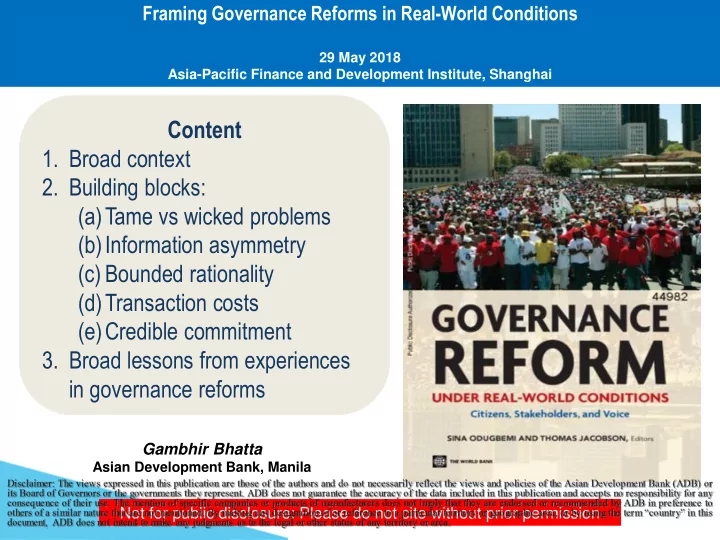
Framing Governance Reforms in Real-World Conditions 29 May 2018 Asia-Pacific Finance and Development Institute, Shanghai Content 1. Broad context 2. Building blocks: (a)Tame vs wicked problems (b)Information asymmetry (c) Bounded rationality


slide-1
SLIDE 1

Framing Governance Reforms in Real-World Conditions

29 May 2018 Asia-Pacific Finance and Development Institute, Shanghai

Content

  • 1. Broad context
  • 2. Building blocks:

(a)Tame vs wicked problems (b)Information asymmetry (c) Bounded rationality (d)Transaction costs (e)Credible commitment

  • 3. Broad lessons from experiences

in governance reforms

Gambhir Bhatta

Asian Development Bank, Manila

Not for public disclosure: Please do not cite without prior permission

slide-2
SLIDE 2

2

“Good governance requires three things: (a) state capability (the extent to which leaders and government are able to get things done); (b) responsiveness (whether public policies and institutions respond to the needs of citizens and uphold their rights; and (c) accountability (the ability of citizens, civil society, and the private sector to scrutinize public institutions and governments and to hold them to account).” Odugbemi and Jacobson, 2008, p. 16.

A social audit in progress in Afghanistan (source: Aga Khan Development Network, “Social Audits in Afghanistan”, http://www.akdn.or g/photos_show.as p?Sid=143) The Beehive, Wellington

slide-3
SLIDE 3

Specific examples: Gender – gender based budgeting Clean energy institutional structure (within a core ministry or autonomous agency?) Infrastructure; Housing; Water; Sanitation; Urban – capacity; O&M funds Health – procurement of essential drugs Institutions – representation in decision fora; access to information

“… build effective, accountable and inclusive institutions at all levels” Target 17.1: “strengthen domestic resource mobilization… through domestic capacity for tax and

  • ther revenue collection”

Global trends that impact new norms in governance

  • A. Primacy of SDGs
slide-4
SLIDE 4

Expected to cause almost a quarter of a million additional deaths per year between 2030 and 2050 (WHO) Climate change … may cause as many as 143m people in just three regions to be displaced by 2050 (World Bank)

  • B. Climate Change
slide-5
SLIDE 5

5

  • C. Urbanization

https://www.unescap.org/commission/73/document/E73_16E.pdf)

slide-6
SLIDE 6

6

Vicious cycle of inadequate revenues

Inability or lack of willingness to pay taxes / user fees Low infrastructure investment Poor quality of services Poor state of municipal finances

Some governance implications of urbanization: (a) Service delivery (b) Moral hazard (c) Quality of life (positive and negative) (d) Municipal financing

“Of the world’s 35 megacities in 2017, 21 were located in the Asia and GlobalData estimates that close to 60% of megacities will be located in the continent by 2025 (including 11 in China and 6 in India).”

Shenzhen: The 1st Special Economic Zone, 1980 Shenzen, 2013

slide-7
SLIDE 7

Road congestion costs Asian economies 2-5% of GDP each year due to lost time and higher transport costs**

  • D. Infrastructure needs…

Each year, Asia-Pacific needs about $1.74tn in infrastructure investment

“Regulatory and institutional reforms are needed to make infrastructure more attractive to private investors… Countries should implement PPP- related reforms such as enacting laws, streamlining procurement and bidding processes, introducing dispute resolution mechanisms, …”

slide-8
SLIDE 8
  • E. Connected and networked?

4.2 billion people in the world are

  • nline and

connected

McKinsey, 2016

slide-9
SLIDE 9

Use of ICT for Service Delivery

Policies Examples of Specific Activities Expand use of ICT as a catalyst for better service delivery Support:

  • Digitization of land records
  • real-time information on effectiveness of

service delivery

(http://www.adb.org/sites/default/files/publication/31238 /ewp-391.pdf, p. 4)

slide-10
SLIDE 10

Countries with sound policies and regulations, an effective public service, and able to control corruption have grown more quickly than others

  • Asian Development Outlook

Update, 2013 “Governance and Service Delivery”

Governments need institutions for effective management and

  • versight to deliver—

accountability, participation, predictability, and transparency

  • ADB. 2008.

Governance: Sound Development

  • Management. Manila
  • F. Need for focus on institutional

performance

“The greatest challenge Asia faces in its endeavors to realize the Asian Century: transforming governance and institutions.”

slide-11
SLIDE 11

To understand institutions, we start with understanding what governments do

0 Proper markets don’t often – and across the board – exist in a

developing country

0 This leads to inefficient production, distribution, sub-optimal

consumption, and generally ineffective and inefficient service delivery

0 Hence, the role of the state: correct the bias

Four core functions of government

Policy Regulation Enforcement Service delivery

slide-12
SLIDE 12

Rittel, Horst. "Dilemmas in a General Theory of Planning." Policy Sciences, 1973: 155- 169.

But governments always face ‘wicked problems’

slide-13
SLIDE 13

Core Concept 1: Information Asymmetry

Therefore, all players are at best boundedly rational…

  • 1. Lack of information across time

(we know more at time T-1 than at T+1)

  • 2. Asymmetry across space

(eg., between core and periphery; organizations, etc.)

  • 3. Asymmetry when static in perception and interpretation

(differential in making sense of available information) Imperfect Information Paradigm: incorporates information (or the lack of it) into standard economic analysis to explain the rise of certain institutional settings and lack

  • f efficiency

Inefficient institutions result from imperfect and costly information

slide-14
SLIDE 14

Concept of bounded rationality

Assertion: “government business is inherently a risky business”  ill- structured problems, ‘wicked issues’, multiple stakeholders No incentives not to be risk averse bounded rationality Incrementalism, at best; Disjointed incrementalism, usually

Muddling Through

slide-15
SLIDE 15

Core Concept 2: Transaction costs (TCs)

Search and information costs Bargaining costs Policing and enforcing costs Variable in impact (Some businesses/firms more able to meet and internalize)

Differential access to, and ability to interpret, information (as well as voting for association) leads to transaction costs

North (1990): “The inability of societies to develop effective, low-cost enforcement of contracts is the most important source of both historical stagnation and contemporary underdevelopment in the third world”

slide-16
SLIDE 16
  • Assumption of a repetitive game
  • Expectation: of quid pro quo in commitment to transaction
  • Policy reversals—or more aptly, the threat (or perception) of such

reversals—lead to a failure to commit credibly

  • Corollary of CC: credible threat

Core Concept 3: Credible Commitment (CC)

CC = TCs

slide-17
SLIDE 17

(1) Beware tendency to take a short-term view of reforms:

Mindsets and institutions take a long time to change

“The three completed programs in Assam, Mizoram, and West Bengal were generally effective … ADB should consider providing longer-term follow-on support to help cement reform gains and institutional development.”

So, what have we learned about governance reform work from our experiences in the region?

slide-18
SLIDE 18

18

(2) Beware difference between ‘what ought to be’ and ‘what can be’: Good Enough Governance over Good Governance “… good governance is deeply problematic as a guide to development” – Merilee Grindle, KSG

Notions of country context and ‘country systems’ are important

Note earlier concepts of bounded rationality and ‘muddling through’

"Idealistic vision is a corruption-free Bangladesh. If Denmark can be number 4 (in the corruption- perception index) why can Bangladesh not be number 3? It is possible, but not probable. The realistic vision is to minimize corruption to ensure good governance. It is possible." Lt. Gen Hasan Mashud Chowdhury (former ACC chairman, Bangladesh)

slide-19
SLIDE 19

(3) Beware difference between best practice and best fit

“… developing countries, which are dominated by informal markets, are risky candidates for applying the New Zealand model… basic reforms to strengthen rule-based government and pave the way for robust markets should be undertaken first.” Allen Schick. 1998. “Why Most Developing Countries Should Not Try New Zealand's Reforms”. World Bank Research Observer Volume 13, Issue 1, Pages: 123 – 131.

slide-20
SLIDE 20

(4) Beware non-adherence to the Rule of Law

slide-21
SLIDE 21

“Don’t worry, I’ll train her in two days”

(5) Beware the urge to see reforms as being simple…

… but also beware NOT seeing the obvious!

“I will learn governance as I did cooking and milking cows”

slide-22
SLIDE 22
  • 6. Beware stated preferences from revealed ones…
slide-23
SLIDE 23
  • 7. Beware lack of political commitment as a

necessary and sufficient condition of reforms

“Frankly, my dear, I don’t give a damn…”

slide-24
SLIDE 24

Pl Please se co contact: ct: Gambh bhir ir Bhatta Email: il: gbhatta@ad ta@adb.org .org ADB’s Governance Team w: w: htt ttp://ww ://www.ad .adb.or b.org/sectors/go g/sectors/govern vernance/main ance/main f: https://w s://www ww.faceb .faceboo

  • ok.co

k.com/Go m/Gover vernanc nanceTG/ eTG/ e: governan nance@ad ce@adb.or b.org t: https://twi s://twitter tter.co .com/adb_ m/adb_gov

  • vern

ernance ance

Questions?