Consumer Financial Protection Bureau 2015 Outlook A Venable CLE - - PDF document

consumer financial protection bureau 2015 outlook a
SMART_READER_LITE
LIVE PREVIEW

Consumer Financial Protection Bureau 2015 Outlook A Venable CLE - - PDF document

JANUARY 8, 2015 Consumer Financial Protection Bureau 2015 Outlook A Venable CLE Webinar Related Articles and Materials EDITORS Jonathan Jonathan L. L. Pompan Pompan JLPompan@Venable.com 202.344.4383 Al Allyson lyson B. B. Baker Baker


slide-1
SLIDE 1

Consumer Financial Protection Bureau 2015 Outlook A Venable CLE Webinar

Related Articles and Materials

EDITORS

Jonathan Jonathan L.

  • L. Pompan

Pompan JLPompan@Venable.com 202.344.4383 Al Allyson lyson B.

  • B. Baker

Baker abbaker@Venable.com 202.344.4708 Randal Randal M.

  • M. Shaheen

Shaheen rmshaheen@Venable.com 202.344.4488 Alexandra Alexandra Megaris Megaris AMegaris@Venable.com 212.370.6210 Andrew E. Bigart aebigart@Venable.com 202.344.4323 For additional articles and presentations, see www.Venable.com/cfpb/publications. CALIFORNIA | DELAWARE | MARYLAND | NEW YORK | VIRGINIA | WASHINGTON, DC 1.888.VENABLE | www.Venable.com JANUARY 8, 2015

slide-2
SLIDE 2

Allyson B. Baker Joanna P. Breslow Boyd Peter S. Frechette Investigations and White Collar Defense Consumer Financial Protection Bureau Task Force Financial Services AUTHORS RELATED PRACTICES RELATED INDUSTRIES December 2014 Consumer Financial Protection Bureau (CFPB or Bureau) investigational fact finding – whether through a civil investigative demand (CID) or other means – might yield evidence for civil lawsuits brought by the Bureau and potential evidence for criminal matters prosecuted by the Department of Justice (DOJ). In addition to the monetary relief and civil money penalties the CFPB can impose, the Consumer Financial Protection Act (Title X of the Dodd-Frank Act) provides that if the CFPB "obtains evidence" of conduct that "may constitute a violation of Federal criminal law, the Bureau shall transmit such evidence" to the

  • DOJ. Individuals or companies that receive a CID from the CFPB should take these requests seriously

and approach them as if they are evidence-gathering mechanisms with far-reaching consequences. Recent enforcement actions demonstrate the extent to which the CFPB and DOJ are working together to investigate and prosecute alleged violations of consumer protection laws. First CFPB Criminal Referral Results in Nine-Year Prison Sentence On December 4, 2014, the CFPB announced a settlement with Premier Consulting Group LLC. In a May 2013 complaint the Bureau alleged that Premier and another debt-settlement firm, Mission Settlement Agency, violated the advance fee prohibition of the Telemarketing Sales Rule (TSR), 16 C.F.R. § 310, which provides that it is abusive to request or receive payment for debt relief services before renegotiating, settling, reducing, or otherwise altering the terms of a consumer's debts. The Bureau alleged that consumers never received the services for which the advance fees were charged and that the companies did not provide actual services, which caused consumers to incur unnecessary debt that further harmed them. The proposed consent order requires Premier to pay a civil money penalty of $69,075. The consent

  • rder enjoins Premier from taking advance fees or violating the TSR, and Premier may not disclose,

use, or benefit from customer information. Among other things, Premier is also required to take additional steps, such as adhering to a compliance plan (including creating and maintaining written policies, training programs, and monitoring processes), and must cooperate with the CFPB on related investigations. In May 2013, in a related case involving some of the same parties, the DOJ unsealed charges against Mission Settlement Agency and several of its executives. Several employees have pleaded guilty, and the former owner was sentenced to nine years in prison on November 29, 2014. According to the CFPB and DOJ, Mission Settlement Agency and its employees offered debt settlement services to customers across the country and charged significant fees while providing little or no actual services. The criminal charges against the Mission Settlement Agency executives marked the first criminal charges stemming from a CFPB referral. The prison sentence for the owner is the first prison sentence resulting from a CFPB criminal referral to the DOJ. The CFPB accused the defendants of engaging in unfair and deceptive acts or practices and violating the TSR, and the DOJ charged the defendants with mail and wire fraud. The owner and company pleaded guilty in April 2014 and were sentenced on November 19, 2014 in the U.S. District Court for the Southern District of New York. Several other principals still await sentencing. In addition to the nine-year prison sentence, the owner must serve three years of supervised release, pay a fine of $15,000, and pay forfeiture and restitution of almost $2.2 million. The company was ordered to pay a fine of nearly $4.4

  • million. In a joint press conference regarding Mission Settlement Agency, U.S. Attorney for the

Southern District of New York Preet Bharara described the CFPB and DOJ as a "potent partnership." CFPB Director Cordray echoed this sentiment in his statement, and noted that the partnership is "integral to [the CFPB's and DOJ's] success and mission." This partnership is ongoing: On November 18, 2014, the DOJ unsealed a criminal complaint against a Georgia debt collection company, Williams Scott & Associates (WSA), and its principals, based on a

PUBLICATIONS CFPB AND DOJ TEAMING UP IN ENFORCEMENT AND OTHER CFPB UPDATES

slide-3
SLIDE 3

CFPB referral. The DOJ accused WSA, its owner, and several employees of conspiring to commit wire fraud in a debt collection scheme. The conspiracy allegedly involved WSA employees calling consumers and representing that they possessed governmental authority and the ability to have arrest warrants issued in order to threaten and coerce consumers into paying making payments on debts. A CFPB investigation may be a prelude to a criminal case. The CFPB and DOJ have pursued several cases together, and the trend is likely to continue. Other CFPB Updates: 1. Sham credit cards: On December 17, 2014, the CFPB filed a lawsuit against a Texas-based company, Union Workers Credit Services (UWCS), alleging that Union Workers Credit Services deceived consumers into paying fees to sign up for a sham credit card. The complaint states that UWCS sells a buying-club membership card that the company advertises as a general-purpose credit

  • card. The CFPB also contends that UWCS's website falsely suggests that the company is affiliated

with labor unions. In addition to false advertising claims, the CFPB alleges that Union Workers Credit Services used consumer credit reports to target certain consumers without their consent. The New York State Attorney General and the U.S. Postal Service have also filed lawsuits against Union Workers Credit Services: the Postal Service sued UWCS in 2005. The New York Attorney General's

  • ffice sued UWCS in 2013.

2. Medical debt report: On December 11, 2014, the CFPB released a report finding that medical debt has a significant impact on consumer credit and that 43 million people have overdue medical debt on their credit reports. The report highlights the complexities of the medical debt collection system, lack

  • f transparency, and use of credit reports as a collection tool as key areas of the Bureau's focus. The

report states, as part of the issue, that the medical debt collection and reporting system "introduces multiple points where error can creep into the system." Director Cordray announced that the CFPB will now require the largest credit reporting companies to provide the Bureau with regular, standardized accuracy reports as part of the Bureau's ongoing examinations of key areas for

  • consumers. "A top priority for the CFPB is to hold all players in the credit reporting market

accountable for ensuring the accuracy of data in credit reports." 3. Student debt relief: On December 11, 2014, the CFPB and Florida's Attorney General filed a proposed consent decree against a student debt relief company, College Education Services, and separately filed a lawsuit against Student Loan Processing US for allegedly illegally marketing student debt relief services. The Bureau alleges that College Education Services charged illegal advance fees and made false statements regarding student loans, including misrepresenting offers for lower payments and relief from default or garnishment. The Bureau seeks to permanently ban College Education Services from lending to students, and also has imposed a $25,000 civil money penalty against the company and its owners. The complaint filed against Student Loan Processing US (also known as Irvine Web Works, Inc.) alleges that the company charged illegal advance fees, deceived borrowers about the costs and terms of its services, and falsely represented an affiliation with the U.S. Department of Education. In addition to injunctive relief, the Bureau is seeking restitution to consumers and a civil money penalty against the company and its owner. 4. Credit Card agreements among college students: On December 15, 2014, the CFPB issued a report on college credit card agreements. The report finds the college credit card agreements are declining, and being replaced by debit and prepaid card agreements, which are now more common than credit card agreements. The report also finds that 80 percent of the institutions surveyed by the Bureau do not put their agreement information on their websites. The report highlights that the CFPB is closely monitoring the marketing arrangements that colleges and universities may have with financial institutions – especially those related to deposit accounts, prepaid cards, debit cards, and

  • ther financial products.

For more details, or for questions regarding CFPB activities and actions, please contact Venable LLP's CFPB Task Force.

slide-4
SLIDE 4

Jeffrey D. Knowles Allyson B. Baker Jonathan L. Pompan Peter S. Frechette Consumer Finance Consumer Financial Protection Bureau Task Force Financial Services AUTHORS RELATED PRACTICES RELATED INDUSTRIES November 2014 This alert highlights some of the recent activities and enforcement actions of the Consumer Financial Protection Bureau (CFPB or the Bureau). For more details, or for questions regarding CFPB activities and actions, please contact Venable LLP's CFPB Taskforce. CFPB Activities

PUBLICATIONS CFPB UPDATES

Speeches On November 20, 2014, CFPB Director Richard Cordray gave a speech to the Clearing House's annual conference in New York in which he discussed electronic payment networks, including the Automated Clearing House network (ACH). Director Cordray noted three areas of concern: consumer harm stemming from electronic payment systems – through unauthorized access to consumers' information; a lack of transparency in electronic payments systems; and fees consumers must pay to access their money through such systems. Director Cordray noted that electronic payment systems could be used to facilitate actions that are unfair to consumers, and specifically highlighted the CFPB's September 2014 lawsuit against the Hydra Group, alleging that the lender illegally deposited payday loans and withdrew fees without consent. Director Cordray concluded his remarks by extolling the Clearing House's efforts to develop a real-time payments system and noted the need to ensure that consumers are able to access their account information and correct errors in real time. Proposed Rulemaking On November 20, 2014, the CFPB published a notice of proposed rulemaking (NPRM) that would provide certain borrowers with additional foreclosure protections. On November 13, 2014, the CFPB released an NPRM regarding prepaid products. The Bureau proposes to extend checking account protections (from the Electronic Transactions Act and Regulation E) and credit account protections (from the Truth in Lending Act and Regulation Z) to prepaid accounts. Learn more about the NPRM here. Guidance and Reports On November 18, 2014, the CFPB issued a bulletin to help lenders avoid imposing illegal burdens on consumers receiving disability income who apply for mortgages. On November 5, 2014, the CFPB released a report highlighting debt collection as a top complaint for

  • lder Americans.

On November 3, 2014, the Federal Financial Institutions Examination Council (FFIEC), of which the CFPB is a member, released observations from the recent cybersecurity assessment. The FFEIC's

  • bservations place responsibility on bank senior management to understand and mitigate the

cybersecurity risks inherent in their financial institutions. Learn more about the FFIEC's cybersecurity actions here. Recent CFPB Enforcement Actions Mortgage Rate Steering On November 7, 2014, the CFPB proposed a consent order in an enforcement action against Castle & Cooke for alleged payment of illegal bonuses to loan originators. The proposed consent order would

  • rder the company to pay $9 million in restitution and $4 million in civil penalties. According to the

complaint filed by the CFPB, Castle & Cook's president and senior vice president of capital markets violated the Loan Origination Compensation Rule, 12 C.F.R. § 1026.36(d)(1)(i) (formerly enforced by the Federal Reserve Board), as well as the Consumer Financial Protection Act (CFPA) and Regulation Z, by paying loan officers quarterly bonuses depending upon the interest rates offered to borrowers. The Loan

slide-5
SLIDE 5

Origination Compensation Rule prohibits mortgage lenders from paying loan officers based on loan terms such as interest rates. In addition to restitution and a civil money penalty, the consent order requires that prospectively Castle & Cooke retain a record of its efforts to comply with the Loan Origination Compensation rule. On November 13, 2014, the CFPB announced that it had filed a complaint and proposed consent

  • rder against Franklin Loan Corporation, a residential mortgage lender based primarily in California. The

CFPB alleged that, from June 2011 to October 2013, Franklin Loan Corporation paid at least $730,000 in quarterly bonuses to 32 loan officers, based in part on the interest rates for the loans they provided to

  • borrowers. Here, too, the Bureau determined that the company's bonus payments violated the Loan

Origination Compensation Rule. "Buy Here, Pay Here" Auto Dealer On November 19, 2014, the CFPB announced that it has entered into a consent order with DriveTime Automotive Group, Inc. and its finance company, DT Acceptance Corporation (collectively, DriveTime). DriveTime is a "buy here, pay here" auto dealer, meaning that the dealer sells the car as well as

  • riginates and services the auto loan. The CFPB alleges that a portion of DriveTime's debt collection

calls violated the CFPA's prohibitions against unfair, deceptive, or abusive acts or practices, 12 U.S.C. §§ 5531, 5536, and that some of DriveTime's credit reporting procedures violated the Fair Credit Reporting Act (FCRA), 15 U.S.C. §§ 1681 et seq., as well. Under the consent order, DriveTime must pay an $8 million civil money penalty. Further, DriveTime has agreed to halt several of its debt collection processes, amend its credit reporting procedures, and facilitate free credit reports for certain

  • consumers. This case is the first time the Bureau has taken enforcement action against a "buy here,

pay here" company.

slide-6
SLIDE 6

Allyson B. Baker Ellen Traupman Berge William R. Nordwind Andrew Olmem

  • D. E. Wilson, Jr.

Andrew E. Bigart Kristin M. Cobb Peter S. Frechette Consumer Financial Protection Bureau Task Force Financial Services AUTHORS RELATED INDUSTRIES ARCHIVES 2015 2014 2013 2012 2011 2010 2009 2008 2007 2006 2005 November 2014 On November 13, 2014, the Consumer Financial Protection Bureau (CFPB) released a proposed rule regulating prepaid products. The proposed rule would amend parts of Regulation E, implementing the Electronic Fund Transfer Act (EFTA) and Regulation Z, implementing the Truth in Lending Act (TILA). The CFPB's proposed rule is accompanied by a study on prepaid account agreements. Background In prepared remarks, at a CFPB Fielding Hearing on November 13, 2014, Director Richard Cordray explained that: "We are proposing to give consumers the basic protections, including safety of the funds, they have come to expect when they pull a debit card out of their wallet or shop online with it," and that the proposed rule "would close the loopholes in [the prepaid products] market and ensure prepaid consumers are protected whether they are swiping a card, scanning their smartphone, or sending a payment." Director Cordray was joined at the Field Hearing by a panel of government, consumer, and industry stakeholders, who discussed the CFPB's proposals. Scope of the Rule The proposal will cover traditional plastic prepaid cards, general purpose reloadable cards, payroll cards, government benefits cards (distributing benefits such as child support and pension payments), mobile and other electronic prepaid accounts, tax refund cards, campus prepaid cards for students, peer-to- peer payment products, and new products that store virtual currencies. The proposal includes "Know Before You Owe" prepaid disclosures that require disclosure of certain information to consumers. The proposal also includes a model disclosure form. Proposed Rule Prepaid Cards

Access to Account Information: Financial institutions would be required to provide either periodic statements or make account information easily accessible online and for free. Further, prepaid card issuers would be required to post their account agreements on their website and submit it to the CFPB for posting on an agency-maintained website.

Error Resolution: Financial institutions would be required to investigate errors on registered cards that consumers report to them and work to resolve those errors in a timely manner.

Fraud Protection: Consumers would be responsible for no more than $50 of the unauthorized charges, provided that the consumers quickly report the activity to the financial institution.

Disclosures: The disclosures would take two forms: (1) a short form that would highlight key information about the account's fees and (2) a long form that would list all of the account's fees. Credit Options

Ability to Pay: As to cards that allow consumers to pay to spend more money than they deposit to the card, companies must ensure the consumer can repay the debt, and companies would not be permitted to take automatic repayments without consumer authorization. For consumers under 21 years of age, companies would be required to assess these consumers' independent abilities to repay the credit.

CFPB CFPB PROPOSES RULE FOR PREPAID PRODUCTS AND RELEASES STUDY ON PREPAID ACCOUNT AGREEMENTS

slide-7
SLIDE 7

Time to Repay: Prepaid companies would be required to give consumers at least 21 days to repay debt tied to a prepaid card before charging a late fee that must be "reasonable and proportional" to the violation of the account terms.

Limited Fee and Interest Charges: The total fees for a prepaid credit product cannot exceed 25% of the credit limit during the first year an account is open. The interest rate on new purchases could be increased, but companies would be required to give consumers 45 days advance notice during which the consumer can cancel the account.

Limited Credit Options: Companies would not be able to offer a credit product until the consumer has first registered the prepaid account for 30 days.

No Automatic Withdrawal: Prepaid companies would be restricted from automatically moving funds from a prepaid account to repay another debt unless the consumer has affirmatively allowed such

  • withdrawals. Companies would be prevented from withdrawing funds more than once per month.

The public and industry stakeholders will have 90 days after publication in the Federal Register to comment on the proposal. For further information about this proposed rule or other CFPB-related issues, contact the authors or

  • ther members of Venable's CFPB Task Force.
slide-8
SLIDE 8

John E. Bowman Ralph E. Sharpe

  • D. E. Wilson, Jr.

Payment Processing and Merchant Services Banking and Financial Services Regulation Privacy and Data Security Financial Services Consumer Financial Protection Bureau Task Force Cybersecurity AUTHORS RELATED PRACTICES RELATED INDUSTRIES ARCHIVES 2015 2014 2013 2012 2011 2010 2009 2008 2007 2006 2005 November 2014 On November 3, 2014, the Federal Financial Institutions Examination Council (FFIEC) set out its Cybersecurity Assessment Observations (FFIEC Observations), placing responsibility squarely on the shoulders of bank senior management to understand and mitigate the cybersecurity risks inherent in their financial institutions. Spurred by significant cybersecurity events in financial institutions that have emphasized the critical role

  • f IT in the ability of a bank to conduct business operations, FFIEC agencies spent the summer of 2014

conducting cybersecurity assessments of 500 community banks. The assessments were done as part

  • f regularly scheduled exams of the banks and built upon supervisory expectations of the banks

contained in existing regulatory guidance and FFIEC IT handbooks in particular. The FFIEC Observations represent the collective evaluations by the FFIEC regulatory agencies of the banks' management of, and preparedness to mitigate, cybersecurity risks. The conclusions have

  • ngoing implications for boards of directors and senior management of all financial institutions and

those that do business with them. From the FFIEC's perspective, senior management and boards of directors of all financial institutions must become more actively engaged in the management of risks presented by their financial institutions' critical dependence on IT. The FFIEC Observations comprise two main areas, (1) Cybersecurity Inherent Risk and (2) Cybersecurity Preparedness. In a nod to the seriousness of the FFIEC's concern, the document "suggests" questions for senior management and boards of directors to assist them in their assessments of their entities' cybersecurity risks and preparedness in dealing with those risks. Cybersecurity Inherent Risk The FFIEC Observations define Cybersecurity Inherent Risk as "the amount of risk posed by a financial institution's activities and connections, notwithstanding risk-mitigation controls in place." An assessment of this risk by senior management and the board of directors must consider the type, volume, and complexity of operational considerations, such as connection types, products and services

  • ffered, and the technologies used, including internet and mobile applications.

Cybersecurity Preparedness The Cybersecurity Observations reviewed the financial institutions' current practices and overall preparedness, including the following areas of particular concern:

Risk Management and Oversight;

Threat Intelligence and Collaboration;

Cybersecurity Controls;

External Dependency Management; and

Cyber Incident Management and Recovery. Please note that although the Cybersecurity Observations focus on financial institutions, it is important to emphasize – for two reasons – the relevance of this document to those entities, including non-banks, that provide IT and other services to financial institutions. First, financial institutions are expected to understand how their institutions are connected to third parties and to ensure that those third parties are managing their own cybersecurity risks. Second, these same third-party service providers, which include non-banks, can be subject to the jurisdiction and oversight of FFIEC regulatory agencies. The Cybersecurity Observations also recommend that financial institutions of all sizes participate in the

FINANCIAL SERVICES ALERT FFIEC CYBERSECURITY ASSESSMENT: SENIOR MANAGEMENT MUST TAKE THE LEAD

slide-9
SLIDE 9

Financial Services Information Sharing and Analysis Center (FS-ISAC). This ISAC is one of a number of nonprofit, industry sector-focused organizations created to quickly share information about data security issues and breaches. Finally, the members of the FFIEC are reviewing and updating current guidance to financial institutions to align more closely with changing cybersecurity risk. It is clear that the FFIEC, along with every other industry and regulatory body, is struggling to make guidance clear enough to give financial institutions good direction without restricting institutions from taking appropriate advantage of the dynamic

  • pportunities presented by the increasing use of IT.

It is difficult to put a timeline on these updates, but given their importance to the financial regulators, we should expect two developments in the very near future: 1. Further formal guidance on cybersecurity risk identification and mitigation; and 2. Requirements for boards of directors and senior management to take a more active role in shaping and overseeing these enhanced policies and procedures. * * * * * * * * * * Please contact one of the authors if you have any questions about this alert.

slide-10
SLIDE 10

Allyson B. Baker Robert L. Hartwell Consumer Finance Consumer Financial Protection Bureau Task Force Financial Services AUTHORS RELATED PRACTICES RELATED INDUSTRIES ARCHIVES 2015 2014 2013 2012 2011 2010 2009 2008 2007 2006 2005 October 2014 On October 22, 2014 the Consumer Financial Protection Bureau (CFPB) issued minor changes to the mortgage rules to "ensure access to credit."1 The announcement finalized adjustments proposed in April 2014. The amendment made the following three general changes to the mortgage rules: (i) established an alternative definition of "small servicer" for certain nonprofit entities; (ii) amended the existing exemptions to the ability-to-repay rule for certain nonprofit entities; and (iii) provided for an ability to cure non-compliance with the points and fees limits that apply to qualified mortgages. The first two amendments focus primarily on the applicability of the mortgage rules to 501(c)(3) nonprofit

  • rganizations. The current small servicer exemption to the mortgage rules defines small servicers as

those entities that service 5,000 or fewer mortgage loans for which the servicer or its affiliate is the creditor or assignee.2 The CFPB amended that definition to allow nonprofit entities that, by agreement,

  • perate using a common name, trademark or service mark and support a common charitable mission to

qualify as small servicers if they meet specific requirements for exemption from certain requirements of Regulation X and Z. The amendments also allow certain 501(c)(3) entities that lend to low and moderate income consumers to extend interest-free, forgivable loans (otherwise known as "soft seconds") without regard to the 200-mortgage loan limit in the mortgage rules. The final change to the mortgage rule relates to the Ability-to-Repay (ATR) requirements of Qualified Mortgages (QM). Currently, the points and fees charged on a QM cannot generally exceed three percent of the loan principal. The amended rule would allow lenders that learn that a QM violates this rule to resolve such an issue. Specifically, lenders may refund the excess amount, with interest, to the consumer within 210 days of making the loan. Along with the refund provisions, the change would also require creditors to create and follow policies and procedures for tracking points and fees, as well as refunds, pursuant to the ATR rules. Creditors in the secondary market may also make these refunds. These rule amendments will take effect upon publication in the Federal Register. We will continue to update you on other mortgage-related developments. For further information about these mortgage rules or other CFPB-related issues, contact the authors or

  • ther members of Venable's CFPB Task Force.

[1] CFPB, CFPB Finalizes Minor Changes to Mortgage Rules to Ensure Access to Credit (Oct. 22, 2014) available at http://www.consumerfinance.gov/newsroom/cfpb-finalizes-minor-changes-to-mortgage- rules-to-ensure-access-to-credit/; See also Amendments to the 2013 Mortgage Rules under the Truth in Lending Act (Regulation Z) available at http://files.consumerfinance.gov/f/201410_cfpb_amendments_mortgage-rules-under-truth-in- lending-act.pdf. [2] 12 C.F.R. § 1026.41(e)(4)(ii).

CFPB CFPB MAKES FINAL MODIFICATIONS TO MORTGAGE RULES

slide-11
SLIDE 11

Allyson B. Baker Consumer Financial Protection Bureau Task Force AUTHORS RELATED INDUSTRIES ARCHIVES 2015 2014 2013 2012 2011 2010 2009 2008 2007 2006 2005 October, 2014 Following its adoption of the mortgage servicing rules on January 17, 2013, the Consumer Financial Protection Bureau (CFPB) indicated that it would not aggressively enforce the rule for the first six months the rule was in effect. With the issuance of an enforcement order for violation of those servicing rules, however, the industry is now on notice that the leniency period is over and servicers need to be fully compliant with the rules. Background: The Servicing Rules The servicing rules are composed of amendments to both Regulations X, the implementing regulation for the Real Estate Settlement Procedures Act, and Regulation Z, the Truth in Lending Act. Regulation X The Regulation X servicing rules are:

Force-Placed Insurance. Imposes a number of limits on force-placed insurance, including a requirement that the servicer send two notices of the required insurance before force-placing insurance.

Error Resolution and Information Requests. Establish requirements for responding to written information requests and complaints of errors.

Policies and Procedures. Establish policies and procedures reasonably designed to achieve certain objectives, including providing timely and accurate disclosures and properly evaluating loss mitigation applications.

Early Intervention. Establish live contact with consumers by the 36th day of delinquency.

Continuity of Contact. Maintain policies and procedures reasonably designed to provide delinquent consumers with access to personnel who can assist them with loss mitigation options where applicable.

Loss Mitigation. Generally require the servicer to, among other things, work with consumers to complete applications for loss mitigation options. Regulation Z The Regulation Z servicing rules are:

Periodic Statements. Periodic statements disclosing the payment due and application of past payments are required for closed-end loans unless the creditor provides a coupon book.

Interest Rate Adjustment Notice. Disclosures required for the initial reset of an adjustable-rate mortgage and each time an interest rate adjustment results in a payment change.

Prompt Crediting of Payments. Periodic payments must be promptly credited as of the day of

  • receipt. A periodic payment consists of the amount necessary to cover principal, interest, and

escrow (if applicable).

Payoff Statements. If a consumer makes a written request for a payoff statement, a creditor, assignee, or servicer must provide the statement within seven business days.

CFPB LESSONS FROM THE CFPB'S FIRST MORTGAGE SERVICER RULE ENFORCEMENT ACTION

slide-12
SLIDE 12

The Enforcement Order In its press release announcing the enforcement order, the CFPB noted that the servicer allegedly "failed" its borrowers "at every step in the foreclosure relief process." The CFPB reached this conclusion based on a review of the servicer's activities from 2011 until present (including a review of compliance with the newly adopted servicing rules). The servicer's alleged violations related to its loss mitigation activities.1 The CFPB alleged that it took the servicer nine months to process loss mitigation applications and that the servicer allegedly had a mere 25 full-time employees to review 13,000 active loss mitigation applications. More specifically, the CFPB alleges the following violations:

Excessive Delays. The servicer took excessive time to review loss mitigation applications, causing them to expire. According to the new rules, a servicer has 30 days from receipt of a complete loss mitigation application to evaluate the application.2

Incomplete Application. The servicer failed to alert consumers to missing documents in their loss mitigation application. The current mortgage servicing rules require that servicers identify the missing documents and inform the consumer of such documents.3

Denied Applications. The servicer miscalculated income and denied applications for unspecified

  • reasons. At present, servicers are required to provide specific reasons for denial of the loss mitigation

application.4

  • Appeal. The servicer mislead borrowers regarding their right to appeal. Under the current rules, if the

servicer receives a complete loss mitigation application 90 days or more before a foreclosure sale, the servicer must permit a borrower to appeal the servicer's determination to deny the request.5

Trial Periods. The servicer needlessly prolonged trial modifications. In light of the above alleged violations, among other things, the servicer agreed to pay $27.5 million in restitution and $10 million as a civil penalty; and is prohibited from acquiring servicing rights for defaulted loan portfolios until it demonstrates an adequate loss mitigation policy and procedure. Recommendations This order is a reminder that servicers cannot expect leniency from the agency with respect to regulations that are in effect. Additionally, it is a reminder that mortgage servicing remains a top-of-mind issue. Servicers are advised to take this opportunity to review their existing policies and procedures to ensure they are current and compliant. This may require some servicers to update their policies and procedures to reflect the new guidance issued by the Bureau related to servicing issues that arise in the context

  • f the transfer of servicing.

If you have any questions about your servicing compliance, please contact a CFPB Taskforce member.

[1] Loss mitigation is regulated in Section 1024.41 of Regulation X. [2] 12 C.F.R. § 1024.41(c). This timing applies if the servicer received the application more than 37 days before a foreclosure sale. [3] 12 C.F.R. § 1024.41(b)(2)(B). "Notify the borrower in writing within 5 days (excluding legal public holidays, Saturdays, and Sundays) after receiving the loss mitigation application that the servicer acknowledges receipt of the loss mitigation application and that the servicer has determined that the loss mitigation application is either complete or incomplete. If a loss mitigation application is incomplete, the notice shall state the additional documents and information the borrower must submit to make the loss mitigation application complete and the applicable date pursuant to paragraph (2)(ii) of this section. The notice to the borrower shall include a statement that the borrower should consider contacting servicers of any other mortgage loans secured by the same property to discuss available loss mitigation options." [4] 12 C.F.R. § 1024.41(d). "If a borrower's complete loss mitigation application is denied for any trial or permanent loan modification option available to the borrower pursuant to paragraph (c) of this section, a servicer shall state in the notice sent to the borrower pursuant to paragraph (c)(1)(ii) of this section: …The specific reasons for the servicer's determination for each such trial or permanent loan modification option[.]" [5] 12 C.F.R. § 1024.41(h). "If a servicer receives a complete loss mitigation application 90 days or more before a foreclosure

slide-13
SLIDE 13

sale or during the period set forth in paragraph (f) of this section, a servicer shall permit a borrower to appeal the servicer's determination to deny a borrower's loss mitigation application for any trial or permanent loan modification program available to the borrower."

slide-14
SLIDE 14

Allyson B. Baker Consumer Financial Protection Bureau Task Force AUTHORS RELATED INDUSTRIES ARCHIVES 2015 2014 2013 2012 2011 2010 2009 2008 2007 2006 2005 September 25, 2014 The Consumer Financial Protection Bureau (“CFPB” or the “Bureau”) recently announced its plans to subject many nonbank automobile financing companies to its supervisory authority. The CFPB’s proposal signals heightened scrutiny of the marketing, credit reporting, and debt collection practices of auto finance companies, in addition to the Bureau’s ongoing focus on pricing practices and equal access to credit. Under the Dodd-Frank Act, the CFPB is able to define certain nonbank markets and the larger participants in those markets for purposes of defining the scope of the Bureau’s supervisory jurisdiction. The Bureau’s supervisory jurisdiction allows it to examine an entity—akin to an audit—for compliance with the consumer finance laws the Bureau is responsible for enforcing, including the Bureau’s prohibitions against unfair, deceptive, and abusive acts and practices (“UDAAP”), as well as the 18 enumerated consumer laws the Bureau enforces. Below is a brief summary of the proposed rulemaking.

Definition of Auto Finance Market - The proposed rulemaking defines the auto financing market to include companies engaged “in one or more of the following activities: granting credit for the purpose

  • f purchasing an automobile; refinancing existing credit obligations or previously refinanced credit
  • bligations that had been made for the purchase of an automobile; purchasing or acquiring such

credit obligations (including refinancings); providing automobile leases; and purchasing or acquiring automobile lease agreements.”

Scope of Auto Finance Market - The proposed rule sets forth a threshold test to determine if an auto finance company is a larger participant under the rule. Specifically, the test provides that “a nonbank covered person would be a larger participant if it has at least 10,000 aggregate annual

  • riginations” and is engaged in one of the activities listed above. The CFPB estimates this is

approximately 38 companies.

Nonbank Financing Targeted - Nonbank auto finance companies eligible for inclusion in the larger participant category under the proposed rule include (1) specialty finance companies, (2) captive nonbanks, and (3) buy here pay here (BHPH) finance companies. The Bureau’s proposed rulemaking explains, “…specialty financing companies serve consumers in specialized markets. Many of these companies focus on providing financing to subprime borrowers who tend to have past credit problems, lower income, or limited credit histories, which prevent them from being able to obtain financing elsewhere.” In announcing this proposed rule, the Bureau also notes the following:

The companies defined as larger participants in the proposed rulemaking originated approximately 90% of nonbank auto loans and leases. In 2013, these companies provided financing to an estimated 6.8 million consumers.

The Bureau also warns that in the auto finance market, it is especially concerned with the marketing

  • f auto loans, the furnishing of accurate consumer information to credit reporting agencies, and the

fair collection of debts.

The Bureau simultaneously released a summary of its Supervisory Highlights (Summer 2014) addressing its fair lending supervisory findings in the indirect auto lending market (supervised banks that finance auto loans). Specifically, the summary notes that the Bureau has found disparities in the pricing of loans based on race and/or the ethnic background of a consumer. The Supervisory Highlights report also notes the key components of a compliance system that effectively identifies and responds to the requirements of the fair lending laws. There is a sixty-day notice and comment period for this rulemaking from the date of publication in Federal Register. The proposed rulemaking is available here. For further information about this proposed larger participant rulemaking or other CFPB-related issues,

CFPB CFPB MOVES TO SUPERVISE AUTO FINANCE COMPANIES

slide-15
SLIDE 15

contact the author of this article or other members of Venable's CFPB Task Force.

slide-16
SLIDE 16

Allyson B. Baker Joanna P. Breslow Boyd Litigation Commercial Litigation Investigations and White Collar Defense Consumer Financial Protection Bureau Task Force Financial Services AUTHORS RELATED PRACTICES RELATED INDUSTRIES ARCHIVES 2015 2014 2013 2012 2011 2010 2009 2008 2007 2006 2005 September, 2014 On Wednesday, September 17th, U.S. Attorney General Eric Holder signaled that the Department of Justice (DOJ) will continue its aggressive prosecution of claims arising out of the financial crisis and called for enhanced financial fraud whistleblower awards. Attorney General Holder also stressed the importance of prosecuting financial fraud, civilly and criminally, against both corporate actors and

  • individuals. In this respect, his statements echoed remarks by Benjamin M. Lawsky, New York State's

Superintendent of Financial Services, who in a speech earlier this year announced his intention to hold more individuals, and not just corporations, accountable for alleged financial wrongdoing. Attorney General Holder indicated that more criminal charges for financial fraud were in the pipeline and argued for enhancing the whistleblower awards available under the Financial Institutions Reform, Recovery, and Enforcement Act of 1989 (FIRREA) on the grounds that the whistleblower awards available under the statute are too low to serve as meaningful incentives for would-be whistleblowers in the financial services industry. FIRREA was enacted in response to the savings and loans crisis of the 1980s. Its primary purpose was to reform the financial regulatory regime for the thrift industry, but Section 951 of FIRREA (12 U.S.C. §1833a) also granted the DOJ new authority to bring civil claims for fraudulent activities. Section 1833a was largely forgotten until the DOJ began using it to investigate and prosecute banks for claims relating to the financial crisis. Since then, FIRREA has been used in some of the largest financial industry cases in recent years, including the $4 billion civil penalty against Citigroup and the $16.65 billion Bank

  • f America settlement in July 2014.

FIRREA contains a whistleblower provision providing for awards of up to $1.6 million dollars if prosecutors pursue a case based on a whistleblower tip. However, the $1.6 million cap under FIRREA is significantly lower than the awards available to whistleblowers under the False Claims Act and the Dodd-Frank Act, both of which provide for awards that are equal to as much as 30% of the assessed penalty. In his speech, Attorney General Holder also responded to recent criticism of the lack of criminal cases against Wall Street executives and asserted that increasing the financial incentives under FIRREA would encourage individuals to "come forward and cooperate with ongoing investigations." This would enable the government to take more rapid and effective action against financial crimes perpetrated by individuals and corporations. According to Attorney General Holder, increasing the whistleblower awards available under FIRREA, "perhaps to False Claim Act levels," would improve the DOJ's ability to conduct investigations and stop misconduct before wrongdoing "becomes so widespread that it foments the next crisis." For more information about this client alert, FIRREA, litigation concerns, or Venable's work advising clients affected by this law, please contact the authors or other members of the Financial Services and Investigations and White Collar Defense groups. Allyson Baker, who is a partner in Venable's commercial litigation group, focuses her practice on litigation involving consumer finance, financial fraud, and complex financial transactions and on law enforcement investigations involving financial institutions, especially those initiated by the Consumer Financial Protection Bureau (CFPB) and the Department of Justice (DOJ). Most recently, Ms. Baker

NEWSLETTERS ATTORNEY GENERAL HOLDER CALLS FOR HIGHER FINANCIAL FRAUD WHISTLEBLOWER AWARDS

was an Enforcement Attorney at the CFPB where she served as lead counsel in In the Matter of Discover Bank, which was one of the first enforcement actions in agency history and resulted in one of the largest agency settlements to date. Since joining Venable in April 2013, Ms. Baker has represented Four Oaks Bank & Trust Company and its holding company, Four Oaks Fincorp, Inc. in a suit arising

slide-17
SLIDE 17

under the Financial Institutions Reform, Recovery and Enforcement Act of 1989 (FIRREA); this matter, which settled, was the first public enforcement action in "Operation Choke Point," a multi-agency law enforcement initiative. Joanna Breslow Boyd is an associate in the Investigations and White Collar Defense Group, specializing in criminal investigations and civil government enforcement actions.

slide-18
SLIDE 18

Jonathan L. Pompan Alexandra Megaris Consumer Finance Advertising and Marketing Consumer Financial Protection Bureau Task Force AUTHORS RELATED PRACTICES RELATED INDUSTRIES ARCHIVES 2015 2014 2013 2012 2011 2010 2009 2008 2007 2006 2005 September 16, 2014 A mortgage lead generator has settled charges that it engaged in deceptive advertising with ads that falsely claimed they could refinance their mortgages for free, according to recently filed court documents by the Federal Trade Commission (FTC). “Lead generators need to understand that federal laws governing truth in advertising apply to them as well as everybody else,” according to Jessica Rich, Director of the FTC’s Bureau of Consumer Protection. The FTC in a complaint filed on September 12, 2014 alleges the lead generator designed and distributed deceptive refinancing ads as part of its service. According to the complaint, the company ran these ads

  • n well-known third-party Internet websites and ad networks, as well as on its own websites. The ads

took consumers to a landing page where they provided contact information, which was passed on to providers of mortgage refinancing. According to the FTC’s complaint, the lead generation company allegedly made deceptive and unsupported claims in its advertisements that overstated how much consumers could reduce their payments if they refinanced their mortgages, how low their annual percentage rate would be, and how easy it would be for them to qualify for refinancing. The complaint also says that some ads falsely claimed there were no hidden fees, and that the mortgage refinancing was “free,” and that other ads claimed that fixed interest rates were available, when in fact the rates and the amount consumers spent

  • n interest were variable.

The complaint charges the lead generator with violating the Federal Trade Commission Act; the Mortgage Acts and Practices Advertising Rule, or “MAP” Rule, and Regulation N; and the Truth in Lending Act and Regulation Z. The terms of the settlement include a $500,000 civil penalty and prohibition on:

misrepresenting the terms and conditions of any financial product or service, and any term or condition of a mortgage credit product;

disclosing, selling, or transferring the consumer data obtained through the Delta Prime Refinance lead generation service; and

violating the FTC Act; the MAP Rule and Regulation N; and the Truth in Lending Act and Regulation Z. The lead generator did not admit or deny any wrongdoing under the terms of the settlement. The settlement reflects that the FTC remains focused on lead generation and, more specifically, mortgage advertising, even though it shares enforcement authority for nonbank mortgage advertising with the Consumer Financial Protection Bureau (CFPB). In addition, the settlement is an important reminder that lead generators and buyers need to review advertising and marketing for compliance with applicable laws and regulations, and bedrock advertising requirements. A copy of the FTC’s press release, complaint, and settlement with the lead generator, Intermundo Media, LLC d/b/a Delta Prime Refinance, Delta Prime Mortgage, and American Dream Quotes, is available here. We recently discussed heightened government scrutiny of online lead generation advertising in greater detail during our panel session, Staying Current with Consumer Protection: Practical Lessons from Recent Enforcement Actions (presentation slides available), at LeadsCon NY 2014. The panel included commentary from Roberto Anguizola, Assistant Director of the FTC Division of Marketing Practices; Natalie Williams, Assistant Litigation Deputy of the CFPB Office of Enforcement; and David ARTICLES

FTC CONTINUES ENFORCEMENT PUSH ON MORTGAGE LEAD GENERATION

slide-19
SLIDE 19

Morgan of PerformLine. For a write-up on the session, see What lead gen firms need to know about consumer protection laws (third party link). Since November 2012, the CFPB and FTC have jointly been investigating mortgage advertising, including lead generators, and since then have brought several public enforcement actions. At the time the CFPB said, “the actions stem from a joint ‘sweep’ – a review conducted by the CFPB and the FTC

  • f about 800 randomly selected mortgage-related ads across the country – including ads for mortgage

loans, refinancing, and reverse mortgages.” * * * * * Below is a list of several relevant articles and presentations from our attorneys, which may be of assistance to your organization in this environment of enhanced scrutiny. To view any of these articles, alerts, or presentations, please click on the title. Navigating CFPB, FTC, and State Attorneys General Consumer Protection Investigations (Presentation) Mortgage Lending: Important Lessons about Advertising, Affiliates, and Authorizations (Article) Advertising and Marketing Law Fundamentals for Consumer Financial Products and Services (Presentation) The FTC's Revised .com Disclosures Guide: What Third Party Advertisers and Lead Generators Need to Know (Presentation) CFPB and FTC Target Mortgage Advertising (Article) New FTC Mortgage Assistance Rule Targets Lead Generators and Affiliate Marketers (Article) * * * * * For more information, please contact Jonathan L. Pompan at 202.344.4383 or jlpompan@Venable.com; or Alexandra Megaris at 212.370.6210 or amegaris@Venable.com. Jonathan L. Pompan, a partner in the Washington, DC office of Venable LLP, co-chairs the firm's Consumer Financial Protection Bureau Task Force. His practice focuses on providing comprehensive legal advice and regulatory advocacy to a broad spectrum of clients, such as nonbank financial products and services providers, advertisers and marketers, and trade and professional associations, before the CFPB, the Federal Trade Commission, state Attorneys General, and regulatory agencies. Alexandra Megaris is an associate in Venable’s regulatory practice group, where she advises clients

  • n advertising and marketing and general business matters, including compliance with the Consumer

Financial Protection Act and the Federal Trade Commission Act. She also assists clients with civil investigations before the CFBP, FTC, U.S. Congress, and various other federal and state enforcement agencies.

slide-20
SLIDE 20

Jonathan L. Pompan Alexandra Megaris Advertising and Marketing Consumer Financial Protection Bureau Task Force Credit Counseling and Debt Services AUTHORS RELATED PRACTICES RELATED INDUSTRIES ARCHIVES 2015 2014 2013 2012 2011 2010 2009 2008 2007 2006 2005 August 27, 2014 All About Advertising Law Blog ARTICLES

STRIKING STATS ABOUT INTERNET MARKETING AND ONLINE LEAD GENERATION

This article was originally published in Venable's All About Advertising Law blog on August 27, 2014. Online advertisers and marketers, including lead generators, and their service providers, have long had to contend with scrutiny from the FTC, state Attorneys General, competitors, and customers. And, since 2012, advertisers of consumer financial products and services have had to contend with the

  • CFPB. Regardless of what you are promoting, bedrock advertising law says an advertiser can't over

promise, be misleading, or deceptive. Moreover, depending on how you advertise, you may have to comply with numerous medium specific requirements, such as the Telemarketing Sales Rule. Finally, some advertisers have to meet product specific regulations (e.g., consumer financial services laws). And, the list goes on. There are many ways for advertising to cause legal risk. But, what are some of the root causes? Survey says: We recently organized and participated in a panel, "Staying Current with Consumer Protection: Practical Lessons from Recent Enforcement Actions,” at LeadsCon NY 2014. The other panelists included enforcers from the CFPB and FTC—Natalie Williams (Assistant Litigation Deputy, Office of Enforcement, CFPB) and Roberto Anguizola (Assistant Director, Division of Marketing Practices, FTC) and David Morgan, Chief Revenue Officer of PerformLine. David identified several compliance trends in his opening comments from a recent infographic that pulled from over 22 billion "compliance

  • bservations from a wide sampling websites and contact centers" from January to June.

Here are some of the findings from the data that jumped out at us: 1. Webpages without violations—determined by the presence of banned language or the absence of required language—doubled from 11% to 20%. In other words, 80% of the pages still present potential legal violations, and that's just based on the words displayed on the webpages without taking into account more complex aspects of an ad, such as its "overall" net impression. 2. In the education advertising market, the top trigger terms were: “scholarship,” “salary,” “FAFSA,” “earn,” and “largest.” 3. In the consumer finance market, the top trigger terms were: “bad credit,” “will qualify,” “free credit,” “credit score,” and “up to $.” 4. At contact centers, the top trigger terms were: “call will be recorded,” “enrollment is not required”, “grant,” “one of the best,” and “automated technology.” 5. Of the websites reviewed in the study, the percentage of sites that appeared to comply with TCPA’s express written consent and disclosure requirements rose to 57% since October 2013 (when the rule took effect). More data, including a full list of flagged rule categories by vertical, and an expanded analysis of education trigger terms, are available here. To be clear, these aren’t the most common terms on the websites that were reviewed. They represent the terms that correlate to a list of “banned” or “required” compliance terms, relevant to each vertical, which are selected and maintained by the company. According to the company, the terms are checked for contextual relevancy and are flagged if a banned term is present or a required term is missing. They are not always indicative of an issue and depending

  • n the fact situation may not be material. Nevertheless, the stats provide some insight into what could

be a potential violation depending on how they're used and the overall net impression conveyed to a

  • consumer. Of course, data from websites doesn't tell the full story of legal compliance, or help to

identify all areas of potential risk.

slide-21
SLIDE 21

For a deeper dive on related topics, see:

The FTCs Revised com Disclosures Guide What Third Party Advertisers and Lead Generators Need to Know - In 2013, the FTC issued new guidance for digital advertisers and marketers titled “.com Disclosures: How to Make Effective Disclosures in Digital Advertising.” It's focus is on one of the most confusing yet important advertising issues confronting digital advertisers:

  • disclosures. There are critical distinctions in this area that are important to understand for online

and mobile advertisers, and there is a host of valuable design techniques and guidance of which every advertiser (and their lawyers) should be aware.

Navigating CFPB, FTC, and State Attorneys General Consumer Protection Investigations - Advertising, marketing, and third party lead generation is increasingly being scrutinized by the CFPB, FTC, and state Attorneys General. All three are focused on compliance with restrictions on unfair, deceptive, or abusive practices, restrictions on telemarketing, consumer privacy, and other subject matter or medium specific statutes and regulations. Government enforcers are issuing civil investigative demands and subpoenas in the areas of education, small dollar lending, debt relief services, mortgage, credit monitoring, business opportunities, coaching and mentoring, and more. This presentation discusses what's driving investigations, what to do when you're the target versus a recipient of a third-party request, and ways to avoid scrutiny all together.

Lessons for Marketers from the CFPB and FTC Attack on For-Profit Education - The CFPB and FTC have stepped-up scrutiny on for-profit education and related marketing. The opening round of federal enforcement actions started in February, when the CFPB filed a lawsuit against a large private sector school with accusations that it "used high-pressure tactics to push many students into expensive private student loans that were likely to end in default." The CFPB is seeking restitution for consumers, a civil fine, and an injunction against the company. For-profit schools and marketers

  • f all types can learn important lessons from this enforcement action.

* * * * * * Given the high stakes of not complying with the substantive and procedural legal and regulatory requirements applicable to online advertising and marketing, compliance is a topic that deserves attention.

slide-22
SLIDE 22

William J. Donovan Jonathan L. Pompan Consumer Finance Banking and Financial Services Regulation Consumer Financial Protection Bureau Task Force AUTHORS RELATED PRACTICES RELATED INDUSTRIES ARCHIVES 2015 2014 2013 2012 2011 2010 2009 2008 2007 2006 2005 August 25, 2014 The Consumer Financial Protection Bureau (CFPB) fined an auto lender for allegedly knowingly furnishing inaccurate consumer information to credit bureaus. The CFPB suggests that the lender used a third-party vendor that had flaws in its computerized credit reporting system. As such, this enforcement action provides a window into potential pitfalls of credit reporting and ways to help mitigate the risk. Investigation and Credit Furnishing Practices First Investors Financial Services Group, Inc. ("First Investors") is a Texas-based company that extends both direct and indirect auto loans to consumers and furnishes information relating to consumers to consumer reporting agencies (CRAs). Many of the borrowers who obtained credit through First Investors were subprime borrowers with impaired credit files. Following a lengthy investigation by the CFPB into First Investors’ business practices and their impact upon consumers, First Investors entered into a consent agreement with the CFPB on August 20, 2014. The CFPB investigation that led to the consent agreement focused on the processes by which First Investors furnishes information regarding its borrowers to CRAs. The CFPB concluded that First Investors’ practices violated: (1) the Fair Credit Reporting Act and its Regulation V (Furnisher Rule) in that the company "failed to establish and/or implement reasonable written policies and procedures regarding the ‘accuracy’ and ‘integrity’ of the information relating to consumers that it furnishes to consumer reporting agencies;" and, (2) the Consumer Financial Protection Act in that representations the company made to consumer reporting agencies concerning the accuracy of the information it furnished were deceptive. The Consent Order acknowledges that First Investors published an address to which customers could send disputes related to credit reporting inaccuracies and that "[i]n general, Respondent timely responded to disputes and corrected information when necessary." That effort was insufficient, however, particularly once the company realized it was inaccurately reporting to the CRAs "many of its customers’ date of first delinquency"—an error that exposed customers to the risk that the delinquency in question “would remain on their credit reports beyond the statutorily-allowed 7-year period.” According to the consent agreement, First Investors was aware as early as April 2011 that it was providing inaccurate dates of first delinquency to the CRAs and "systemically overstating to the CRAs the dollar amount by which its customers were past due on their accounts." At that time, the company "notified its furnishing service provider of the inaccuracy," but did nothing further to resolve the problem until after receiving a Civil Investigative Demand from the CFPB in December 2012. Although the company notified its furnishing service provider of the reporting problem and arranged a “workaround” with one of the CRAs to stop the misreporting of payment history, between the time they discovered the problem and implemented the workaround, First Investors "continued to furnish payment history profile information it knew to be inaccurate for between 11,804 and 14,622 customer accounts

  • n a monthly basis."

Consent Order Following an investigation by the CFPB, First Investors stipulated to certain facts related to its business practices and entered into a Consent Order with the CFPB, without admitting or denying any of the CFPB’s findings of fact or conclusions of law. Under the terms of the agreement, First Investors agreed to:

Change those business practices that led to erroneous reporting to the CRAs;

Remedy errors in its reporting to consumer reporting agencies;

Inform affected consumers and assist them in obtaining free copies of their credit reports; ARTICLES

FURNISHING INFORMATION TO THE BUREAUS? MAKE SURE IT IS ACCURATE

slide-23
SLIDE 23

Establish safeguards to guard against erroneous reporting in the future; and

Pay a civil money penalty of $2.75 million. Of note, the Consent Order does not discuss actual "consumer injury," which often can be difficult to prove in FCRA lawsuits without a specific fact-based inquiry. Rather, the Consent Order focused on potential consumer harm. As a result, the Consent Order suggests that a robust compliance management system, prompt remediation, and third-party vendor management are key areas on which furnishers should focus to help avoid similar potential risks to consumers. What’s Next? The CFPB’s enforcement action may be only a preview of credit furnishing related enforcement actions announced by the CFPB. In announcing the enforcement action, CFPB Director Richard Cordray declared, "First Investors showed careless disregard for its customers’ financial lives by knowingly distorting their credit profiles for years." Director Cordray went on to emphasize, "Companies cannot pass the buck by blaming a computer system or vendor for their mistakes. Today’s action sends a signal that the CFPB will hold companies accountable for sending inaccurate information to credit reporting agencies.” In addition, the CFPB has made furnisher responsibilities a top priority. In September 2013, the CFPB released a bulletin stressing that furnishers are responsible for investigating consumer disputes forwarded by consumer reporting companies. In February 2014, the CFPB placed furnishers of consumer information to CRAs on notice that they are responsible for investigating and resolving any consumer complaints that they may receive from reporting agencies. In addition, the CFPB has been adamant about its expectations surrounding robust compliance management systems and third-party vendor monitoring. * * * * * * Furnishers should take steps to understand and satisfy obligations under the FCRA. The CFPB is subjecting furnishers of consumer information to CRAs—and any third party vendors and systems used to avoid potential harm to consumers—to heightened scrutiny.

slide-24
SLIDE 24

Allyson B. Baker Jonathan L. Pompan Advertising and Marketing Consumer Finance Consumer Financial Protection Bureau Task Force Financial Services AUTHORS RELATED PRACTICES RELATED INDUSTRIES ARCHIVES 2015 2014 2013 2012 2011 2010 2009 2008 2007 2006 2005 August 18, 2014 On August 12, the Consumer Financial Protection Bureau (CFPB or Bureau) entered into a consent

  • rder with an online mortgage company, its affiliated appraisal company, and its chief executive officer;

they agreed to pay $20.8 million to settle allegations of deceptive advertising and illegal lending

  • practices. This particular action, In the Matter of Amerisave Mortgage Corporation et al., reflects the

CFPB's continued focus on mortgage lending and online advertising practices. As such, this enforcement action provides a window into potential pitfalls that third-party marketers, including online lead generators, mortgage lenders, and brokers can encounter when advertising mortgages online. Mortgage Advertising The Order alleges – and Amerisave Mortgage neither admits nor denies the allegations in the Consent Order – that the mortgage company offered mortgage loans to consumers over the Internet via three paths: its own website, a "rate publisher" (e.g., lead generator), and banner advertisements. According to the CFPB, for approximately two years, the mortgage company allegedly listed rates with the rate publisher that were lower than the mortgage company was willing to honor for jumbo conforming

  • loans. Additionally, the mortgage company is alleged to have provided mortgage rates for other

mortgage companies that were not likely to be locked by the majority of the companies' customers. The rates displayed by the rate publisher were allegedly based on a sample consumer profile that included an 800 credit score even though the majority of the mortgage company's customers had credit scores below 800. The ads, according to the Order, also often assumed factors in the pricing such as paying relatively high discount points of $10,000, without disclosures of the parameters. Because of the arguably misleading nature of the rates disclosed, the CFPB found that these advertisements were materially inaccurate for most of its customers and violated the Mortgage Advertising Practices (MAP) rule. The Bureau also found that the mortgage company provided inaccurate rate quotes for consumers with credit scores below 800. This resulted in higher costs, interest, and fees paid by these consumers. Frequently, mortgage companies confront the question of how many of their customers or potential customers must qualify for an advertised rate for it to be "actually available" as required by Regulation Z. Although the Bureau's Order does not answer this question directly, it suggests that unless the rate is available to a majority of applicants, the lender should either refrain from advertising that rate or make it clear that the rate is available only to highly qualified borrowers. Authorizations Lenders are familiar with the prohibitions arising under both the Real Estate Settlement Procedures Act (RESPA) and the Truth in Lending Act (TILA) against charging a fee (other than a credit report fee) before providing a Good Faith Estimate (GFE) and early Truth in Lending disclosure and receiving an affirmative intent to proceed with the application. Lenders may, however, be surprised to learn that not

  • nly can they not charge any other fees, the CFPB's Order takes issue with placing a "hold" on a

consumer's credit card. The Order states: ARTICLES

MORTGAGE LENDING: IMPORTANT LESSONS ABOUT ADVERTISING, AFFILIATES, AND AUTHORIZATIONS

By marking up the cost of credit reports and requiring appraisal fee credit or debit card authorizations before giving customers their first GFE and receiving an indication of the consumer's intention to proceed with a loan covered by the GFE, [company] violated RESPA, Regulation X and TILA, Regulation Z. The CFPB's position is significant for lenders who are currently enhancing their policies and procedures

slide-25
SLIDE 25

in preparation of the TILA/RESPA integration. The Order suggests that the CFPB's expectation is that not only should lenders expressly prohibit the charging of fees (other than for a credit report) before receiving an intention to proceed, they also should expressly prohibit the marking-up of a credit report fee and the "holding" of any amounts on a credit or debit card. Mortgage Company Affiliates The Order also states that the mortgage company maintained an affiliate relationship with an appraisal company and referred over 99% of its appraisals to its affiliate. Consumers were allegedly not allowed to shop for appraisal services. The mortgage company, however, allegedly failed to disclose the affiliate nature of the relationship to consumers; and, in fact, provided disclosures that could arguably mislead consumers regarding the nature of the relationship: "Appraisers do not work for [company]…they are an independent third party." Based on their affiliated relationship, and the alleged failure to disclose such affiliation to consumers, the Bureau found that the mortgage company violated the anti-kickback prohibition under Section 8(a) of RESPA. The mortgage company also allegedly made certain representations related to fees charged for an appraisal review fee. Although this fee was paid to the company's affiliates, the company allegedly made representations suggesting, inaccurately, that it did not receive any benefit from the fee: "[t]hese fees are not paid to [company]." The Order also alleges that the mortgage company suggested that consumers were receiving a beneficial price on the service: "[i]f a fee is guaranteed, this means that [company] has negotiated a special deal on your behalf for this fee," when, in fact, according to the Bureau, other lenders were charging much less for the appraisal review service. The Bureau found that these statements constitute an unfair practice and mislead consumers regarding the nature of the fee that they pay for the appraisal review service. The Bureau also found that this practice violates the MAP rule's prohibition against misleading consumers about the nature or existence

  • f fees on a mortgage loan.

Takeaways This Order is yet another reminder that mortgage advertising and RESPA cases are appealing enforcement actions to the Bureau for a couple of reasons. First, these cases are often easier to bring than other types of enforcement actions because they frequently involve less intensive fact-gathering; and, for the CFPB, the link between alleged misconduct and consumer injury is frequently easier to

  • allege. Second, RESPA cases are perhaps easier to explain to a fact finder than other consumer

financial protection cases, as the concept of kickbacks and why they should be prohibited generally resonates with experts and non-experts alike. Unlike most affiliated business cases, however, this case also provides insights into the Bureau's perspective on acceptable mortgage advertising practices and pre-application activities. Lenders and lead generators should take this opportunity to review their advertising relationships and be prepared for heightened scrutiny. Finally, mortgage lenders should also ensure that, as part of their preparation for August 2015, they have clear policies and procedures related to their pre-application communications with applicants. A copy of the CFPB's Consent Order is available here. * * * * * Related Articles and Presentations Below is a list of several relevant articles and presentations from our attorneys, which may be of assistance to your company in this environment of enhanced scrutiny. To view any of these articles, alerts, or presentations, please click on the title. Preparing for a CFPB Examination or Investigation (Article) CFPB Compliance Myths That Deserve Debunking (Article) Lessons from the FTC's Latest Lead Generation Enforcement Action (Article)

slide-26
SLIDE 26

Are You Ready for the New Mortgage Landscape? (Article) Advertising and Marketing Law Fundamentals for Consumer Financial Products and Services (Presentation) The FTC's Revised .com Disclosures Guide: What Third Party Advertisers and Lead Generators Need to Know (Presentation) What to Look for in 2014 – CFPB Regulatory Outlook (Recording and Presentation) Consumer Financial Protection Bureau Investigations and FTC Coordination Tips and Techniques (Presentation) Telemarketing, E-mail, and Text Message Marketing: Tips to Avoid Lawsuits (Presentation) CFPB and FTC Target Mortgage Advertising (Article) New FTC Mortgage Assistance Rule Targets Lead Generators and Affiliate Marketers (Article) CFPB Issues Its Spring 2014 Supervisory Highlights Report with a Focus on Nonbank Examination Findings (Article)

slide-27
SLIDE 27

Jonathan L. Pompan Advertising and Marketing Consumer Finance Consumer Financial Protection Bureau Task Force Financial Services AUTHORS RELATED PRACTICES RELATED INDUSTRIES ARCHIVES 2015 2014 2013 2012 2011 2010 2009 2008 2007 2006 2005 August 12, 2014 The Consumer Financial Protection Bureau (“CFPB”) has entered into a consent order under which, Amerisave Mortgage Corporation, an affiliate, and the owner of both companies, agreed to pay a total of $20.8 million to settle allegations of deceptive advertising and illegal lending practices. The Consent Order reflects the CFPB’s continued focus on mortgage lending and online advertising practices. The

  • rder also provides a window into potential pitfalls to avoid when advertising mortgages online.

CFPB’s Investigation The CFPB investigation of Amerisave covered activities from 2010-2014. Amerisave advertised its interest rates and terms using online banner ads and searchable rate tables on third-party websites. The CFPB alleged that the lender posted inaccurate rates on these banner ads and rate tables, inducing consumers to pursue a mortgage with Amerisave. Moreover, the CFPB alleged that when consumers were directed to the lender’s own website, the lender gave consumers quotes based on an 800 FICO score, even where consumers provided lower self-reported scores on the third-party website that led them to the lender. According to the CFPB this resulted in Amerisave offering many consumers misleadingly low quotes. In addition, the CFPB alleged that the lender required payment authorization before receiving a Good Faith Estimate and referred appraisal orders to an affiliated company without disclosure. The CFPB found:

Deceptively advertised low interest rates that were not available. In its Consent Order, the CFPB found that this practice was deceptive under the Consumer Financial Protection Act (“CFPA”) and the Mortgage Acts and Practices (“MAP”) Rule.

Locked consumers in with costly up-front fees in violation of the Truth in Lending Act (“TILA”) and the Real Estate Settlement Procedures Act (“RESPA”).

Failed to properly disclose its affiliate relationship in violation of RESPA.

Charged unfairly inflated prices for services through its affiliate in violation of the CFPB. Enforcement Action The CFPB’s Consent Order requires Amerisave, its affiliate, and its principal to take the following actions:

Pay $14.8 million in consumer refunds.

Stop advertising unavailable mortgage rates. The order requires that the lender:

Ensure that it will not engage in deceptive mortgage advertising practices. Those practices include, but are not limited to, advertising unavailable rates on third-party searchable rate tables, advertising deceptive rates in its banner ads, and giving consumers mortgage quotes based on an undisclosed 800 credit score.

If the majority of consumers who applied for loans with the lender during the previous calendar quarter would not qualify for the rate and discount point combination advertised in display and banner ads, then it is required to make specific disclosures of parameters related the advertised rates.

Implement a quality control program and retain an independent consultant to review its advertising practices

No longer charge illegal fees.

Pay $6 million in fines to the CFPB’s Civil Penalty Fund. Third-party marketers, including online lead generators, and mortgage lenders and brokers need to be prepared to respond to increased scrutiny. A copy of the CFPB’s Consent Order is available here. ARTICLES

CFPB TARGETS MORTGAGE ONLINE ADVERTISING: LEAD GENERATION LESSONS

slide-28
SLIDE 28

* * * * * Below is a list of several relevant articles and presentations from our attorneys, which may be of assistance to your company in this environment of enhanced scrutiny. To view any of these articles, alerts, or presentations, please click on the title. Preparing for a CFPB Examination or Investigation (Article) CFPB Compliance Myths That Deserve Debunking (Article) Lessons from the FTC's Latest Lead Generation Enforcement Action (Article) Are You Ready for the New Mortgage Landscape? (Article) Advertising and Marketing Law Fundamentals for Consumer Financial Products and Services (Presentation) The FTC's Revised .com Disclosures Guide: What Third Party Advertisers and Lead Generators Need to Know (Presentation) What to Look for in 2014 – CFPB Regulatory Outlook (Recording and Presentation) Consumer Financial Protection Bureau Investigations and FTC Coordination Tips and Techniques (Presentation) Telemarketing, E-mail, and Text Message Marketing: Tips to Avoid Lawsuits (Presentation) Understanding New Restrictions on Advertising GI Bill Benefits (Article) CFPB and FTC Target Mortgage Advertising (Article) New FTC Mortgage Assistance Rule Targets Lead Generators and Affiliate Marketers (Article) * * * * * For more information, please contact Jonathan L. Pompan at 202.344.4383

  • r jlpompan@Venable.com.

Jonathan L. Pompan, a partner in the Washington, DC office of Venable LLP, co-chairs the firm's Consumer Financial Protection Bureau Task Force. His practice focuses on providing comprehensive legal advice and regulatory advocacy to a broad spectrum of clients, such as nonbank financial products and services providers, advertisers and marketers, and trade and professional associations, before the CFPB, the Federal Trade Commission, state Attorneys General, and regulatory agencies.

slide-29
SLIDE 29

Jonathan L. Pompan Consumer Finance Banking and Financial Services Regulation Consumer Financial Protection Bureau Task Force Credit Counseling and Debt Services AUTHORS RELATED PRACTICES RELATED INDUSTRIES ARCHIVES 2015 2014 2013 2012 2011 2010 2009 2008 2007 2006 2005 August 4, 2014 On August 4, 2014, the Office of the Comptroller of the Currency (“OCC”) released new guidance to (Bulletin 2014-37) regulated entities on the application of consumer protection requirements and safe and sound banking practices to consumer debt-sale arrangements with third parties (e.g., debt buyers) that intend to pursue collection of the underlying obligations. This new guidance takes the place of a best practices document provided in July 2013 to the Senate Subcommittee on Financial Institutions and Consumer Protection. It emphasizes that banks must be cognizant of the significant risks associated with debt-sale arrangements, including operational, compliance, reputation, and strategic

  • risks. The OCC’s view is that banks that engage in debt sales should do so in a safe and sound

manner and in compliance with applicable laws—including consumer protection laws. The guidance describes the OCC’s expectations for banks that engage in debt-sale arrangements, including

ensuring that appropriate internal policies and procedures have been developed and implemented to govern debt-sale arrangements consistently across the bank.

performing appropriate due diligence when selecting debt buyers.

ensuring that debt-sale arrangements with debt buyers cover all important considerations.

providing accurate and comprehensive information regarding each debt sold, at the time of sale.

ensuring compliance by the bank with applicable consumer protection laws and regulations.

implementing appropriate oversight of debt-sale arrangements. The guidance makes clear that if OCC examiners find unsafe or unsound practices or practices that fail to comply with applicable laws or regulations, the OCC may bring enforcement actions. For example, the OCC announced a large enforcement action with a major bank regarding its collection activities in September 2013. The guidance also states that when the OCC becomes aware of concerns with nonbank debt buyers, the agency refers those issues to the CFPB, which has jurisdiction over these entities. As OCC Bulletin 2014-37 is effective immediately, banks should consider and enhance their debt sales programs to achieve full compliance with the new guidance. At the same time, would-be debt buyers should consider and enhance their compliance management systems and compliance programs in

  • rder to meet the expectations of banks and their supervisory examiners.

A copy of the Bulletin can be found here. * * * * * * For more information, please contact Jonathan L. Pompan at 202.344.4383 or jlpompan@Venable.com. Jonathan L. Pompan, a partner in the Washington, DC office of Venable LLP, co-chairs the firm’s Consumer Financial Protection Bureau (“CFPB”) Task Force. His practice focuses on providing comprehensive legal advice and regulatory advocacy to a broad spectrum of clients, such as nonbank financial products and services providers, including debt buyers and collectors, advertisers and marketers, and trade and professional associations, before the CFPB, FTC, state Attorneys General, and regulatory agencies. For more information about this and related industry topics, see www.venable.com/cfpb/publications. ARTICLES

NEW OCC GUIDANCE ON DEBT SALES

This article is not intended to provide legal advice or opinion and should not be relied on as such. Legal advice can only be provided in response to a specific fact situation.

slide-30
SLIDE 30

Kristen R. Brown Alexandra Megaris Jonathan L. Pompan Advertising and Marketing Consumer Finance Consumer Financial Protection Bureau Task Force Credit Counseling and Debt Services Financial Services AUTHORS RELATED PRACTICES RELATED INDUSTRIES ARCHIVES 2015 2014 2013 2012 2011 2010 2009 2008 2007 2006 2005 July 24, 2014 ARTICLES

CFPB TURNS THREE: THREE YEARS, BIG IMPACT

This article was also published in the August 2014 edition of the Independent Counselor, the quarterly e-newsletter of the Association of Independent Consumer Credit Counseling Agencies. The Consumer Financial Protection Bureau (“CFPB”) has concluded its third year. Created under the Dodd-Frank Wall Street Reform and Consumer Protection Act (the “Dodd-Frank Act”), the Bureau has taken significant steps to define its role in the consumer financial services industry and to establish itself as a major regulatory player. There’s no doubt that as the CFPB has grown, it has had a significant impact on the consumer financial services industry, by adopting new industry-shaping regulations, better defining the voice of the consumer, and exercising supervisory and enforcement authority over players in the consumer financial services industry. The proof is in the pudding: banks and nonbanks, in order to meet CFPB expectations, have increased their focus on the full life cycle of their products and services, enhanced compliance measures, and consumer-centric policies. While there are a lot of drivers for change in the consumer financial services market, the CFPB’s high dollar (and profile) enforcement actions show the costs of not meeting the CFPB’s expectations. In many cases, the enforcement actions amount to cash and/or forgiveness to consumers. In addition, as part of settlements and consent orders, the CFPB has collected civil money penalties averaging $7 million per action. In one proceeding, it, in conjunction with the Federal Deposit Insurance Corporation (“FDIC”), the Board of Governors of the Federal Reserve System (“Federal Reserve Board”), and the Office of the Comptroller of the Currency (“OCC”) collected over $27 million in penalties alone. In a more recent case, the CFPB (and the U.S. Department of Justice, U.S. Department of Housing and Urban Development (“HUD”), and various states attorneys general) awarded up to $500 million in consumer restitution. According to figures released by the CFPB in reports to Congress and based off press releases on its website, the CPFB has concluded approximately 34 enforcement actions since it opened its doors in July 2011. The CFPB’s bases for the enforcement actions have varied from specific mortgage and housing laws, such as the Real Estate Settlement Procedures Act (“RESPA”), the Truth in Lending Act (“TILA”), and the Interstate Land Sales Full Disclosure Act (“ILSA”), to its general authority to bring actions against consumer financial services providers alleged to be engaged in unfair, deceptive, and abusive acts and practices (“UDAAPs”) under the Consumer Financial Protection Act (“CFPA”). A number of these proceedings have been referred to the CFPB by other agencies; the CFPB has brought approximately 11 joint actions with other government agencies like the U.S. Department of Justice, the OCC, the FDIC, and numerous states. In addition to the high costs associated with enforcement proceedings, the CFPB has reshaped the consumer financial services marketplace using its rulemaking and supervisory authority. In the rulemaking context, it has issued final rules in connection with numerous subjects and statutes, including Truth in Lending (Regulation Z), Integrated Mortgage Disclosures under the Real Estate Settlement Procedures Act (Regulation X), and the Remittance Transfer Rule (Regulation E). It has also issued proposed rules in numerous areas, including additional regulations implementing the Real Estate Settlement Procedures Act (Regulation X), among others. The Bureau also shook the debt collection industry when it issued an advanced notice of proposed rulemaking regarding debt collection practices in November 2013. The CFPB supervises depository institutions and credit unions with total assets of more than $10 billion, and their affiliates. The Bureau also has authority under the Dodd-Frank Act to supervise nonbanks, regardless of size, in certain specific markets: mortgage companies (originators, brokers, servicers, and providers of loan modification or foreclosure relief services); payday lenders; and private

slide-31
SLIDE 31

education lenders. The CFPB may also supervise the “larger participants” in other nonbank markets as the Bureau defines by rule, including entities engaged in consumer reporting, consumer debt collection, and student loan servicing. Under its supervisory authority, the CFPB anticipates that it will engage in 150 exams in 2014 (including full scope-reviews and follow-up examinations). Below is a quick rundown of notable facts and statistics about the CFPB’s growth and impact over the last three years: CFPB Resources

Number of employees as of July 18, 2011: 4521

Number of employees by the end of 2011: 7502

Number of employees as of March 2014: 1,362 (and growing)3

CFPB’s Estimated Budget for 2014 Fiscal Year: $497 million4 CFPB Activity

Number of final rules issued to date: 56

Number of Consumer Complaints Received as of July 2014: 400,0005

Number of banks and credit unions under the CFPB’s supervisory authority as of June 2014: 1426

Number of exams planned for 2014: 1507

Number of public enforcement actions in 2011: 0

Number of public settlements/final judgments to date: 348

Number of joint settlements/final judgments to date: 119 Penalties / Consumer Relief Obtained

Amount of penalties ordered to be paid in enforcement actions (total): $150 million10

Highest civil money penalty ordered to date: $27.5 million

Amount ordered to be returned to consumers: $4.6 billion (more than half of which is mortgage servicing related).11 * * * * * * For more information, please contact Jonathan L. Pompan at 202.344.4383

  • r jlpompan@Venable.com, Alexandra Megaris at 212.370.6210 or amegaris@venable.com, or

Kristen R. Brown at 202.344.4468 or krbrown@venable.com. Jonathan L. Pompan, a partner in the Washington, DC office of Venable LLP, co-chairs the firm’s Consumer Financial Protection Bureau (“CFPB”) Task Force. His practice focuses on providing comprehensive legal advice and regulatory advocacy to a broad spectrum of clients, such as nonbank financial products and services providers, including debt buyers and collectors, advertisers and marketers, and trade and professional associations, before the CFPB, FTC, state Attorneys General, and regulatory agencies. Alexandra Megaris is an associate in Venable’s regulatory practice group, where she advises clients

  • n advertising and marketing and general business matters, including compliance with the Consumer

Financial Protection Act and the Federal Trade Commission Act. She also assists clients with civil investigations before the CFBP, FTC, U.S. Congress, and various other federal and state enforcement agencies. Kristen R. Brown is an associate in Venable’s regulatory practice who routinely advises on consumer financial services matters and represents clients in investigations and enforcement actions brought by the CFPB, FTC, state Attorneys General, and regulatory agencies. For more information about this and related industry topics, see www.venable.com/cfpb/publications. This article is not intended to provide legal advice or opinion and should not be relied on as such. Legal advice can only be provided in response to a specific fact situation.

1 Based on the “confirmed” number of employees in a report issued by the CFPB in July 2011. See

Consumer Fin. Protection Bur, Building the CFPB (July 18, 2011),

slide-32
SLIDE 32

http://files.consumerfinance.gov/f/2011/07/Report_BuildingTheCfpb1.pdf.

2 See Consumer Fin. Protection Bur., Semi-Annual Report of The Consumer Financial Protection

Bureau 6 (Jan. 30, 2012), http://files.consumerfinance.gov/f/2012/01/Congressional_Report_Jan2012.pdf.

3 See Consumer Fin. Protection Bur., Semi-Annual Report of The Consumer Financial Protection

Bureau 12 (May 28, 2014), http://files.consumerfinance.gov/f/201405_cfpb_semi-annual- report.pdf.

4 See Consumer Fin. Protection Bur., The CFPB Strategic Plan, Budget, and Performance Plan and

Report (Apr. 2013), http://files.consumerfinance.gov/f/strategic-plan-budget-and-performance- plan-and-report-FY2012-14.pdf.

5 See Consumer Fin. Protection Bur., Consumer Financial Protection Bureau: By the Numbers (July 21,

2014), http://files.consumerfinance.gov/f/201407_cfpb_factsheet_by-the-numbers.pdf.

6 See Consumer Fin. Protection Bur., Consumer Financial Protection Bureau: By the Numbers (July 21,

2014), http://files.consumerfinance.gov/f/201407_cfpb_factsheet_by-the-numbers.pdf.

7 See Consumer Fin. Protection Bur., Supervisory Highlights, Spring 2014,

http://files.consumerfinance.gov/f/201405_cfpb_supervisory-highlights-spring-2014.pdf.

8 At least 5 enforcement proceedings are currently pending. Enforcement proceedings have included

proceedings involving credit cards, mortgage servicing, mortgage lending, mortgage kickbacks and illegal practices, mortgage loan modification scams, mortgage loan data reporting, auto lending, payday and installment lending, debt collection, student lending, and illegal debt-relief services, among others. See Consumer Fin. Protection Bur., Consumer Financial Protection Bureau: By the Numbers (July 21, 2014), http://files.consumerfinance.gov/f/201407_cfpb_factsheet_by-the-numbers.pdf.

9The CFPB has brought joint enforcement proceedings with the Department of Justice (“DOJ”), the

Office of the Comptroller of the Currency (“OCC”), the Federal Deposit Insurance Corporation (“FDIC”), the Department of Housing and Urban Development (“HUD”), and numerous states.

10 See Consumer Fin. Protection Bur., Consumer Financial Protection Bureau: Enforcing Consumer

Protection Laws (July 21, 2014), http://files.consumerfinance.gov/f/201407_cfpb_factsheet_supervision-and-enforcement.pdf.
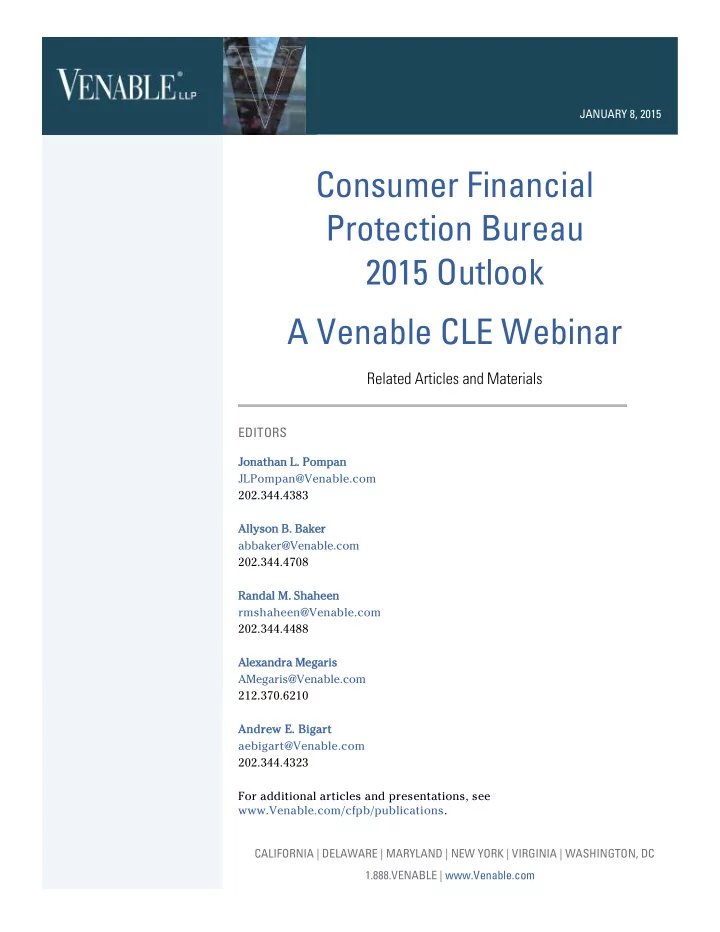
11 See Consumer Fin. Protection Bur., Consumer Financial Protection Bureau: Enforcing Consumer

Protection Laws (July 21, 2014), http://files.consumerfinance.gov/f/201407_cfpb_factsheet_supervision-and-enforcement.pdf.

slide-33
SLIDE 33

Jonathan L. Pompan Consumer Finance Consumer Financial Protection Bureau Task Force Credit Counseling and Debt Services AUTHORS RELATED PRACTICES RELATED INDUSTRIES ARCHIVES 2015 2014 2013 2012 2011 2010 2009 2008 2007 2006 2005 July 21, 2014 Three years after it opened for business, on July 21, 2014, the Consumer Financial Protection Bureau (CFPB) announced it was accepting complaints from consumers with problems with (1) prepaid cards; (2) debt settlement services; (3) credit repair services; and (4) pawn and title loans. This signals that the CFPB will now be subjecting companies in these markets to heightened scrutiny. Background The CFPB started taking complaints about credit cards when it

  • pened its doors in July 2011. It also solicits complaints about

mortgages, bank accounts and services, private student loans, auto and other consumer loans, credit reporting, debt collection, payday loans, and money transfers. To date, the CFPB has received 400,000 complaints from consumers. Complaint Process The CFPB expects companies to respond to complaints within 15 days and describe the steps they have taken or plan to take. The CFPB expects companies to close all but the most complicated complaints within 60 days. Consumers are given a tracking number after submitting a complaint and can check the status of their complaint by logging on to the CFPB website. Prepaid Cards Prepaid cards, which include gift cards, benefit cards, and general purpose reloadable cards (GPRCs), generally allow a consumer to access money that has been paid and loaded onto the card upfront. The CFPB and consumer groups believe that some prepaid cards have fewer consumer protections than debit or credit cards. As a result, the CFPB indicates it will issue a proposed rule aimed at increasing federal consumer protections for general purpose reloadable prepaid cards. Complaint categories include:

Problems managing, opening, or closing an account

Overdraft issues and incorrect or unexpected fees

Frauds, scams, or unauthorized transactions

Advertising, disclosures, and marketing practices

Adding money and savings or rewards features Debt Settlement and Credit Repair Services While debt settlement services fall under the jurisdiction of the CFPB, credit repair services don’t clearly do so. Nonetheless, they are now included in the portal. Complaint categories include:

Excessive or unexpected fees

Advertising, disclosures, and marketing practices ARTICLES

CFPB TO SCRUTINIZE NONBANK PRODUCTS: PREPAID CARDS, DEBT SETTLEMENT, CREDIT REPAIR, AND PAWN AND TITLE LOANS

slide-34
SLIDE 34

Customer service issues

Frauds or scams Pawn and Title Loans According to the CFPB, pawn stores and title loan companies often provide small loans to consumers using personal property or a vehicle title as collateral that are frequently short-term and may have high interest rates. Complaint categories include:

Unexpected charges or interest fees

Loan application issues

Problems with the lender correctly charging and crediting payments

Issues with the lender repossessing, selling, or damaging the consumer’s property or vehicle

Unable to contact lender * * * * * * The consumer complaint portal is an integral part of the CFPB’s data gathering process and used to inform decisions about regulatory, supervision and examination, and enforcement priorities. * * * * * * For more information, please contact Jonathan L. Pompan at 202.344.4383 or jlpompan@Venable.com. Jonathan L. Pompan, a partner in the Washington, DC office of Venable LLP, co-chairs the firm’s Consumer Financial Protection Bureau Task Force. His practice focuses on providing comprehensive legal advice and regulatory advocacy to a broad spectrum of clients, such as nonbank financial products and services providers, advertisers and marketers, and trade and professional associations, before the CFPB, the Federal Trade Commission, state Attorneys General, and regulatory agencies.

slide-35
SLIDE 35

John F. Cooney Legislative and Government Affairs Consumer Financial Protection Bureau Task Force AUTHORS RELATED PRACTICES RELATED INDUSTRIES ARCHIVES 2015 2014 2013 2012 2011 2010 2009 2008 2007 2006 2005 July 11, 2014 In January 2012, President Obama made recess appointments of the first Director of the Consumer Financial Protection Bureau and two members of the National Labor Relations Board during a three day period when the Senate was in pro forma session. The Senate later confirmed Director Cordray to his ARTICLES

THE SUPREME COURT LIMITS THE PRESIDENT'S RECESS APPOINTMENT POWER

position, resolving questions about the legality of his actions going forward. But in late June, in National Labor Relations Board v. Noel Canning, the Supreme Court unanimously declared the recess appointments to the NLRB to be unconstitutional. This potentially raises questions about the legality of actions taken by the CFPB while the Director was serving under his recess appointment. President Obama made these recess appointments despite substantial doubts among Executive Branch lawyers, dating back to the Carter Administration, about whether the Recess Appointment Clause of the Constitution would apply during such a three-day Senate recess. The Supreme Court has definitively answered that question. Its decision that reduces the powers of all future Presidents to make recess appointments to fill vacancies that have occurred in senior leadership positions in the Executive Branch. In reality, the Office of the President dodged a bullet. It avoided much more severe limitations on the President’s powers that were brought into play by these risky appointments. The Justices divided sharply about the scope of the Recess Appointment Clause. Four conservative Justices who concurred in the ultimate decision would have limited this power so drastically that it would have lost any significance as a tool for effectively managing the Executive Branch. The five Justices, including Justice Kennedy, who signed Justice Breyer’s majority opinion, rejected more sweeping limitations on recess appointments and largely adopted the Executive Branch’s position

  • n the scope of the Recess Appointment power that had been developed gradually by Attorneys

General starting in Andrew Jackson’s Administration. The majority held that the President can make recess appointments during any recess of the Senate, whether between its Sessions or in the course of a Session, as long as the Senate is not prepared to do business for a significant period of time. The actual holding in Noel Canning is extremely narrow – that a three day recess is not sufficiently long for the President to make recess appointments. At the same time, the majority held that the Senate has the power under its own Rules to prevent the President from making recess appointments by keeping itself in “session,” defined as meaning that the Senate has the capacity to act on public business. Noel Canning thereby recognizes and preserves the powers of both Branches of government concerning appointment of senior Executive Branch officials. It forces all future Presidents to negotiate with future Senates concerning his ability to make recess appointments during a Congressional adjournment. The Senate will be able to prevent or permit such appointments depending upon whether it chooses to stay in pro forma session. In the view of the five majority Justices, this outcome preserves the balance of powers between the Legislative and Executive Branches. By contrast, Justice Scalia’s minority opinion would have sharply curtailed the President’s power to make recess appointments by restricting this authority only to vacancies that occur and are filled in the short period between when one session of Congress ends in December and the next session begins in early January. In sum, Noel Canning is a loss for the Presidency. President Obama will pass along diminished powers to all his successors. But given the extraordinary risks the Administration ran and the 5 to 4 division with the Supreme Court, the outcome could have been much worse from the Executive Branch’s

  • perspective. The Presidency dodged a bullet.
slide-36
SLIDE 36

Jonathan L. Pompan Andrew E. Bigart Alexandra Megaris Kristen R. Brown Banking and Financial Services Regulation Consumer Finance Consumer Financial Protection Bureau Task Force Credit Counseling and Debt Services Financial Services AUTHORS RELATED PRACTICES RELATED INDUSTRIES ARCHIVES 2015 2014 2013 2012 2011 2010 2009 2008 2007 2006 2005 July 2014 On November 12, 2013, the Consumer Financial Protection Bureau (“CFPB” or the “Bureau”) issued an Advance Notice of Proposed Rulemaking (“ANPR”) seeking comment, data, and information from the public about debt collection practices, and in January 2014, the CFPB extended the comment period to February 28, 2014. The CFPB has indicated that it will move to the next stage in rulemaking in December 2014. While the ANPR is far from a final rule, the ANPR included a number of policy statements and questions that provide insight into the direction the CFPB may be headed when it releases a proposed rule. Why is the CFPB engaged in a rulemaking? For the last several years, the Federal Trade Commission (“FTC”) and now the CFPB have reportedly received more consumer complaints about debt collectors than about any other single industry. What Federal rules presently apply to debt collection? The Fair Debt Collection Practices Act (“FDCPA”) prohibits debt collectors from engaging in unfair, deceptive, abusive, and other unlawful collection practices, but no federal agency was vested with authority to issue general implementing regulations prior to the creation of the CFPB. In addition, generally consumer financial services providers are subject to restrictions on unfair, deceptive, or abusive acts and practices (“UDAAPs”) under the Consumer Financial Protection Act (“CFPA”), and, for the most part, restrictions on unfair and deceptive trade practices under the Federal Trade Commission Act. From 1977 to 2010, the primary enforcement authority on the federal level for the FDCPA was the FTC. Under the Dodd-Frank Act, the CFPB has primary government responsibility for administering the

  • FDCPA. The Bureau has the authority to prescribe rules with respect to debt collection; issue guidance

concerning compliance with the law; collect complaint data; educate consumers and collectors; and undertake research and policy initiatives related to consumer debt collection. The Bureau now shares federal enforcement responsibility for the FDCPA with the FTC and other federal agencies. In January 2012, the CFPB and the FTC entered into a Memorandum of Understanding (“MOU”) to coordinate efforts to protect consumers and avoid duplication of federal law enforcement and regulatory efforts. The MOU allows the FTC and CFPB to share enforcement information and coordinate activities. What are the highlights of the rulemaking? The CFPB is considering whether rules governing the collection of debts are warranted under the FDCPA or other CFPB authorities, including the CFPA, and, if so, what types of rules would be

  • appropriate. Among the highlights:

Scope of Rulemaking - Significantly, the CFPB indicated that future rules could encompass parties that collect their own debts—entities that are, under most circumstances, not subject to the

  • FDCPA. The FDCPA generally applies to third-party debt collectors, such as collection agencies,

debt purchasers, and attorneys who are regularly engaged in debt collection. In addition, in Bulletin 2013-07 (July 10, 2013) the CFPB stated that by its authority under Dodd- Frank, all “covered persons,” including originating creditors, must refrain from committing UDAAPs when engaging in debt collection. The Bulletin offered examples of conduct that could constitute UDAAPs, including various acts or practices specifically identified in the FDCPA as prohibited, as well as various acts or practices that would likely be covered by the general FDCPA prohibitions on harassment or abuse, false or misleading representations, and unfair practices. Also, the CFPB notes in the ANPR that some debt collection that is subject to the FDCPA may not be subject to the CFPA’s restriction on UDAAPs, and hence, it sought information about different types of debts in collection to help it determine which debts involve a consumer financial product or service. ARTICLES

CFPB DEBT COLLECTION (REGULATION F) RULEMAKING FAQS

slide-37
SLIDE 37

Disclosures - The CFPB indicated that the rulemaking might include disclosures or address acts or practices in connection with debt collection activities. Of note, the CFPB expressed concerns about time-barred debt and the risk it poses to consumers who may not understand their legal rights and

  • bligations. However, at the time of the ANPR there was a circuit split on whether settlement letters

in which debt collectors made no affirmative disclosure about the time-barred nature of the debt violated the FDCPA.

Litigation Practices - The CFPB indicated that there is a state role in debt collection

  • litigation. However, based on the questions asked it appears that the CFPB may seek to influence

state court procedures through imposing requirements on collectors by creating higher burdens of substantiation using UDAAP concepts. What areas of the collections process is the CFPB considering for a rule? The ANPR requested responses to 450 questions and sub questions. Among the topics the ANPR addressed were: Scope; Information Accuracy; Validation Notices, Disputes, and Verifications; Debt Collection Communications; Unfair, Deceptive, and Abusive Acts and Practices; Collection of Timed- Barred Debts; Debt Collection Litigation Practices; State and Local Debt Collection Systems; Recordkeeping Monitoring; and Compliance Requirements. What questions did the CFPB ask about information accuracy? The CFPB has stated several times that it is concerned about the transfer of information from an original creditor to third-party debt collection firms and debt buyers, and from those parties to other debt collectors and credit bureaus. The CFPB asked how documents and records are currently transferred and how to improve the accuracy of that information. The Bureau asked questions about how to ensure that debt collectors identify the correct person, claim the correct amount, and have adequate paperwork

  • r data to support their claims about the amount owed.

What questions did the CFPB ask about information provided to the consumer? Among the questions the ANPR raised is whether federal rules can better ensure that consumers receive clear information about debts and adequate information about legal rights. The CFPB is presently testing disclosures for debt collection. What questions did the CFPB ask about communication tactics used by collectors? Among the questions the ANPR raised is how federal rules can regulate contact frequency, contact methods, and contact claims. Have the FTC and the CFPB previously taken steps to study the debt collection market? The FTC and CFPB have undertaken several studies of the debt collection industry.

Collecting Consumer Debts: The Challenges of Change (2009) – This FTC report recognized that the modernization of the FDCPA was needed in order to address new technologies, and noted inconsistencies in the implementation and interpretation of the law.

Repairing a Broken System: Protecting Consumers in Debt Collection Litigation and Arbitration (2010) – This FTC report made recommendations for enhanced state court and arbitration rules.

The Structure and Practices of the Debt Buying Industry(2013) – This FTC report took an extensive look at the debt buying industry, focusing primarily on the manner and flow of information from creditors and other owners of debts to debt buyers. Of note, the FTC acknowledged in the report that its study did not permit any conclusions as to the prevalence of errors or inaccuracies in the information about the debts transferred.

Life of A Debt: Date Integrity in Debt Collection(2013) – The FTC and CFPB held a joint roundtable that focused on four key areas: (1) information available to debt collectors at the time of assignment or sale, (2) verifying disputed debts both from the perspective of the FDCPA and FCRA, (3) debt collection litigation, and (4) time-barred debt. * * * * * * For more information, please contact Jonathan L. Pompan at 202.344.4383 or jlpompan@Venable.com. Jonathan L. Pompan, a partner in the Washington, DC office of Venable LLP, co-chairs the firm’s Consumer Financial Protection Bureau (“CFPB”) Task Force. His practice focuses on providing comprehensive legal advice and regulatory advocacy to a broad spectrum of clients, such as nonbank financial products and services providers, including debt buyers and collectors, advertisers and

slide-38
SLIDE 38

marketers, and trade and professional associations, before the CFPB, the Federal Trade Commission, state Attorneys General, and regulatory agencies. Andrew E. Bigart, Alexandra Megaris, and Kristen R. Brown are associates in Venable’s regulatory practice who routinely advise on consumer financial services matters and represent clients in investigations and enforcement actions brought by the Consumer Financial Protection Bureau, Federal Trade Commission, state Attorneys General, and regulatory agencies. For more information about this and related industry topics, see www.venable.com/cfpb/publications. This article is not intended to provide legal advice or opinion and should not be relied on as such. Legal advice can only be provided in response to a specific fact situation.

slide-39
SLIDE 39

Jonathan L. Pompan John B. Beaty Frederick M. Joyce

  • D. E. Wilson, Jr.

Banking and Financial Services Regulation Consumer Finance Consumer Financial Protection Bureau Task Force Credit Counseling and Debt Services Financial Services AUTHORS RELATED PRACTICES RELATED INDUSTRIES ARCHIVES 2015 2014 2013 2012 2011 2010 2009 2008 2007 2006 2005 July 2014 On June 12, 2014, the Consumer Financial Protection Bureau (CFPB) published in the Federal Register a notice and request for information (RFI) about how consumers are using mobile financial services to access products and services, manage finances, and achieve their financial goals (with a focus on economically vulnerable consumers). The CFPB uses the term “mobile financial services” to cover mobile banking services and mobile financial management services. As a result, the RFI does not address mobile point of sale (POS) payments, except with respect to mobile payment products that are targeted specifically for low-income and underserved consumers. The Bureau is seeking to learn how such targeting could benefit or harm those categories of consumers. Information is requested in the following categories:

Mobile financial services (mobile banking and mobile financial management services) to enhance access and opportunities for consumers;

Specific types of mobile financial products and services, including personal financial management applications and features;

Opportunities for population subgroups;

Challenges and barriers to expanding use and reach of mobile financial services, particularly for economically vulnerable populations;

Consumers' understanding of risks involved in using mobile financial services and steps to protect them; and

International experience in using mobile technology to enhance access and increase financial capability of economically vulnerable consumers. The information from the responses will be used to inform the CFPB’s consumer education and empowerment strategies related to developments in these areas. The comment deadline is on or before September 10, 2014. * * * * * For more information, please contact Jonathan L. Pompan at 202.344.4383 or jlpompan@Venable.com; John B. Beaty at 202.344.4859 or jbbeaty@Venable.com; Frederick

  • M. Joyce at 202.344.4653 or rjoyce@Venable.com; or D.E. Wilson, Jr. at 202.344.4819 or

dewilsonjr@Venable.com. For more information about this and related industry topics, see www.venable.com/cfpb/publications. ARTICLES

CFPB SEEKS COMMENT ON THE USE OF MOBILE FINANCIAL SERVICES

This article is not intended to provide legal advice or opinion and should not be relied on as such. Legal advice can only be provided in response to a specific fact situation.

slide-40
SLIDE 40

Jonathan L. Pompan Banking and Financial Services Regulation Consumer Finance Consumer Financial Protection Bureau Task Force Credit Counseling and Debt Services Financial Services AUTHORS RELATED PRACTICES RELATED INDUSTRIES ARCHIVES 2015 2014 2013 2012 2011 2010 2009 2008 2007 2006 2005 June 2014 On May 23, 2014, the Consumer Financial Protection Bureau (CFPB) released its semi-annual update to its rulemaking agenda. The spring 2014 agenda covers rulemaking mandated by the Dodd-Frank Wall Street Reform and Consumer Protection Act (“Dodd-Frank Act”) that the CFPB is continuing to develop and implement. The agenda also reveals that the Bureau has turned its attention to issues in

  • ther major markets for consumer financial products and services. The regulatory agenda provides

banks and nonbanks, and their service providers, a useful guide for understanding the CFPB’s rulemaking direction and related priorities. Mortgage Rulemakings Continue The agenda reflects continuing work on several significant rulemakings mandated by the Dodd-Frank Act, including implementation of rules and other significant reforms concerning mortgage originations, servicing, and most recently, the federal disclosures that consumers receive shortly after application and shortly before closing. In addition, the CFPB has convened a small business review (SBREFA) panel to discuss potential amendments to the Home Mortgage Disclosure Act. Larger Participant Supervisory Implementation – Auto Lending and International Money Transfer Markets The CFPB continues to consider regulations that further establish the scope of the CFPB's nonbank supervision program by defining who is a larger participant in certain markets for consumer financial products or services. The CFPB is in the process of developing a proposal to identify “larger participants” in the market for auto lending (August 2014) and is finalizing a rule defining larger participants in the international money transfer market (September 2014). The CFPB already has supervisory authority over other nonbanks such as mortgage originators and servicers, payday lenders, larger debt collectors, larger consumer reporting agencies, private student loan originators, and student loan servicers. Nonbanks that are not classified as “larger participants” may still be subject to the Bureau’s supervisory authority if the Bureau has reasonable cause to determine a company poses risk to consumers. Debt Collection Rulemaking In November 2013, the CFPB issued an Advance Notice of Proposed Rulemaking seeking comment, data, and information from the public about debt collection. Significantly, the CFPB indicated that the rules could encompass parties that collect their own debts—entities that are, under most circumstances, not subject to the Fair Debt Collections Practices Act (FDCPA). The comment period closed in February 2014. The CFPB indicates that it expects to advance to the next stage in December 2014. Small Dollar Loans, Overdraft Fees, and Prepaid Cards The CFPB’s agenda indicates it is researching and considering whether rulemaking is warranted in the areas of payday and deposit advance products, as well as consumer overdraft products. The CFPB held a field hearing in March 2014 in Nashville, Tennessee, and also released a report that analyzed payday

  • lending. The CFPB says it is expecting to build on an Advance Notice of Proposed Rulemaking that

it published in 2012 concerning prepaid cards by issuing a proposed rule to strengthen federal consumer protections for these products. In addition, the CFPB has been testing potential disclosures that it may propose to be used on the packaging of prepaid cards. Initiatives to Streamline and Modernize Annual Privacy Notices The CFPB issued a proposal regarding annual privacy notices in May 2014. Specifically, the CFPB proposed to amend Regulation P, which (in part) requires that financial institutions provide an annual ARTICLES

CFPB ISSUES SPRING REGULATORY AGENDA

slide-41
SLIDE 41

disclosure of their privacy policies to their customers. The amendment would create an alternative delivery method for this annual disclosure, which financial institutions would be able to use under certain circumstances (including not engaging in certain types of information-sharing activities and posting the annual notices on their websites). The comment period closed on June 12, 2014, and the CFPB is presently considering potential next steps. Civil Penalty Fund and Consumer Education and Financial Literacy Programs The Dodd-Frank Act establishes a "Consumer Financial Civil Penalty Fund" (Civil Penalty Fund) into which the CFPB must deposit any civil penalty it obtains against any person in any judicial or administrative action under federal consumer financial laws. Under the Dodd-Frank Act, funds in the Civil Penalty Fund may be used for payments to the victims of activities for which civil penalties have been imposed under federal consumer financial laws. In addition, to the extent that such victims cannot be located or such payments are otherwise not practicable, the CFPB may use funds in the Civil Penalty Fund for the purpose of consumer education and financial literacy programs. This rule will implement the statutory provisions by (a.) outlining what kinds of payments to victims are appropriate and (b.) establishing procedures for allocating funds to victims, to consumer education, and to financial literacy

  • programs. The agenda indicates a final rule is expected in November 2014.

* * * * * * For more information, please contact Jonathan L. Pompan at 202.344.4383 or jlpompan@Venable.com. Jonathan L. Pompan, a partner in the Washington, DC office of Venable LLP, co-chairs the firm's Consumer Financial Protection Bureau Task Force. His practice focuses on providing comprehensive legal advice and regulatory advocacy to a broad spectrum of clients, such as nonbank financial products and services providers, advertisers and marketers, and trade and professional associations, before the CFPB, the Federal Trade Commission, state Attorneys General, and regulatory agencies.

slide-42
SLIDE 42

Jonathan L. Pompan Advertising and Marketing Consumer Financial Protection Bureau Task Force Financial Services AUTHORS RELATED PRACTICES RELATED INDUSTRIES ARCHIVES 2015 2014 2013 2012 2011 2010 2009 2008 2007 2006 2005 May 14, 2014 The Federal Trade Commission (FTC) recently announced a settlement of a lead generation enforcement action. The settlement reflects that the FTC remains focused on lead generation and, more specifically, mortgage advertising, even though it shares enforcement authority for nonbank mortgage advertising with the Consumer Financial Protection Bureau (CFPB). In addition, the settlement is an important reminder that lead generators and buyers need to review advertising and marketing for compliance with applicable laws and regulations. The FTC's complaint alleged that the online lead generator operated websites that advertised low interest-rate loans as fixed-rate mortgages, when, in fact, they were adjustable-rate mortgages that could become more expensive for borrowers over time. The advertising also allegedly failed to include required disclosures, such as the annual percentage rate, amount of down payment, and repayment terms that figure into the advertised payment amounts and interest rate. The complaint charged the lead generator with allegedly violating the FTC Act, the Mortgage Acts and Practices Advertising (MAP) Rule (also known as Regulation N), and the Truth in Lending Act and

  • Regulation. The settlement imposes a $225,000 civil penalty and forbids the lead generator from a)

violating the law; b) misrepresenting the terms and conditions of any financial product or service, and term or condition of a mortgage credit product; and c) assisting others to misrepresent any material fact about a mortgage credit product. In addition, the settlement prohibits the disclosing, selling, or transferring of consumer data. The lead generator did not admit or deny any wrongdoing under the terms

  • f the settlement.

In November 2012, the CFPB and FTC jointly announced they began formal investigations of six companies that may have violated federal law. At the time the CFPB said, "the actions stem from a joint 'sweep' – a review conducted by the CFPB and the FTC of about 800 randomly selected mortgage- related ads across the country – including ads for mortgage loans, refinancing, and reverse mortgages." The CFPB and FTC also issued warning letters to mortgage lenders and mortgage brokers advising them to "clean up potentially misleading advertisements, particularly those targeted toward veterans and

  • lder Americans."

Third-party marketers, including online lead generators, and mortgage lenders and brokers need to be prepared to respond to increased scrutiny. * * * * * Below is a list of several relevant articles and presentations from our attorneys, which may be of assistance to your organization in this environment of enhanced scrutiny.

ARTICLES LESSONS FROM THE FTC'S LATEST LEAD GENERATION ENFORCEMENT ACTION To view any of these articles, alerts, or presentations, please click on the title. Preparing for a CFPB Examination or Investigation (Article) CFPB Compliance Myths That Deserve Debunking (Article) Are You Ready for the New Mortgage Landscape? (Article) Advertising and Marketing Law Fundamentals for Consumer Financial Products and Services (Presentation) The FTC's Revised .com Disclosures Guide: What Third Party Advertisers and Lead Generators Need to Know (Presentation)

slide-43
SLIDE 43

What to Look for in 2014 – CFPB Regulatory Outlook (Recording and Presentation) Consumer Financial Protection Bureau Investigations and FTC Coordination Tips and Techniques (Presentation) Telemarketing, E-mail, and Text Message Marketing: Tips to Avoid Lawsuits (Presentation) Understanding New Restrictions on Advertising GI Bill Benefits (Article) CFPB and FTC Target Mortgage Advertising (Article) New FTC Mortgage Assistance Rule Targets Lead Generators and Affiliate Marketers (Article) * * * * * For more information, please contact Jonathan L. Pompan at 202.344.4383 or jlpompan@Venable.com. Jonathan L. Pompan, a partner in the Washington, DC office of Venable LLP, co-chairs the firm's Consumer Financial Protection Bureau Task Force. His practice focuses on providing comprehensive legal advice and regulatory advocacy to a broad spectrum of clients, such as nonbank financial products and services providers, advertisers and marketers, and trade and professional associations, before the CFPB, the Federal Trade Commission, state Attorneys General, and regulatory agencies.

slide-44
SLIDE 44

Jonathan L. Pompan Advertising and Marketing Consumer Finance Consumer Financial Protection Bureau Task Force Credit Counseling and Debt Services AUTHORS RELATED PRACTICES RELATED INDUSTRIES ARCHIVES 2015 2014 2013 2012 2011 2010 2009 2008 2007 2006 2005 March 19, 2014 Recently the Ninth Circuit Court of Appeals issued its opinion in the appeal of Stout v. FreeScore, LLC concerning the scope of the Credit Repair Organizations Act (“CROA”). The result is not good for advertisers of credit counseling, debt relief services, credit monitoring, and similar products and services, principally because it further confuses application of CROA across the nation. The Ninth Circuit’s decision is a departure from the text of CROA and falls in line with a broad view that has been asserted by the Federal Trade Commission and class action attorneys. Accordingly, companies advertising credit-related products and services will need to consider CROA compliance as part of their

  • verall compliance program.

In this case, the defendant offered credit scores, reports, and consumer credit information via an online website and television advertising. The plaintiffs in a putative class action alleged that the defendants were subject to the strict requirements of CROA. The district court dismissed the action for failure to state a claim. On appeal, the panel reversed the judgment of the district court and remanded the case for further proceedings. The appeals court held that the defendant was a “credit repair organization” because the defendant, through the representations it made on its website and in its television advertising, offered a service, in return for the payment of money, for the implied purpose of providing advice or assistance to consumers with regard to improving the consumer’s credit record, credit history,

  • r credit rating.

The defendant argued that it did not make any promises of credit improvement. The district court agreed and held that the plaintiff failed to demonstrate that any of defendant’s representations were made for the express or implied purpose of improving a consumer’s credit record, credit history, or credit rating as required by CROA. Rather, the defendant merely promises to provide a consumer with his or her credit score; it is up to the consumer to improve it. However, according to the appeals court: From the plain language of the statute, it is clear that under the CROA, a person need not actually provide credit repair services to fall within the statutory definition of a credit repair

  • rganization. Instead, the person need only represent that it can or will sell, provide, or perform a

service for the purpose of providing advice or assistance to a consumer with regard to improving a consumer’s credit record, credit history, or credit rating. The Ninth Circuit found that “FreeScore’s advertisements clearly go beyond merely providing information about one’s credit. FreeScore even goes so far to recommend a course of action to consumers, as its advertisements tell consumers to use FreeScore.com to ‘[s]pot damaging inaccuracies,’ and use ‘[i] nstant email alerts’ which notify them when ‘critical changes appear on [their] Credit Report so [they] can make corrections fast!’” The court concluded “‘[t]he overall net impression communicated by FreeScore.com is that in order to ‘repair a damaged credit score,’ the ‘best solution’ is to ‘utilize[e] services like credit monitoring,’ which ‘can have an immediate effect on your credit score.’” The appeals court noted similar decisions including Zimmerman v. Puccio, 613 F.3d 60 (1st Cir. 2010), where the First Circuit concluded that services or “credit counseling aimed at improving future creditworthy behavior is the quintessential credit repair service;” and Helms v. Consumerinfo.com, Inc., 436 F. Supp. 2d 1220, 1224–26 (N.D. Ala. 2005), where the court concluded that a company only

  • ffering educational information, such as credit reports, credit scores, and credit monitoring, was a

credit repair organization. For more on Zimmerman click here. But, in reaching its decision, the Ninth Circuit also noted contrasting court decisions that found that the definition of “credit repair organization” does not encompass entities that provide credit information so ARTICLES

APPEALS COURT LIBERALLY INTERPRETS CREDIT REPAIR STATUTE

slide-45
SLIDE 45

consumers can improve their own credit. See Hillis v. Equifax Consumer Servs., Inc., 237 F.R.D. 491 (N.D. Ga. 2006); Plattner v. Edge Solutions, Inc., 422 F. Supp. 2d 969 (N.D. Ill. 2006). * * * * * * For more information, please contact Jonathan L. Pompan at 202.344.4383 or jlpompan@Venable.com.

slide-46
SLIDE 46
slide-47
SLIDE 47
slide-48
SLIDE 48
slide-49
SLIDE 49

Legal Research

slide-50
SLIDE 50
slide-51
SLIDE 51
slide-52
SLIDE 52

Jonathan L. Pompan Consumer Financial Protection Bureau Task Force Credit Counseling and Debt Services AUTHORS RELATED INDUSTRIES ARCHIVES 2015 2014 2013 2012 2011 2010 2009 2008 2007 2006 2005 March 19, 2014 New regulations that will impose severe requirements on for-profit colleges and career training programs may open the door to an increased need for independent third-party student loan debt counseling. On March 14, 2014, the Obama administration released its “gainful employment” rule that would establish student-loan default thresholds that, if exceeded, could lead to schools losing access to student financial assistance programs authorized under Title IV of the Higher Education Act of 1965, as amended (HEA). The 841-page rule uses student-loan default rates to determine whether a program’s students are burdened with unpaid debt. Programs with a cohort default rate higher than 30% for three consecutive years may lose access to federal financial aid. Training programs could lose funding if the annual education-debt payments of typical graduates exceed 20% of their discretionary earnings or 8% of their total income. Schools that fail to comply for two out of three years would lose eligibility for funding. At the same time, the Department of Education predicts one million students will lose access to post- secondary education. The gainful employment rule would also require programs to meet applicable accreditation requirements, state or federal licensure standards, and publicly disclose information about the cost, debt, and student outcomes of those programs. Even before the recent announcement of the gainful employment rule, there are incentives for schools to focus on ways to keep student loan defaults low. Integrating third-party student loan debt counseling into a lending program may help increase retention, and making counseling available to graduates may help with repayment. The CFPB Student Loan Ombudsman concluded that “students borrowing substantial amounts of private student loans would be well-served by individual counseling, potentially with third parties, on how to enroll in alternative payment programs to comfortably service their debt.” (CFPB Annual Report of the Student Loan Ombudsman, Oct. 16, 2012). ARTICLES

GAINFUL EMPLOYMENT RULE AND STUDENT LOAN DEBT COUNSELING: A PERFECT MATCH?

An earlier set of requirements was challenged in court and blocked in 2012. See Association of Private Sector Colleges and Universities v. Duncan, 870 F. Supp. 2d 133 (D.D.C. 2012). Thus, this round of requirements – still viewed as controversial – represents a second attempt by the Department of Education. The regulations are open for comment for 60 days after they are published in the Federal Register. Based on the timetable the Department of Education is working within and public statements, it appears a final rule should be available this summer and that the requirements would take effect in July 2015. * * * * * * For more information, please contact Jonathan L. Pompan at 202.344.4383 or jlpompan@Venable.com.

slide-53
SLIDE 53

Jonathan L. Pompan Advertising and Marketing Consumer Financial Protection Bureau Task Force Credit Counseling and Debt Services AUTHORS RELATED PRACTICES RELATED INDUSTRIES ARCHIVES 2015 2014 2013 2012 2011 2010 2009 2008 2007 2006 2005 March 11, 2014 The Federal Trade Commission (“FTC”) recently announced that it intends to begin review of, and solicit comments on the Telemarketing Sales Rule (“TSR”). The opportunity to provide comments will be a significant opportunity for marketers to weigh-in on one of the FTC’s main regulatory and enforcement tools. Despite its focus on telemarketing practices, the TSR’s breadth and impact goes far beyond merely the telephone and the well-known Do Not Call Registry. The TSR is one of the few methods the FTC can efficiently (although sometimes controversially) adopt rules prohibiting deceptive or abusive practices. And, it’s the TSR’s broad scope of coverage that has made it a popular enforcement vehicle for the FTC, Consumer Financial Protection Bureau (“CFPB”), and state Attorneys General. Since the TSR was promulgated it has undergone several significant expansions, and at the same time the marketplace for telemarketing has changed in significant ways that impact consumers and

  • marketers. The TSR gives effect to the Telemarketing and Consumer Fraud and Abuse Prevention Act

(the “Telemarketing Act”) that was signed into law in 1994. The Telemarketing Act directed the FTC to adopt a rule prohibiting deceptive or abusive practices in telemarketing and specified, among other things, certain acts or practices that should be addressed, and additional practices if found deceptive or

  • abusive. Pursuant to its authority under the Telemarketing Act, the FTC promulgated the TSR in

August 1995, and has subsequently amended the TSR on three occasions, in 2003, 2008, and in 2010. Key provisions of the TSR include:

Prohibits calling consumers who have put their phone on the National Do Not Call Registry

Coverage of solicitation of charitable contributions by for-profit telemarketers

Disclosures of specific information

Prohibits misrepresentations

Limits when telemarketers may call consumers

Requires transmission of Caller ID information

Prohibits unauthorized billing

Addresses the use of pre-recorded messages in telemarketing

Sets payment restrictions and other requirements for credit repair services, recovery services, advance-fee loans, and debt relief services

Requires specific business records to be kept for two years In 2013, the FTC also issued a Notice of Proposed Rulemaking concerning, primarily, proposed prohibitions on telemarketers and sellers in both inbound and outbound telemarketing calls from accepting or requesting remotely created checks, remotely created payment orders, money transfers, and cash reload mechanisms. The FTC’s position is that these four payment methods are favored in fraudulent telemarketing transactions. The FTC also proposed expanding the scope of the advance fee ban on recovery services. The TSR gives the FTC, CFPB, and state Attorneys General broad enforcement power over telemarketers and those that provide “substantial assistance” to a seller or telemarketer when that person knows or consciously avoids knowing that the seller or telemarketer is engaged in any act or practice that violates the rule. As a result, the TSR has become a favored enforcement tool of the FTC against those that allegedly facilitate the conduct of others. Under the Telemarketing Act, the FTC was given an exception from its Magnuson-Moss Act rulemaking constraints that place practical limits on the FTC's ability to regulate specific marketing practices. Of note, however, the FTC has come under criticism for using the TSR as a means to extend its reach

  • utside its jurisdiction and authority by using the rule to regulate particular products and services, and

ARTICLES ON DECK, TELEMARKETING SALES RULE REGULATORY REVIEW

slide-54
SLIDE 54

with respect to the ongoing effort to regulate payment methods. The FTC has justified regulatory expansion of the TSR, in part, using its “unfairness” doctrine, derived from Section 5 of the FTC Act. Violations of the TSR are subject to civil penalties of up to $16,000 per violation. In addition, the TSR allows for nationwide injunctions that prohibit certain conduct, and redress to injured consumers. The Federal Register notice could be released by the FTC before the start of summer 2014; however, the FTC previously announced that the TSR would be reviewed in 2013.

slide-55
SLIDE 55

Jonathan L. Pompan Alexandra Megaris Advertising and Marketing Consumer Finance Consumer Financial Protection Bureau Task Force Financial Services AUTHORS RELATED PRACTICES RELATED INDUSTRIES ARCHIVES 2015 2014 2013 2012 2011 2010 2009 2008 2007 2006 2005 February 28, 2014 We have written recently about the stepped-up scrutiny that the Consumer Financial Protection Bureau (the CFPB) and the Federal Trade Commission (FTC) are placing on for-profit education and related marketing. The opening round of federal enforcement actions started on Wednesday, when the CFPB filed a lawsuit against ITT Educational Services, Inc. with accusations that ITT "used high- pressure tactics to push many students into expensive private student loans that were likely to end in default." The CFPB is seeking restitution for consumers, a civil fine, and an injunction against the

  • company. For-profit schools and marketers of all types can learn important lessons from this

enforcement action. Background The CFPB brings its lawsuit against ITT under the Dodd-Frank Wall Street Reform and Consumer Protection Act, which grants it authority to take action against institutions engaging in unfair, deceptive,

  • r abusive practices. The CFPB's lawsuit alleges that (1) ITT "misled students by overstating their job

prospects and likely salaries upon graduation;" (2) it then pushed students into high-cost private loans that were likely to end in default; and (3) ITT credits typically didn't transfer to nonprofit schools or community colleges, so it used the prospect of expulsion and the loss of the money already spent during the student's first year to coerce students into taking out the private loans. While this is the CFPB's first public enforcement action against a company in the for-profit education sector, there are likely to be more actions taken against private sector schools, and others involved in student recruitment and lending. According to the prepared remarks of CFPB Director Richard Cordray, "Moving forward, the Consumer [Financial Protection] Bureau will subject the financial products and services offered by for-profit colleges and their partners to the same standards as any other consumer financial product or service." Key Takeaways for Advertisers and Marketers

Don't rush enrollment/purchase decisions. The CFPB alleges here that ITT used its financial aid staff to rush students through an automated application process without affording them a fair

  • pportunity to understand the loan obligations involved. In some cases, students did not even know

they had a private student loan until they started getting collection calls.

SEC filings and investor calls are not beyond scrutiny. According to the CFPB, the school was providing limited information about the loan programs at issue to its students, but at the same time providing more information to its investors. According to the CFPB's press release, "ITT's CEO revealed in investor calls that converting the temporary loans to long-term loans was the company's 'plan all along.'"

Set reasonable expectations. When you have aggregate data and specific information about the consumer to whom you are marketing, take it all into account in order to help avoid allegations about a product or service being inappropriate for a specific consumer. According to the CFPB, "ITT exploited student expectations while it knew that a majority of students would default." The CFPB bases its allegations on the company's own default rate calculations. Finally, for those advertising and marketing educational services and student loans, check out the Federal Trade Commission's (FTC) Vocational School Guides, which are newly revised and provide a roadmap of best practices (even if written primarily for the vocational school audience). The Guides warn against deceptive marketing practices by businesses that offer vocational training, provide specific guidance on representations used in recruitment, and address claims about how long it takes people to complete the program, whether the program will qualify them for licensing exams, and their likelihood of

  • success. The Guides also warn about misrepresentations regarding financial aid, help with language

skills, assistance with learning disabilities, and how many credits students can transfer from other ARTICLES

LESSONS FOR MARKETERS FROM THE CFPB ATTACK ON FOR-PROFIT EDUCATION

slide-56
SLIDE 56

schools. For more on the CFPB and FTC's enhanced scrutiny of private sector colleges and universities and related student recruitment by third-party lead generators, click here. If you're a recipient of a CFPB (or FTC) civil investigative demand and subject to an investigation, you may find useful this primer by Venable attorneys Jonathan L. Pompan and Alexandra Megaris.

slide-57
SLIDE 57

Jonathan L. Pompan Education Consumer Financial Protection Bureau Task Force Credit Counseling and Debt Services Financial Services AUTHORS RELATED INDUSTRIES ARCHIVES 2015 2014 2013 2012 2011 2010 2009 2008 2007 2006 2005 February 2014 The Federal Trade Commission (FTC) and the Consumer Financial Protection Bureau (CFPB) are intensifying their regulatory and enforcement focus on proprietary schools and third-party marketing companies. In the fall of 2013, the FTC released revised Vocational School Guides (School Guides), which advise against deceptive marketing practices by businesses that offer vocational training. While only a guide and not directly written for all degree-granting schools, the FTC’s discussion provides a useful roadmap for educational institutions for the type of conduct it may find objectionable. The School Guides address questionable practices regarding misrepresentation of accreditation, the transferability of credit to other schools, government or employment agency affiliation, and testimonials

  • r endorsements. The Guides also warn against misrepresenting teacher or enrollment qualifications,

the nature of courses, the availability of financial aid, and the availability of jobs for graduates. In addition, the School Guides address the use of deceptive diplomas or certificates or placing classified ads that appear to be “help wanted” ads. The FTC has also released guidelines for servicemembers, veterans, and their families regarding questions to ask when choosing a college. The guidance, “8 Questions to Ask When Choosing a College,” put consumers on notice that terms such as “veteran” or “military-approved” may not necessarily equate to “better” education and support. The foregoing guidance reflects the FTC’s continued broad focus on the for-profit education sector and companies that assist in recruitment. In 2012, several U.S. Senators called on the FTC to take action “concerning unscrupulous for-profit colleges that engage in deceptive and abusive recruitment practices, including their use of third-party, online-marketing companies, or 'lead generators,' to mislead prospective students.” In response, the FTC has said: "[t]he Commission is actively engaged in examining issues related to the for-profit education industry.” (Letter from FTC Secretary to Senator Durbin, dated October 22, 2012). The FTC is not the only federal enforcement agency focused on for-profit education and third-party student recruitment. The CFPB also has been focused on advertising and marketing of student loans, including by lead generators; origination of student loans; and servicemembers and veterans’ issues. The Bureau, along with the U.S. Department of Education, has studied the private student loan market. The Bureau will soon begin supervising student loan servicers and is taking complaints about student

  • loans. Moreover, the FTC, CFPB, the Department of Education, state Attorneys General, and other

governmental agencies are increasingly coordinating in unprecedented ways. Private sector colleges and universities and third-party marketers, including online lead generators, need to be prepared to respond to increased scrutiny. Below is a list of several relevant articles and presentations from our attorneys, which may be of assistance to your organization in this environment

  • f enhanced scrutiny.

ARTICLES PRIVATE SECTOR SCHOOLS AND THIRD-PARTY STUDENT RECRUITMENT UNDER FTC AND CFPB SCRUTINY To view any of these articles, alerts, or presentations, please click on the title. Student Recruitment, Third-Party Vendors, and the Federal Trade Commission (Presentation) What to Look for in 2014 – CFPB Regulatory Outlook (Recording and Presentation) Preparing for a CFPB Examination or Investigation (Article) CFPB Compliance Myths That Deserve Debunking (Article)

slide-58
SLIDE 58

Advertising and Marketing Law Fundamentals for Consumer Financial Products and Services (Presentation) The FTC's Revised .com Disclosures Guide: What Third Party Advertisers and Lead Generators Need to Know (Presentation) CFPB Examination Procedures for Student Lenders (Article) Senators Push FTC to Investigate Online "Lead Generators" (Article) Consumer Financial Protection Bureau Investigations and FTC Coordination Tips and Techniques (Presentation) Telemarketing, E-mail, and Text Message Marketing: Tips to Avoid Lawsuits (Presentation) Understanding New Restrictions on Advertising GI Bill Benefits (Article)

slide-59
SLIDE 59

Jonathan L. Pompan Consumer Finance Consumer Financial Protection Bureau Task Force Credit Counseling and Debt Services AUTHORS RELATED PRACTICES RELATED INDUSTRIES ARCHIVES 2015 2014 2013 2012 2011 2010 2009 2008 2007 2006 2005 December 19, 2013 ARTICLES

CFPB ENFORCEMENT USES UDAAP TO PUT FOCUS ON STATE LAW COMPLIANCE

This article was also published in the January 2014 edition of The Independent Counselor, the quarterly newsletter of the Association of Independent Consumer Credit Counseling Agencies. The Consumer Financial Protection Bureau (“CFPB” or the “Bureau”) has put state law compliance front and center in a case filed in federal court against an online payday lender, related companies, and their principal for allegedly collecting on money they did not owe. According to the CFPB, the companies funded, purchased, serviced and collected online payday loans made by a tribally-affiliated lender (not sued by the CFPB). The defendants were charged with engaging in unfair, deceptive and abusive acts and practices (“UDAAP”) in seeking to collect loans that were purportedly void in whole or in part under state law. The CFPB does not have authority to enforce state usury rates or establish its own standard, so this approach has become one of the few ways that the CFPB can go after online small-dollar or payday lenders. The CFPB seeks:

Monetary relief, damages, and civil penalties: The CFPB wants the lender to refund consumers the money that they took from them where the loans were void or the consumer’s obligation was

  • therwise nullified. The Bureau’s complaint also seeks additional damages and civil penalties.

No further violations of federal consumer laws: The Bureau wants the defendants to adhere to all federal consumer financial protection laws, including prohibitions on UDAAPs. This is the CFPB’s first lawsuit against companies involved in online payday lending, and it advances an aggressive legal theory by asserting UDAAP violations as a result of alleged violations of state law. In addition, the Bureau is working closely with state Attorneys General and banking regulators. According to the press release announcing the lawsuit, many of these state officials are also filing their own lawsuits and announcing formal investigations; others are already in litigation. This type of allegation by a federal enforcer is rare, but not entirely novel. In our experience, we have seen enforcement staff at the Federal Trade Commission base allegations of deceptive conduct on alleged violations of state law compliance in some debt relief and loan modification cases. Notably, unlike the CFPB’s complaint against the payday lender, in the FTC examples that we are familiar with the alleged state law compliance violations were not the primary allegation that led to the enforcement action. Rather, the main issues were telemarketing (e.g., robocalling) or a perceived lack of claim substantiation for advertising and marketing. Bottom line, the CFPB scrutinizes state law compliance, and may consider non-compliance as the basis for a deceptive activity, even in the absence of other perceived violations of federal consumer protection law. Accordingly, state law compliance cannot be ignored by nonbanks that fall under the scope of the CFPB. This includes requirements under such statutes as state money services business acts, debt adjusting laws, credit services organization acts, state usury and payday loan statutes and

  • ther laws that would often result in a void or voidable consumer agreement if there is non-compliance

with the state law. * * * * * For more information, please contact Jonathan L. Pompan at 202.344.4383 or jlpompan@Venable.com. Jonathan L. Pompan, a partner in the Washington, DC office of Venable LLP, co-chairs the firm’s Consumer Financial Protection Bureau (“CFPB”) Task Force. His practice focuses on providing comprehensive legal advice and regulatory advocacy to a broad spectrum of clients, such as nonbank

slide-60
SLIDE 60

financial products and services providers, advertisers and marketers, and trade and professional associations, before the CFPB, the Federal Trade Commission, state Attorneys General, and regulatory agencies.

slide-61
SLIDE 61

Jonathan L. Pompan Alexandra Megaris Regulatory Consumer Finance Consumer Financial Protection Bureau Task Force Credit Counseling and Debt Services Financial Services AUTHORS RELATED PRACTICES RELATED INDUSTRIES ARCHIVES 2015 2014 2013 2012 2011 2010 2009 2008 2007 2006 2005 March 7, 2013 The Consumer Financial Protection Bureau (“CFPB”) has investigations underway that span the full breadth of the Bureau’s enforcement authority over providers of financial products and services and their

  • vendors. If your company is the recipient of a civil investigative demand (“CID”) from the CFPB the

process is not an easy one. You have to issue a record retention notice, negotiate the scope of the CID, collect responsive information and materials, respond to the CID, and then wait for the CFPB to make decision on whether it will bring an enforcement action or close the investigation. All of this can be challenging, especially since the CFPB is still in the process of rolling out regulatory reforms and articulating its positions. On top of this, for many nonbanks, the CFPB has or will be able to exercise supervision authority and launch examinations of business practices. (For depository institutions with assets over $10 billion the CFPB already has supervision authority). As a result, there is likely no escaping additional CFPB scrutiny in the future—even after the investigation is concluded. When the CFPB launches an investigation, it operates under its procedures for investigating whether persons have engaged in conduct that violates federal consumer financial law. The CFPB’s investigation rules are somewhat similar to those used by other regulators, such as the Federal Trade Commission, and they establish the procedures the CFPB follows when conducting investigations. CFPB investigations generally will not be made public by the Bureau until a public enforcement action is filed or consent order is issued. While the CFPB has the power to compel information in an investigation, the CFPB’s investigatory process is not self-executing. Accordingly, when a CID is received, the recipient first must decide whether to (1) petition the CFPB for an order modifying or setting aside the CID, or (2) negotiate the scope of the CID. These decisions must be made quickly. The CFPB’s rules require the CID recipient and the CFPB to meet and confer within 10 days on the terms of compliance with the CID, including appropriate limitations on the scope of the request, issues related to electronically stored information (“ESI”), issues related to privilege and confidential information, and a reasonable time for compliance. Moreover, the CFPB rules allow only for a short window—20 days—to petition the CFPB for an order to modify or set aside the CID. Accordingly, a CID recipient must decide quickly on an approach and overall strategy to navigate the investigation and identify long- and short-term goals. Petition to Modify or Set Aside the CID The Consumer Financial Protection Act (“CFPA”) provides a mechanism whereby the recipient of a CID may challenge a CID by filing a petition with the CFPB Director seeking a petition to modify or set aside the CID altogether. When deciding whether or not to file a petition, the recipient of a CID must balance many factors. For instance, while the investigation itself is nonpublic, a petition to modify or set aside the CID is made public by the CFPB. On the other hand, under FTC precedent, the failure to file a petition could result in the waiver of any objections to the CID. The CFPB’s regulations relating to petitions to modify or set aside a CID impose the following requirements:

  • Timing. A petition must be filed within 20 days after service of the CID. However, if the return date
  • n the CID is less than 20 days after service, the petition must be filed prior to the return date.

Requests for Extension of Time. The Assistant Director of the Division of Enforcement may grant a request for an extension of time to file a petition (although such requests are disfavored). ARTICLES

WHAT TO EXPECT WHEN YOU'RE UNDER A CFPB INVESTIGATION – NEGOTIATING THE SCOPE OF THE CID

slide-62
SLIDE 62

  • Substance. The petition must set forth all assertions of privilege or other factual and legal objection

to the CID, including all appropriate arguments, affidavits, and other supporting documentation. To date, the CFPB has issued only one decision in response to a petition to modify or set aside a CID. In this order, the CFPB Director denied the request and ordered the recipient to comply with the CID. The Director cited the CFPA and the broad latitude in the use of investigative subpoenas afforded to administrative agencies in order to advance the government’s duty to enforce the law. As a result, the decision process on whether to petition the CFPB or negotiate can feel like a catch-22 situation that is setup to result in cooperation. Negotiating the Scope of CID Request The key to successfully negotiating a CID is preparation and working quickly. The CFPB typically will not grant a modification to a CID request unless the justification for the modification is both legitimate and specific. The more details you provide the CFPB to support your rationale for seeking the modification and substantiate claims of burden—especially with respect to any technical burden imposed on the company—the greater likelihood you will succeed. It also is advisable to offer specific alternatives and suggestions for responding to the requests instead of simply asserting that the requests are too broad. The first opportunity you likely will have to discuss the scope of the CID with the CFPB and negotiate the terms of compliance is during the mandatory meet and confer with the CFPB attorneys, which is supposed to take place within 10 calendar days after receipt of the CID. In order to be prepared for the meet and confer, you must quickly assemble a legal team, assess the scope of the CID, consult with the relevant IT and business personnel, and outline, request-by-request, a proposal for modifying the CID. There are many ways to push back on the scope of a CID, and all options should be put on the table in

  • rder to reach maximum results. While each CID is different and highly dependent on the underlying

legal issues and facts, there are several areas common to all CIDs that greatly affect the burden and cost of complying with a CID. Below we provide an overview of these areas and some suggestions. 1. Applicable Time Period. Each CID includes a defined time period covered by the CID. Typically the CFPB will seek information and materials going back several years, until “the date of full compliance with this CID.” Although the CFPB may not agree to a blanket modification to the applicable time period, it may consider limiting the time period for select requests. 2.

  • Definitions. It is easy to overlook the Definitions section of the CID and go straight to the CID

requests, but it is important to review the definitions carefully because they greatly affect the scope and burden of the CID. For instance, the CFPB typically defines the term “company” broadly to include the CID recipient plus all entities affiliated with the recipient—even if those affiliates are in different lines of business than the recipient. Depending on the company, this could significantly expand the scale of the document/data collection and review. This is particularly true for larger entities with complicated corporate structures. 3. Redundant or Superfluous Documents. Like other government investigators, the CFPB typically will phrase its requests as broadly as possible to capture all documents and information (using phrases such as “all documents relating to”). Often times such requests require the production of numerous copies of materials that are, in all material respects, identical. For instance, a request for all consumer contracts could potentially require the production of millions of contracts, all of which are identical except for the name and signature of the consumer. Consider offering the CFPB models, templates, or samples of documents in lieu of a full production to reduce the overall burden and cost of the document production. Further, companies that are publicly traded will have disclosed through filings with the Securities and Exchange Commission information that may duplicate information responsive to the CID. 4. ESI Considerations. The search, collection, and production of ESI are particularly daunting when dealing with a CID. You should treat the issue of ESI here the same as you would in civil litigation. At a minimum, you will need to (1) issue a records retention notice to ensure all potentially responsive ESI is preserved, (2) confer with your IT staff to identify potential sources, locations, and storage and retrieval mechanisms of ESI, and (3) work with the IT and business departments to determine the nature and volume of potentially responsive ESI. Depending on the volume of potentially responsive ESI and the degree of difficulty of retrieving it, you may need to narrow the amount of ESI collected. To do so, you will need to present to the CFPB information about the

slide-63
SLIDE 63

unavailability, inaccessibility, or excessive volumes of ESI. In any event, the first step will be to understand where and what ESI is held by the company and how that fits with the requests of the CID. 5. Privileged and Confidential Information. The CID likely will require you to identify all materials withheld or redacted on the grounds of privilege. The process of identifying privileged documentation and creating a privilege log may, depending on the nature of your business, be extremely time consuming and costly. Consider ways to modify the scope of the CID to minimize this burden (for example, excluding the company’s lawyers from any custodian lists). At the same time, it may be useful to consider whether privileged material would be useful to disclose and whether it can still be protected with causing waiver issues. 6. Time for Compliance. Regardless of what you ultimately negotiate with respect to the terms of compliance with the CID, you should consider requesting a rolling production of information and documents, in order to help manage the time and resources needed to respond to the requests. Whether the CFPB will grant the request will depend upon the circumstances and if it’s a “win-win” for both parties. Obviously, an extension and rolling production can allow the CFPB to receive some materials sooner, but also it can give recipients of a CID valuable time to collect and process other information that is potentially responsive to the request. Responding to a CFPB investigation can be a difficult process. A company that is the recipient of a CID will be better able to be successful if it understands and minimizes its risks and at the same time maximizes its opportunity for a successful long-term relationship as a regulated entity. The decision to challenge a CID or to negotiate the terms of the CID, and that negotiation, is just the first step on this long road. * * * * * For more information, please contact Jonathan L. Pompan at 202.344.4383 or jlpompan@Venable.com; or Alexandra Megaris at 212.370.6210 or amegaris@Venable.com. Jonathan L. Pompan, a partner in the Washington, DC office of Venable LLP, co-chairs the firm’s Consumer Financial Protection Bureau Task Force. His practice focuses on providing comprehensive legal advice and regulatory advocacy to a broad spectrum of clients, such as nonbank financial products and services providers, nonprofit organizations, and trade and professional associations, before the CFPB, the FTC, state Attorneys General, and regulatory agencies. Alexandra Megaris is an associate in Venable’s Regulatory Practice Group, where she advises clients

  • n advertising and marketing, communications, and general business matters, including compliance

with the Consumer Financial Protection Act, and the Federal Trade Commission Act. She also assists clients with civil and criminal investigations before the U.S. Congress, the CFPB, the FTC, and various

  • ther federal and state agencies.

This article is not intended to provide legal advice or opinion and should not be relied on as such. Legal advice can only be provided in response to a specific fact situation.