SLIDE 1
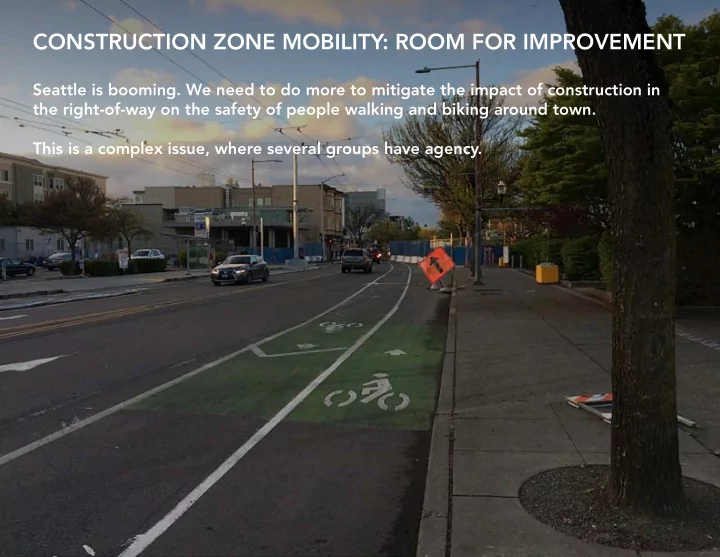
CONSTRUCTION ZONE MOBILITY: ROOM FOR IMPROVEMENT
Seattle is booming. We need to do more to mitigate the impact of construction in the right-of-way on the safety of people walking and biking around town. This is a complex issue, where several groups have agency.
SLIDE 2
THE CITY can tighten their review of Street Use permits, making sure that the Traffic Control plans submitted for construction projects prioritize and adequately anticipate the needs of people walking and biking through the construction zone. The Traffic Control Manual for In-Street Work is a document that guides construction in the ROW and includes provisions for the safe routing of people walking and biking. However, the language is sometimes soft. We are all familiar with construction zone efforts that fall short.
SLIDE 3 “Where it is necessary to divert pedestrians into the roadway, barricading
- r channelizing devices shall be provided to separate the pedestrian
walkway from the adjacent traffic lane.” “At locations where adjacent alternate walkways cannot be provided, appropriate signs shall be posted at the limits of construction and in advance of the closure at the nearest crosswalk or intersection to divert pedestrians across the street.”
(the nearest intersection is ~60’ from this signage)
SLIDE 4 “When the work area encroaches upon a sidewalk, pedestrian walkway or crosswalk area, special considerations must be given to the pedestrian’s access and safety. A maximum effort must be made to provide and maintain an accessible, safe, clearly defined and convenient pedestrian way separate from the work area.”
(If street parking spots are a place to store private property, perhaps
used for these materials!)
SLIDE 5 “When work encroaches upon a bike lane, bike trail, shared lane, signed bike route or a road
used by bicyclists as identified on SDOT’s “Seattle Bicycling Guide Map,” an accessible, safe and clearly defined route shall be provided and maximum effort made to provide a convenient bicycle way separate from active work areas.”
(I can read the words on the sign, but the traffic cones aren’t “clearly defining” much of anything)
SLIDE 6
“Note bicycle lanes, and include alternative bike routing as part of the plan.” Until recently, this was the example Traffic Control Plan provided by SDOT.
SLIDE 7 (Something was missing.)
BIKE LANE
SLIDE 8
THE CITY can tighten their review of Street Use permits, making sure that the Traffic Control plans submitted for construction projects prioritize and adequately anticipate the needs of people walking and biking through the construction zone. The Traffic Control Manual for In-Street Work is a document that guides construction in the ROW and includes provisions for the safe routing of people walking and biking. However, the language is sometimes soft. We are all familiar with construction zone efforts that fall short... CONSTRUCTION COMPANIES can expand their efforts to educate their crews on how to keep the job site safe for everyone. A traffic control plan and guidelines or best practices are only as good as their implementation by the boots on the ground. The safety and comfort of people walking and biking around job sites must be a shared priority.
SLIDE 9 CONSTRUCTION COMPANIES know about signage. Nearly all signage on job sites (that is not for marketing purposes) in one way or another aims to maintain safe and efficient
SLIDE 10 Sometimes, a No Parking sign is the most notice a resident might get about construction impacts in the ROW. But what if we knew more? The unpredictability of faulty traffic routing or mistakes in job site management can present urgently dangerous conditions for people walking and biking. While those users are often the first to observe those conditions, the pathways for feedback are unclear to
- many. These dangerous situations deserve immediate attention, not just “Find It, Fix It.”
SLIDE 11
CONSTRUCTION IMPACT NOTICE ADDRESS: 5555 N MAIN ST PERMIT DURATION: 01/01/15 - 12/31/15 SEE TRAFFIC CONTROL PLAN FOR ANTICIPATED ROAD & SIDEWALK CLOSURES. REPORT SAFETY CONCERNS TO: SITE SUPER: J. SMITH, 555-5555 CITY INSPECTOR: J. BROWN, 555-5555
+
What if every construction project in the ROW posted a plan for all expected impacts to site mobility? What if, upon noticing a dangerous situation, you knew exactly who to call?
SLIDE 12
THE CITY can tighten their review of Street Use permits, making sure that the Traffic Control plans submitted for construction projects prioritize and adequately anticipate the needs of people walking and biking through the construction zone. The Traffic Control Manual for In-Street Work is a document that guides construction in the ROW and includes provisions for the safe routing of people walking and biking. However, the language is sometimes soft. We are all familiar with construction zone efforts that fall short... CONSTRUCTION COMPANIES can expand their efforts to educate their crews on how to keep the job site safe for everyone. A traffic control plan and other guidelines and best practices are only as good as their implementation by the boots on the ground. The safety and comfort of people walking and biking around job sites must be a shared priority. RESIDENTS have already been asked by the City to pay attention and use Find It, Fix It to report concerns. The City may not have salaried inspectors on every block, but the people using the right-of-way can act as a proxy. Clearly posted project and contact information on-site is a direct and accessible approach towards empowering users to cooperate and make construction zones safer for everyone. Until then: Know what to expect, know what to accept: The City’s Traffic Control Manual for In- Street Work is here. Then, if you see something, say something: Contact information for the SDOT Street Use Inspectors for each section of the City can be found here.