SLIDE 1
SPEAKER 1
1
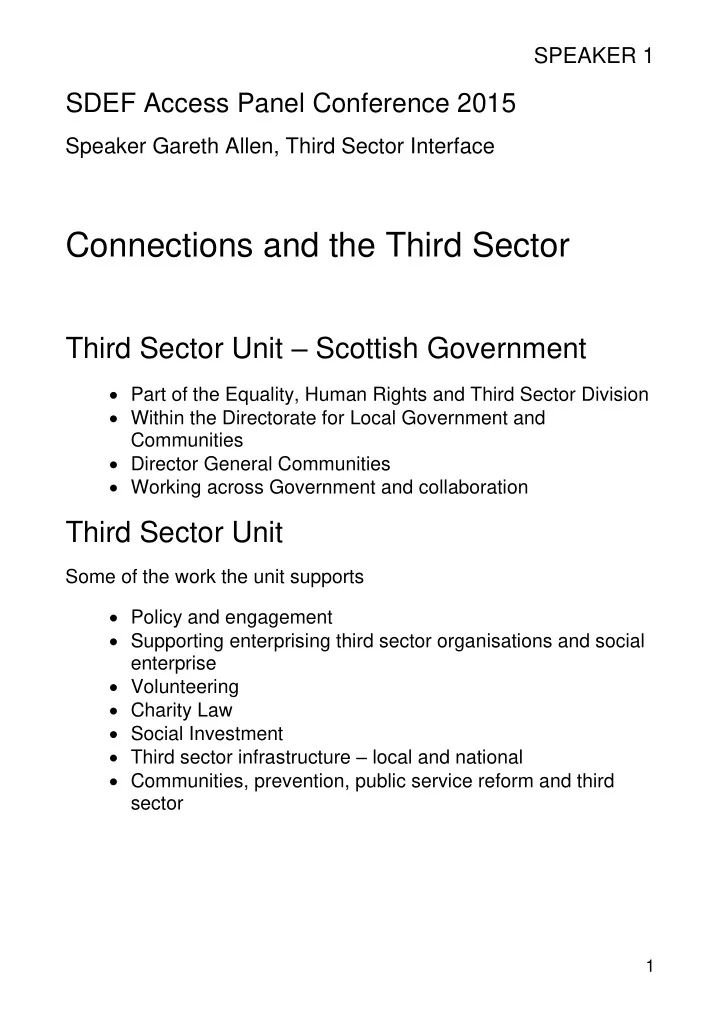
SDEF Access Panel Conference 2015
Speaker Gareth Allen, Third Sector Interface
Connections and the Third Sector
Third Sector Unit – Scottish Government
Part of the Equality, Human Rights and Third Sector Division Within the Directorate for Local Government and Communities Director General Communities Working across Government and collaboration
Third Sector Unit
Some of the work the unit supports Policy and engagement Supporting enterprising third sector organisations and social enterprise Volunteering Charity Law Social Investment Third sector infrastructure – local and national Communities, prevention, public service reform and third sector
SLIDE 2
SPEAKER 1
2
Priorities – Programme for Government
Economic competitiveness and fairness Social justice and tackling inequality Democratic renewal Community empowerment and engagement Key transformational role for the third sector and communities remains central
Strategic Conversation
What future approaches might best ensure a buoyant and sustainable third sector into the longer term? Frame the big challenges Approaches to creating the conditions necessary for a buoyant and sustainable sector Ambitions for the sector Look up to 10 years ahead Aims share understanding of current context surface significant issues for the sector discuss ambitions for the sector explore the conditions necessary for a buoyant and sustainable sector reflect on the roles of State, sector and communities in this environment consider what relationships are necessary; and the conversations that need to be had to take thinking forward
SLIDE 3
SPEAKER 1
3
Third Sector Interfaces
Each local authority area in Scotland has a Third Sector Interface (TSI) to support, promote, develop and represent the third sector: Community groups Voluntary organisations Social enterprises Volunteering Slides 7-11 draw on information from the website of Voluntary Action Scotland The TSI is also the connection between the Community Planning Partnership (CPP) and the third sector CPPs are made up of public, private and third sector bodies including the local authority, health board, fire, police, enterprise agency and others. They are tasked with ensuring “public services provided in the area of the local authority are provided and the planning of that provision takes place” Background 20 TSIs are single agencies and 12 of them are formed of partnerships across bodies historically associated with supporting their local voluntary sector, social enterprises and volunteers. Some of these are ‘Volunteer Centres’, ‘Centres for Voluntary Service’ or ‘Social Enterprise Networks’. Your local TSI might be known by one of these titles, as a ‘TSI’ or a local ‘Voluntary Action’ agency. They are independent from Government but the Scottish Government invests in four key functions
SLIDE 4
SPEAKER 1
4
A set of common standards, services and outcomes Helping communities help themselves through the power of volunteering Social enterprise development Supporting and developing a strong third sector – harnessing the passion of individuals to come together to improve their community Building the third sector relationship with community planning
Voluntary Action Scotland
Voluntary Action Scotland is the network organisation for Scotland’s TSIs http://www.vascotland.org What a TSI is and does Find a TSI
Other third sector connections
There are a range of national third sector intermediaries which form part of the third sector infrastructure They can cover, for example, particular parts of the sector, or a particular policy area, or provide a function