
SLIDE 1
320-477
October 15, 2011
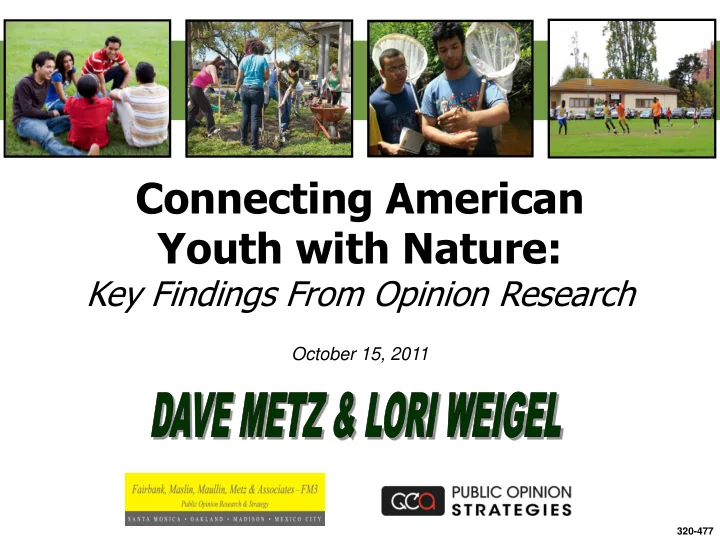
Connecting American Youth with Nature: Key Findings From Opinion - - PowerPoint PPT Presentation
Connecting American Youth with Nature: Key Findings From Opinion Research October 15, 2011 320-477 Methodology On-line interviews with 602 youth between the ages of 13-18 Interviews conducted July 28 August 4, 2011 Quotas set
320-477
October 15, 2011
2
13-18
ensure a diverse and representative sample
(Latinos); two groups in New York City (African- Americans and mixed-race); and Berkeley, CA (mixed- race)
Metz & Associates (D) and Public Opinion Strategies (R)
4
88% 69% 58% 18% 17% 15% 12% 11% 11% 11% 9% 22% 30% 22% 24% 25% 22% 38% 26% 23% 11% 20% 29% 24% 44% 32% 32% 15% 15% 21% 19% 21% 18% 24% 10% 24% 8% 15%
6% 6%
5%
33%
0% 20% 40% 60% 80% 100%
Use a computer Play video games or watch TV Do homework or study for school Participate in an organized sport or athletic team Skateboard, rollerblade or ride bikes outside Swim outdoors Watch nature shows on TV Go shopping Visit a local park, creek or beach in a city or town Visit a natural area outdoors, with lots of trees, plants, water or wildlife and few or no buildings
Almost Every Day Weekly Monthly Yearly Almost Never
Q8.
Below is a list of common activities. Please indicate how often you do each one: almost every day, weekly, monthly, yearly or less, or almost never.
5
6% 6% 5%
22% 12% 7% 11% 8% 17% 16% 16% 16% 14% 29% 42% 26% 39% 34% 46%
6%
8%
14% 20% 21% 39% 39% 36% 26% 21% 28% 41% 35% 12% 59%
0% 20% 40% 60% 80% 100%
Almost Every Day Weekly Monthly Yearly Almost Never
Q8.
Picnic or cook out outdoors Go hiking outdoors Visit a national or state park outside a city Participate in an organized youth group like Scouts, 4H, Boys and Girls Clubs or the “Y” Volunteer for a group or at an event related to the environment, like tree-planting or a clean-up day at a park, river, or beach Go on an outdoor field trip with your school Go fishing or hunting Go camping overnight
6
Common Activities All Respondents Teens of Color Big City Residents Use a computer 97% 97% 99% Play video games or watch TV 91% 90% 92% Do homework or study for school 88% 87% 87% Go shopping 49% 54% 56% Skateboard, rollerblade or ride bikes outside 41% 42% 47% Participate in an organized sport or athletic team 40% 41% 42% Swim outdoors 40% 37% 38% Visit a local park, creek or beach in a city or town 37% 40% 45% Watch nature shows on TV 34% 41% 45% Visit a natural area outdoors, with lots of trees, plants, water or wildlife and few or no buildings 34% 38% 36%
less, or almost never.
(% Total Almost Every Day/Weekly)
7
5% 8% 7% 8%
3%
12% 41% 8%
3% 4%
0% 20% 40% 60% 80% 100%
Q9.
In general, when you have free time, do you prefer to spend it doing something outdoors or doing something indoors? Please use a scale from 0 to 10, where (0) means you would prefer to spend all your time doing something indoors and ten (10) means you would prefer to spend all your time doing something outdoors. Five (5) means an even mix of the two.
1 2 3 4 5 6 7 8 9 10
All the Time Doing Something Indoors An Even Mix
and Outdoors All the Time Doing Something Outdoors
Mean: 5.2
0 1 2 3 4 5 8 7 6 10 9
8
use a scale from 0 to 10, where (0) means you would prefer to spend all your time doing something indoors and ten (10) means you would prefer to spend all your time doing something outdoors. Five (5) means an even mix of the two.
By Body Mass Index
2 8 % 2 6 % 2 9 % 4 7 % 3 8 % 4 4 % 3 7 % 3 5 % 3 4 % 3 % 3 4 % 1 8 %
0% 15% 30% 45% 60%
Under Weight Normal Weight Over Weight Obese
Prefer Indoors (Score 0-4) Even Mix (Score 5) Prefer Outdoors (Score 6-10)
(% of Sample) (20%) (15%) (54%) (9%)
9
Q10.
14% 10% 9% 8% 6% 5% 5% 5% 4% 4% 4% 3% 3%
0% 5% 10% 15%
It's relaxing/takes the stress off It's fun to be outdoors I like spending time outdoors Beautiful scenery Fresh air Spending time with friends I enjoy playing sports (baseball, soccer, etc.) I enjoy outdoor activities (hunting, biking, etc.) To get out of the house/office To get some exercise I like to be in nature Spending time with family/kids I live in a rural area
You indicated a few moments ago that you participate in some activity outdoors in a natural area on at least a monthly basis. In a few words of your own, please tell us what the main reasons are why you spend time in these kinds of places:
(Open-End; Asked Only of 72% Youth Who Do Spend Time in Nature; Responses 3% and Above Shown)
10
(OPEN END)
11
Q11.
79% 46% 44% 23% 22% 19% 15% 13% 7% 5% 2%
0% 20% 40% 60% 80% 100%
Thinking back to the last time you visited the outdoors doing any activity, who were you with? (Asked Only of 72% of Youth Who Do Frequently Spend Time in Nature)
Friend(s) A parent/guardian Brother(s) and/or sister(s) Grandparent, aunt/uncle, cousins or other family members Classmates from school Other adults A youth group Other teens attending a camp A teacher Other None of the above
12
56% 29% 32% 37% 10% 22% 12%
0% 20% 40% 60% 80% 100%
S.W. Agr. S.W. Disagr.
15e/g. Regarding the general statements below, tell us what you think by indicating whether you strongly agree, somewhat agree, somewhat disagree, or strongly disagree with each one.
Total Strng./ S.W. Agree
88% 66%
I like knowing that there are natural areas and wildlife out there, even if I never go to those places. I have had a personal experience in nature that has made me appreciate it more.
13
By Body Mass Index
64% 69% 64% 52% 36% 31% 36% 48%
0% 15% 30% 45% 60% 75%
Under Weight Normal Weight Over Weight Obese
Total Agree Total Disagree
(% of Sample) (20%) (15%) (54%) (9%)
with: I have had a personal experience in nature that has made me appreciate it more.
14
Those who participate in a variety of outdoor activities on at least a weekly basis are far more likely to “strongly agree” that they have had an experience in nature that makes them appreciate it more, in particular:
16
31% 34% 34% 24% 22% 23% 22% 22% 11% 12% 30% 26% 24% 31% 29% 25% 26% 23% 22% 17% 22% 25% 21% 29% 27% 29% 27% 29% 34% 33% 18% 15% 22% 16% 22% 23% 25% 27% 33% 38%
0% 20% 40% 60% 80% 100%
The quality of public education Bullying Crime Lack of summer and part-time jobs for teens The condition of the environment and nature Air pollution Pollution of lakes, rivers and streams *Global warming *Climate change A lack of neighborhood parks or places to spend time outdoors in your area
Very Ser. S.W. Ser. Not Ser./DK/NA
serious, very serious, somewhat serious, or not serious.
Total Ext./Very Serious Issue 61% 60% 58% 55% 51% 48% 48% 45% 33% 29%
Please indicate how serious a problem you think each of the following issues is for young people today: extremely serious, very serious, somewhat serious, or not serious.
17
serious, very serious, somewhat serious, or not serious.
(% Total Extremely/Very Serious Problem)
Issues All Respondents Teens of Color Big City Residents The quality of public education 61% 68% 68% Bullying 60% 65% 61% Crime 58% 66% 70% Lack of summer and part-time jobs for teens 55% 62% 62% The condition of the environment and nature 51% 60% 57% Air pollution 48% 58% 56% Pollution of lakes, rivers and streams 48% 52% 56% *Global warming 45% 66% 63% *Climate change 33% 43% 40% A lack of neighborhood parks or places to spend time outdoors in your area 29% 33% 28%
18
serious, very serious, somewhat serious, or not serious.
(% at Least “Somewhat Serious”)
“A lack of neighborhood parks in your area” “A lack of neighborhood parks or places to spend time outdoors in your area”
19
Strong environmen- talist 19% Not an environmen- talist/DK/ NA 23% Moderate environmen- talist 58% Moderate environmen- talist 67% Not an environmen- talist/DK/ NA 20% Strong environmen- talist 13%
Adults (2010) Youth (2011)
20
16% 70% 14% 7% 61% 32%
0% 20% 40% 60% 80%
Have Had Meaningful Experience in Nature Have Not
19 by 15e. Do you consider yourself a strong environmentalist, a moderate environmentalist, or not an environmentalist at all?
Strong environmentalist Moderate environmentalist Not an environmentalist/DK/NA Consider Themselves a…
21
19 by 8i.
How often do you visit a natural area outdoors, with lots of trees, plants, water or wildlife and few or no buildings?
21% 9% 9%
69% 73% 60%
10% 18% 31%
0% 20% 40% 60% 80% 100%
Strong environmentalist Moderate environmentalist Not an environmentalist
Weekly Monthly Less Often
90% 82% 69%
22
pollution, global warming, and the condition of the environment;
acting now;
prioritized over economic growth;
environment is “cool;” and
than twice as likely to consider themselves a “strong environmentalist.”
23
51% 23% 36% 55% 38% 10% 19% 36% 22%
0% 20% 40% 60% 80% 100%
S.W. Agr. S.W. Disagr. S.W./Strng. Disagr.
Youth who identify themselves as environmentalists are more likely to say they regularly act to protect the environment.
15b by 19.
Among strong environmentalists Among moderate environmentalists Among non-environmentalists
87% 78% 42% 13% 22% 58%
“I always take actions to protect the environment – like recycling, and using less water and electricity.”
24
52% 42% 23% 15% 39% 44% 49% 32% 8% 11% 21% 31% 22%
7%
0% 20% 40% 60% 80% 100%
S.W. Agr. S.W. Disagr.
15b/c/d/f. Regarding the general statements below, tell us what you think by indicating whether you strongly agree, somewhat agree, somewhat disagree, or strongly disagree with each one.
I care about helping animals and wildlife I think it is cool to do things to protect the environment I always take actions to protect the environment – like recycling, and using less water and electricity There is too much hype and exaggeration about environmental issues
Total Agree
91% 86% 72% 47%
25
Protection of the environment should be given priority, even at the risk of slowing economic growth Economic growth should be given priority, even if the environment suffers to some extent
Adults (2011) Youth (2011)
With which of these statements about the environment and the economy do you most agree:
OR
26
Q16.
The best reason to conserve nature is for its own sake – to leave systems of plants and wildlife undisturbed to evolve, change and grow The best reason to conserve nature is to preserve the benefits people can derive from it – for our economy, our health, and our enjoyment.
Adults (2010) Youth (2011)
OR
27
Q16.
The best reason to conserve nature is for its own sake – to leave systems of plants and wildlife undisturbed to evolve, change and grow The best reason to conserve nature is to preserve the benefits people can derive from it – for our economy, our health, and our enjoyment.
All Respondents Teens of Color Big City Residents
OR
28
28% 8% 45% 25% 21% 39% 29%
6%
0% 20% 40% 60% 80% 100%
S.W. Agr. S.W. Disagr.
In thinking about solutions for environmental problems, youth have little confidence in government or in prior generations.
15a/i. Regarding the general statements below, tell us what you think by indicating whether you strongly agree, somewhat agree, somewhat disagree, or strongly disagree with each one.
Total Agree
73% 33%
Previous generations have damaged
generation to fix it Government leaders are doing a good job addressing major problems facing our country
29
36% 40% 15% 9%
0% 10% 20% 30% 40% 50%
Strongly agree Somwhat agree Somwhat disagree Strongly disagree
Total Disagree 24% Total Agree 76%
agree, somewhat disagree, or strongly disagree with each one.
“We can solve climate change if we take action now.”
31
Q12.
20% 17% 12% 12% 11% 8% 5% 2% 2% 2%
0% 5% 10% 15% 20% 25%
You indicated a few moments ago that you rarely spend time outdoors in a natural area. In a few words of your own, what are the main reasons you do not spend time in these kinds of natural areas? (Open-End; Asked Only of Youth Who do Not Spend Time in Nature; Responses 2% and Above Shown)
None nearby/too urban Weather (too hot, cold, etc.) Don't like bugs/insects Don't enjoy spending time outdoors/I’m an indoor person Nothing to do No time/too busy I am hooked on technology I'm not allowed to Unsafe neighborhood Exposure to the sun
32
what are the main reasons you do not spend time in these kinds of natural areas? (OPEN END)
33
36% 28% 26% 17% 18% 13% 11% 14% 12% 44% 34% 35% 32% 28% 32% 32% 25% 27% 21%
10%
0% 20% 40% 60% 80%
Major Reason Minor Reason
80% 62% 61%
Q13.
The list below includes sample reasons why some youth do not spend more time outdoors in natural
personally, do not spend more time outdoors. It’s uncomfortable, because of things like bugs, heat, etc. I don’t have any transportation to get to a natural area There are no natural areas anywhere near my home I’m just not interested in spending time in nature Gangs or crime make these kinds of areas unsafe There’s too much risk of getting hurt in a natural area (i.e., from animals, I might fall, get lost, etc.) I don’t feel welcome among the other people there Personal health issues keep me from participating in activities in nature It costs too much to participate in activities out in nature My family will not let me spend time outdoors in a natural area
49% 39% 31% 49% 45% 43% 39%
34
Q13.
(% Total Major/Minor Reason)
List of Reasons All Respondents Teens of Color Big City Residents It’s uncomfortable, because of things like bugs, heat, etc.
80% 80% 82%
I don’t have any transportation to get to a natural area
62% 68% 66%
There are no natural areas anywhere near my home
61% 61% 70%
I’m just not interested in spending time in nature
49% 47% 48%
Gangs or crime make these kinds of areas unsafe
46% 55% 60%
There’s too much risk of getting hurt in a natural area (i.e., from animals, I might fall, get lost, etc.)
45% 55% 54%
I don’t feel welcome among the other people there
43% 45% 51%
It costs too much to participate in activities out in nature
39% 46% 49%
Personal health issues keep me from participating in activities in nature
39% 44% 48%
My family will not let me spend time outdoors in a natural area
31% 40% 39%
35
36
Steering Committee Steve Hagler – Foundation for Youth Investment Deb Bialeschki - American Camp Association Nina Roberts - San Francisco State University Akiima Price - New York Restoration Project Rue Mapp - Outdoor Afro Eugenie Bostrom - Department of the Interior / Youth in the Great Outdoors Brother Yusuf Burgess - Children and Nature Network Michael Conn - Girl Scouts Eleanor Morris - The Nature Conservancy Angelica Tassoulas - The Nature Conservancy Hazel Wong - The Nature Conservancy Berkeley Darr - The Nature Conservancy Elizabeth Ward - The Nature Conservancy Financial Supporters Toyota USA Foundation Foundation for Youth Investment The Nature Conservancy
17145 West 62nd Circle Golden, CO 80403 Phone (303) 324-7655 Fax (303) 433-4253 lori@pos.org 1999 Harrison St., Suite 1290 Oakland, CA 94612 Phone (510) 451-9521 Fax (510) 451-0384 Dave@FM3research.com
Council on the Environmental of New York City and the New York City Department of Education.
from all five boroughs. A Title I school, that serves a majority of students coming from low income families.
with Career Development, Environmental Education and Professional Development programs.
before and after LEAF program.
LEAF Program Model
1. A partnership between The Nature Conservancy and urban environmental high schools to combine classroom lessons with real world conservation work experience on nature preserves 2. Serves 85% students of color age 16-17; 70% eligible for free or reduced lunch
schools to serve 20 schools in NYC, Newark, New Haven, Boston, Atlanta, Chicago, Seattle and Los Angeles by 2012
Maine, the giant Sequoias of California, the deserts of New Mexico, the jungles of Peru, and all the villages and cities in between. I see the connections between all these places ecologically, and understand the importance of land use and policy decisions.
2007 – LEAF 2008– University of Vermont, School of Natural Resources, Wildlife Biology 2009 – Diversity Internship Program, Pine Butte Ranch, Montana 2010 – Diversity Internship Program, Long Island 2011 – Study Abroad, Ecuador and Brazil
1996 – LEAF 1998 – Syracuse University, New York, Environmental Studies, GIS 2004 – Florida Atlantic University, Masters of Urban and Regional Planning 2008 – Urban Planner and GIS specialist, Hollywood, FL
1997 – LEAF 1999 – SUNY Long Island, Environmental Studies, College Internship with TNC 2000 – Central Park Ranger, New York 2003 – Forest Park Conservancy, Urban Educator, Portland, Oregon 2005 – Patagonia, Environmental Grants Program Manager, Portland, Oregon 2008– ConEX Featured Speaker
2007 – LEAF 2008 – Nature Conservancy Gala, Public Speaker/Interpreter 2009 – Bethany College, Communications Major 2009 – Internship, Saco River, Maine, Leave no Trace Public Outreach 2010 – Diversity Program Internship, Saco River, Maine, Leave no Trace Public Outreach
LEAF Expansion Strategy (over three years)
Create a Nationwide Network of Environmental High Schools
Provide 221 summer jobs
Enrich Classroom Education with Scientific Resources
Build the Pipeline
49% reported LEAF influenced their academic study 34% pursued life sciences in college and 21% pursued environmental studies 79% identify as environmentalists 52% volunteer for environmental causes 33% have worked for an environmental
67% believe loss of natural areas is “extremely serious” 73% believe climate change is “extremely serious”
The conservation community is 90% Caucasian and over 50 years old By 2043, people of color will represent the majority of the U.S. population Youth are driving the racial demographic shift – 44% of youth age 18 and younger are people of Color, 20% of Baby Boomers are people of color Students of color constitute only 11% of college graduates in natural resource/agricultural fields
Conservation Career Program The Next Phase
1. An unprecedented program to build upon LEAF’s success and support program Alums in higher education / conservation career exploration 2. Includes multi-year summer work experiences with conservation organizations, career mentoring and guidance through regular workshops and retreats, and university tuition/living assistance (promotion of environmental scholarships) 3. Vision is to support a professional pipeline for underrepresented youth through college/graduate school to job placement to diversify the conservation workforce of the future