Congruences for Fishburn numbers modulo prime powers Partitions, q - - PowerPoint PPT Presentation

congruences for fishburn numbers modulo prime powers
SMART_READER_LITE
LIVE PREVIEW

Congruences for Fishburn numbers modulo prime powers Partitions, q - - PowerPoint PPT Presentation

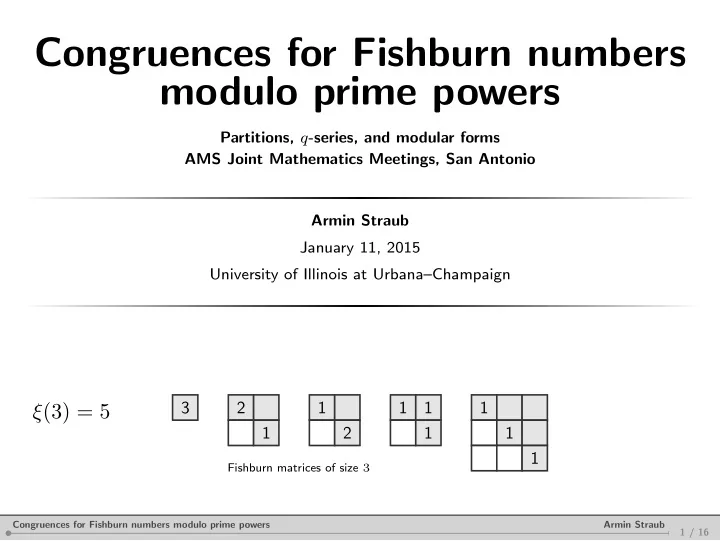
Congruences for Fishburn numbers modulo prime powers Partitions, q -series, and modular forms AMS Joint Mathematics Meetings, San Antonio Armin Straub January 11, 2015 University of Illinois at UrbanaChampaign 3 2 1 1 1 1 (3) = 5 1


slide-1
SLIDE 1

Congruences for Fishburn numbers modulo prime powers

Partitions, q-series, and modular forms AMS Joint Mathematics Meetings, San Antonio Armin Straub January 11, 2015 University of Illinois at Urbana–Champaign

ξ(3) = 5

Fishburn matrices of size 3

3 2 1 1 2 1 1 1 1 1 1

Congruences for Fishburn numbers modulo prime powers Armin Straub 1 / 16

slide-2
SLIDE 2

Examples of partitions

  • p(3) = 3

The integer partitions of 3:

Congruences for Fishburn numbers modulo prime powers Armin Straub 2 / 16

slide-3
SLIDE 3

Examples of partitions

  • p(3) = 3

The integer partitions of 3:

  • ξ(3) = 5

The Fishburn matrices of size 3:

3 2 1 1 2 1 1 1 1 1 1

A Fishburn matrix is an

  • upper-triangular matrix with entries in Z0, such that
  • every row and column contains at least one non-zero entry.

Its size is the sum of the entries.

DEF

Congruences for Fishburn numbers modulo prime powers Armin Straub 2 / 16

slide-4
SLIDE 4

Examples of partitions

  • p(4) = 5

The integer partitions of 4:

  • ξ(4) = 15

The Fishburn matrices of size 4:

4 3 1 2 2 2 1 1 1 1 2 1 3 1 2 1 2 1 1 1 2 1 1 1 2 1 1 1 1 1 1 1 1 1 1 1 1 1 1 1 1 1 1 1 1

Congruences for Fishburn numbers modulo prime powers Armin Straub 3 / 16

slide-5
SLIDE 5

Examples of partitions

primitive Fishburn matrices ξ−1(4) = 5

  • p(4) = 5

The integer partitions of 4:

  • ξ(4) = 15

The Fishburn matrices of size 4:

4 3 1 2 2 2 1 1 1 1 2 1 3 1 2 1 2 1 1 1 2 1 1 1 2 1 1 1 1 1 1 1 1 1 1 1 1 1 1 1 1 1 1 1 1

Congruences for Fishburn numbers modulo prime powers Armin Straub 3 / 16

slide-6
SLIDE 6

Asymptotic facts

p(n) : 1, 1, 2, 3, 5, 7, 11, 15, 22, 30, 42, . . . p(2015) ≈ 7.20 × 1045 ξ(n) : 1, 1, 2, 5, 15, 53, 217, 1014, 5335, 31240, 201608, . . . ξ(2015) ≈ 4.05 × 105351

Congruences for Fishburn numbers modulo prime powers Armin Straub 4 / 16

slide-7
SLIDE 7

Asymptotic facts

p(n) : 1, 1, 2, 3, 5, 7, 11, 15, 22, 30, 42, . . . p(2015) ≈ 7.20 × 1045 ξ(n) : 1, 1, 2, 5, 15, 53, 217, 1014, 5335, 31240, 201608, . . . ξ(2015) ≈ 4.05 × 105351

p(n) ∼ 1 4n √ 3eπ√

2n/3

THM

Hardy– Ramanujan 1918

ξ(n) ∼ 12 √ 3n π5/2 eπ2/12 6 π2 n n!

THM

Zagier 2001

Congruences for Fishburn numbers modulo prime powers Armin Straub 4 / 16

slide-8
SLIDE 8

Asymptotic facts

p(n) : 1, 1, 2, 3, 5, 7, 11, 15, 22, 30, 42, . . . p(2015) ≈ 7.20 × 1045 ξ(n) : 1, 1, 2, 5, 15, 53, 217, 1014, 5335, 31240, 201608, . . . ξ(2015) ≈ 4.05 × 105351

p(n) ∼ 1 4n √ 3eπ√

2n/3

THM

Hardy– Ramanujan 1918

ξ(n) ∼ 12 √ 3n π5/2 eπ2/12 6 π2 n n!

THM

Zagier 2001

  • Primitive Fishburn matrices are those with entries 0, 1 only.

lim

n→∞

# of primitive Fishburn matrices of size n # of Fishburn matrices of size n (= ξ(n)) = e−π2/6 ≈ 0.193

Jel´ ınek–Drmota, 2011

Congruences for Fishburn numbers modulo prime powers Armin Straub 4 / 16

slide-9
SLIDE 9

Fishburn numbers

  • The Fishburn numbers ξ(n) have the following generating function.
  • n0

ξ(n)qn =

  • n0

n

  • j=1

(1 − (1 − q)j) = F(1 − q)

THM

Zagier 2001

  • F(q) is Kontsevich’s “strange” function (more later)

Congruences for Fishburn numbers modulo prime powers Armin Straub 5 / 16

slide-10
SLIDE 10

Fishburn numbers

  • The Fishburn numbers ξ(n) have the following generating function.
  • n0

ξ(n)qn =

  • n0

n

  • j=1

(1 − (1 − q)j) = F(1 − q)

THM

Zagier 2001

  • F(q) is Kontsevich’s “strange” function (more later)
  • The primitive Fishburn numbers have generating function F(

1 1+q).

Congruences for Fishburn numbers modulo prime powers Armin Straub 5 / 16

slide-11
SLIDE 11

Fishburn numbers

  • The Fishburn numbers ξ(n) have the following generating function.
  • n0

ξ(n)qn =

  • n0

n

  • j=1

(1 − (1 − q)j) = F(1 − q)

THM

Zagier 2001

  • F(q) is Kontsevich’s “strange” function (more later)
  • The primitive Fishburn numbers have generating function F(

1 1+q).

  • Garvan introduces the numbers ξr,s(n) by
  • n0

ξr,s(n)qn = (1 − q)s

n0 n

  • j=1

(1 − (1 − q)rj) = (1 − q)sF((1 − q)r).

  • ξ(n) = ξ1,0(n)
  • (−1)nξ−1,0(n) count primitive Fishburn matrices
  • For instance, ξ1,3(n) = ξ(n) − 3ξ(n − 1) + 3ξ(n − 2) − ξ(n − 3).

Congruences for Fishburn numbers modulo prime powers Armin Straub 5 / 16

slide-12
SLIDE 12

Interval orders and Fishburn matrices

  • An interval order is a poset consisting of intervals I ⊆ R with
  • rder given by:

I < J ⇐ ⇒ i < j for all i ∈ I, j ∈ J

R 1 2 3

1 2 3 4 5

Congruences for Fishburn numbers modulo prime powers Armin Straub 6 / 16

slide-13
SLIDE 13

Interval orders and Fishburn matrices

  • An interval order is a poset consisting of intervals I ⊆ R with
  • rder given by:

I < J ⇐ ⇒ i < j for all i ∈ I, j ∈ J ξ(n) = # of interval orders of size n (up to isomorphism)

FACT

R 1 2 3

1 2 3 4 5

Congruences for Fishburn numbers modulo prime powers Armin Straub 6 / 16

slide-14
SLIDE 14

Interval orders and Fishburn matrices

  • An interval order is a poset consisting of intervals I ⊆ R with
  • rder given by:

I < J ⇐ ⇒ i < j for all i ∈ I, j ∈ J ξ(n) = # of interval orders of size n (up to isomorphism)

FACT

R 1 2 3

1 2 3 4 5

standard representation

R 1 2 3

1 2 3 4 5

Congruences for Fishburn numbers modulo prime powers Armin Straub 6 / 16

slide-15
SLIDE 15

Interval orders and Fishburn matrices

  • An interval order is a poset consisting of intervals I ⊆ R with
  • rder given by:

I < J ⇐ ⇒ i < j for all i ∈ I, j ∈ J ξ(n) = # of interval orders of size n (up to isomorphism)

FACT

R 1 2 3

1 2 3 4 5

standard representation

R 1 2 3

1 2 3 4 5

Fishburn matrix M Mi,j = # of intervals [i, j]

1 1 2 1

Congruences for Fishburn numbers modulo prime powers Armin Straub 6 / 16

slide-16
SLIDE 16

Partition congruences

  • Ramanujan proved the striking congruences

p(5m − 1) ≡ 0 (mod 5), p(7m − 2) ≡ 0 (mod 7), p(11m − 5) ≡ 0 (mod 11).

Congruences for Fishburn numbers modulo prime powers Armin Straub 7 / 16

slide-17
SLIDE 17

Partition congruences

  • Ramanujan proved the striking congruences

p(5m − 1) ≡ 0 (mod 5), p(7m − 2) ≡ 0 (mod 7), p(11m − 5) ≡ 0 (mod 11).

  • Also conjectured generalizations with moduli powers of 5, 7, 11.

p(5λm − δ5(λ)) ≡ 0 (mod 5λ), p(7λm − δ7(λ)) ≡ 0 (mod 7λ), p(11λm − δ11(λ)) ≡ 0 (mod 11λ), where δp(λ) ≡ −1/24 (mod pλ).

Congruences for Fishburn numbers modulo prime powers Armin Straub 7 / 16

slide-18
SLIDE 18

Partition congruences

  • Ramanujan proved the striking congruences

p(5m − 1) ≡ 0 (mod 5), p(7m − 2) ≡ 0 (mod 7), p(11m − 5) ≡ 0 (mod 11).

  • Also conjectured generalizations with moduli powers of 5, 7, 11.

p(5λm − δ5(λ)) ≡ 0 (mod 5λ), p(7λm − δ7(λ)) ≡ 0 (mod 7⌊λ/2⌋+1), p(11λm − δ11(λ)) ≡ 0 (mod 11λ), where δp(λ) ≡ −1/24 (mod pλ).

Watson (1938), Atkin (1967)

Congruences for Fishburn numbers modulo prime powers Armin Straub 7 / 16

slide-19
SLIDE 19

Partition congruences

  • Ramanujan proved the striking congruences

p(5m − 1) ≡ 0 (mod 5), p(7m − 2) ≡ 0 (mod 7), p(11m − 5) ≡ 0 (mod 11).

  • Also conjectured generalizations with moduli powers of 5, 7, 11.

p(5λm − δ5(λ)) ≡ 0 (mod 5λ), p(7λm − δ7(λ)) ≡ 0 (mod 7⌊λ/2⌋+1), p(11λm − δ11(λ)) ≡ 0 (mod 11λ), where δp(λ) ≡ −1/24 (mod pλ).

Watson (1938), Atkin (1967)

There appear to be additional congruences, such as p(72m − 2, 9, 16, 30) ≡ 0 (mod 72), p(53m − 1, 26, 51) ≡ 0 (mod 53).

RK

Congruences for Fishburn numbers modulo prime powers Armin Straub 7 / 16

slide-20
SLIDE 20

The Andrews–Sellers congruences

Let p be a prime, and j ∈ Z>0 such that 1 − 24k p

  • = −1

for k = 1, 2, . . . , j. (AS) Then, for all m 1, ξ(pm − j) ≡ 0 (mod p).

THM

Andrews, Sellers 2014

ξ(5m − 1) ≡ ξ(5m − 2) ≡ 0 (mod 5) ξ(7m − 1) ≡ 0 (mod 7) ξ(11m − 1) ≡ ξ(11m − 2) ≡ ξ(11m − 3) ≡ 0 (mod 11)

EG

Congruences for Fishburn numbers modulo prime powers Armin Straub 8 / 16

slide-21
SLIDE 21

The Andrews–Sellers congruences

Let p be a prime, and j ∈ Z>0 such that 1 − 24k p

  • = −1

for k = 1, 2, . . . , j. (AS) Then, for all m 1, ξ(pm − j) ≡ 0 (mod p).

THM

Andrews, Sellers 2014

ξ(5m − 1) ≡ ξ(5m − 2) ≡ 0 (mod 5) ξ(7m − 1) ≡ 0 (mod 7) ξ(11m − 1) ≡ ξ(11m − 2) ≡ ξ(11m − 3) ≡ 0 (mod 11)

EG

  • Garvan (2014) proved that (AS) may be replaced with

1 − 24k p

  • = 1

for k = 1, 2, . . . , j, and that analogous congruences hold for the generalizations ξr,s(n).

Congruences for Fishburn numbers modulo prime powers Armin Straub 8 / 16

slide-22
SLIDE 22

Garvan’s generalized congruences

Andrews–Sellers congruences

ξ(5m − 1) ≡ ξ(5m − 2) ≡ 0 (mod 5) ξ(7m − 1) ≡ 0 (mod 7)

Garvan’s additional congruences

ξ(23m − 1) ≡ ξ(23m − 2) ≡ . . . ≡ ξ(23m − 5) ≡ 0 (mod 23)

Congruences for primitive Fishburn numbers

ξ−1(5m − 1) ≡ 0 (mod 5)

Extensions observed by Garthwaite–Rhoades

ξ(5m + 2) − 2ξ(5m + 1) ≡ 0 (mod 5)

Garvan’s congruences for r-Fishburn numbers

ξ23(7m − 1) ≡ ξ23(7m − 2) ≡ ξ23(7m − 3) ≡ 0 (mod 7) ξ−1(5m − 1) − 2ξ−1(5m − 2) + ξ−1(5m − 3) ≡ 0 (mod 5)

Congruences for Fishburn numbers modulo prime powers Armin Straub 9 / 16

slide-23
SLIDE 23

Garvan’s generalized congruences

Andrews–Sellers congruences

ξ(5λm − 1) ≡ ξ(5λm − 2) ≡ 0 (mod 5λ) ξ(7λm − 1) ≡ 0 (mod 7λ)

Garvan’s additional congruences

ξ(23λm − 1) ≡ ξ(23λm − 2) ≡ . . . ≡ ξ(23λm − 5) ≡ 0 (mod 23λ)

Congruences for primitive Fishburn numbers

ξ−1(5m − 1) ≡ 0 (mod 5)

x

Extensions observed by Garthwaite–Rhoades

ξ(5λm + 2) − 2ξ(5λm + 1) ≡ 0 (mod 5λ)

Garvan’s congruences for r-Fishburn numbers

ξ23(7λm − 1) ≡ ξ23(7λm − 2) ≡ ✘✘✘✘✘✘

✘ ❳❳❳❳❳❳ ❳

ξ23(7λm − 3) ≡ 0 (mod 7λ)

x

ξ−1(5λm − 1) − 2ξ−1(5λm − 2) + ξ−1(5λm − 3) ≡ 0 (mod 5λ)

  • Most, but not all, of these congruences can be lifted to prime powers.

Congruences for Fishburn numbers modulo prime powers Armin Straub 9 / 16

slide-24
SLIDE 24

Congruences modulo prime powers

Let p be a prime, p ∤ r, and j ∈ Z>0 such that

1 − 24(k + s)/r p

  • = −1

for k = 1, 2, . . . , j. (C) Then, for all m 1 and λ, ξr,s(pλm − j) ≡ 0 (mod pλ).

THM

S 2014

Congruences for Fishburn numbers modulo prime powers Armin Straub 10 / 16

slide-25
SLIDE 25

Congruences modulo prime powers

Let p be a prime, p ∤ r, and j ∈ Z>0 such that

1 − 24(k + s)/r p

  • = −1

for k = 1, 2, . . . , j. (C) Then, for all m 1 and λ, ξr,s(pλm − j) ≡ 0 (mod pλ). In (C), “= −1” may be replaced with “= 1”, if p 5 and digit1(s − r/24; p) = p − 1. (*)

THM

S 2014

  • (*) states that n1 = p − 1 in s − r/24 = n0 + n1p + n2p2 + . . .

Congruences for Fishburn numbers modulo prime powers Armin Straub 10 / 16

slide-26
SLIDE 26

Congruences modulo prime powers

Let p be a prime, p ∤ r, and j ∈ Z>0 such that

1 − 24(k + s)/r p

  • = −1

for k = 1, 2, . . . , j. (C) Then, for all m 1 and λ, ξr,s(pλm − j) ≡ 0 (mod pλ). In (C), “= −1” may be replaced with “= 1”, if p 5 and digit1(s − r/24; p) = p − 1. (*)

THM

S 2014

Andrews–Sellers conjectured and Garvan proved that ξ−1(5m − 1) ≡ 0 (mod 5). But (*) is not satisfied: s − r/24 = 1/24 ≡ −1 (mod 52)

EG

Congruences for Fishburn numbers modulo prime powers Armin Straub 10 / 16

slide-27
SLIDE 27

Congruences modulo prime powers

Let p be a prime, p ∤ r, and j ∈ Z>0 such that

1 − 24(k + s)/r p

  • = −1

for k = 1, 2, . . . , j. (C) Then, for all m 1 and λ, ξr,s(pλm − j) ≡ 0 (mod pλ). In (C), “= −1” may be replaced with “= 1”, if p 5 and digit1(s − r/24; p) = p − 1. (*)

THM

S 2014

Andrews–Sellers conjectured and Garvan proved that ξ−1(5m − 1) ≡ 0 (mod 5). But (*) is not satisfied: s − r/24 = 1/24 ≡ −1 (mod 52) Indeed, the congruences do not extend to prime powers: ξ−1(52 − 1) = 11115833059268126770 ≡ 20 ≡ 0 (mod 52)

EG

Congruences for Fishburn numbers modulo prime powers Armin Straub 10 / 16

slide-28
SLIDE 28

Primitive Fishburn matrices

Can we give a combinatorial interpretation for any of these con- gruences?

Q

  • In particular, for the number of primitive Fishburn matrices,

ξ−1(5m − 1) ≡ 0 (mod 5).

Congruences for Fishburn numbers modulo prime powers Armin Straub 11 / 16

slide-29
SLIDE 29

Primitive Fishburn matrices

Can we give a combinatorial interpretation for any of these con- gruences?

Q

  • In particular, for the number of primitive Fishburn matrices,

ξ−1(5m − 1) ≡ 0 (mod 5).

  • The Ramanujan congruences

(Atkin, Swinnerton-Dyer (1954))

p(5m − 1) ≡ 0 (mod 5), p(7m − 2) ≡ 0 (mod 7), p(11m − 5) ≡ 0 (mod 11). modulo 5 and 7 are explained by Dyson’s rank.

(rank = largest part of a partition minus the number of its parts)

Congruences for Fishburn numbers modulo prime powers Armin Straub 11 / 16

slide-30
SLIDE 30

Primitive Fishburn matrices

Can we give a combinatorial interpretation for any of these con- gruences?

Q

  • In particular, for the number of primitive Fishburn matrices,

ξ−1(5m − 1) ≡ 0 (mod 5).

  • The Ramanujan congruences

(Atkin, Swinnerton-Dyer (1954))

p(5m − 1) ≡ 0 (mod 5), p(7m − 2) ≡ 0 (mod 7), p(11m − 5) ≡ 0 (mod 11). modulo 5 and 7 are explained by Dyson’s rank.

(rank = largest part of a partition minus the number of its parts)

  • All three congruences are explained by Dyson’s speculated crank,

which was found by Andrews and Garvan (1988).

Congruences for Fishburn numbers modulo prime powers Armin Straub 11 / 16

slide-31
SLIDE 31

Kontsevich’s “strange” function

F(q) =

  • n0

(1 − q)(1 − q2) · · · (1 − qn)

DEF

  • does not converge in any open set
  • series terminates when q is a root of unity

Congruences for Fishburn numbers modulo prime powers Armin Straub 12 / 16

slide-32
SLIDE 32

Kontsevich’s “strange” function

F(q) =

  • n0

(1 − q)(1 − q2) · · · (1 − qn)

DEF

  • does not converge in any open set
  • series terminates when q is a root of unity

The following “strange” identity “holds”:

q1/24F(q) = −1 2

  • n=1

n 12 n

  • qn2/24

THM

Zagier 1999

  • LHS agrees at roots of unity with the radial limit of the RHS

(and similarly for the derivatives of all orders)

Congruences for Fishburn numbers modulo prime powers Armin Straub 12 / 16

slide-33
SLIDE 33

Kontsevich’s “strange” function

F(q) =

  • n0

(1 − q)(1 − q2) · · · (1 − qn)

DEF

  • does not converge in any open set
  • series terminates when q is a root of unity

The following “strange” identity “holds”:

q1/24F(q) = −1 2

  • n=1

n 12 n

  • qn2/24

THM

Zagier 1999

  • LHS agrees at roots of unity with the radial limit of the RHS

(and similarly for the derivatives of all orders)

  • RHS is the “half-derivative” (up to constants) of the Dedekind eta function

η(τ) = q1/24

n1

(1 − qn) =

  • n=1

12 n

  • qn2/24.

Congruences for Fishburn numbers modulo prime powers Armin Straub 12 / 16

slide-34
SLIDE 34

Eichler integrals of half-integral weight

  • If f(τ) =
  • a(n)qn is a cusp form of integral weight k on SL2(Z),

then ˜ f(τ) =

  • n1−ka(n)qn is its Eichler integral.

˜ f(τ + 1) = ˜ f(τ), τ k−2 ˜ f(−1/τ) = ˜ f(τ) + poly(τ).

Congruences for Fishburn numbers modulo prime powers Armin Straub 13 / 16

slide-35
SLIDE 35

Eichler integrals of half-integral weight

  • If f(τ) =
  • a(n)qn is a cusp form of integral weight k on SL2(Z),

then ˜ f(τ) =

  • n1−ka(n)qn is its Eichler integral.

˜ f(τ + 1) = ˜ f(τ), τ k−2 ˜ f(−1/τ) = ˜ f(τ) + poly(τ).

  • n=1

σk−1(n)qn

integrate

− − − − − →

  • n=1

σk−1(n) nk−1 qn =

  • n=1

σ1−k(n)qn EG

Eisenstein series

Congruences for Fishburn numbers modulo prime powers Armin Straub 13 / 16

slide-36
SLIDE 36

Eichler integrals of half-integral weight

  • If f(τ) =
  • a(n)qn is a cusp form of integral weight k on SL2(Z),

then ˜ f(τ) =

  • n1−ka(n)qn is its Eichler integral.

˜ f(τ + 1) = ˜ f(τ), τ k−2 ˜ f(−1/τ) = ˜ f(τ) + poly(τ).

  • n=1

σk−1(n)qn

integrate

− − − − − →

  • n=1

σk−1(n) nk−1 qn =

  • n=1

σ1−k(n)qn EG

Eisenstein series

  • η(τ) =

12

n

  • qn2/24 has weight k = 1/2.
  • Its formal Eichler integral is

˜ η(τ) =

1 √ 24

  • n

12

n

  • qn2/24 = − 1

√ 6 q1/24F(q).

Congruences for Fishburn numbers modulo prime powers Armin Straub 13 / 16

slide-37
SLIDE 37

Eichler integrals of half-integral weight

  • If f(τ) =
  • a(n)qn is a cusp form of integral weight k on SL2(Z),

then ˜ f(τ) =

  • n1−ka(n)qn is its Eichler integral.

˜ f(τ + 1) = ˜ f(τ), τ k−2 ˜ f(−1/τ) = ˜ f(τ) + poly(τ).

  • n=1

σk−1(n)qn

integrate

− − − − − →

  • n=1

σk−1(n) nk−1 qn =

  • n=1

σ1−k(n)qn EG

Eisenstein series

  • η(τ) =

12

n

  • qn2/24 has weight k = 1/2.
  • Its formal Eichler integral is

˜ η(τ) =

1 √ 24

  • n

12

n

  • qn2/24 = − 1

√ 6 q1/24F(q).

  • Bringmann–Rolen (2014) study Eichler integrals of half-integral

weight systematically.

(inspired by examples of Lawrence–Zagier, 1999)

Congruences for Fishburn numbers modulo prime powers Armin Straub 13 / 16

slide-38
SLIDE 38

Quantum modular forms

If ˜ f(τ) is a formal Eichler integral of half-integral weight, then ˜ f(τ) is a quantum modular form.

THM

Bringmann Rolen 2014 Congruences for Fishburn numbers modulo prime powers Armin Straub 14 / 16

slide-39
SLIDE 39

Quantum modular forms

If ˜ f(τ) is a formal Eichler integral of half-integral weight, then ˜ f(τ) is a quantum modular form.

THM

Bringmann Rolen 2014

  • According to an intentionally vague definition of Zagier (2010), a

quantum modular form is a function f : P1(Q) → C with f(τ) −

1 (cτ+d)k f( aτ+b cτ+d) = nice(τ).

Congruences for Fishburn numbers modulo prime powers Armin Straub 14 / 16

slide-40
SLIDE 40

Quantum modular forms

If ˜ f(τ) is a formal Eichler integral of half-integral weight, then ˜ f(τ) is a quantum modular form.

THM

Bringmann Rolen 2014

  • According to an intentionally vague definition of Zagier (2010), a

quantum modular form is a function f : P1(Q) → C with f(τ) −

1 (cτ+d)k f( aτ+b cτ+d) = nice(τ).

  • Above, nice(τ) is defined and real analytic on R (except at one point).

Congruences for Fishburn numbers modulo prime powers Armin Straub 14 / 16

slide-41
SLIDE 41

Congruences for coefficients of quantum modular forms

  • Is there a general theory of congruences for the coefficients An of

˜ f(τ) =

  • An(1 − q)n if ˜

f is a quantum modular form?

  • In particular, if ˜

f is the Eichler integral of a half-integral weight modular form?

  • What about expansions ˜

f(τ) =

  • Bn(ζ − q)n at other roots of unity?

Congruences for Fishburn numbers modulo prime powers Armin Straub 15 / 16

slide-42
SLIDE 42

Congruences for coefficients of quantum modular forms

  • Is there a general theory of congruences for the coefficients An of

˜ f(τ) =

  • An(1 − q)n if ˜

f is a quantum modular form?

  • In particular, if ˜

f is the Eichler integral of a half-integral weight modular form?

  • What about expansions ˜

f(τ) =

  • Bn(ζ − q)n at other roots of unity?
  • Inspiring results by Guerzhoy–Kent–Rolen (2014) for Eichler integrals
  • f certain unary theta series.

Congruences for Fishburn numbers modulo prime powers Armin Straub 15 / 16

slide-43
SLIDE 43

Congruences for coefficients of quantum modular forms

  • Is there a general theory of congruences for the coefficients An of

˜ f(τ) =

  • An(1 − q)n if ˜

f is a quantum modular form?

  • In particular, if ˜

f is the Eichler integral of a half-integral weight modular form?

  • What about expansions ˜

f(τ) =

  • Bn(ζ − q)n at other roots of unity?
  • Inspiring results by Guerzhoy–Kent–Rolen (2014) for Eichler integrals
  • f certain unary theta series.
  • In all cases, is it true that the known congruences are complete?

Congruences for Fishburn numbers modulo prime powers Armin Straub 15 / 16

slide-44
SLIDE 44

THANK YOU!

Slides for this talk will be available from my website: http://arminstraub.com/talks

  • S. Ahlgren, B. Kim

Dissections of a “strange” function Preprint, 2014

  • G. E. Andrews, J. A. Sellers

Congruences for the Fishburn numbers Preprint, 2014

  • F. G. Garvan

Congruences and relations for r-Fishburn numbers Preprint, 2014

  • P. Guerzhoy, Z. A. Kent, L. Rolen

Congruences for Taylor expansions of quantum modular forms Preprint, 2014

  • A. Straub

Congruences for Fishburn numbers modulo prime powers Preprint, 2014 Congruences for Fishburn numbers modulo prime powers Armin Straub 16 / 16

slide-45
SLIDE 45

Ingredients of proof

  • Crucial ingredients:

F(q) ←

N

  • n=0

(q; q)n =

p−1

  • i=0

qiAp(N, i, qp)

Congruences for Fishburn numbers modulo prime powers Armin Straub 17 / 18

slide-46
SLIDE 46

Ingredients of proof

  • Crucial ingredients:

F(q) ←

N

  • n=0

(q; q)n =

p−1

  • i=0

qiAp(N, i, qp)

If i ∈ S(p) and i0 ≡ −1/24 modulo p, then

Ap(pn − 1, i, q) = (1 − q)nαp(n, i, q),

(Andrews–Sellers)

Ap(pn − 1, i0, q) =

  • 12

p

  • pq⌊p/24⌋F(qp, pn − 1) + (1 − q)nβp(n, q).

(Garvan)

where αp ∈ Z[q] and βp ∈ Z[q].

Congruences for Fishburn numbers modulo prime powers Armin Straub 17 / 18

slide-47
SLIDE 47

Ingredients of proof

  • Crucial ingredients:

F(q) ←

N

  • n=0

(q; q)n =

p−1

  • i=0

qiAp(N, i, qp)

If i ∈ S(p) and i0 ≡ −1/24 modulo p, then

Ap(pn − 1, i, q) = (1 − q)nαp(n, i, q),

(Andrews–Sellers)

Ap(pn − 1, i0, q) =

  • 12

p

  • pq⌊p/24⌋F(qp, pn − 1) + (1 − q)nβp(n, q).

(Garvan)

where αp ∈ Z[q] and βp ∈ Z[q].

  • Ahlgren–Kim (2014) show that, in fact, (q; q)n divides

Ap(pn − 1, i, q).

Congruences for Fishburn numbers modulo prime powers Armin Straub 17 / 18

slide-48
SLIDE 48

Partition congruences

  • Atkin (1968) proved further congruences for small prime moduli.

p(13 · 113m + 237) ≡ 0 (mod 13) p(23 · 54m + 3474) ≡ 0 (mod 23)

EG

Congruences for Fishburn numbers modulo prime powers Armin Straub 18 / 18

slide-49
SLIDE 49

Partition congruences

  • Atkin (1968) proved further congruences for small prime moduli.

p(13 · 113m + 237) ≡ 0 (mod 13) p(23 · 54m + 3474) ≡ 0 (mod 23)

EG

  • Ono (2000) and Ahlgren–Ono (2001) show that, if M is coprime to

6, then p(Am + B) ≡ 0 (mod M) for infinitely many non-nested arithmetic progressions Am + B.

  • It is conjectured that no congruences exist for moduli 2 and 3.

Congruences for Fishburn numbers modulo prime powers Armin Straub 18 / 18