CSE not every positive integer is prime 311 some positive integer - - PowerPoint PPT Presentation

cse
SMART_READER_LITE
LIVE PREVIEW

CSE not every positive integer is prime 311 some positive integer - - PowerPoint PPT Presentation

Negations of quantifiers CSE not every positive integer is prime 311 some positive integer is not prime prime numbers do not exist Foundations of every positive integer is not prime Computing I Fall 2014 Negations of


slide-1
SLIDE 1

Foundations of Computing I

CSE 311

Fall 2014

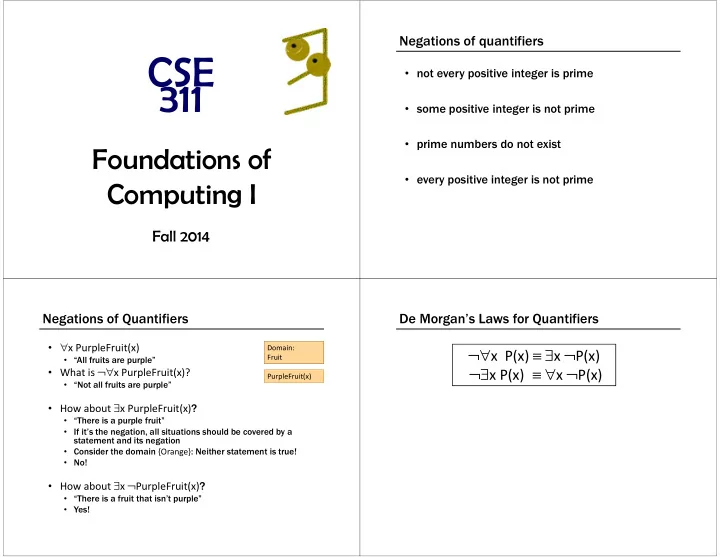
Negations of quantifiers

  • not every positive integer is prime
  • some positive integer is not prime
  • prime numbers do not exist
  • every positive integer is not prime

Negations of Quantifiers

  • ∀x PurpleFruit(x)
  • “All fruits are purple”
  • What is ¬∀x PurpleFruit(x)?
  • “Not all fruits are purple”
  • How about ∃x PurpleFruit(x)?
  • “There is a purple fruit”
  • If it’s the negation, all situations should be covered by a

statement and its negation

  • Consider the domain {Orange}: Neither statement is true!
  • No!
  • How about ∃x ¬PurpleFruit(x)?
  • “There is a fruit that isn’t purple”
  • Yes!

Domain: Fruit PurpleFruit(x)

De Morgan’s Laws for Quantifiers

¬∀x P(x) ≡ ∃x ¬P(x) ¬∃x P(x) ≡ ∀x ¬P(x)

slide-2
SLIDE 2

De Morgan’s laws for Quantifiers ¬ ∃ x ∀ y ( x ≥ y) ≡∀ x ¬ ∀y ( x ≥ y) ≡∀ x ∃ y ¬ ( x ≥ y) ≡∀ x ∃ y (y > x)

“There is no largest integer” “For every integer there is a larger integer”

¬∀x P(x) ≡ ∃x ¬P(x) ¬ ∃x P(x) ≡ ∀x ¬P(x)

Scope of Quantifiers

Example: NotLargest(x) ≡ ∃ y Greater (y, x) ≡ ∃ z Greater (z, x) truth value: doesn’t depend on y or z “bound variables” does depend on x “free variable” quantifiers only act on free variables of the formula they quantify ∀ x (∃ y (P(x,y) → ∀ x Q(y, x)))

scope of quantifiers ∃x (P(x) ∧ ∧ ∧ ∧ Q(x)) vs. ∃x P(x) ∧ ∧ ∧ ∧ ∃x Q(x)

This one asserts P and Q of the same x. This one asserts P and Q

  • f potentially different x’s.

CSE 311: Foundations of Computing

Fall 2014 Lecture 6: Predicate Logic, Logical Inference

slide-3
SLIDE 3

Domain: Non-negative Integers

Turtles All The Way Down

If the tortoise walks at a rate of one node per step, and the hare walks at a rate of two nodes per step, then the distance between them increases by one node per step. If the tortoise is on node x, and the hare is on node 2x, then the distance between them increases by one node per step

OnNode(x)

Nested Quantifiers

  • Bound variable names don’t matter

∀ x ∃ y P(x, y) ≡ ∀ a ∃ b P(a, b)

  • Positions of quantifiers can sometimes change

∀ x (Q(x) ∧ ∃ y P(x, y)) ≡ ∀ x ∃ y (Q(x) ∧ P(x, y))

  • But: order is important...

Predicate with Two Variables

P(x,y) x y

Quantification with Two Variables

expression when true when false ∀x ∀ y P(x, y) ∃ x ∃ y P(x, y) ∀ x ∃ y P(x, y) ∃ y ∀ x P(x, y)

slide-4
SLIDE 4

Logical Inference

  • So far we’ve considered:

– How to understand and express things using propositional and predicate logic – How to compute using Boolean (propositional) logic – How to show that different ways of expressing or computing them are equivalent to each other

  • Logic also has methods that let us infer implied

properties from ones that we know

– Equivalence is a small part of this

Applications of Logical Inference

  • Software Engineering

– Express desired properties of program as set of logical constraints – Use inference rules to show that program implies that those constraints are satisfied

  • Artificial Intelligence

– Automated reasoning

  • Algorithm design and analysis

– e.g., Correctness, Loop invariants.

  • Logic Programming, e.g. Prolog

– Express desired outcome as set of constraints – Automatically apply logic inference to derive solution

Proofs

  • Start with hypotheses and facts
  • Use rules of inference to extend set of facts
  • Result is proved when it is included in the set

An inference rule: Modus Ponens

  • If p and p → q are both true then q must be true
  • Write this rule as
  • Given:

– If it is Monday then you have a 311 class today. – It is Monday.

  • Therefore, by modus ponens:

– You have a 311 class today.

p, p → q ∴ q

slide-5
SLIDE 5

Proofs

Show that r follows from p, p → q, and q → r 1. p given 2. p → q given 3. q → r given 4. q modus ponens from 1 and 2 5. r modus ponens from 3 and 4

Proofs can use equivalences too

Show that ¬p follows from p → q and ¬q 1. p → q given 2. ¬ q given 3. ¬ q → ¬ p contrapositive of 1 4. ¬ p modus ponens from 2 and 3

Inference Rules

  • Each inference rule is written as:

...which means that if both A and B are true then you can infer C and you can infer D.

– For rule to be correct (A ∧ B) → C and (A ∧ B) → D must be a tautologies

  • Sometimes rules don’t need anything to start with.

These rules are called axioms:

– e.g. Excluded Middle Axiom

A, B ∴ C,D ∴ p ∨¬p Simple Propositional Inference Rules

Excluded middle plus two inference rules per binary connective, one to eliminate it and one to introduce it

p ∧ q ∴ p, q p, q ∴ p ∧ q p x ∴ p ∨ q, q ∨ p p ∨ q , ¬p ∴ q p, p → q ∴ q p ⇒ q ∴ p → q

Direct Proof Rule

Not like other rules

slide-6
SLIDE 6

Important: Applications of inference rules

  • You can use equivalences to make substitutions
  • f any sub-formula.
  • Inference rules only can be applied to whole

formulas (not correct otherwise). e.g. 1. p → q given

  • 2. (p ∨ r) → q intro ∨ from 1.

Does not follow! e.g . p=F F F F, q=F F F F, r=T T T T

Direct Proof of an Implication

  • p ⇒ q denotes a proof of q given p as an

assumption

  • The direct proof rule:

If you have such a proof then you can conclude that p → q is true Example:

  • 1. p

assumption

  • 2. p ∨ q

intro for ∨ from 1

  • 3. p → (p ∨ q) direct proof rule

proof subroutine