Approximating the Virtual Network Embedding Problem: Theory and - - PowerPoint PPT Presentation

approximating the virtual network embedding problem
SMART_READER_LITE
LIVE PREVIEW

Approximating the Virtual Network Embedding Problem: Theory and - - PowerPoint PPT Presentation

Approximating the Virtual Network Embedding Problem: Theory and Practice 2 5 3 AC B 2 2 2 2 D 0 3 1 23rd International Symposium on Mathematical Programming 2018 Bordeaux, France Matthias Rost Technische Universitt Berlin,


slide-1
SLIDE 1

Approximating the Virtual Network Embedding Problem: Theory and Practice

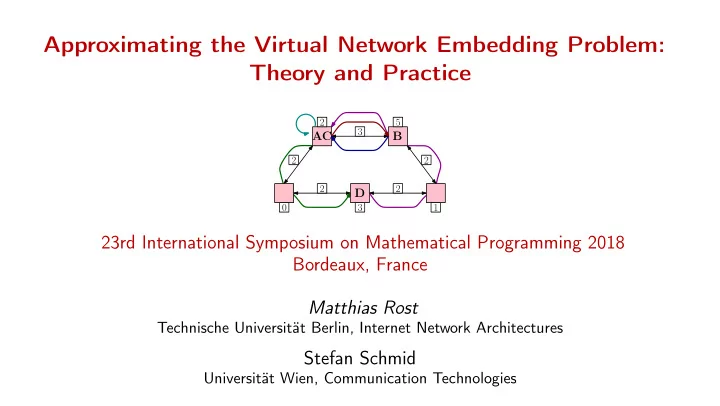
2 5 3 1 3 2 2 2 2

AC B D
23rd International Symposium on Mathematical Programming 2018 Bordeaux, France Matthias Rost

Technische Universität Berlin, Internet Network Architectures

Stefan Schmid

Universität Wien, Communication Technologies

slide-2
SLIDE 2

A Short Introduction to the Virtual Network Embedding Problem

slide-3
SLIDE 3

Operators offer their Network Resources

Data Center Network Wide-Area Network

Substrate (Physical Network) Directed graph GS = (VS, ES) Capacities cS : GS → R≥0

Matthias Rost (TU Berlin) Approximating the Virtual Network Embedding Problem: Theory and Practice ISMP 2018, Bordeaux 3

slide-4
SLIDE 4

Operators offer their Network Resources

Data Center Network Wide-Area Network

Substrate (Physical Network) Directed graph GS = (VS, ES) Capacities cS : GS → R≥0 ‘Classic’ Cloud Computing

A B C D

1 4 3 1

requests

bunch of VMs

User requests virtual machines No guarantee on network performance

Matthias Rost (TU Berlin) Approximating the Virtual Network Embedding Problem: Theory and Practice ISMP 2018, Bordeaux 3

slide-5
SLIDE 5

Operators offer their Network Resources

Data Center Network Wide-Area Network

Substrate (Physical Network) Directed graph GS = (VS, ES) Capacities cS : GS → R≥0 ‘Classic’ Cloud Computing

A B C D

1 4 3 1

requests

bunch of VMs

User requests virtual machines No guarantee on network performance Goal: Virtual Networks (since ≈ 2006)

A B C D

1 4 3 1 1 1 1 1 6

Virtual Network requests

Communication requirements given Network performance will be guaranteed

Matthias Rost (TU Berlin) Approximating the Virtual Network Embedding Problem: Theory and Practice ISMP 2018, Bordeaux 3

slide-6
SLIDE 6

Operators offer their Network Resources

Data Center Network Wide-Area Network

Substrate (Physical Network) Directed graph GS = (VS, ES) Capacities cS : GS → R≥0 Goal: Virtual Networks (since ≈ 2006)

A B C D

1 4 3 1 1 1 1 1 6

Virtual Network requests

Virtual Network Request Gr = (Vr, Er) demands dr : Gr → R≥0 mapping restrictions

V i

S ⊆ VS for i ∈ Vr

E i,j

S ⊆ ES for (i, j) ∈ Er

Matthias Rost (TU Berlin) Approximating the Virtual Network Embedding Problem: Theory and Practice ISMP 2018, Bordeaux 4

slide-7
SLIDE 7

Goal: Virtual Networks (since ≈ 2006)

A B C D

1 4 3 1 1 1 1 1 6

Virtual Network requests

Virtual Network Request Gr = (Vr, Er) demands dr : Gr → R≥0 mapping restrictions

V i

S ⊆ VS for i ∈ Vr

E i,j

S ⊆ ES for (i, j) ∈ Er

Valid Mapping

A B C D AC B D

Substrate (Physical Network) Virtual Network Embedding

Def: Valid mapping mr = (mV , mE) . . .

mV : Vr → VS and mE : Er → P(ES) satisfies valid connectivity: mV (i)

mE (i,j)

  • mV (j)

valid node mapping: mV (i) ∈ V i

S

valid edge mapping: mE(i, j) ⊆ E i,j

S

Matthias Rost (TU Berlin) Approximating the Virtual Network Embedding Problem: Theory and Practice ISMP 2018, Bordeaux 4

slide-8
SLIDE 8

Goal: Virtual Networks (since ≈ 2006)

A B C D

1 4 3 1 1 1 1 1 6

Virtual Network requests

Virtual Network Request Gr = (Vr, Er) demands dr : Gr → R≥0 mapping restrictions

V i

S ⊆ VS for i ∈ Vr

E i,j

S ⊆ ES for (i, j) ∈ Er

Feasible Embedding

A B C D AC B D

1 1 1 1 6

Substrate (Physical Network) Virtual Network Embedding

1/2 1/2 1/2 1/2 2/3 1/3 1 4 3 1 2/2 4/5 0/0 1/1 3/3

Def: Valid mapping mr = (mV , mE) . . .

mV : Vr → VS and mE : Er → P(ES) satisfies valid connectivity: mV (i)

mE (i,j)

  • mV (j)

valid node mapping: mV (i) ∈ V i

S

valid edge mapping: mE(i, j) ⊆ E i,j

S

Def: Feasible embedding mr . . . . . . is valid and respects capacities.

Matthias Rost (TU Berlin) Approximating the Virtual Network Embedding Problem: Theory and Practice ISMP 2018, Bordeaux 4

slide-9
SLIDE 9

Goal: Virtual Networks (since ≈ 2006)

A B C D

1 4 3 1 1 1 1 1 6

Virtual Network requests

Virtual Network Request Gr = (Vr, Er) demands dr : Gr → R≥0 mapping restrictions

V i

S ⊆ VS for i ∈ Vr

E i,j

S ⊆ ES for (i, j) ∈ Er

Feasible Embedding

A B C D AC B D

1 1 1 1 6

Substrate (Physical Network) Virtual Network Embedding

1/2 1/2 1/2 1/2 2/3 1/3 1 4 3 1 2/2 4/5 0/0 1/1 3/3

Def: Feasible embedding mr . . . . . . is valid and respects capacities. Virtual Network Embedding Problem Setting Online vs. Offline Objectives resource minimization, profit maximization, energy minimization, . . .

Matthias Rost (TU Berlin) Approximating the Virtual Network Embedding Problem: Theory and Practice ISMP 2018, Bordeaux 4

slide-10
SLIDE 10

Related Work & Overview of Contributions

slide-11
SLIDE 11

Related Work

Computational Complexity

Andersen [2002] NP-hardness (argument) Amaldi et al. [2016] NP-hardness and inapproximability for offline VNEP (profit)

Heuristics & Exact Algorithms

Generally ≫ 100 works, e.g. . . . Chowdhury et al. [2009] Heuristics based on Linear Programming; hoped for approximations...

Approximations

None for general graphs! Bansal et al. [2011] for trees Even et al. [2016] for chains

Matthias Rost (TU Berlin) Approximating the Virtual Network Embedding Problem: Theory and Practice ISMP 2018, Bordeaux 6

slide-12
SLIDE 12

Related Work

Computational Complexity

Andersen [2002] NP-hardness (argument) Amaldi et al. [2016] NP-hardness and inapproximability for offline VNEP (profit)

Heuristics & Exact Algorithms

Generally ≫ 100 works, e.g. . . . Chowdhury et al. [2009] Heuristics based on Linear Programming; hoped for approximations...

Approximations

None for general graphs! Bansal et al. [2011] for trees Even et al. [2016] for chains VNEP is of crucial importance, yet is hardly understood!

Matthias Rost (TU Berlin) Approximating the Virtual Network Embedding Problem: Theory and Practice ISMP 2018, Bordeaux 6

slide-13
SLIDE 13

Related Work

Computational Complexity

Andersen [2002] NP-hardness (argument) Amaldi et al. [2016] NP-hardness and inapproximability for offline VNEP (profit)

Heuristics & Exact Algorithms

Generally ≫ 100 works, e.g. . . . Chowdhury et al. [2009] Heuristics based on Linear Programming; hoped for approximations...

Approximations

None for general graphs! Bansal et al. [2011] for trees Even et al. [2016] for chains Idea of this Talk: Give Overview on Our Results Complexity results showing NP-completeness and inapproximability. (FPT-)Linear Programs for computing convex combinations of valid mappings. (FPT-)Approximations for offline VNEP based on randomized rounding. Computational evaluation of derived heuristics for offline profit VNEP.

Matthias Rost (TU Berlin) Approximating the Virtual Network Embedding Problem: Theory and Practice ISMP 2018, Bordeaux 6

slide-14
SLIDE 14

Related Work

Computational Complexity

Andersen [2002] NP-hardness (argument) Amaldi et al. [2016] NP-hardness and inapproximability for offline VNEP (profit)

Heuristics & Exact Algorithms

Generally ≫ 100 works, e.g. . . . Chowdhury et al. [2009] Heuristics based on Linear Programming; hoped for approximations...

Approximations

None for general graphs! Bansal et al. [2011] for trees Even et al. [2016] for chains Idea of this Talk: Give Overview on Our Results Complexity results showing NP-completeness and inapproximability. (FPT-)Linear Programs for computing convex combinations of valid mappings. (FPT-)Approximations for offline VNEP based on randomized rounding. Computational evaluation of derived heuristics for offline profit VNEP.

Matthias Rost (TU Berlin) Approximating the Virtual Network Embedding Problem: Theory and Practice ISMP 2018, Bordeaux 6

slide-15
SLIDE 15

Related Work

Computational Complexity

Andersen [2002] NP-hardness (argument) Amaldi et al. [2016] NP-hardness and inapproximability for offline VNEP (profit)

Heuristics & Exact Algorithms

Generally ≫ 100 works, e.g. . . . Chowdhury et al. [2009] Heuristics based on Linear Programming; hoped for approximations...

Approximations

None for general graphs! Bansal et al. [2011] for trees Even et al. [2016] for chains Idea of this Talk: Give Overview on Our Results Complexity results showing NP-completeness and inapproximability. (FPT-)Linear Programs for computing convex combinations of valid mappings. (FPT-)Approximations for offline VNEP based on randomized rounding. Computational evaluation of derived heuristics for offline profit VNEP.

Matthias Rost (TU Berlin) Approximating the Virtual Network Embedding Problem: Theory and Practice ISMP 2018, Bordeaux 6

slide-16
SLIDE 16

Related Work

Computational Complexity

Andersen [2002] NP-hardness (argument) Amaldi et al. [2016] NP-hardness and inapproximability for offline VNEP (profit)

Heuristics & Exact Algorithms

Generally ≫ 100 works, e.g. . . . Chowdhury et al. [2009] Heuristics based on Linear Programming; hoped for approximations...

Approximations

None for general graphs! Bansal et al. [2011] for trees Even et al. [2016] for chains Idea of this Talk: Give Overview on Our Results Complexity results showing NP-completeness and inapproximability. (FPT-)Linear Programs for computing convex combinations of valid mappings. (FPT-)Approximations for offline VNEP based on randomized rounding. Computational evaluation of derived heuristics for offline profit VNEP.

Matthias Rost (TU Berlin) Approximating the Virtual Network Embedding Problem: Theory and Practice ISMP 2018, Bordeaux 6

slide-17
SLIDE 17

Idea of this Talk: Give Overview on Our Results Complexity results showing NP-completeness and inapproximabilitya. (FPT-)Linear Programs for computing convex combinations of valid mappingsb,c. (FPT-)Approximations for offline VNEP based on randomized roundingb,c. Computational evaluation of derived heuristics for offline profit VNEPb.

a

Matthias Rost and Stefan Schmid. Charting the Complexity Landscape of Virtual Network

  • Embeddings. In Proc. IFIP Networking, 2018c

b Matthias Rost and Stefan Schmid. Virtual Network Embedding Approximations: Leveraging

Randomized Rounding. In Proc. IFIP Networking, 2018d

c Matthias Rost and Stefan Schmid. (FPT-)Approximation Algorithms for the Virtual Network

Embedding Problem. Technical report, March 2018a. URL http://arxiv.org/abs/1803.04452

Matthias Rost (TU Berlin) Approximating the Virtual Network Embedding Problem: Theory and Practice ISMP 2018, Bordeaux 6

slide-18
SLIDE 18

Complexity of the VNEP1

1Matthias Rost and Stefan Schmid. Charting the Complexity Landscape of Virtual Network Embeddings.

In Proc. IFIP Networking, 2018c

slide-19
SLIDE 19

Reminder: 3-SAT and NP-Completeness

3-SAT-Formula φ φ =

Ci∈Cφ Ci with Ci ∈ Cφ being disjunctions of at most 3 (possible negated) literals.

Example 3-SAT formula φ over literals Lφ = {x1, x2, x3, x4} φ = (x1 ∨ x2 ∨ x3)

  • C1

∧ (¯ x1 ∨ x2 ∨ x4)

  • C2

∧ (x2 ∨ ¯ x3 ∨ x4)

  • C3

Definition of 3-SAT Decide whether satisfying assignment a : Lφ → {F, T} exists for formula φ. Output: Yes/No. Theorem: Karp [1972] 3-SAT is NP-complete.

Matthias Rost (TU Berlin) Approximating the Virtual Network Embedding Problem: Theory and Practice ISMP 2018, Bordeaux 8

slide-20
SLIDE 20

Methodology: Proving NP-completeness

Proving NP-completeness of the VNEP

1 VNEP lies in NP (answer can be checked in polynomial time). 2 Reduction from 3-SAT to VNEP.

Outline of Reduction Framework

3-SAT instance φ VNEP instance (Gr(φ), GS(φ), restrictions) φ satisfiable? feasible embedding of Gr(φ) on GS(φ) under restrictions?

Matthias Rost (TU Berlin) Approximating the Virtual Network Embedding Problem: Theory and Practice ISMP 2018, Bordeaux 9

slide-21
SLIDE 21

Our Reduction Framework

Proving NP-completeness of the VNEP

1 VNEP lies in NP (answer can be checked in polynomial time). 2 Reduction from 3-SAT to VNEP.

Outline of Reduction Framework

3-SAT instance φ VNEP instance (Gr(φ), GS(φ), restrictions) φ satisfiable? feasible embedding of Gr(φ) on GS(φ) under restrictions?

Matthias Rost (TU Berlin) Approximating the Virtual Network Embedding Problem: Theory and Practice ISMP 2018, Bordeaux 10

slide-22
SLIDE 22

Our Reduction Framework

Input: 3-SAT formula φ = (x1 ∨ x2 ∨ x3) ∧ (¯ x1 ∨ x2 ∨ x4) ∧ (x2 ∨ ¯ x3 ∨ x4) Request Gr(φ) Vr(φ) = {vi | Ci ∈ Cφ}

v1 v3 v2

Er(φ) = { (vi, vj) | Ci introduces literal used by Cj } Substrate GS(φ)

  • ne node per clause and

per satisfying assignment edges as for the requests, if assignments do not contradict

x1, x2, x3 :TTT x1, x2, x3 :TTF x1, x2, x3 :TFT x1, x2, x4 : TTT x1, x2, x4 : TTF x2, x3, x4 : TTT x2, x3, x4 : TTF x2, x3, x4 : TFT x1, x2, x4 : TFT

Matthias Rost (TU Berlin) Approximating the Virtual Network Embedding Problem: Theory and Practice ISMP 2018, Bordeaux 10

slide-23
SLIDE 23

Complete Picture

φ:

(x1 ∨ x2 ∨ x3) ∧ (¯ x1 ∨ x2 ∨ x4) ∧ (x2 ∨ ¯ x3 ∨ x4)

GS(φ):

x1, x2, x3 : TTT x1, x2, x3 : TTF x1, x2, x3 : TFT x1, x2, x3 : TFF x1, x2, x3 : FTT x1, x2, x3 : FTF x1, x2, x3 : FFT x1, x2, x4 : TTT x1, x2, x4 : TTF x1, x2, x4 : FTT x1, x2, x4 : FTF x1, x2, x4 : FFT x1, x2, x4 : FFF x2, x3, x4 : TTT x2, x3, x4 : TTF x2, x3, x4 : TFT x2, x3, x4 : TFF x2, x3, x4 : FTT x2, x3, x4 : FFT x2, x3, x4 : FFF v1 v3 v2

Gr(φ):

x1, x2, x4 : TFT Matthias Rost (TU Berlin) Approximating the Virtual Network Embedding Problem: Theory and Practice ISMP 2018, Bordeaux 11

slide-24
SLIDE 24

Our Reduction Framework

Outline of Reduction Framework

3-SAT instance φ VNEP instance (Gr(φ), GS(φ), restrictions) φ satisfiable? feasible embedding of Gr(φ) on GS(φ) under restrictions?

Matthias Rost (TU Berlin) Approximating the Virtual Network Embedding Problem: Theory and Practice ISMP 2018, Bordeaux 12

slide-25
SLIDE 25

Our Reduction Framework

Outline of Reduction Framework

3-SAT instance φ VNEP instance (Gr(φ), GS(φ), restrictions) φ satisfiable? feasible embedding of Gr(φ) on GS(φ) under restrictions?

Base Lemma Formula φ is satisfiable if and only if there exists a mapping of Gr(φ) on GS(φ), s.t. (1) each virtual node vi is mapped to a ‘satisfying assignment node’ of the i-th clause, and (2) all virtual edges are mapped on exactly one substrate edge.

Matthias Rost (TU Berlin) Approximating the Virtual Network Embedding Problem: Theory and Practice ISMP 2018, Bordeaux 12

slide-26
SLIDE 26

Our Reduction Framework

Base Lemma Formula φ is satisfiable if and only if there exists a mapping of Gr(φ) on GS(φ), s.t. (1) each virtual node vi is mapped to a ‘satisfying assignment node’ of the i-th clause, and (2) all virtual edges are mapped on exactly one substrate edge. Example φ = (x1 ∨ x2 ∨ x3) ∧ (¯ x1 ∨ x2 ∨ x4) ∧ (x2 ∨ ¯ x3 ∨ x4)

Assignment for φ x1 →T x2 →T x3 →F x4 →F Request

v1 v3 v2

Embedding satisfying conditions (1) and (2)

x1, x2, x3 : TTF x1, x2, x3 : TFT x1, x2, x3 : TFF x1, x2, x4 : TTF x2, x3, x4 : TTF x2, x3, x4 : TFT x2, x3, x4 : TFF x1, x2, x4 : TFT

Matthias Rost (TU Berlin) Approximating the Virtual Network Embedding Problem: Theory and Practice ISMP 2018, Bordeaux 12

slide-27
SLIDE 27

Our Reduction Framework

Base Lemma Formula φ is satisfiable if and only if there exists a mapping of Gr(φ) on GS(φ), s.t. (1) each virtual node vi is mapped to a ‘satisfying assignment node’ of the i-th clause, and (2) all virtual edges are mapped on exactly one substrate edge. Decision VNEP is NP-complete under mapping restrictions Node placement restrictions enforce (1)

x1, x2, x3 : TTT x1, x2, x3 : TTF x1, x2, x3 : TFT x1, x2, x3 : TFF x1, x2, x4 : TTT x1, x2, x4 : TTF x2, x3, x4 : TTT x2, x3, x4 : TTF x2, x3, x4 : TFT x2, x3, x4 : TFF v1 v3 v2 x1, x2, x4 : TFT

Routing restrictions enforce (2)

x1, x2, x3 : TTT x1, x2, x3 : TTF x1, x2, x3 : TFT x1, x2, x3 : TFF x1, x2, x4 : TTT x1, x2, x4 : TTF x2, x3, x4 : TTT x2, x3, x4 : TTF x2, x3, x4 : TFT x2, x3, x4 : TFF v1 v3 v2 x1, x2, x4 : TFT Matthias Rost (TU Berlin) Approximating the Virtual Network Embedding Problem: Theory and Practice ISMP 2018, Bordeaux 12

slide-28
SLIDE 28

Our Reduction Framework

Base Lemma Formula φ is satisfiable if and only if there exists a mapping of Gr(φ) on GS(φ), s.t. (1) each virtual node vi is mapped to a ‘satisfying assignment node’ of the i-th clause, and (2) all virtual edges are mapped on exactly one substrate edge. Decision VNEP is NP-complete for degree-bounded, planar request graphs Reduction from planar 3-SAT variant using literals max. 4 times (see Kratochvíl [1994]):

each planar formula φ leads to a planar request graph Gr(φ) each node of Gr(φ) has degree at most 12

v1 v3 v2 u1 u2 u4 u3

planar graph Gφ

u1 u2 u4 u3 v1 v3 v2 u1 u2 u4 u3 v1 v3 v2

planar graph Gr(φ)

v1 v3 v2 Matthias Rost (TU Berlin) Approximating the Virtual Network Embedding Problem: Theory and Practice ISMP 2018, Bordeaux 12

slide-29
SLIDE 29

(FPT-)Linear Programs for Computing Convex Combinations of Valid Mappings2,3

2

Matthias Rost and Stefan Schmid. Virtual Network Embedding Approximations: Leveraging Randomized

  • Rounding. In Proc. IFIP Networking, 2018d

3

Matthias Rost and Stefan Schmid. (FPT-)Approximation Algorithms for the Virtual Network Embedding

  • Problem. Technical report, March 2018a. URL http://arxiv.org/abs/1803.04452
slide-30
SLIDE 30

Linear Programming: Classic MCF Formulation and its Limits

Classic LP Formulation

Formulation 1: Classic MCF Formulation for the VNEP

  • u∈V i

S

yu

r,i= xr

∀r ∈ R, i ∈ Vr (1)

  • u∈VS\V i

S

yu

r,i= 0

∀r ∈ R, i ∈ Vr (2)   

  • (u,v)∈δ+(u)

zu,v

r,i,j

  • (v,u)∈δ−(u)

zv,u

r,i,j

  =

  • yu

r,i

−yu

r,j

  • r ∈ R, (i, j) ∈ Er,

u ∈ VS

  • (3)

zu,v

r,i,j= 0

  • r ∈ R, (i, j) ∈ Er,

(u, v) ∈ ES \ E i,j

S

  • (4)
  • i∈Vr,τr(i)=τ

dr(i) · yu

r,i= aτ,u r

∀r ∈ R, (τ, u) ∈ RV

S

(5)

  • (i,j)∈Er

dr(i, j) · zu,v

r,i,j= au,v r

∀r ∈ R, (u, v) ∈ ES (6)

  • r∈R

ax,y

r

≤ cS(x, y) ∀(x, y) ∈ RS (7)

Main Building Block: Multi-Commodity Flows yu

r,i ∈ [0, 1]: maps node i ∈ Vr on VS

zu,v

r,i,j ∈ [0, 1]: maps (i, j) ∈ Er on (u, v) ∈ ES

  • (u,v)∈δ+(u)

zu,v

r,i,j

  • (v,u)∈δ−(u)

zv,u

r,i,j = yu r,i − yu r,j

(3) Local Connectivity Property Given a (fractional) mapping of i ∈ Vr to u ∈ VS, a ‘valid’ mapping can be recovered for edges incident to i and their respective endpoints.

Matthias Rost (TU Berlin) Approximating the Virtual Network Embedding Problem: Theory and Practice ISMP 2018, Bordeaux 14

slide-31
SLIDE 31

Linear Programming: Classic MCF Formulation and its Limits

Example

Request i j k Substrate

1 2i 1 2j 1 2k

LP

1 2i 1 2k 1 2j 1 2j

Solution

Main Building Block: Multi-Commodity Flows yu

r,i ∈ [0, 1]: maps node i ∈ Vr on VS

zu,v

r,i,j ∈ [0, 1]: maps (i, j) ∈ Er on (u, v) ∈ ES

  • (u,v)∈δ+(u)

zu,v

r,i,j

  • (v,u)∈δ−(u)

zv,u

r,i,j = yu r,i − yu r,j

(3) Local Connectivity Property Given a (fractional) mapping of i ∈ Vr to u ∈ VS, a ‘valid’ mapping can be recovered for edges incident to i and their respective endpoints.

Matthias Rost (TU Berlin) Approximating the Virtual Network Embedding Problem: Theory and Practice ISMP 2018, Bordeaux 15

slide-32
SLIDE 32

Linear Programming: Classic MCF Formulation and its Limits

Example

Request i j k Substrate

1 2i 1 2j 1 2k

LP

1 2i 1 2k 1 2j 1 2j

Extraction i j k Order Solution

Main Building Block: Multi-Commodity Flows yu

r,i ∈ [0, 1]: maps node i ∈ Vr on VS

zu,v

r,i,j ∈ [0, 1]: maps (i, j) ∈ Er on (u, v) ∈ ES

  • (u,v)∈δ+(u)

zu,v

r,i,j

  • (v,u)∈δ−(u)

zv,u

r,i,j = yu r,i − yu r,j

(3) Local Connectivity Property Given a (fractional) mapping of i ∈ Vr to u ∈ VS, a ‘valid’ mapping can be recovered for edges incident to i and their respective endpoints.

Matthias Rost (TU Berlin) Approximating the Virtual Network Embedding Problem: Theory and Practice ISMP 2018, Bordeaux 15

slide-33
SLIDE 33

Linear Programming: Classic MCF Formulation and its Limits

Example

Request i j k Substrate

1 2i 1 2j 1 2k

LP

1 2i 1 2k 1 2j 1 2j

Extraction i j k Order Solution

Local Connectivity Property Given a (fractional) mapping of i ∈ Vr to u ∈ VS, a ‘valid’ mapping can be recovered for edges incident to i and their respective endpoints. Main Issue Targets of confluences pose problems! In the example: target k of confluence (i, k), (i, j), (j, k).

Matthias Rost (TU Berlin) Approximating the Virtual Network Embedding Problem: Theory and Practice ISMP 2018, Bordeaux 15

slide-34
SLIDE 34

Linear Programming: Classic MCF Formulation and its Limits

Example

Request i j k Substrate

1 2i 1 2j 1 2k

LP

1 2i 1 2k 1 2j 1 2j

Extraction i j k Order Solution

Main Issue Targets of confluences pose problems! In the example: target k of confluence (i, k), (i, j), (j, k). Theorem Decomposing solutions to the MCF LP is not possible in general.

Matthias Rost (TU Berlin) Approximating the Virtual Network Embedding Problem: Theory and Practice ISMP 2018, Bordeaux 15

slide-35
SLIDE 35

Linear Programming: Classic MCF Formulation and its Limits

Example

Request i j k Substrate

1 2i 1 2j 1 2k

LP

1 2i 1 2k 1 2j 1 2j

Extraction i j k Order Solution

Main Issue Targets of confluences pose problems! In the example: target k of confluence (i, k), (i, j), (j, k). Theorem Decomposing solutions to the MCF LP is not possible in general. Theorem MCF LP Formulation has infinite integrality gap.

Matthias Rost (TU Berlin) Approximating the Virtual Network Embedding Problem: Theory and Practice ISMP 2018, Bordeaux 15

slide-36
SLIDE 36

Linear Programming: Classic MCF Formulation and its Limits

Example

Request i j k Substrate

1 2i 1 2j 1 2k

LP

1 2i 1 2k 1 2j 1 2j

Extraction i j k Order Solution

Main Issue Targets of confluences pose problems! In the example: target k of confluence (i, k), (i, j), (j, k). Key Insight If we fix confluence target nodes valid mappings can always be extracted, when following the extraction order. In the example: Consider one sub-LP formulation per potential mapping location of k.

Matthias Rost (TU Berlin) Approximating the Virtual Network Embedding Problem: Theory and Practice ISMP 2018, Bordeaux 15

slide-37
SLIDE 37

Outline of Novel Decomposable LP Formulations

Extraction Order G X

r

Rooted acyclic reorientation of the original request graph Gr. G X

r

is not unique! Confluence C X

i,j

A confluence C X

i,j from i to j is a pair of

(node-)disjoint paths connecting i to j in G X

r .

Matthias Rost (TU Berlin) Approximating the Virtual Network Embedding Problem: Theory and Practice ISMP 2018, Bordeaux 16

slide-38
SLIDE 38

Outline of Novel Decomposable LP Formulations

Extraction Order G X

r

Rooted acyclic reorientation of the original request graph Gr. G X

r

is not unique! Confluence C X

i,j

A confluence C X

i,j from i to j is a pair of

(node-)disjoint paths connecting i to j in G X

r .

Pre-Processing Extraction Orders If edge e lies on confluence C X

i,j, then it is labeled with the confluence’s target j.

Labeling can be computed in polynomial-time (by applying Menger’s theorem). Each label has unique root node at which the mapping of the label must be fixed. Outgoing edges are partitioned into edge bags not sharing labels.

b c a k {c} {a} {k}

{a, b, c}

{a, b}

Matthias Rost (TU Berlin) Approximating the Virtual Network Embedding Problem: Theory and Practice ISMP 2018, Bordeaux 16

slide-39
SLIDE 39

Outline of Novel Decomposable LP Formulations

Extraction Order G X

r

Rooted acyclic reorientation of the original request graph Gr. G X

r

is not unique! Confluence C X

i,j

A confluence C X

i,j from i to j is a pair of

(node-)disjoint paths connecting i to j in G X

r .

Pre-Processing Extraction Orders If edge e lies on confluence C X

i,j, then it is labeled with the confluence’s target j.

Labeling can be computed in polynomial-time (by applying Menger’s theorem). Each label has unique root node at which the mapping of the label must be fixed. Outgoing edges are partitioned into edge bags not sharing labels.

b c a k {c} {a} {k}

{a, b, c}

{a, b} {j, l} i l j k {j} {i, l} {k} {l}

Matthias Rost (TU Berlin) Approximating the Virtual Network Embedding Problem: Theory and Practice ISMP 2018, Bordeaux 16

slide-40
SLIDE 40

Outline of Novel Decomposable LP Formulations

Extraction Order G X

r

Rooted acyclic reorientation of the original request graph Gr. G X

r

is not unique! Confluence C X

i,j

A confluence C X

i,j from i to j is a pair of

(node-)disjoint paths connecting i to j in G X

r .

Pre-Processing Extraction Orders If edge e lies on confluence C X

i,j, then it is labeled with the confluence’s target j.

Labeling can be computed in polynomial-time (by applying Menger’s theorem). Each label has unique root node at which the mapping of the label must be fixed. Outgoing edges are partitioned into edge bags not sharing labels.

b c a k {c} {a} {k}

{a, b, c}

{a, b} {j, l} i l j k {j} {i, l} {k} {l}

Edge Bags

Matthias Rost (TU Berlin) Approximating the Virtual Network Embedding Problem: Theory and Practice ISMP 2018, Bordeaux 16

slide-41
SLIDE 41

Outline of Novel Decomposable LP Formulations

Extraction Order G X

r

Rooted acyclic reorientation of the original request graph Gr. G X

r

is not unique! Confluence C X

i,j

A confluence C X

i,j from i to j is a pair of

(node-)disjoint paths connecting i to j in G X

r .

Pre-Processing Extraction Orders If edge e lies on confluence C X

i,j, then it is labeled with the confluence’s target j.

Labeling can be computed in polynomial-time (by applying Menger’s theorem). Each label has unique root node at which the mapping of the label must be fixed. Outgoing edges are partitioned into edge bags not sharing labels.

b c a k {c} {a} {k}

{a, b, c}

{a, b}

a

c

Matthias Rost (TU Berlin) Approximating the Virtual Network Embedding Problem: Theory and Practice ISMP 2018, Bordeaux 16

slide-42
SLIDE 42

Outline of Novel Decomposable LP Formulations

Pre-Processing Extraction Orders If edge e lies on confluence C X

i,j, then it is labeled with the confluence’s target j.

Labeling can be computed in polynomial-time (by applying Menger’s theorem). Each label has unique root node at which the mapping of the label must be fixed. Outgoing edges are partitioned into edge bags not sharing labels.

b c a k {c} {a} {k}

{a, b, c}

{a, b} b c a k {k}

{a, b, c}

b c a {c} {a, b}

Matthias Rost (TU Berlin) Approximating the Virtual Network Embedding Problem: Theory and Practice ISMP 2018, Bordeaux 16

slide-43
SLIDE 43

Outline of Novel Decomposable LP Formulation

Extraction Order G X

r

Rooted acyclic reorientation of the original request graph Gr. G X

r

is not unique! Confluence C X

i,j

A confluence C X

i,j from i to j is a pair of

(node-)disjoint paths connecting i to j in G X

r .

Pre-Processing Extraction Orders Generation of Linear Program If edge e ∈ E X

r

lies on confluence C X

i,j, then

it is labeled with the confluence’s target j. If e ∈ Er is labeled with LX

r,e, then |VS||LX

r,e|

many commodities are considered for e. Outgoing edges are partitioned into edge bags not sharing labels. For each edge bag variables are introduced to enumerate all potential label mappings. Each label has unique root node at which the mapping of the label must be fixed. Root nodes of labels ‘decide’ on the confluence’s mapping.

Matthias Rost (TU Berlin) Approximating the Virtual Network Embedding Problem: Theory and Practice ISMP 2018, Bordeaux 17

slide-44
SLIDE 44

Outline of Novel Decomposable LP Formulation

Extraction Order G X

r

Rooted acyclic reorientation of the original request graph Gr. G X

r

is not unique! Confluence C X

i,j

A confluence C X

i,j from i to j is a pair of

(node-)disjoint paths connecting i to j in G X

r .

Pre-Processing Extraction Orders Generation of Linear Program If edge e ∈ E X

r

lies on confluence C X

i,j, then

it is labeled with the confluence’s target j. If e ∈ Er is labeled with LX

r,e, then |VS||LX

r,e|

many commodities are considered for e. Outgoing edges are partitioned into edge bags not sharing labels. For each edge bag variables are introduced to enumerate all potential label mappings. Each label has unique root node at which the mapping of the label must be fixed. Root nodes of labels ‘decide’ on the confluence’s mapping.

Matthias Rost (TU Berlin) Approximating the Virtual Network Embedding Problem: Theory and Practice ISMP 2018, Bordeaux 17

slide-45
SLIDE 45

Outline of Novel Decomposable LP Formulation

Extraction Order G X

r

Rooted acyclic reorientation of the original request graph Gr. G X

r

is not unique! Confluence C X

i,j

A confluence C X

i,j from i to j is a pair of

(node-)disjoint paths connecting i to j in G X

r .

Pre-Processing Extraction Orders Generation of Linear Program If edge e ∈ E X

r

lies on confluence C X

i,j, then

it is labeled with the confluence’s target j. If e ∈ Er is labeled with LX

r,e, then |VS||LX

r,e|

many commodities are considered for e. Outgoing edges are partitioned into edge bags not sharing labels. For each edge bag variables are introduced to enumerate all potential label mappings. Each label has unique root node at which the mapping of the label must be fixed. Root nodes of labels ‘decide’ on the confluence’s mapping.

Matthias Rost (TU Berlin) Approximating the Virtual Network Embedding Problem: Theory and Practice ISMP 2018, Bordeaux 17

slide-46
SLIDE 46

Outline of Novel Decomposable LP Formulation

Pre-Processing Extraction Orders Generation of Linear Program If edge e ∈ E X

r

lies on confluence C X

i,j, then

it is labeled with the confluence’s target j. If e ∈ Er is labeled with LX

r,e, then |VS||LX

r,e|

many commodities are considered for e. Outgoing edges are partitioned into edge bags not sharing labels. For each edge bag variables are introduced to enumerate all potential label mappings. Each label has unique root node at which the mapping of the label must be fixed. Root nodes of labels ‘decide’ on the confluence’s mapping.

Stitching Flow Variables via Node Mapping Variables

yi1

r,i(i, a), [i → i1, l → l1]

yi1

r,f(i, a), [i → i1, l → l2]

yi1

r,i(i, a), [i → i2, l → l1]

yi1

r,i(i, a), [i → i2, l → l2]

γi1

r,i,1,[j→j1,l→l1]

{j} {i, l} {j, l} a i c f

γi1

r,i,1,[j→j1,l→l2]

γi1

r,i,1,[j→j2,l→l1]

γi1

r,i,1,[j→j2,l→l2]

yi1

r,i(i, c), [j → j1]

yi1

r,i(i, c), [j → j2]

yi1

r,i(f, i), [j → j1, l → l1]

yi1

r,i(f, i), [j → j1, l → l2]

yi1

r,i(f, i), [j → j2, l → l1]

yi1

r,i(f, i), [j → j2, l → l2]

Matthias Rost (TU Berlin) Approximating the Virtual Network Embedding Problem: Theory and Practice ISMP 2018, Bordeaux 17

slide-47
SLIDE 47

Outline of Novel Decomposable LP Formulation

Pre-Processing Extraction Orders Generation of Linear Program If edge e ∈ E X

r

lies on confluence C X

i,j, then

it is labeled with the confluence’s target j. If e ∈ Er is labeled with LX

r,e, then |VS||LX

r,e|

many commodities are considered for e. Outgoing edges are partitioned into edge bags not sharing labels. For each edge bag variables are introduced to enumerate all potential label mappings. Each label has unique root node at which the mapping of the label must be fixed. Root nodes of labels ‘decide’ on the confluence’s mapping.

  • Def. Extraction Width ewX (G X

r )

. . . is the size of the largest edge bag plus

  • ne of the extraction order ewX (G X

r ).

Proof of Decomposability . . . via decomposition algorithm. Overall runtime O(poly(|GS|ewX (G X

r ) · |Gr|)). Matthias Rost (TU Berlin) Approximating the Virtual Network Embedding Problem: Theory and Practice ISMP 2018, Bordeaux 17

slide-48
SLIDE 48

Novel Decomposable LP Formulation: Takeaways

Overview of Construction Request Graph Gr ⇓ Extraction Order G X

r

⇓ Labeling / Extraction Width ewX (G X

r )

⇓ LP of size O(poly(|GS|ewX (G X

r ) · |Gr|))

⇓ Decomposition Algorithm with runtime O(poly(|GS|ewX (G X

r ) · |Gr|))

⇓ Convex Combinations of valid mappings: Dr = {(f k

r , mk r )|f k r > 0, mk r ∈ Mr}

Matthias Rost (TU Berlin) Approximating the Virtual Network Embedding Problem: Theory and Practice ISMP 2018, Bordeaux 18

slide-49
SLIDE 49

Extraction Width – Overview of Results

Which graphs have bounded extraction width? How to find extraction orders of small width?

Matthias Rost (TU Berlin) Approximating the Virtual Network Embedding Problem: Theory and Practice ISMP 2018, Bordeaux 19

slide-50
SLIDE 50

Extraction Width – Overview of Results

Which graphs have bounded extraction width? How to find extraction orders of small width? Extraction Width: Overview of Results Extraction width may vary by factor Ω(|Vr|) Minimizing extraction width is NP-hard (via reduction from Vertex-Cover) Cactus graphs (cycles intersect in at most a single node) have bounded extraction width ewX(GX

w) ≥ |Vr|/2

ewX(GX

w) = 2

w1 w2 w3 wn/2 wn wn/2+1 wn/2+2 w1 w2 w3 wn/2 wn wn/2+1 wn/2+2 wc wc

Matthias Rost (TU Berlin) Approximating the Virtual Network Embedding Problem: Theory and Practice ISMP 2018, Bordeaux 19

slide-51
SLIDE 51

Extraction Width – Overview of Results

Which graphs have bounded extraction width? How to find extraction orders of small width? Extraction Width: Overview of Results Extraction width may vary by factor Ω(|Vr|) Minimizing extraction width is NP-hard (via reduction from Vertex-Cover) Cactus graphs (cycles intersect in at most a single node) have bounded extraction width

Vertex Cover

Matthias Rost (TU Berlin) Approximating the Virtual Network Embedding Problem: Theory and Practice ISMP 2018, Bordeaux 19

slide-52
SLIDE 52

Extraction Width – Overview of Results

Which graphs have bounded extraction width? How to find extraction orders of small width? Extraction Width: Overview of Results Extraction width may vary by factor Ω(|Vr|) Minimizing extraction width is NP-hard (via reduction from Vertex-Cover) Cactus graphs (cycles intersect in at most a single node) have bounded extraction width Real World Cactus Graph Examples

Customer Internet LB1 LB2 Cache FW NAT VM1 VM2 VM3 VM4 VM5

Service Chain Virtual Cluster

Matthias Rost (TU Berlin) Approximating the Virtual Network Embedding Problem: Theory and Practice ISMP 2018, Bordeaux 19

slide-53
SLIDE 53

Extraction Width – Overview of Results

Extraction Width: Overview of Results Extraction width may vary by factor Ω(|Vr|) Minimizing extraction width is NP-hard (via reduction from Vertex-Cover) Cactus graphs (cycles intersect in at most a single node) have bounded extraction width Real World Cactus Graph Examples

Customer Internet LB1 LB2 Cache FW NAT VM1 VM2 VM3 VM4 VM5

Service Chain Virtual Cluster Can we do substantially better? No! Computing valid mappings for planar graphs is NP-complete ⇒ FPT algorithms are necessary.

Matthias Rost (TU Berlin) Approximating the Virtual Network Embedding Problem: Theory and Practice ISMP 2018, Bordeaux 19

slide-54
SLIDE 54

(FPT-)Approximations for offline VNEP based on Randomized Rounding2,3

2

Matthias Rost and Stefan Schmid. Virtual Network Embedding Approximations: Leveraging Randomized

  • Rounding. In Proc. IFIP Networking, 2018d

3

Matthias Rost and Stefan Schmid. (FPT-)Approximation Algorithms for the Virtual Network Embedding

  • Problem. Technical report, March 2018a. URL http://arxiv.org/abs/1803.04452
slide-55
SLIDE 55

Approximating the Offline VNEP

Profit Variant A set of request R = {r1, r2, . . .} is given. Profit for request pr > 0. Task: Embed subset of requests feasibly maximizing the attained profit.

Matthias Rost (TU Berlin) Approximating the Virtual Network Embedding Problem: Theory and Practice ISMP 2018, Bordeaux 21

slide-56
SLIDE 56

Approximating the Offline VNEP

Profit Variant A set of request R = {r1, r2, . . .} is given. Profit for request pr > 0. Task: Embed subset of requests feasibly maximizing the attained profit. Cost Variant A set of request R = {r1, r2, . . .} is given. Substrate resource costs kS : GS → R≥0. Task: Find feasible embeddings for all requests minimizing cost.

Matthias Rost (TU Berlin) Approximating the Virtual Network Embedding Problem: Theory and Practice ISMP 2018, Bordeaux 21

slide-57
SLIDE 57

Approximating the Offline VNEP

Focus: Profit Variant A set of request R = {r1, r2, . . .} is given. Profit for request pr > 0. Task: Embed subset of requests feasibly maximizing the attained profit. Cost Variant A set of request R = {r1, r2, . . .} is given. Substrate resource costs kS : GS → R≥0. Task: Find feasible embeddings for all requests minimizing cost.

Matthias Rost (TU Berlin) Approximating the Virtual Network Embedding Problem: Theory and Practice ISMP 2018, Bordeaux 21

slide-58
SLIDE 58

Approximating the Offline VNEP

Focus: Profit Variant A set of request R = {r1, r2, . . .} is given. Profit for request pr > 0. Task: Embed subset of requests feasibly maximizing the attained profit. Cost Variant A set of request R = {r1, r2, . . .} is given. Substrate resource costs kS : GS → R≥0. Task: Find feasible embeddings for all requests minimizing cost. Combine Single Decomposable LP Formulations while . . . . . . enforcing capacity constraints and maximizing the profit. ⇒ LP for offline VNEP (profit).

Matthias Rost (TU Berlin) Approximating the Virtual Network Embedding Problem: Theory and Practice ISMP 2018, Bordeaux 21

slide-59
SLIDE 59

Approximating the Offline VNEP

Combine Single Decomposable LP Formulations while . . . . . . enforcing capacity constraints and maximizing the profit. ⇒ LP for offline VNEP (profit). Request A B C D

1 4 3 1 1 1 1 1 6

Valid Mappings Mr = {m1

r , m2 r , m3 r , . . .}

AC B D

1/2 1/2 1/2 1/2 2/3 1/3 2/2 4/5 0/0 3/3 0/0

AC

2/2 7/5 0/0 0/3 2/3 2/3 0/0 0/0 0/0 0/0 0/0

BD

. . . Valid mappings do not necessarily respect capacity constraints!

Matthias Rost (TU Berlin) Approximating the Virtual Network Embedding Problem: Theory and Practice ISMP 2018, Bordeaux 21

slide-60
SLIDE 60

Approximating the Offline VNEP

Combine Single Decomposable LP Formulations while . . . . . . enforcing capacity constraints and maximizing the profit. ⇒ LP for offline VNEP (profit). Decomposable LP Formulation allows us to solve Fractional VNEP

Is k-th mapping of request r chosen? Select at most one mapping: Enforce capacity for each resource x: Maximize the profit: f k

r ∈ {0, 1}

∀r ∈ R, mk

r ∈ Mr

(8)

  • mk

r ∈Mr

f k

r ≤ 1

∀r ∈ R (9)

  • r∈R
  • mk

r ∈Mr

A(mk

r , x) · f k r ≤ cS(x)

∀x ∈ RS (10) max

  • r∈R
  • mk

r ∈Mr

prf k

r

(11)

Matthias Rost (TU Berlin) Approximating the Virtual Network Embedding Problem: Theory and Practice ISMP 2018, Bordeaux 21

slide-61
SLIDE 61

Randomized Rounding Revisited

Example Substrate Network

2 5 3 1 3 2 2 2 2

Request r1: profit 100$

A B C D

1 4 3 1 1 1 1 1 6

Request r2: profit 50$

E F G

1 2 1 3 1 2 Matthias Rost (TU Berlin) Approximating the Virtual Network Embedding Problem: Theory and Practice ISMP 2018, Bordeaux 22

slide-62
SLIDE 62

Randomized Rounding Revisited

Example Substrate Network

2 5 3 1 3 2 2 2 2

Request r1: profit 100$

A B C D

1 4 3 1 1 1 1 1 6

Request r2: profit 50$

E F G

1 2 1 3 1 2

Example Solution to Linear Program: Profit 133$ Variables of r1 (profit: 100$) f 1

1 = 0.5

AC B D

1/2 1/2 1/2 1/2 2/3 1/3 2/2 4/5 0/0 3/3 0/0

f 2

1 = 0.3

AC

2/2 7/5 0/0 0/3 2/3 2/3 0/0 0/0 0/0 0/0 0/0

BD

f 3

1 = 0.2

AC B D

2/2 2/2 1/3 1/3 2/2 4/5 0/0 3/3 0/0 0/0 0/0

. . . Variables of r2 (profit: 50$) f 1

2 = 0.5

1/2 3/3 0/3 2/2 1/5 0/0 1/3 0/0

G E F

1/2 2/2 2/2

f 2

2 = 0.16

EF G

0/2 3/3 1/3 2/2 2/5 0/0 0/0 0/3 0/2 0/2 0/2

f 3

2 = 0

EFG

0/2 0/3 0/2 5/5 0/0 0/0 0/3 0/2 0/2 0/2

. . .

Matthias Rost (TU Berlin) Approximating the Virtual Network Embedding Problem: Theory and Practice ISMP 2018, Bordeaux 22

slide-63
SLIDE 63

Randomized Rounding Revisited

Example Solution to Linear Program: Profit 133$ Variables of r1 (profit: 100$) f 1

1 = 0.5

AC B D

1/2 1/2 1/2 1/2 2/3 1/3 2/2 4/5 0/0 3/3 0/0

f 2

1 = 0.3

AC

2/2 7/5 0/0 0/3 2/3 2/3 0/0 0/0 0/0 0/0 0/0

BD

f 3

1 = 0.2

AC B D

2/2 2/2 1/3 1/3 2/2 4/5 0/0 3/3 0/0 0/0 0/0

. . . Variables of r2 (profit: 50$) f 1

2 = 0.5

1/2 3/3 0/3 2/2 1/5 0/0 1/3 0/0

G E F

1/2 2/2 2/2

f 2

2 = 0.16

EF G

0/2 3/3 1/3 2/2 2/5 0/0 0/0 0/3 0/2 0/2 0/2

f 3

2 = 0

EFG

0/2 0/3 0/2 5/5 0/0 0/0 0/3 0/2 0/2 0/2

. . . Idea: Treat weights as probabilities!

Algorithm: RoundingProcedure

Input : Optimal convex combinations {Dr}r∈R foreach r ∈ R do choose mk

r with probability f k r

end return solution

Matthias Rost (TU Berlin) Approximating the Virtual Network Embedding Problem: Theory and Practice ISMP 2018, Bordeaux 22

slide-64
SLIDE 64

Randomized Rounding Revisited

Example Solution to Linear Program: Profit 133$ Variables of r1 (profit: 100$) f 1

1 = 0.5

AC B D

1/2 1/2 1/2 1/2 2/3 1/3 2/2 4/5 0/0 3/3 0/0

f 2

1 = 0.3

AC

2/2 7/5 0/0 0/3 2/3 2/3 0/0 0/0 0/0 0/0 0/0

BD

f 3

1 = 0.2

AC B D

2/2 2/2 1/3 1/3 2/2 4/5 0/0 3/3 0/0 0/0 0/0

. . . Variables of r2 (profit: 50$) f 1

2 = 0.5

1/2 3/3 0/3 2/2 1/5 0/0 1/3 0/0

G E F

1/2 2/2 2/2

f 2

2 = 0.16

EF G

0/2 3/3 1/3 2/2 2/5 0/0 0/0 0/3 0/2 0/2 0/2

f 3

2 = 0

EFG

0/2 0/3 0/2 5/5 0/0 0/0 0/3 0/2 0/2 0/2

. . . Idea: Treat weights as probabilities!

Algorithm: RoundingProcedure

Input : Optimal convex combinations {Dr}r∈R foreach r ∈ R do choose mk

r with probability f k r

end return solution Rounding Outcomes Iter.

  • Req. 1
  • Req. 2

Profit max Load

Matthias Rost (TU Berlin) Approximating the Virtual Network Embedding Problem: Theory and Practice ISMP 2018, Bordeaux 22

slide-65
SLIDE 65

Randomized Rounding Revisited

Example Solution to Linear Program: Profit 133$ Variables of r2 (profit: 50$) f 1

1 = 0.5

AC B D

1/2 1/2 1/2 1/2 2/3 1/3 2/2 4/5 0/0 3/3 0/0

f 2

1 = 0.3

AC

2/2 7/5 0/0 0/3 2/3 2/3 0/0 0/0 0/0 0/0 0/0

BD

f 3

1 = 0.2

AC B D

2/2 2/2 1/3 1/3 2/2 4/5 0/0 3/3 0/0 0/0 0/0

. . . Variables of r2 (profit: 50$) f 1

2 = 0.5

1/2 3/3 0/3 2/2 1/5 0/0 1/3 0/0

G E F

1/2 2/2 2/2

f 2

2 = 0.16

EF G

0/2 3/3 1/3 2/2 2/5 0/0 0/0 0/3 0/2 0/2 0/2

f 3

2 = 0

EFG

0/2 0/3 0/2 5/5 0/0 0/0 0/3 0/2 0/2 0/2

. . . Idea: Treat weights as probabilities!

Algorithm: RoundingProcedure

Input : Optimal convex combinations {Dr}r∈R foreach r ∈ R do choose mk

r with probability f k r

end return solution Rounding Outcomes Iter.

  • Req. 1
  • Req. 2

Profit max Load 1 m1

1

m2

2

150$ 200%

Matthias Rost (TU Berlin) Approximating the Virtual Network Embedding Problem: Theory and Practice ISMP 2018, Bordeaux 22

slide-66
SLIDE 66

Randomized Rounding Revisited

Example Solution to Linear Program: Profit 133$ Variables of request 1 f 1

1 = 0.5

AC B D

1/2 1/2 1/2 1/2 2/3 1/3 2/2 4/5 0/0 3/3 0/0

f 2

1 = 0.3

AC

2/2 7/5 0/0 0/3 2/3 2/3 0/0 0/0 0/0 0/0 0/0

BD

f 3

1 = 0.2

AC B D

2/2 2/2 1/3 1/3 2/2 4/5 0/0 3/3 0/0 0/0 0/0

. . . Variables of r2 (profit: 50$) f 1

2 = 0.5

1/2 3/3 0/3 2/2 1/5 0/0 1/3 0/0

G E F

1/2 2/2 2/2

f 2

2 = 0.16

EF G

0/2 3/3 1/3 2/2 2/5 0/0 0/0 0/3 0/2 0/2 0/2

f 3

2 = 0

EFG

0/2 0/3 0/2 5/5 0/0 0/0 0/3 0/2 0/2 0/2

. . . Idea: Treat weights as probabilities!

Algorithm: RoundingProcedure

Input : Optimal convex combinations {Dr}r∈R foreach r ∈ R do choose mk

r with probability f k r

end return solution Rounding Outcomes Iter.

  • Req. 1
  • Req. 2

Profit max Load 1 m1

1

m2

2

150$ 200% 2 m3

1

∅ 100$ 100%

Matthias Rost (TU Berlin) Approximating the Virtual Network Embedding Problem: Theory and Practice ISMP 2018, Bordeaux 22

slide-67
SLIDE 67

Randomized Rounding Revisited

Example Solution to Linear Program: Profit 133$ Variables of request 1 f 1

1 = 0.5

AC B D

1/2 1/2 1/2 1/2 2/3 1/3 2/2 4/5 0/0 3/3 0/0

f 2

1 = 0.3

AC

2/2 7/5 0/0 0/3 2/3 2/3 0/0 0/0 0/0 0/0 0/0

BD

f 3

1 = 0.2

AC B D

2/2 2/2 1/3 1/3 2/2 4/5 0/0 3/3 0/0 0/0 0/0

. . . Variables of r2 (profit: 50$) f 1

2 = 0.5

1/2 3/3 0/3 2/2 1/5 0/0 1/3 0/0

G E F

1/2 2/2 2/2

f 2

2 = 0.16

EF G

0/2 3/3 1/3 2/2 2/5 0/0 0/0 0/3 0/2 0/2 0/2

f 3

2 = 0

EFG

0/2 0/3 0/2 5/5 0/0 0/0 0/3 0/2 0/2 0/2

. . . Idea: Treat weights as probabilities!

Algorithm: RoundingProcedure

Input : Optimal convex combinations {Dr}r∈R foreach r ∈ R do choose mk

r with probability f k r

end return solution Rounding Outcomes Iter.

  • Req. 1
  • Req. 2

Profit max Load 1 m1

1

m2

2

150$ 200% 2 m3

1

∅ 100$ 100% 3 m1

1

m1

2

150$ 200%

Matthias Rost (TU Berlin) Approximating the Virtual Network Embedding Problem: Theory and Practice ISMP 2018, Bordeaux 22

slide-68
SLIDE 68

Randomized Rounding Revisited

Example Solution to Linear Program: Profit 133$ Variables of request 1 f 1

1 = 0.5

AC B D

1/2 1/2 1/2 1/2 2/3 1/3 2/2 4/5 0/0 3/3 0/0

f 2

1 = 0.3

AC

2/2 7/5 0/0 0/3 2/3 2/3 0/0 0/0 0/0 0/0 0/0

BD

f 3

1 = 0.2

AC B D

2/2 2/2 1/3 1/3 2/2 4/5 0/0 3/3 0/0 0/0 0/0

. . . Variables of r2 (profit: 50$) f 1

2 = 0.5

1/2 3/3 0/3 2/2 1/5 0/0 1/3 0/0

G E F

1/2 2/2 2/2

f 2

2 = 0.16

EF G

0/2 3/3 1/3 2/2 2/5 0/0 0/0 0/3 0/2 0/2 0/2

f 3

2 = 0

EFG

0/2 0/3 0/2 5/5 0/0 0/0 0/3 0/2 0/2 0/2

. . . Idea: Treat weights as probabilities!

Algorithm: RoundingProcedure

Input : Optimal convex combinations {Dr}r∈R foreach r ∈ R do choose mk

r with probability f k r

end return solution Rounding Outcomes Iter.

  • Req. 1
  • Req. 2

Profit max Load 1 m1

1

m2

2

150$ 200% 2 m3

1

∅ 100$ 100% 3 m1

1

m1

2

150$ 200% 4 m2

1

m1

2

150$ 200%

Matthias Rost (TU Berlin) Approximating the Virtual Network Embedding Problem: Theory and Practice ISMP 2018, Bordeaux 22

slide-69
SLIDE 69

Randomized Rounding Revisited

Example Solution to Linear Program: Profit 133$ Variables of request 1 f 1

1 = 0.5

AC B D

1/2 1/2 1/2 1/2 2/3 1/3 2/2 4/5 0/0 3/3 0/0

f 2

1 = 0.3

AC

2/2 7/5 0/0 0/3 2/3 2/3 0/0 0/0 0/0 0/0 0/0

BD

f 3

1 = 0.2

AC B D

2/2 2/2 1/3 1/3 2/2 4/5 0/0 3/3 0/0 0/0 0/0

. . . Variables of r2 (profit: 50$) f 1

2 = 0.5

1/2 3/3 0/3 2/2 1/5 0/0 1/3 0/0

G E F

1/2 2/2 2/2

f 2

2 = 0.16

EF G

0/2 3/3 1/3 2/2 2/5 0/0 0/0 0/3 0/2 0/2 0/2

f 3

2 = 0

EFG

0/2 0/3 0/2 5/5 0/0 0/0 0/3 0/2 0/2 0/2

. . . Idea: Treat weights as probabilities!

Algorithm: RoundingProcedure

Input : Optimal convex combinations {Dr}r∈R foreach r ∈ R do choose mk

r with probability f k r

end return solution Rounding Outcomes Iter.

  • Req. 1
  • Req. 2

Profit max Load 1 m1

1

m2

2

150$ 200% 2 m3

1

∅ 100$ 100% 3 m1

1

m1

2

150$ 200% 4 m2

1

m1

2

150$ 200% . . . . . . . . . . . . . . .

Matthias Rost (TU Berlin) Approximating the Virtual Network Embedding Problem: Theory and Practice ISMP 2018, Bordeaux 22

slide-70
SLIDE 70

First (FPT-)Approximation Algorithm for VNEP

Randomized Rounding Approximation

Algorithm: VNEP Approximation (Profit) // perform preprocessing compute optimal LP solution compute {Dr}r∈R from LP solution do solution ← RoundingProcedure({Dr}r∈R) while solution not (α, β, γ)-approximate and rounding tries not exceeded

  • Algorithm: RoundingProcedure

Input : Optimal convex combinations {Dr}r∈R foreach r ∈ R do choose mk

r with probability f k r

end return solution

Matthias Rost (TU Berlin) Approximating the Virtual Network Embedding Problem: Theory and Practice ISMP 2018, Bordeaux 23

slide-71
SLIDE 71

First (FPT-)Approximation Algorithm for VNEP

Randomized Rounding Approximation

Algorithm: VNEP Approximation (Profit) // perform preprocessing compute optimal LP solution compute {Dr}r∈R from LP solution do solution ← RoundingProcedure({Dr}r∈R) while solution not (α, β, γ)-approximate and rounding tries not exceeded

  • Main Theorem: (FPT-)Approximation for the Virtual Network Embedding Problem

The Algorithm returns (α, β, γ)-approximate solutions for the of at least an α fraction of the

  • ptimal profit, and allocations on nodes and edges within factors of β and γ of the original

capacities, respectively, with high probability.

Matthias Rost (TU Berlin) Approximating the Virtual Network Embedding Problem: Theory and Practice ISMP 2018, Bordeaux 23

slide-72
SLIDE 72

First (FPT-)Approximation Algorithm for VNEP

Randomized Rounding Approximation

Algorithm: VNEP Approximation (Profit) // perform preprocessing compute optimal LP solution compute {Dr}r∈R from LP solution do solution ← RoundingProcedure({Dr}r∈R) while solution not (α, β, γ)-approximate and rounding tries not exceeded

  • Definition of Parameters

α =1/3 (relative achieved profit) β =(1 + ε ·

  • 2 · ∆(VS) · log(|VS|))

(max node load) γ =(1 + ε ·

  • 2 · ∆(ES) · log(|ES|))

(max edge load) ε = max

r∈R,x∈RS

dmax(r, x)/cS(x) ≤ 1 (max demand/capacity) ∆(X) = max

x∈X

  • r∈R

(Amax(r, x)/dmax(r, x))2 sum over R of squared max (total / single) alloc

  • Main Theorem: (FPT-)Approximation for the Virtual Network Embedding Problem

The Algorithm returns (α, β, γ)-approximate solutions for the of at least an α fraction of the

  • ptimal profit, and allocations on nodes and edges within factors of β and γ of the original

capacities, respectively, with high probability.

Matthias Rost (TU Berlin) Approximating the Virtual Network Embedding Problem: Theory and Practice ISMP 2018, Bordeaux 23

slide-73
SLIDE 73

First (FPT-)Approximation Algorithm for VNEP

Randomized Rounding Approximation

Algorithm: VNEP Approximation (Profit) // perform preprocessing compute optimal LP solution compute {Dr}r∈R from LP solution do solution ← RoundingProcedure({Dr}r∈R) while solution not (α, β, γ)-approximate and rounding tries not exceeded

  • Definition of Parameters

α =1/3 (relative achieved profit) β =(1 + ε ·

  • 2 · ∆(VS) · log(|VS|))

(max node load) γ =(1 + ε ·

  • 2 · ∆(ES) · log(|ES|))

(max edge load) ε = max

r∈R,x∈RS

dmax(r, x)/cS(x) ≤ 1 (max demand/capacity) ∆(X) = max

x∈X

  • r∈R

(Amax(r, x)/dmax(r, x))2 sum over R of squared max (total / single) alloc

  • Applicability in Practice: Computing β and γ is hard . . .

Computing β and γ requires enumerating all valid mappings. β ∈ O(ε ·

  • |R| · maxr∈R |Vr| · log(|VS|)) and γ ∈ O(ε ·
  • |R| · maxr∈R |Er| · log(|ES|))

Matthias Rost (TU Berlin) Approximating the Virtual Network Embedding Problem: Theory and Practice ISMP 2018, Bordeaux 23

slide-74
SLIDE 74

First (FPT-)Approximation Algorithm for VNEP

Randomized Rounding Approximation

Algorithm: VNEP Approximation (Profit) // perform preprocessing compute optimal LP solution compute {Dr}r∈R from LP solution do solution ← RoundingProcedure({Dr}r∈R) while solution not (α, β, γ)-approximate and rounding tries not exceeded

  • Definition of Parameters

α =1/3 (relative achieved profit) β =(1 + ε ·

  • 2 · ∆(VS) · log(|VS|))

(max node load) γ =(1 + ε ·

  • 2 · ∆(ES) · log(|ES|))

(max edge load) ε = max

r∈R,x∈RS

dmax(r, x)/cS(x) ≤ 1 (max demand/capacity) ∆(X) = max

x∈X

  • r∈R

(Amax(r, x)/dmax(r, x))2 sum over R of squared max (total / single) alloc

  • Applicability in Practice: Computing β and γ is hard . . .

Computing β and γ requires enumerating all valid mappings. β ∈ O(ε ·

  • |R| · maxr∈R |Vr| · log(|VS|)) and γ ∈ O(ε ·
  • |R| · maxr∈R |Er| · log(|ES|))

Consider Heuristics Return best solution found within X iterations.

Matthias Rost (TU Berlin) Approximating the Virtual Network Embedding Problem: Theory and Practice ISMP 2018, Bordeaux 23

slide-75
SLIDE 75

Derived Heuristics

Randomized Rounding Approximation

Algorithm: VNEP Approximation // perform preprocessing compute optimal LP solution compute {Dr}r∈R from LP solution do solution ← RoundingProcedure({Dr}r∈R) while solution not (α, β, γ)-approximate and rounding tries not exceeded

  • Matthias Rost (TU Berlin)

Approximating the Virtual Network Embedding Problem: Theory and Practice ISMP 2018, Bordeaux 24

slide-76
SLIDE 76

Derived Heuristics

Heuristic Idea: Fixed #Iterations

Algorithm: Heuristic Adaptation // perform preprocessing compute optimal LP solution compute {Dr}r∈R from LP solution do solution ← RoundingProcedure({Dr}r∈R) while rounding tries not exceeded return best solution

Vanilla Rounding: RRMinLoad still may exceed capacities return solution with least resource violations (among those: highest profit)

Matthias Rost (TU Berlin) Approximating the Virtual Network Embedding Problem: Theory and Practice ISMP 2018, Bordeaux 24

slide-77
SLIDE 77

Derived Heuristics

Heuristic Idea: Fixed #Iterations

Algorithm: Heuristic Adaptation // perform preprocessing compute optimal LP solution compute {Dr}r∈R from LP solution do solution ← RoundingProcedure({Dr}r∈R) while rounding tries not exceeded return best solution Algorithm: RoundingProcedure (Heuristic) Input : Optimal convex combinations {Dr}r∈R foreach r ∈ R do choose mk

r with probability f k r

discard mapping if capacity violated end return solution

Vanilla Rounding: RRMinLoad still may exceed capacities return solution with least resource violations (among those: highest profit) Heuristic Rounding: RRHeuristic RoundingProcedure: discard chosen mappings exceeding capacities always yields feasible solutions return solution with highest profit

Matthias Rost (TU Berlin) Approximating the Virtual Network Embedding Problem: Theory and Practice ISMP 2018, Bordeaux 24

slide-78
SLIDE 78

Computational Evaluation4,5

4

Matthias Rost and Stefan Schmid. Virtual Network Embedding Approximations: Leveraging Randomized

  • Rounding. In Proc. IFIP Networking, 2018d

5

Matthias Rost and Stefan Schmid. Virtual Network Embedding Approximations: Leveraging Randomized

  • Rounding. Technical report, March 2018b. URL http://arxiv.org/abs/1803.03622
slide-79
SLIDE 79

Computational Evaluation: Setup

Substrate: GEANT Code available:

https://github.com/vnep-approx/ evaluation-ifip-networking-2018

Generation Parameters for 1,500 instances

Number of requests: 40, 60, 80, 100 Node-Resource Factor (NRF): 0.2, 0.4, 0.6, 0.8, 1.0 Edge-Resource Factor (ERF): 0.25, 0.5, 1.0, 2.0, 4.0 Instances per combination: 15

Requests: Synthetic Cactus Requests

3 6 9 12 15 18 21 0.0 0.1 0.2 0.3 0.4 0.5 0.6 0.7 0.8 0.9 1.0 ECDF number of nodes: |Vr| number of edges: |Er| number of cycles: |Er| |Vr| + 1

Profit: minimum embedding resource costs Node mapping restriction: 1/4 substrate nodes Demands: exp. dist. according to NRF/ERF

Matthias Rost (TU Berlin) Approximating the Virtual Network Embedding Problem: Theory and Practice ISMP 2018, Bordeaux 26

slide-80
SLIDE 80

Computational Evaluation: Setup

Baseline Algorithm – MIPMCF: solve classic MIP Formulation for upto 3 hours Acceptance Ratio

40 60 80 100 Number of Requests 0.25 0.5 1.0 2.0 4.0 Edge Resource Factor 20 40 60 80 100

  • Avg. Node Load

40 60 80 100 Number of Requests 0.2 0.4 0.6 0.8 1.0 Node Resource Factor 10 20 30 40 50 60

  • Avg. Edge Load

40 60 80 100 Number of Requests 0.25 0.5 1.0 2.0 4.0 Edge Resource Factor 6 12 18 24 30 Matthias Rost (TU Berlin) Approximating the Virtual Network Embedding Problem: Theory and Practice ISMP 2018, Bordeaux 26

slide-81
SLIDE 81

Computational Evaluation: Heuristic Performance

Vanilla Rounding Performance

60 80 100 120 140 Profit(RRMinLoad)/Profit(MIPMCF) [%] 100 125 150 175 200 225 Max Load (RRMinLoad) [%]

ERF 0.25 0.5 1.0 2.0 4.0

Relative profit ≈ 80 - 120% Resource augmentations mostly < 200%

Matthias Rost (TU Berlin) Approximating the Virtual Network Embedding Problem: Theory and Practice ISMP 2018, Bordeaux 27

slide-82
SLIDE 82

Computational Evaluation: Heuristic Performance

Vanilla Rounding Performance

60 80 100 120 140 Profit(RRMinLoad)/Profit(MIPMCF) [%] 100 125 150 175 200 225 Max Load (RRMinLoad) [%]

ERF 0.25 0.5 1.0 2.0 4.0

Relative profit ≈ 80 - 120% Resource augmentations mostly < 200%

Heuristic Rounding (w/o augmentations)

40 60 80 100 Number of Requests 0.25 0.5 1.0 2.0 4.0 Edge Resource Factor 60 70 80 90 100

Relative profit ≈ 65 - 90% min: 22.5% / mean: 73.8% / max: 101%

Matthias Rost (TU Berlin) Approximating the Virtual Network Embedding Problem: Theory and Practice ISMP 2018, Bordeaux 27

slide-83
SLIDE 83

Computational Evaluation: Runtimes

Runtime MIPMCF (Gurobi 7.5.1)

0.2 0.4 0.6 0.8 1.0 Node Resource Factor 0.25 0.5 1.0 2.0 4.0 Edge Resource Factor 36 72 108 144 180

Runtime LPnovel (Gurobi 7.5.1)

40 60 80 100 Number of Requests 0.25 0.5 1.0 2.0 4.0 Edge Resource Factor 2 4 6 8 10

Matthias Rost (TU Berlin) Approximating the Virtual Network Embedding Problem: Theory and Practice ISMP 2018, Bordeaux 28

slide-84
SLIDE 84

Computational Evaluation: Formulation Strengths

0.75 1.00 1.50 2.00 2.50 3.00 3.50 Bound(MIPMCF) / Bound(LPnovel) 0.0 0.2 0.4 0.6 0.8 1.0 ECDF Bound(MIPMCF)

initial final

#Requests

40 60 80 100

Root relaxation values upto 3.5 times better than when using the MCF LP. Final MIP bounds improve novel LP bounds by at most a factor of 1.3.

Matthias Rost (TU Berlin) Approximating the Virtual Network Embedding Problem: Theory and Practice ISMP 2018, Bordeaux 29

slide-85
SLIDE 85

Conclusion

slide-86
SLIDE 86

Conclusion

Summary Complexity: Computing valid mappings is NP-complete for planar graphs. (FPT-)Linear Programs: Valid mappings can be computed in FPT using novel LP. (FPT-)Approximations: For offline VNEP (profit & cost) based on randomized rounding. Evaluation: Solutions quite good even without resource augmentations. Novel formulation is much stronger. Runtime becomes an issue.

Matthias Rost (TU Berlin) Approximating the Virtual Network Embedding Problem: Theory and Practice ISMP 2018, Bordeaux 31

slide-87
SLIDE 87

Conclusion

Summary Complexity: Computing valid mappings is NP-complete for planar graphs. (FPT-)Linear Programs: Valid mappings can be computed in FPT using novel LP. (FPT-)Approximations: For offline VNEP (profit & cost) based on randomized rounding. Evaluation: Solutions quite good even without resource augmentations. Novel formulation is much stronger. Runtime becomes an issue. Future Work Runtime: Column generation could be readily applied, need to try it. Heuristics: Many possibilities, also for online problem. Extraction width: Can improve the formulation further (→ tree-width). Online Approximation: Need to improve rounding scheme (using e.g. Bansal et al. [2011]).

Matthias Rost (TU Berlin) Approximating the Virtual Network Embedding Problem: Theory and Practice ISMP 2018, Bordeaux 31

slide-88
SLIDE 88

Thank You!

Questions?

Matthias Rost (TU Berlin) Approximating the Virtual Network Embedding Problem: Theory and Practice ISMP 2018, Bordeaux 32

slide-89
SLIDE 89

References I

Edoardo Amaldi, Stefano Coniglio, Arie M.C.A. Koster, and Martin Tieves. On the computational complexity of the virtual network embedding problem. Electronic Notes in Discrete Mathematics, 52:213 – 220, 2016. David G. Andersen. Theoretical approaches to node assignment. [Online]. Available: http://repository.cmu.edu/compsci/86/, December 2002. Nikhil Bansal, Kang-Won Lee, Viswanath Nagarajan, and Murtaza Zafer. Minimum congestion mapping in a cloud. In Proc. ACM PODC, 2011.

  • N. Chowdhury, M.R. Rahman, and R. Boutaba. Virtual network embedding with coordinated

node and link mapping. In Proc. IEEE INFOCOM, 2009. Guy Even, Matthias Rost, and Stefan Schmid. An approximation algorithm for path computation and function placement in sdns. In Jukka Suomela, editor, Structural Information and Communication Complexity. Springer, 2016.

Matthias Rost (TU Berlin) Approximating the Virtual Network Embedding Problem: Theory and Practice ISMP 2018, Bordeaux 33

slide-90
SLIDE 90

References II

Richard M Karp. Reducibility among combinatorial problems. In Complexity of computer computations, pages 85–103. Springer, 1972. Jan Kratochvíl. A special planar satisfiability problem and a consequence of its np-completeness. Discrete Applied Mathematics, 52(3), 1994. Matthias Rost and Stefan Schmid. (FPT-)Approximation Algorithms for the Virtual Network Embedding Problem. Technical report, March 2018a. URL http://arxiv.org/abs/1803.04452. Matthias Rost and Stefan Schmid. Virtual Network Embedding Approximations: Leveraging Randomized Rounding. Technical report, March 2018b. URL http://arxiv.org/abs/1803.03622. Matthias Rost and Stefan Schmid. Charting the Complexity Landscape of Virtual Network

  • Embeddings. In Proc. IFIP Networking, 2018c.

Matthias Rost and Stefan Schmid. Virtual Network Embedding Approximations: Leveraging Randomized Rounding. In Proc. IFIP Networking, 2018d.

Matthias Rost (TU Berlin) Approximating the Virtual Network Embedding Problem: Theory and Practice ISMP 2018, Bordeaux 34