Confounders and Corfield: Back to the Future 12 July, 2018 0G 2018 - - PDF document

confounders and corfield back to the future 12 july 2018
SMART_READER_LITE
LIVE PREVIEW

Confounders and Corfield: Back to the Future 12 July, 2018 0G 2018 - - PDF document

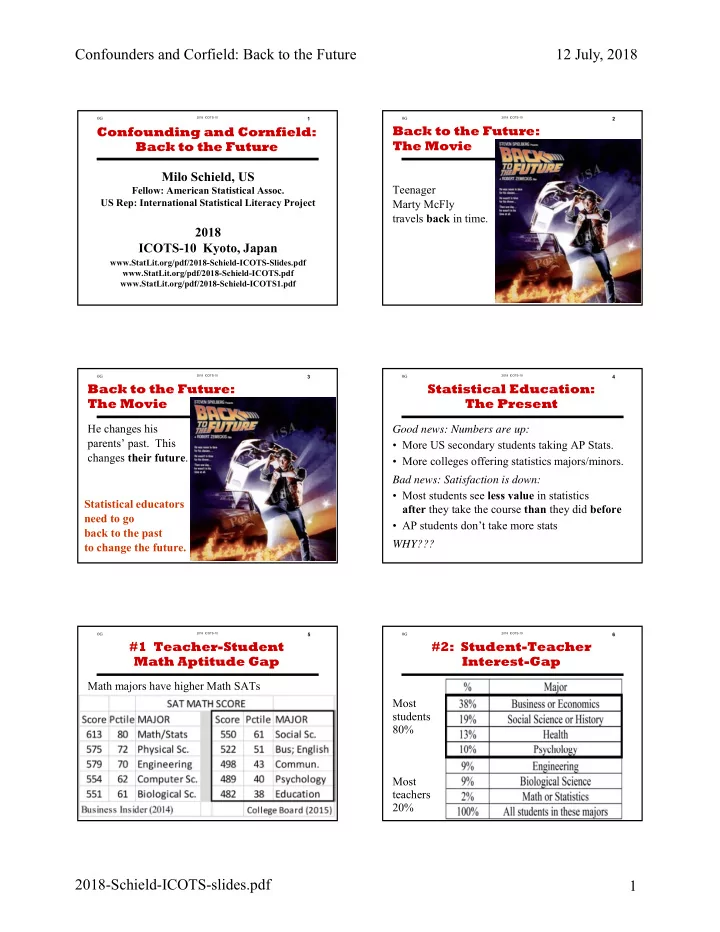
Confounders and Corfield: Back to the Future 12 July, 2018 0G 2018 ICOTS-10 1 0G 2018 ICOTS-10 2 Back to the Future: Confounding and Cornfield: Back to the Future The Movie Milo Schield, US Teenager Fellow: American Statistical


slide-1
SLIDE 1

Confounders and Corfield: Back to the Future 12 July, 2018 2018-Schield-ICOTS-slides.pdf 1

2018 ICOTS-10 0G 1

Milo Schield, US

Fellow: American Statistical Assoc. US Rep: International Statistical Literacy Project

2018 ICOTS-10 Kyoto, Japan

www.StatLit.org/pdf/2018-Schield-ICOTS-Slides.pdf www.StatLit.org/pdf/2018-Schield-ICOTS.pdf www.StatLit.org/pdf/2018-Schield-ICOTS1.pdf

Confounding and Cornfield: Back to the Future

2018 ICOTS-10 0G 2

Teenager Marty McFly travels back in time.

Back to the Future: The Movie

2018 ICOTS-10 0G 3

He changes his parents’ past. This changes their future.

Back to the Future: The Movie

Statistical educators need to go back to the past to change the future.

2018 ICOTS-10 0G 4

Good news: Numbers are up:

  • More US secondary students taking AP Stats.
  • More colleges offering statistics majors/minors.

Bad news: Satisfaction is down:

  • Most students see less value in statistics

after they take the course than they did before

  • AP students don’t take more stats

WHY???

Statistical Education: The Present

2018 ICOTS-10 0G 5

Math majors have higher Math SATs

#1 Teacher-Student Math Aptitude Gap

2018 ICOTS-10 0G 6

Most students 80% Most teachers 20%

#2: Student-Teacher Interest-Gap

slide-2
SLIDE 2

Confounders and Corfield: Back to the Future 12 July, 2018 2018-Schield-ICOTS-slides.pdf 2

2018 ICOTS-10 0G 7

Fisher (1925) Descriptive statistics Sampling: Binomial distribution, sampling distribution & error. Inference: hypothesis tests, statistical significance, p-values Causation: random assignment * Confidence Intervals Most important statistics book: Teacher’s Choice

2018 ICOTS-10 0G 8

No [coherent] focus on any of the following:

  • multi-variate thinking (modelling)
  • studies: observational vs. quasi-experiments
  • confounding [as a causal concept]
  • causal statistics in observational studies

But these are the topics most of our students need.

“Teaching the wrong things” What’s missing?

2018 ICOTS-10 0G 9

Intro: Mind over Data 1: Ladder of causation 2: Genesis of causal inference 3: From evidence to causes 4: Confounding… 5: Debate: smoking & cancer 6: Paradoxes galore 7: Beyond adjustment 8: Counterfactuals 9: Search for mechanism 10 Big Data, AI, etc. Most Important Statistics Book: Students/Users Choice

2018 ICOTS-10 0G 10

Our past: our triumphs and our failures. What are the three biggest contributions of statistics to human knowledge? What are the three biggest deficiencies of statistical educators in teaching intro statistics?

To change our future, we must revisit our past

2018 ICOTS-10 0G 11

What are the three biggest contributions of statistics to human knowledge???

  • 1. Association is not causation
  • 2. Standard error in random sampling
  • 3. Random assignment: controls for confounding

Back to the Future: Three Biggest Contributions:

2018 ICOTS-10 0G 12

What are three biggest deficiencies by statistical educators in teaching introductory statistics? All three involve multivariate data.

  • 1. Failure to focus on observational studies.
  • 2. Failure to show that controlling for a confounder

can change statistical significance.

  • 3. Failure to connect effect size to confounder
  • resistance. E.g., Smoking and lung cancer.

Back to the Future: Three Biggest Deficiencies

slide-3
SLIDE 3

Confounders and Corfield: Back to the Future 12 July, 2018 2018-Schield-ICOTS-slides.pdf 3

2018 ICOTS-10 0G 13

We used confounding to show that “association is not causation.” We then spend an entire semester

  • n randomness (never mentioning confounding

again). This is “Bait and Switch”. “Bait and switch” is unethical! “Bait and switch” is professional negligence! This is one reason why most students see less value in ‘statistics’ after taking the course than before.

Misuse of Confounding

2018 ICOTS-10 0G 14

Most introductory statistics textbooks DO NOT list “confounding” in their index. Schield (2018) Confounding was not listed in McKenzie’s (2004) list of the top 30 intro-statistics topics Confounding was not mentioned in McKenzie’s (2005) review of several introductory textbooks.

Intro statistics is silent on confounding

2018 ICOTS-10 0G 15

Why are we interested in effect sizes?

Books on Effect Sizes: Silent on Confounding

2018 ICOTS-10 0G 16

When confounding is mentioned, it is often in a very limited or specialized context.

  • Wikipedia: under Design of experiments.

In 2016, SERJ published a special issue on Statistical Literacy. Of the 18 articles, only three mentioned confounding or lurking variable.

Intro statistics is select on confounding

2018 ICOTS-10 0G 17

Statistical literacy: the discipline that studies: * all the influences on a statistic. In observational studies, confounding is arguably a most common – a most important – influence. The statistical literacy “debate” is ultimately between the ‘pro’ and the ‘anti’ confounders. Schield is – and has always been – pro-confounder. See Schield (1998) for “confounding factors”.

Statistical Literacy and Confounding

2018 ICOTS-10 0G 18

K-12 report: The first line: “The ultimate goal: statistical literacy”. Confounding is mentioned twice: once to define and once to note it may create patterns that are not a “reliable basis for statistical inference”. College report: Confounding is mentioned only

  • nce. It is not defined; it appears in a sample

problem in a list of words that may apply in analyzing data from an observational study.

Confounding Almost Absent in GAISE 2005

slide-4
SLIDE 4

Confounders and Corfield: Back to the Future 12 July, 2018 2018-Schield-ICOTS-slides.pdf 4

2018 ICOTS-10 0G 19

Plus: Confounding shown 20 times (big increase):

  • Twice up front:
  • Goal 9: Ethics: “with large data sets, … under-

standing confounding … even more relevant.” p 11

  • Recommendation: Multivariable thinking. Examples

“show how confounding plays an important role…” p.15

  • Appendix B (9 times) 34, 38 (3), 40 (2), 41(3)
  • Footnotes (7 times) 105; 113, 120, 122 (4).

Minus: Not in any one-line recommendations/goals

Confounding mentioned in GAISE 2016 Update

2018 ICOTS-10 0G 20

Extremely important observational studies. Question: Is smoking a cause of cancer? MINUS:

  • Not in most statistics textbooks.
  • Not mentioned in GAISE 2005 College.

PLUS:

  • Discussed in detail in GAISE 2004 K-12.

But confounding was never used in the discussion

Silence on Smoking and Lung Cancer

2018 ICOTS-10 0G 21
  • 1. Confounding is not an issue in predicting.
  • 2. There is no test for confounding. Judea Pearl
  • 3. Using association as evidence for causation is a

matter for subject-matter experts. Statisticians have no professional opinion on the subject.

  • 4. Discussing confounding would bring disrepute
  • n our discipline.

Why are we silent

  • n confounding?
2018 ICOTS-10 0G 22

We need to go back to the past. We need to revisit the Fisher-Cornfield dialogue on whether smoking caused lung cancer. We need to revisit Cornfield’s conditions for a confounder to nullify or reverse an association. We need to see how to change statistical education to include Cornfield’s criteria for confounding.

How can we change the present?

2018 ICOTS-10 0G 23

Back to 1958.

Back to the Future: Here we Go!

2018 ICOTS-10 0G 24

Jerome Cornfield got his BA and MA in history. He studied statistics at the US Dept of Agriculture. He worked for USDA on sampling and study design He created two common statistical measures: Relative risk (RR) and the Odds Ratio (OR). He carefully compared prospective (cohort) and retrospective (case control) studies. He was President of the ASA in 1974.

Back to the Future: Jerome Cornfield: 1912-1979

slide-5
SLIDE 5

Confounders and Corfield: Back to the Future 12 July, 2018 2018-Schield-ICOTS-slides.pdf 5

2018 ICOTS-10 0G 25

Jerome Cornfield: Ronald Fisher YES! NO! Strong evidence. Weak evidence

Does Smoking “Cause” Cancer?

Fisher (a smoker) gave two arguments:

  • 1. Association not causation (observational studies)
  • 2. Degree of twinship linked to smoking preference
2018 ICOTS-10 0G 26

Cornfield

  • knew there was no statistical test for confounding.
  • derived necessary conditions for a confounder to

nullify (or reverse) an observed association. Fisher’s twinship data had a relative risk (RR) of 3. Fisher’s RR was inadequate to nullify Cornfield’s RR of 10. Fisher never replied.

Back to the Future: Cornfield Conditions

2018 ICOTS-10 0G 27

Statisticians subdued in talking about Cornfield. Cornfield is …

  • 1. not listed in the RSS statistical timeline.
  • 2. not listed in Wikipedia Timeline of Statistics.
  • 3. not listed in Stigler’s 2013 list of twenty ASA

members who have strongly influenced the development of statistics.

Back to the Future: Cornfield

2018 ICOTS-10 0G 28

Statisticians are silent on the Cornfield conditions. Nothing on the Cornfield conditions

  • 1. in the Wikipedia entry for Jerome Cornfield.
  • 2. in the Wikipedia entry for Tobacco and Health.
  • 3. in most statisticians’ comments on Cornfield’s

statistical achievements.

Back to the Future: Cornfield Conditions

2018 ICOTS-10 0G 29

Because we don’t know Cornfield’s conditions! #3: Cornfield conditions: Minimum confounder size needed to nullify an observed association. Impact: Allowed statisticians to say that “Smoking causes cancer” using data from an observational study.

Why are We Silent

  • n Confounding?
2018 ICOTS-10 0G 30

With Cornfield conditions, we can

  • 1. Show that the larger the effect size, the

more resistance an association has to causation. (Schield and Burnham, 1998)

  • 2. Show how to use Cornfield’s conditions as

necessary conditions. Schield (2012).

  • 3. Show how to work problems controlling for a

binary confounder. Schield ().

Summary Need Cornfield Conditions

slide-6
SLIDE 6

Confounders and Corfield: Back to the Future 12 July, 2018 2018-Schield-ICOTS-slides.pdf 6

2018 ICOTS-10 0G 31

Confounders have no single analytical distribution. There is no way to say that a given effect size will resist X% of all relevant confounders. But we can postulate a standard (S) distribution of confounders: say an exponential distribution of relative risks with a mean of 2 (median of 1.7). RR=4 will resist 95% of these S-confounders. RR=1.5 resists less than half.

Can we talk about Confounder Significance?

2018 ICOTS-10 0G 32

Confounder Distriution: A Proposed Standard

Arbitrary, but simple and fits existing data.

F D C B A

2018 ICOTS-10 0G 33

Conclusion

Statistical education is at a fork in the road. Which path will we take? Will we stay steadfast in our allegiance to Fisher? Or will we include confounding and Cornfield? Our choice will determine the statistics that most college graduates study in decades to come. By featuring confounding in introductory statistics we can change our destiny. Instead of being “the worst course I took”, most students will agree that “statistical literacy should be taken by all college students.”

slide-7
SLIDE 7

2018 ICOTS-10

0G

1

Milo Schield, US

Fellow: American Statistical Assoc. US Rep: International Statistical Literacy Project

2018 ICOTS-10 Kyoto, Japan

www.StatLit.org/pdf/2018-Schield-ICOTS-Slides.pdf www.StatLit.org/pdf/2018-Schield-ICOTS.pdf www.StatLit.org/pdf/2018-Schield-ICOTS1.pdf

Confounding and Cornfield: Back to the Future

slide-8
SLIDE 8

2018 ICOTS-10

0G

2

Teenager Marty McFly travels back in time.

Back to the Future: The Movie

slide-9
SLIDE 9

2018 ICOTS-10

0G

3

He changes his parents’ past. This changes their future.

Back to the Future: The Movie

Statistical educators need to go back to the past to change the future.

slide-10
SLIDE 10

2018 ICOTS-10

0G

4

Good news: Numbers are up:

  • More US secondary students taking AP Stats.
  • More colleges offering statistics majors/minors.

Bad news: Satisfaction is down:

  • Most students see less value in statistics

after they take the course than they did before

  • AP students don’t take more stats

WHY???

Statistical Education: The Present

slide-11
SLIDE 11

2018 ICOTS-10

0G

5

Math majors have higher Math SATs

#1 Teacher-Student Math Aptitude Gap

slide-12
SLIDE 12

2018 ICOTS-10

0G

6

Most students 80% Most teachers 20%

#2: Student-Teacher Interest-Gap

slide-13
SLIDE 13

2018 ICOTS-10

0G

7

Fisher (1925) Descriptive statistics Sampling: Binomial distribution, sampling distribution & error. Inference: hypothesis tests, statistical significance, p-values Causation: random assignment * Confidence Intervals

Most important statistics book: Teacher’s Choice

slide-14
SLIDE 14

2018 ICOTS-10

0G

8

No [coherent] focus on any of the following:

  • multi-variate thinking (modelling)
  • studies: observational vs. quasi-experiments
  • confounding [as a causal concept]
  • causal statistics in observational studies

But these are the topics most of our students need.

“Teaching the wrong things” What’s missing?

slide-15
SLIDE 15

2018 ICOTS-10

0G

9

Intro: Mind over Data 1: Ladder of causation 2: Genesis of causal inference 3: From evidence to causes 4: Confounding… 5: Debate: smoking & cancer 6: Paradoxes galore 7: Beyond adjustment 8: Counterfactuals 9: Search for mechanism 10 Big Data, AI, etc.

Most Important Statistics Book: Students/Users Choice

slide-16
SLIDE 16

2018 ICOTS-10

0G

10

Our past: our triumphs and our failures. What are the three biggest contributions of statistics to human knowledge? What are the three biggest deficiencies of statistical educators in teaching intro statistics?

To change our future, we must revisit our past

slide-17
SLIDE 17

2018 ICOTS-10

0G

11

What are the three biggest contributions of statistics to human knowledge???

  • 1. Association is not causation
  • 2. Standard error in random sampling
  • 3. Random assignment: controls for confounding

Back to the Future: Three Biggest Contributions:

slide-18
SLIDE 18

2018 ICOTS-10

0G

12

What are three biggest deficiencies by statistical educators in teaching introductory statistics? All three involve multivariate data.

  • 1. Failure to focus on observational studies.
  • 2. Failure to show that controlling for a confounder

can change statistical significance.

  • 3. Failure to connect effect size to confounder
  • resistance. E.g., Smoking and lung cancer.

Back to the Future: Three Biggest Deficiencies

slide-19
SLIDE 19

2018 ICOTS-10

0G

13

We used confounding to show that “association is not causation.” We then spend an entire semester

  • n randomness (never mentioning confounding

again). This is “Bait and Switch”. “Bait and switch” is unethical! “Bait and switch” is professional negligence! This is one reason why most students see less value in ‘statistics’ after taking the course than before.

Misuse of Confounding

slide-20
SLIDE 20

2018 ICOTS-10

0G

14

Most introductory statistics textbooks DO NOT list “confounding” in their index. Schield (2018) Confounding was not listed in McKenzie’s (2004) list of the top 30 intro-statistics topics Confounding was not mentioned in McKenzie’s (2005) review of several introductory textbooks.

Intro statistics is silent on confounding

slide-21
SLIDE 21

2018 ICOTS-10

0G

15

Why are we interested in effect sizes?

Books on Effect Sizes: Silent on Confounding

slide-22
SLIDE 22

2018 ICOTS-10

0G

16

When confounding is mentioned, it is often in a very limited or specialized context.

  • Wikipedia: under Design of experiments.

In 2016, SERJ published a special issue on Statistical Literacy. Of the 18 articles, only three mentioned confounding or lurking variable.

Intro statistics is select on confounding

slide-23
SLIDE 23

2018 ICOTS-10

0G

17

Statistical literacy: the discipline that studies: * all the influences on a statistic. In observational studies, confounding is arguably a most common – a most important – influence. The statistical literacy “debate” is ultimately between the ‘pro’ and the ‘anti’ confounders. Schield is – and has always been – pro-confounder. See Schield (1998) for “confounding factors”.

Statistical Literacy and Confounding

slide-24
SLIDE 24

2018 ICOTS-10

0G

18

K-12 report: The first line: “The ultimate goal: statistical literacy”. Confounding is mentioned twice: once to define and once to note it may create patterns that are not a “reliable basis for statistical inference”. College report: Confounding is mentioned only

  • nce. It is not defined; it appears in a sample

problem in a list of words that may apply in analyzing data from an observational study.

Confounding Almost Absent in GAISE 2005

slide-25
SLIDE 25

2018 ICOTS-10

0G

19

Plus: Confounding shown 20 times (big increase):

  • Twice up front:
  • Goal 9: Ethics: “with large data sets, … under-

standing confounding … even more relevant.” p 11

  • Recommendation: Multivariable thinking. Examples

“show how confounding plays an important role…” p.15

  • Appendix B (9 times) 34, 38 (3), 40 (2), 41(3)
  • Footnotes (7 times) 105; 113, 120, 122 (4).

Minus: Not in any one-line recommendations/goals

Confounding mentioned in GAISE 2016 Update

slide-26
SLIDE 26

2018 ICOTS-10

0G

20

Extremely important observational studies. Question: Is smoking a cause of cancer? MINUS:

  • Not in most statistics textbooks.
  • Not mentioned in GAISE 2005 College.

PLUS:

  • Discussed in detail in GAISE 2004 K-12.

But confounding was never used in the discussion

Silence on Smoking and Lung Cancer

slide-27
SLIDE 27

2018 ICOTS-10

0G

21

  • 1. Confounding is not an issue in predicting.
  • 2. There is no test for confounding. Judea Pearl
  • 3. Using association as evidence for causation is a

matter for subject-matter experts. Statisticians have no professional opinion on the subject.

  • 4. Discussing confounding would bring disrepute
  • n our discipline.

Why are we silent

  • n confounding?
slide-28
SLIDE 28

2018 ICOTS-10

0G

22

We need to go back to the past. We need to revisit the Fisher-Cornfield dialogue on whether smoking caused lung cancer. We need to revisit Cornfield’s conditions for a confounder to nullify or reverse an association. We need to see how to change statistical education to include Cornfield’s criteria for confounding.

How can we change the present?

slide-29
SLIDE 29

2018 ICOTS-10

0G

23

Back to 1958.

Back to the Future: Here we Go!

slide-30
SLIDE 30

2018 ICOTS-10

0G

24

Jerome Cornfield got his BA and MA in history. He studied statistics at the US Dept of Agriculture. He worked for USDA on sampling and study design He created two common statistical measures: Relative risk (RR) and the Odds Ratio (OR). He carefully compared prospective (cohort) and retrospective (case control) studies. He was President of the ASA in 1974.

Back to the Future: Jerome Cornfield: 1912-1979

slide-31
SLIDE 31

2018 ICOTS-10

0G

25

Jerome Cornfield: Ronald Fisher YES! NO! Strong evidence. Weak evidence

Does Smoking “Cause” Cancer?

Fisher (a smoker) gave two arguments:

  • 1. Association not causation (observational studies)
  • 2. Degree of twinship linked to smoking preference
slide-32
SLIDE 32

2018 ICOTS-10

0G

26

Cornfield

  • knew there was no statistical test for confounding.
  • derived necessary conditions for a confounder to

nullify (or reverse) an observed association. Fisher’s twinship data had a relative risk (RR) of 3. Fisher’s RR was inadequate to nullify Cornfield’s RR of 10. Fisher never replied.

Back to the Future: Cornfield Conditions

slide-33
SLIDE 33

2018 ICOTS-10

0G

27

Statisticians subdued in talking about Cornfield. Cornfield is …

  • 1. not listed in the RSS statistical timeline.
  • 2. not listed in Wikipedia Timeline of Statistics.
  • 3. not listed in Stigler’s 2013 list of twenty ASA

members who have strongly influenced the development of statistics.

Back to the Future: Cornfield

slide-34
SLIDE 34

2018 ICOTS-10

0G

28

Statisticians are silent on the Cornfield conditions. Nothing on the Cornfield conditions

  • 1. in the Wikipedia entry for Jerome Cornfield.
  • 2. in the Wikipedia entry for Tobacco and Health.
  • 3. in most statisticians’ comments on Cornfield’s

statistical achievements.

Back to the Future: Cornfield Conditions

slide-35
SLIDE 35

2018 ICOTS-10

0G

29

Because we don’t know Cornfield’s conditions! #3: Cornfield conditions: Minimum confounder size needed to nullify an observed association. Impact: Allowed statisticians to say that “Smoking causes cancer” using data from an observational study.

Why are We Silent

  • n Confounding?
slide-36
SLIDE 36

2018 ICOTS-10

0G

30

With Cornfield conditions, we can

  • 1. Show that the larger the effect size, the

more resistance an association has to causation. (Schield and Burnham, 1998)

  • 2. Show how to use Cornfield’s conditions as

necessary conditions. Schield (2012).

  • 3. Show how to work problems controlling for a

binary confounder. Schield ().

Summary Need Cornfield Conditions

slide-37
SLIDE 37

2018 ICOTS-10

0G

31

Confounders have no single analytical distribution. There is no way to say that a given effect size will resist X% of all relevant confounders. But we can postulate a standard (S) distribution of confounders: say an exponential distribution of relative risks with a mean of 2 (median of 1.7). RR=4 will resist 95% of these S-confounders. RR=1.5 resists less than half.

Can we talk about Confounder Significance?

slide-38
SLIDE 38

2018 ICOTS-10

0G

32

Confounder Distriution: A Proposed Standard

Arbitrary, but simple and fits existing data.

F D C B A

slide-39
SLIDE 39

2018 ICOTS-10

0G

33

Conclusion

Statistical education is at a fork in the road. Which path will we take? Will we stay steadfast in our allegiance to Fisher? Or will we include confounding and Cornfield? Our choice will determine the statistics that most college graduates study in decades to come. By featuring confounding in introductory statistics we can change our destiny. Instead of being “the worst course I took”, most students will agree that “statistical literacy should be taken by all college students.”