Conflict of Interest Conflict of Interest Where are we on HRT for - - PowerPoint PPT Presentation

conflict of interest
SMART_READER_LITE
LIVE PREVIEW

Conflict of Interest Conflict of Interest Where are we on HRT for - - PowerPoint PPT Presentation

10/18/2019 Conflict of Interest Conflict of Interest Where are we on HRT for prevention? KEEPS investigator Marcelle I. Cedars, M.D. Professor and Director Division of Reproductive Endocrinology and Infertility UCSF 1 2 Problems in


slide-1
SLIDE 1

10/18/2019 1

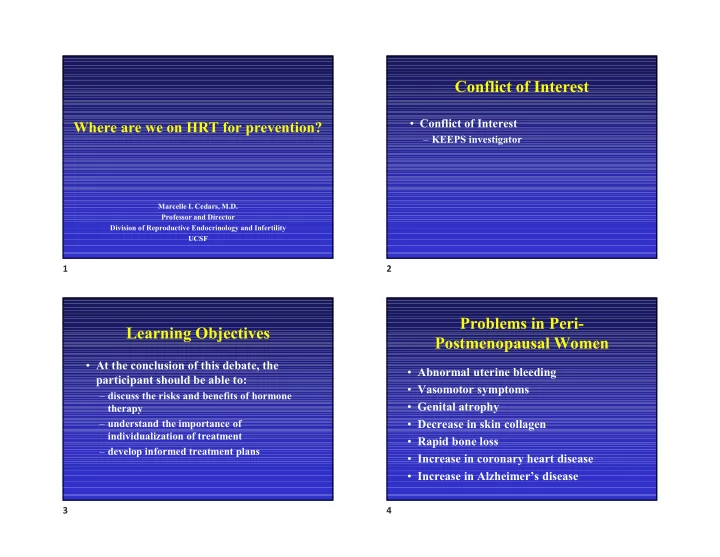
Where are we on HRT for prevention?

Marcelle I. Cedars, M.D. Professor and Director Division of Reproductive Endocrinology and Infertility UCSF

Conflict of Interest

  • Conflict of Interest

– KEEPS investigator

Learning Objectives

  • At the conclusion of this debate, the

participant should be able to:

– discuss the risks and benefits of hormone therapy – understand the importance of individualization of treatment – develop informed treatment plans

Problems in Peri- Postmenopausal Women

  • Abnormal uterine bleeding
  • Vasomotor symptoms
  • Genital atrophy
  • Decrease in skin collagen
  • Rapid bone loss
  • Increase in coronary heart disease
  • Increase in Alzheimer’s disease

1 2 3 4

slide-2
SLIDE 2

10/18/2019 2

Menopausal Hormone Therapy (MHT) over the decades

1966 “Feminine Forever” 1980’s – cohort and case/control Studies – support MHT reduces CHD and osteoporosis 1992 – American College of Physicians Recommends MHT to prevent CHD 1995 PEPI trial 2002 WHI – E+P2004 WHI - ERT 2015 ELITE 1998 HERS

HRT for Prevention

  • A. HRT should be used for

prevention in all women

  • B. HRT should be used for

prevention in young women

  • C. HRT should not be used for

prevention

H R T s h

  • u

l d b e u s e d f

  • r

. . . H R T s h

  • u

l d b e u s e d f

  • r

. . . H R T s h

  • u

l d n

  • t

b e u s e d f . .

15% 53% 32%

WHI vs. Observational studies

Manson JE, et al. 2006; 13:139

5 6 7 8

slide-3
SLIDE 3

10/18/2019 3

Patient Characteristics: Age the “timing” hypothesis

  • Grodstein et al. J Womens Health 2006

– Nurse’s Health Study: evaluating time from menopause – women near menopause reduced CV risk (RR 0.66 CI: 0.54-0.80)

  • Manson et al. NEJM 2007

– WHI: coronary calcium – women 50-59, coronary calcium score lower in women on ET vs. placebo (OR 0.69 CI: 0.48-0.98)

  • ELITE Trial – Hodus HN 2015

– Protection from CIMT changes in younger women

Early vs Late Intervention Trial with Estrogen (ELITE)

Hodis H, NEJM 2016

Estrogen and the Brain Alzheimer Disease

  • Observational studies suggest protection
  • Meta-analyses suggest risk reduction of

approximately 1/3

  • Contradicted by the WHIMS trial (ages 65-79)

– Risk of dementia increased two-fold with combined HRT – Impact noted within a few years, suggesting impact primarily on the vasculature – Past history of use associated with lowered incident risk of dementia (including Alzheimer Disease)

  • Initiation in older women WITH disease is not

beneficial

Estrogen and the Brain

  • Direct effects

– Enhances synaptic plasticity, neurite growth, hippocampal neurogenesis and long-term potentiation (memory) – Protects against apoptosis and neural injury – Stimulates aceytlcholine (memory), serotonin, noradrenalin – Decrease deposition of b-amyloid – Promotes morphological and electrophysiological correlates of learning and memory

  • Indirect effects

– Vasculature – Immune system

NIA – Frontiers proposal – Bench to Bedside Estrogen as a case-study (2009)

9 10 11 12

slide-4
SLIDE 4

10/18/2019 4

Verbal Memory

Decrement in immediate (A) and delayed (B) verbal recall Epperson JCEM 2013

Estrogen and the Brain

  • Estrogen effect on memory
  • Estrogen effect on mood
  • Estrogen effect on stress and cognition

– Reduction in cortisol response to stress – Reduction in effect of stress to reduce working memory

Early effects of estrogen

  • Girard: Scientific Reports 2017
  • Neurocognitive function

– Cognitive control; mental set shifting – Response to environmental context

  • Functional MRI

– Prefrontal functions – Cognitive flexibility

  • Method to identify effect (pre-behavioral)

Estrogen and the Brain

  • Alzheimer Disease

– Early and consistent symptom – loss of episodic memory (failing to recall appointments and events) – In the laboratory: estrogen reduces the formation of b-amyloid formation and diminishes hyperphosphorylation of tau protein 13 14 15 16

slide-5
SLIDE 5

10/18/2019 5

Age-stratified Risk for Alzheimer Disease

OR Adjusted OR Entire Sample (age 50-99) HRT 0.47 (0.35-0.63) 0.70 (0.51-0.95) Ages 50-63 HRT 0.35 (0.19-0.64) 0.35 (0.19-0.66) Ages 64-71 HRT 0.65 (0.39-1.1) 0.86 (0.5-1.5)

Henderson VW MIRAGE 2005

Estrogen effect on verbal recall

Joffe, H Menopause 2006

Amyloid Deposition

Kantarci J J Alzheimer Disease 2016

Cognition and Estrogen

  • No risk with early exposure

– KEEPS – ELITE – WHIMSY

17 18 19 20

slide-6
SLIDE 6

10/18/2019 6

The “Menopausal Syndrome”

  • Epidemiological Studies: proximity to

menopause, not associated with aging, relieved with estrogen

– Vasomotor Symptoms – Vaginal dryness/dyspareunia – Difficulty sleeping/insomnia – Mood and depression – Changes in cognitive function

Trouble Sleeping by Cycle Day

Kravitz, H. M. et al. Arch Intern Med

Hot Flashes worsen Sleep

  • 20 healthy premenopausal women

receiving GnRHa

  • 80% concordance between

subjective/objective VMS (sVMS/oVMS)

  • Sleep efficiency (actigraphy) worse with
  • VMS, quality worse with sVMS

(questionnaire)

Joffe H, Menopause 2013 PMID 23481119

Duration of VMS

Avis, NE: JAMA Int Med 2015

21 22 23 24

slide-7
SLIDE 7

10/18/2019 7

Adjusted OR for CES-D > 16 Across Menopausal Transition

0.2 0.4 0.6 0.8 1 1.2 1.4 1.6 1.8 Pre Early Peri Late Peri Post HT Users

Bromberger, J Affect Disord 2007

Estradiol and Depressive Disorders

(Soares et al., Arch Gen Psychiatry 2001;58:529)

  • 50 perimenopausal women aged 40-55 with irregular

menstrual periods and FSH > 25 IU/L meeting criteria for major depressive, dysthymic, or minor depressive disorder by DSM-IV blindly randomized to transdermal estradiol (0.1 mg) or placebo for 12 wks

  • Remission of depression observed in 17 of 25 (68%)
  • n E2 and 5% on placebo
  • Regardless of DSM-IV diagnosis, subjects responded

similarly to E2

Estrogen for Depression Prevention

Gordon, J JAMA Psychiatry 2018

Breast Cancer

Risk Factors

  • Low body weight
  • High mammographic breast density
  • Late menopause

25 26 27 28

slide-8
SLIDE 8

10/18/2019 8

Severity of Cancer by Treatment Group in WHI Women with Breast Cancer

10 20 30 40 50 60 70 80

With Positive Nodes SEER Stage R or D Not well Differentiated E + P Placebo

Percent of Breast Cancers Tested Severity 81/341 43/263 91/379 53/291 232/332 193/260 p = 0.03 p = 0.07 p = 0.51

Adapted from: Chlebowski RT, et al. JAMA 2010;304:1684

Cumulative Breast Cancer Mortality in WHI Women Taking

E +P vs. Placebo

Cumulative Breast Cancer Mortality in WHI Women Taking E +P vs. Placebo

2.6 vs. 1.3 deaths per 10,000 women per year

Chlebowski RT, et al. JAMA 2010;304:1684

Breast Cancer Risk Factors

  • Was there truly a “protective” effect of

estrogen in the E-only arm – WHI?

  • Estrogen

– Role of estrogen deprivation

  • Whether natural or via anti-estrogens

(tamoxifen/aromatase inhibitors)

– Estrogen as a pro-apoptotic

Breast Cancer The ‘Gap’ Hypothesis

  • Starting estrogen remote from menopause

decreases risk while treatment within 2 years increases breast cancer risk

  • The ‘gap hypothesis’ and the ‘timing

hypothesis’ are thus in conflict

29 30 31 32

slide-9
SLIDE 9

10/18/2019 9

Breast Cancer

Risk Factors

  • Low body weight
  • High mammographic breast density
  • Late menopause
  • Starting close to menopause
  • 2 years after stopping HRT – risk

equivalent to never users

Role of Progestational Agents

  • Gompel, Climacteric 2018

– Estrogen alone lowest risk

  • Not indicated with uterus in situ

– Synthetic progestins higher risk

  • Higher affinity for glucocorticoid receptor
  • Also androgen receptor and mineralocorticoid

– Natural progesterone risk lowest

U.S Preventative Task Force

Gartlehner, JAMA 2017 Gross D, JAMA 2017

WHI E+P: During Study and Follow-up: Mortality

Modified from Heiss et al. JAMA 2008;299:1036-45

33 34 35 36

slide-10
SLIDE 10

10/18/2019 10

Danish Osteoporosis Prevention Study (DOPS)

  • 1006 women
  • Randomized 45-58 years, last vaginal

bleeding 3-24 months prior to enrollment and increased FSH

  • Randomized, open-label, trial of estrogen

(2mg daily), triphasic estradiol + norethisterone (uterus) vs. no treatment

Schierbeck LL, BMJ 2012

DOPS - 2012

Schierbeck LL, BMJ 2012

Long-term risk/benefit

Mikkola TS. Menopause 2015

Menopausal Hormone Therapy Good Prevention Strategy

  • Rise in mortality for women - increased

44% compared with 3% for men since 2002

  • Only other preventative strategy -

lifestyle

37 38 39 40

slide-11
SLIDE 11

10/18/2019 11

Menopausal Hormone Therapy Good Prevention Strategy

  • Prevention of cardiovascular disease
  • Prevention of osteoporosis and fractures
  • Reduction in new onset diabetes
  • Reduction in dementia
  • Reduction in all-cause mortality
  • Improved quality of life

Menopausal Hormone Therapy Good Prevention Strategy

  • Absolute risks

– Breast cancer: 5-8/10,000 women years – Venous thrombosis: 5/10,000 women years

  • Use of non-oral eliminates risk

Modified from Heiss et al. JAMA 2008;299:1036-45

Study Publication Oral Estrogen Transdermal Estrogen

Scarabin, et al (1) 3.5 (1.8-6.8) 0.9 (0.5-1.6) Canonico, et al (2) 4.2 (1.5-11.6) 0.9 (0.4-2.1)

1.Lancet, 2003,362: 428-3 2.Circulation, 2007,115: 840-845

Endocrine Society 2010

41 42 43 44

slide-12
SLIDE 12

10/18/2019 12

Endocrine Society 2010 Current Thinking

  • Best treatment population

– Young women < 60 years of age – < 10 years from menopause

  • Individualization

– Personal preference – Baseline risk – Characteristics of MHT (route, type, dose)

Duration

  • 3-5 years
  • Stopping guidelines

– Breast cancer risk after combined continuous for 7 years – Bone loss will resume – Vasomotor and vaginal symptoms may return

  • Long-term treatment

Impact of Stopping HT

MikkolaTS 2015 JCEM

45 46 47 48

slide-13
SLIDE 13

10/18/2019 13

Impact of Stopping HT

MikkolaTS 2015 JCEM Venetkoski M 2017 Menopause

Individualization

  • Risk profile
  • Symptom profile
  • Medication selection
  • Patient preferences

49 50 51 52