Computer science & should be introduced to Numerical computing - - PowerPoint PPT Presentation

computer science
SMART_READER_LITE
LIVE PREVIEW

Computer science & should be introduced to Numerical computing - - PowerPoint PPT Presentation

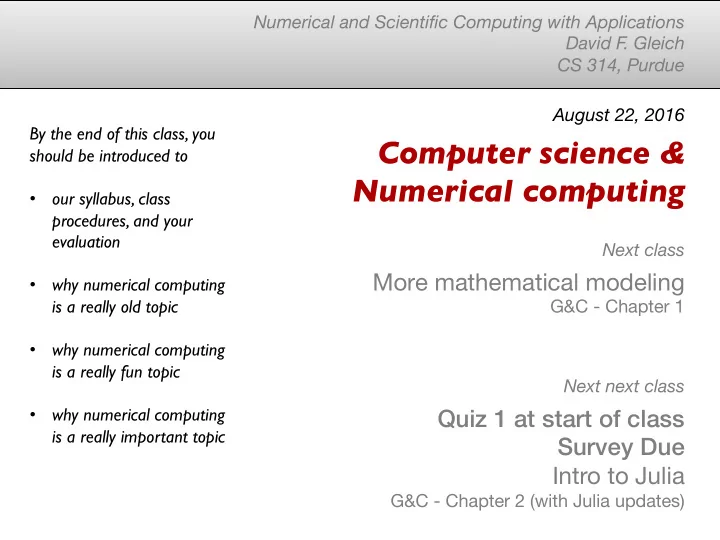
Numerical and Scientific Computing with Applications David F . Gleich CS 314, Purdue August 22, 2016 By the end of this class, you Computer science & should be introduced to Numerical computing our syllabus, class procedures, and


slide-1
SLIDE 1

More mathematical modeling

G&C - Chapter 1 Numerical and Scientific Computing with Applications David F . Gleich CS 314, Purdue August 22, 2016

Computer science & Numerical computing

Next class

Quiz 1 at start of class Survey Due Intro to Julia

G&C - Chapter 2 (with Julia updates) Next next class By the end of this class, you should be introduced to

  • ur syllabus, class

procedures, and your evaluation

  • why numerical computing

is a really old topic

  • why numerical computing

is a really fun topic

  • why numerical computing

is a really important topic

slide-2
SLIDE 2

Your professor!

Formal Professor Gleich, Dr. Gleich Informal Hey matrix prof! I think this class is

cool fun deep challenging fascinating interesting beautiful important important

slide-3
SLIDE 3

The website

The class website is

http://www.cs.purdue.edu/homes/dgleich/cs314-2016

We’ll also use Piazza & Blackboard

http://mycourses.purdue.edu http://piazza.com (you should have gotten an invite)

slide-4
SLIDE 4

The syllabus

The latest syllabus will always be on the website with the latest policies

www.cs.purdue.edu/homes/dgleich/cs314-2016/syllabus.html

It will be updated if there are any changes (and with a new date at the bottom).

slide-5
SLIDE 5

Syllabus break-down

  • 1. Course objectives (what you’ll learn!)
  • 2. Course evaluation (how you’ll earn a grade!)
  • 3. Course materials (the textbook)
  • 4. Course policies

Make sure to read the collaboration policy! Also make sure to read attendance policy.

  • 5. Course outline: 3 units
slide-6
SLIDE 6

… syllabus walk through …

slide-7
SLIDE 7

www.cs.purdue.edu/homes/dgleich/cs314-2016/syllabus.html

slide-8
SLIDE 8

… back to the class …

slide-9
SLIDE 9

Computer science & Numerical computing

An old topic because the first computers were number crunchers (from Wikipedia, “Computer”).

[Babbage] invented the first mechanical computer in the early 19th century. After working on his revolutionary difference engine, designed to aid in navigational calculations, in 1833 he realized that a much more general design, an Analytical Engine, was possible. During the first half of the 20th century, many scientific computing needs were met by increasingly sophisticated analog computers, which used a direct mechanical or electrical model of the problem as a basis for computation. Zeus Z3 (German, 1941) had floating point arithmetic ABC computer (US, 1942 - Iowa State) solved “complicated algebraic equations” ENIAC (US, 1946) - Electronic Numerical Integrator and Computer

slide-10
SLIDE 10

The first computers

The very first computers were actually people!

  • A computer is a person who computes.
  • One of the original “important” computations was to

predict the date that Halley’s comet would return.

  • The goal was to systematically

evaluate the equations of motion to predict the return time

Halley’s comet orbit from Wikipedia There are relevant interactions with the outer planets that change the date that the comet will be visible again from Earth.

slide-11
SLIDE 11

What is numerical computing?

mathematical modeling scientific computing numerical analysis matrix computations applied mathematics

slide-12
SLIDE 12

Where is numerical computing used?

everywhere

slide-13
SLIDE 13

Everywhere?

Games Graphics Machine Learning Typesetting Medicine Compilers Physics, Chemistry, Biology, EE, Wifi,

slide-14
SLIDE 14

Who is this?

slide-15
SLIDE 15

How did I do that?

a few lines of MATLAB code using the Fast Fourier Transform

(you’ll get to make your own soon!)

slide-16
SLIDE 16

Matlab? Julia? Numpy?

Our first quiz! Take out a sheet of paper, write your name …

  • 1. Do you know how to run Matlab, Julia, or

Python?

  • 2. If what is

A = 1 2 −1

  • AT
slide-17
SLIDE 17

… julia demo …

slide-18
SLIDE 18

Your professor!

Formal Professor Gleich, Dr. Gleich Informal Hey matrix prof! I think this class is

cool fun deep challenging fascinating interesting beautiful important important

slide-19
SLIDE 19

This class is important

REALLY IMPORTANT!

Some examples http://ta.twi.tudelft.nl/users/vuik/wi211/disasters.html

slide-20
SLIDE 20

Patriot Missile Failure

On February 25, 1991, during the Gulf War, an American Patriot Missile battery in Dharan, Saudi Arabia, failed to intercept an incoming Iraqi Scud missile. The Scud struck an American Army barracks and killed 28 soldiers. A report of the General Accounting office, GAO/IMTEC-92-26, entitled Patriot Missile Defense: Software Problem Led to System Failure at Dhahran, Saudi Arabia reported on the cause of the failure. It turns out that the cause was an inaccurate calculation of the time since boot due to computer arithmetic errors.

slide-21
SLIDE 21

Explosion of the Ariane 5

On June 4, 1996 an unmanned Ariane 5 rocket launched by the European Space Agency exploded just forty seconds after lift-off. The rocket was on its first voyage, after a decade of development costing $7 billion. The destroyed rocket and its cargo were valued at $500 million. A board of inquiry investigated the causes of the explosion and in two weeks issued a report. It turned out that the cause of the failure was a software error in the inertial reference system. Specifically a 64 bit floating point number relating to the horizontal velocity of the rocket with respect to the platform was converted to a 16 bit signed integer. The number was larger than 32,768, the largest integer storeable in a 16 bit signed integer, and thus the conversion failed.

slide-22
SLIDE 22

The Pentium division bug

Intel had to issue a large number of replacements for the original Pentium processor, that had a bug in its floating point math unit.

Google Spreadsheet’s variance function

… will return the wrong variance! …

slide-23
SLIDE 23

“But these don’t affect me” How will you know?

slide-24
SLIDE 24

The next few classes

Today (If time left) Mathematical Modeling

  • Wed. Mathematical Modeling (Chapter 1 in book)

Friday Intro to Julia + Quiz + Survey due Next Monday. More Julia. Next Wed. Intro to LaTeX + more Julia Next Friday HW1 due (will be posted Wed.)