Software is one of the most > 1 million Software is one of the - - PowerPoint PPT Presentation

software is one of the most
SMART_READER_LITE
LIVE PREVIEW

Software is one of the most > 1 million Software is one of the - - PowerPoint PPT Presentation

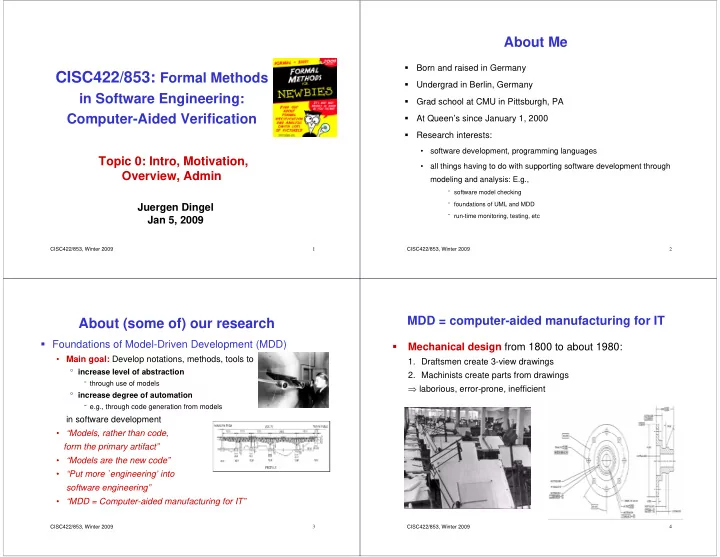
About Me Born and raised in Germany CISC422/853: Formal Methods Undergrad in Berlin, Germany in Software Engineering: Grad school at CMU in Pittsburgh, PA Computer-Aided Verification At Queens since January 1, 2000


slide-1
SLIDE 1

CISC422/853, Winter 2009 1

CISC422/853: Formal Methods

in Software Engineering: Computer-Aided Verification

Juergen Dingel Jan 5, 2009

Topic 0: Intro, Motivation, Overview, Admin

CISC422/853, Winter 2009 2

About Me

  • Born and raised in Germany
  • Undergrad in Berlin, Germany
  • Grad school at CMU in Pittsburgh, PA
  • At Queen’s since January 1, 2000
  • Research interests:
  • software development, programming languages
  • all things having to do with supporting software development through

modeling and analysis: E.g.,

q software model checking q foundations of UML and MDD q run-time monitoring, testing, etc

CISC422/853, Winter 2009 3

About (some of) our research

Foundations of Model-Driven Development (MDD)

  • Main goal: Develop notations, methods, tools to

° increase level of abstraction

qthrough use of models

° increase degree of automation

qe.g., through code generation from models

in software development

  • “Models, rather than code,

form the primary artifact”

  • “Models are the new code”
  • “Put more `engineering’ into

software engineering”

  • “MDD = Computer-aided manufacturing for IT”

CISC422/853, Winter 2009 4

MDD = computer-aided manufacturing for IT

  • Mechanical design from 1800 to about 1980:
  • 1. Draftsmen create 3-view drawings
  • 2. Machinists create parts from drawings

⇒ laborious, error-prone, inefficient

slide-2
SLIDE 2

CISC422/853, Winter 2009 5

MDD = Computer-aided manufacturing for IT (Cont’d)

  • Concorde (1976 – 2003)
  • > 100,000 drawings
  • in 2 languages, using both metric and imperial systems

⇒ worked, but 7x over budget

CISC422/853, Winter 2009 6

MDD = Computer-aided manufacturing for IT (Cont’d)

  • Mechanical design from about 1972: CAD/CAM
  • 1. Create drawings with computer (CAD)
  • 2. From drawing, computer automatically generates program to

drive the milling and CNC machines (CAM) ⇒ much better analysis capabilities and productivity ⇒ CAD/CAM has revolutionized manufacturing

  • Most IT development today:
  • models are still predominantly for communication
  • MDD suggests to

° make computers “understand” the models, and ° automatically generate code from models

This course is not about MDD, but it is about models and analysis This course is not about MDD, but it is about models and analysis I am looking for grad students to help us make this vision a reality I am looking for grad students to help us make this vision a reality

CISC422/853, Winter 2009 7

Next few lectures

  • Motivation
  • Software development is hard
  • It won’t get any easier
  • Need more powerful tools and techniques
  • Overview
  • Admin stuff

CISC422/853, Winter 2009 8

Microsoft Word in 2005 Microsoft XP Microsoft Word in 1983 > 1 million > 45 million 27,000

Complexity of today’s software

Pacemaker > 100,000 Car in 2005 (BMW) 7.5 million Cellphone in 2005 2 million Product Lines of code

[Source: “Why Software Fails”. R.N. Charette. IEEE Spectrum, Sept 2005]

Tax processing system for IRS > 100 million

Software is one of the most complex man-made artifacts! Software is one of the most complex man-made artifacts!

Cellphone in 2010 ? Car in 2010 ?

But perhaps “Lines of code” is a poor measure of complexity?! But perhaps “Lines of code” is a poor measure of complexity?!

slide-3
SLIDE 3

CISC422/853, Winter 2009 9

Complexity of today’s software (Cont’d)

State of a program P

  • snapshot of execution of P
  • formally: mapping of variables in P to values

State space of P

  • set of reachable states of P

State spaces can be very large

  • in Java, an integer has 4.2 billion possible values
  • an object with 2 ints and a boolean field has 40 thousand

quadrillion values

  • What about Windows XP?

Software is one of the most complex man-made artifacts! Software is one of the most complex man-made artifacts!

CISC422/853, Winter 2009 10

“It is widely agreed that the main obstacle to “help computers help us more” and relegate to these helpful partners even more complex and sensitive tasks is not inadequate speed and unsatisfactory raw computing power in the existing machines, but our limited ability to design and implement complex systems with a sufficiently high degree of confidence in their correctness under all circumstances” Amir Pnueli, Turing Award Winner in foreword to [CGP99] “It is widely agreed that the main obstacle to “help computers help us more” and relegate to these helpful partners even more complex and sensitive tasks is not inadequate speed and unsatisfactory raw computing power in the existing machines, but our limited ability to design and implement complex systems with a sufficiently high degree of confidence in their correctness under all circumstances” Amir Pnueli, Turing Award Winner in foreword to [CGP99]

Consequences of this complexity

Computers still “under-utilized”

CISC422/853, Winter 2009 11

Failing software

  • money

° Examples: ESA Ariane 5, Mars Climate Orbiter, US telephone system, … ° Cost of errors in software in US in 2001:

  • lives

° Therac 25, …

More details

° Peter Neumann’s www.risks.org ° Ivars Peterson. Fatal Defect: Chasing Killer Computer Bugs. Vintage Books, New York, 1996.

Consequences of this complexity (Cont’d)

[Source: US National Institute of Standards and Technology]

US$ 60B US$ 60B

CISC422/853, Winter 2009 12

Consequences of this complexity (Cont’d)

Failing software development

  • According to the 1995 Standish report

° 94 of 100 projects have to be restarted ° 31% of all projects are cancelled ° Of the ones not cancelled

q23% have cost overruns of > 50% q67% have time overruns of > 50%

  • Most costly activity in SW development:

° Quality assurance

  • Examples:

° Luggage Handling system at Denver airport, Canadian Gun Registry, US FAA Advanced Automation System, German Tax Processing system, …

slide-4
SLIDE 4

CISC422/853, Winter 2009 13

Example: Therac-25 (1985-87)

Radiotherapy machine with SW controller Several deaths due to burning Problems:

  • “poor SWE practices”,
  • error messages cryptic/undocumented,
  • false error messages,
  • user interface w/o safety checks

References:

  • N.G. Leveson and C.S. Turner. An Investigation of the

Therac-25 accidents. Computer, 26(7):18-41, July 1993.

CISC422/853, Winter 2009 14

Example: “Browser War” (MS vs NS)

  • In a nutshell:
  • From 1995 to 1997 NS concentrated on features at the expense of

good design

  • MS hurried to get IE going, but took time to restructure IE3.0 (NT

built from scratch, shared components in Office)

  • By 1997, NS C4.0 had 130 developers, 3M loc
  • Two months not enough to rearchitect NS C4.0
  • NS decides to start from scratch with C6.0
  • C6.0 never finished, developers reassigned to C4.0
  • C5.0 open source, but nobody wants to work on it
  • MS wins Browser War, AOL buys NS
  • NS C4.0 still contains 1.2M loc
  • Reference:
  • [CY98]

CISC422/853, Winter 2009 15

Example: ESA Ariane 5 (June 1996)

  • On June 4, 1996, unmanned Ariane 5 launched by ESA explodes

40 seconds after lift-off

  • One decade of development costing $7billion lost
  • Rocket and cargo valued at $500million destroyed
  • What went wrong?
  • Bad reuse of code from Ariane 4
  • Bad fault-tolerance mechanism
  • Bad coding practices

CISC422/853, Winter 2009 16

Example: ESA Ariane 5 (June 1996) (Cont’d)

  • Example of how not to do reuse:
  • Parts of Flight Control System (FCS)

taken from Ariane 4

  • Horizontal velocity much greater for

Ariane 5

  • Unprotected conversion operation in FCS causes error
  • On-board computer (OBC) interprets error code as flight data
  • Launcher self-destructs
  • Example of how not to achieve fault-tolerance:
  • FCS and backup FCS identical, thus backup also failed
  • Example of how not to code:
  • When code caused exception, it wasn’t even needed anymore
  • References:
  • [Gle96] and www.ima.umn.edu/~arnold/disasters/ariane.html
slide-5
SLIDE 5

CISC422/853, Winter 2009 17

Example: NASA Mars Climate Orbiter (1999)

Some programs worked in English units, some metric units Conversion from English to metric forgotten Instead of 65 miles probe attempted to orbit 65 km (40 miles) above Mars $327M lost References:

  • http://mars.jpl.nasa.gov/msp98/
  • rbiter/

CISC422/853, Winter 2009 18

Example: FAA Advanced Automation System (2001)

Reference:

www.house.gov/transportation/press/press2001/release15.html

“FAA’s major modernization project, the Advanced Automation System (AAS), was originally estimated to cost $2.5 billion with a completion date of 1996. The program, however, experienced numerous delays and cost overruns, which were blamed on both FAA and the primary contractor, IBM. In 1994, FAA cancelled part of the program and split the remaining systems into three phases, and in several cases, re-bid the contracts. […] According to the General Accounting Office, almost $1.5 billion of the $2.6 spent on AAS was completely wasted.” “FAA’s major modernization project, the Advanced Automation System (AAS), was originally estimated to cost $2.5 billion with a completion date of 1996. The program, however, experienced numerous delays and cost overruns, which were blamed on both FAA and the primary contractor, IBM. In 1994, FAA cancelled part of the program and split the remaining systems into three phases, and in several cases, re-bid the contracts. […] According to the General Accounting Office, almost $1.5 billion of the $2.6 spent on AAS was completely wasted.”

CISC422/853, Winter 2009 19

Example: Intel’s Pentium FDIV Bug

In summer 1994, Prof Thomas Nicely of Lynchburg College first identified a problem with the floating point processor of Intel Pentium chips The result of entering (4195835/3145727) * 3145727 - 4195835 into the Windows calculator was 512, not 0 Intel’s PR disaster:

  • Nov 1994: Intel disputes the severity of the problem
  • Intel offers to replace chip based on need
  • Intel stock price falls
  • Dec 1994, Intel offers to replace all chips

Total cost of bug to Intel estimated at: $475million

CISC422/853, Winter 2009 20

Example: NASA Mars PathFinder

Launched December 4, 1996 A few days after landing on Mars, the Sojourner rover tasks began missing their deadlines causing total system resets Problem: priority inversion is the scenario where a low priority task holds a shared resource that is required by a high priority task Reference:

http://research.microsoft.com/en-us/um/ people/mbj/mars_pathfinder/ Authoritative_Account.html

slide-6
SLIDE 6

CISC422/853, Winter 2009 21

Example: Skype

CISC422/853, Winter 2009 22

Example: The Blackout Bug

50 Million people w/o electricity Worst black out in North American history Cause: Race condition in alarm system (10^6Loc of C)

<snip> <snip>

CISC422/853, Winter 2009 23

In the future …

Our dependency on SW will grow

  • More software in almost everything

° health care

qcomputer-aided surgery qtele-medicine qHL7 standards (www.hl7.org)

⋅ for exchange, management and integration of electronic healthcare information

qnetworked watches, appliances, …

° cars

q“drive by wire”

° infrastructure

qintelligent highways

° Clothes

q“smart” diapers

The "smart" diaper moisture detection system. Siden, J.; Koptioug, A.; Gulliksson, M. Microwave Symposium Digest, 2004 IEEE MTT-S International 2, June 2004 Page(s): 659 - 662

CISC422/853, Winter 2009 24

For Example: In Cars

In English:

  • In 2010, software will make up 13% of a car’s overall value
  • Compared to 2000, the market for automotive software will

quadruple to 100 Billion Euro

[source: www.automagazin.de]

slide-7
SLIDE 7

CISC422/853, Winter 2009 25

For Example: In Cars (Cont’d)

In English:

  • There are up to 80 separate electronic systems and

components in a car. In 2010, all of these could be networked. Their functionality will then be solely driven by software.

[source: www.automagazin.de]

CISC422/853, Winter 2009 26

In the future … (Cont’d)

SW will get more and more complex

  • Because it will …

° … be even larger ° … carry out more complex tasks ° … be more concurrent

q“In the future, applications will need to be concurrent to fully exploit CPU throughput gains” [Sut05]

° … therefore potentially be more buggy

q“I conjecture that most multithreaded-general purpose applications are so full of concurrency bugs that - as multicore architectures become commonplace – these bugs will begin to show up as system failures” [Lee06]

° … have to function in more complex environments

CISC422/853, Winter 2009 27

Microsoft Word in 2005 Microsoft XP Microsoft Word in 1983 > 1 million > 45 million 27,000

In the future … (Cont’d)

Pacemaker > 100,000 Car in 2005 (BMW) 7.5 million Car in 2010 (GM) 100 million Cellphone in 2005 2 million Cellphone in 2010 20 million Product Lines of code

[Source: “Why Software Fails”. R.N. Charette. IEEE Spectrum, Sept 2005]

Tax processing system for IRS > 100 million

CISC422/853, Winter 2009 28

In the future: Conclusion

Potential costs of SW failure will grow while likelihood of failure will increase

  • Most vulnerable:

° Safety critical systems ° Concurrent, distributed, and embedded systems

We will need

  • better ways to deal with complexity
  • more powerful QA techniques

° achieving acceptable levels of quality in, e.g., large concurrent or embedded systems with standard techniques is very hard if not impossible

  • see, for instance,

° 1999 PITAC-report (www.nitrd.gov/pitac/report/) ° research at MSR

More on this later… More on this later…

slide-8
SLIDE 8

CISC422/853, Winter 2009 29

http://research.microsoft.com/apps/dp/areas.aspx

CISC422/853, Winter 2009 30

What can we do?

Ways to control complexity

Reuse, decomposition (e.g., modularity, divide & conquer) Improve abstraction mechanisms

  • e.g., through use of models such as finite state machines

Improve analysis

  • e.g., through model checking

° on models ° directly on software

And this is what this course is about! And this is what this course is about! Key ingredients for “Model-Driven Development” Key ingredients for “Model-Driven Development”

CISC422/853, Winter 2009 31

Software Verification: The Dream

Program Requirements

class Main { void static main () { ... } } “The program should ... “

Checker “Yes” “No, because ...”

CISC422/853, Winter 2009 32

SW verification: Fundamental limitations

Some assumptions are always necessary

  • Correct execution of a program relies on many things (e.g.,

editor, compiler, libraries, optimizer, hardware) ⇒ correct workings of some things will have to be assumed

Some formality is necessary

  • Must express requirements in precise, unambiguous terms
  • E.g., propositional logic, predicate logic, temporal logic

Precision/scalability tradeoff

  • The more complex the analysis, the less likely it will scale

⇒ have to find happy medium

Undecidability

  • Some properties of programs are undecidable

⇒ must be careful we don’t ask for something impossible

slide-9
SLIDE 9

CISC422/853, Winter 2009 33

Software Verification: The State of the Art

Program Requirements

system DiningPhilosophers { Fork[] forks; thread P(Fork l, Fork r) { loc loc0: when !(l.isHeld) do {...} goto loc1 ... } ... G !(forks[0].isHeld && forks[1].isHeld && ...)

Model Checker “Yes” “No” Model of moderately sized expressed in some formal notation of useful, yet limited expressiveness “Maybe”

  • 1. pc1=0, pc2=0, x=0, y=1, ...
  • 2. pc1=1, pc2=0, x=1, y=1, ...
  • 3. pc1=1, pc2=1, x=1, y=2, ...

...

+ counter example

CISC422/853, Winter 2009 34

Model Checking

Typically:

Automatic technique based on exhaustive state space exploration to decide if a finite state machine satisfies a temporal logic specification

Developed in early 1980s; has been tremendously successful for hardware and protocol verification

  • All large chip manufacturers (e.g., Intel, Motorola, Cadence)

use model checking

Keys to success

  • full automation (allows to hide complexity)
  • counter examples (allow developers to see precisely where

things go wrong)

  • optimization techniques (e.g., abstraction, Partial Order

Reduction, Binary Decision Diagrams)

CISC422/853, Winter 2009 35

Model Checking (Cont’d)

Challenges

  • state space explosion through

° large number of variables ° large number of values variables can take on ° high degree of non-determinism (e.g., through large number of unsynchronized parallel processes)

Successes

  • new optimization techniques (e.g., Boolean programs)
  • lots of publicly available tools (e.g., Bandera, VeriSoft, JPF)
  • already some industrial success stories (e.g., SLAM at MSR)
  • 2008 Turing Award for Clarke, Emerson, and Sifakis

CISC422/853, Winter 2009 36

This Course

Introduction to fundamental concepts, techniques, tools, and research questions in model checking Other forms of software verification that we will not consider:

  • proofs of correctness

° e.g., Hoare logic, weakest preconditions ° because it doesn’t scale

  • theorem proving

° because it doesn’t scale

(However, both areas of research have been very influential and we will use some of their results E.g., MSR’s Spec# http://research.microsoft.com/en-

us/projects/specsharp/)

slide-10
SLIDE 10

CISC422/853, Winter 2009 37

Success Story 1: SLAM Project at MSR

Started in 2000, hired lots of “formal people” SLAM starting points:

  • Buggy third-party device drivers are big headache for MS

° more than 5,000 device drivers for Windows in the field ° Windows Kernel interface provides more than 800 functions ° MS provides Driver Development toolkit to facilitate development

  • Device drivers good domain for formal analysis, because

° relatively small (typically less than 100,000 lines of C code) ° interface rules mostly control oriented

SLAM goal:

  • use model checking to check rigorously that code obeys

“interface usage rules”

CISC422/853, Winter 2009 38

Success Story 1: SLAM Project at MSR

  • SLAM main ingredients:
  • Boolean programs

° subset of C ° conservative abstraction of original C program ° many difficult problems (e.g., Halting problem) are decidable

  • abstract-check-refine loop for Boolean programs
  • innovative use of established formal analysis techniques, e.g.,

° model checking ° theorem proving ° static analysis

void add(Object o) { buffer[head] = o; head = (head+1)%size; } Object take() { … tail=(tail+1)%size; return buffer[tail]; }

Program Custom Model Checker “Correct!”

Error-trace

Abstract Program

Abstraction refinement

Abstraction Error-trace spurious?

[yes] [no]

“Bug!”

CISC422/853, Winter 2009 39

Success Story 1: SLAM Project at MSR

  • SLAM mile stones:
  • 2001: SLAM finds its first bug
  • March 2002: demo to Bill Gates
  • August 2002: Driver Quality Team formed to

° gradually hand over project to Windows development group ° extend SLAM to a user-friendly tool SDV (Static Driver Verifier)

  • April 2003: decision made to turn SDV into a product
  • Nov 2003: SDV presented at Driver Developer Conference
  • Aug 2005: beta-version of SDV released
  • References:
  • [BCLR04]: Th.Ball, B.Cook, V.Levin, S.Rajamani: SLAM and Static

Driver Verifier: Technology Transfer of Formal Methods inside

  • Microsoft. MSR-TR-2004-08.
  • www.research.microsoft.com/slam
  • www.microsoft.com/whdc/devtools/tools/sdv.mspx

CISC422/853, Winter 2009 40

Success Story 2: Java PathFinder

voi voi d a d add( O bj ec j ect o t o) { bu buf f e f f er [ r [ he head] = d] = o; he head = ( h ad = ( head+ ad+1) % 1) % si si ze ze; } O bj O bj ect ect t t ake( ) ( ) { … t a t ai l = i l =( t ( t ai ai l +1) +1) % si % si ze ze; r e r et ur t ur n bu n buf f er f er [ t a [ t ai l i l ] ; ] ; }

Java Code JAVAC JVM

0: 0: i c i con

  • nst _0

t _0 1: 1: i s i st o t or e_2 e_2 2: 2: go got o t o #39 #39 5: 5: ge get s t st at i at i c 8: 8: al al oa

  • ad_0

9: 9: i l i l oa

  • ad_2

10: 10: aa aal o l oad

Bytecode Special JVM Model Checker

  • Developed at NASA AMES
  • Helped find bugs in

spacecraft software

  • Now open source
  • n SourceForge at

javapathfinder.sourgeforge.net

  • Possibly more on this later
slide-11
SLIDE 11

CISC422/853, Winter 2009 41

CISC422/853: Contents

  • 1. A few words on concurrency
  • 2. Modeling: How to describe behaviour of a software system?

° finite automata

  • 3. Intro to 2 software model checkers

° Bogor (Santos group at Kansas State University) ° Spin (G. Holzmann at JPL)

  • 4. Model checking I

° algorithms for basic exploration

  • 5. Specifying: How to express properties of a software system?

° assertions, invariants, safety and liveness properties ° Linear temporal logic (LTL) and Buechi automata ° Computation Tree Logic (CTL)

  • 6. Model checking II

° algorithms for checking properties

Assignment 1 (Bogor) Assignment 1 (Bogor) Assignment 2 (Spin) Assignment 2 (Spin) Assignment 3 (Theory) Assignment 3 (Theory)

CISC422/853, Winter 2009 42

CISC422/853: Contents (Cont’d)

  • 8. Optimizations
  • Partial order reduction
  • Static analysis and slicing
  • 9. Overview of software model checking tools

Final exam

  • Covering the theoretical parts and some of the practical

Projects (for grad students)

  • 2 possibilities

° practical: experimentation with a tool ° theoretical: look at some details of the theory

  • I will provide list of suggestions
  • In both cases, I expect project proposal, presentation &

summary paper Assignment 4 (slicing) Assignment 4 (slicing)

CISC422/853, Winter 2009 43

CISC422/853: Goals

Provide introduction to fundamental

  • concepts,
  • techniques,
  • tools and
  • research questions

in model checking Give you some ideas for your own research Have fun!

CISC422/853, Winter 2009 44

CISC422/853: Expected Background

Programming

  • concurrent
  • object-oriented

Discrete maths

  • sets, functions, relations, automata

Logic

  • propositional and predicate logic
slide-12
SLIDE 12

CISC422/853, Winter 2009 45

CISC422/853: Evaluation

For undergrads

  • 4 assignments

60%

° In groups of 1-2 students

  • Final exam

40%

For grads

  • 4 assignments

50%

° In groups of 1-2 students

  • Final exam

20%

  • project-related work

30%

° In groups of 1-2 students ° Proposal, presentation, summary paper

CISC422/853, Winter 2009 46

CISC422/853: Evaluation

Assignments

  • A1 using Bogor
  • A2 using Spin
  • A4 using Java
  • A3 using pencil and paper

Tutorials will be given to introduce these tools; Details tba

CISC422/853, Winter 2009 47

CISC422/853: Material

Lecture slides

  • will be posted

Spin book

  • Gerard Holzmann. The Spin Model Checker: Primer and

Reference Manual. Addison Wesley. 2004. ($80)

  • You are encouraged to purchase it, but don’t have to
  • At least 3 copies will be available in Douglas library

Course notes and papers

  • distributed by instructor

Online information (code and documentation)

  • www.cs.queensu.ca/~cisc853 with link to WebCT forum
  • www.spinroot.com

// Spin website

  • bogor.projects.cis.ksu.edu

// Bogor website

CISC422/853, Winter 2009 48

CISC422/853: Material (Cont’d)

Lectures

  • I highly recommend coming to lectures
  • Text book doesn’t cover everything (it’s mostly for the Spin part)
  • Slides “supersede” text book in case of “conflict”

Tutorials

  • Every practical assignment will be preceded by a tutorial

providing a short introduction to the tool/software the assignment asks you to use

  • Led by TA Scott
  • Dates and times: tba
slide-13
SLIDE 13

CISC422/853, Winter 2009 49

References

Books:

  • [CGP99]: E.Clarke, O.Grumberg, D.Peled. Model Checking. MIT Press. 1999.
  • [Pet96]: I. Peterson. Fatal Defect: Chasing Killer Computer Bugs. Vintage Books, New York. 1996.
  • [CY98]: M.A. Cusumano, D.B. Yoffie. Competing on Internet Time: Lessons from Netscape and Its

Battle with Microsoft. Free Press. 1998.

Articles:

  • [Gle96]: J. Gleick. A Bug and a Crash: Sometimes a Bug Is More Than a Nuisance. 1996. Available at

www.around.com.

  • [LT93]: N.G. Leveson and C.S. Turner. An Investigation of the Therac-25 accidents. Computer,

26(7):18-41, July 1993.

  • [Man02]: C. Mann. Why Software Is So Bad. Technology Review. July/August 2002.
  • [Eco03]: Building a better bug-trap. The Economist, June 19, 2003.
  • [BCLR04]: Th.Ball, B.Cook, V.Levin, S.Rajamani: SLAM and Static Driver Verifier: Technology Transfer
  • f Formal Methods inside Microsoft. MSR-TR-2004-08.
  • [Sut05]: H. Sutter. The free lunch is over: A fundamental turn toward concurrency in software. Dr.

Dobb's Journal, 30(3), March 2005

  • [Lee06]: Edward A. Lee. The problem with threads. Computer, 39(5):33– 42, May 2006.
  • [Pou04]: K. Poulsen, “Tracking the blackout bug”, SecurityFocus, http://www.securityfocus.com, Apr.

2004

CISC422/853, Winter 2009 50

References (Cont’d)

Web Pages:

  • [Neu04]: P. Neumann. The Risk Digest. Available at www.risks.org.
  • www.research.microsoft.com/slam
  • www.microsoft.com/whdc/devtools/tools/sdv.mspx
  • www.house.gov/transportation/press/press2001/release15.html
  • mars.jpl.nasa.gov/msp98/orbiter/
  • www.ima.umn.edu/~arnold/disasters/ariane.html

CISC422/853, Winter 2009 51 CISC422/853, Winter 2009 52

Acknowledgements

Course designed following

  • CIS842: Specification and Verification of Reactive Systems at

Kansas State University

  • G. Holzmann. The Spin Model Checker: Primer and

Reference Manual. Addison Wesley. 2004.

Thanks to John Hatcliff, Matt Dwyer, Robby, and Gerard Holzmann for letting me use some of their slides