Computational Mater ials Design and Disc over y E ner gy and E - - PowerPoint PPT Presentation

computational mater ials design and disc over y
SMART_READER_LITE
LIVE PREVIEW

Computational Mater ials Design and Disc over y E ner gy and E - - PowerPoint PPT Presentation

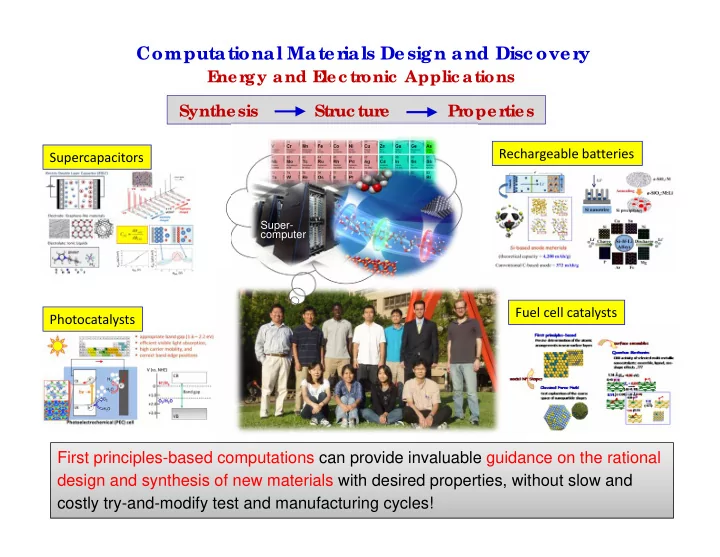
Computational Mater ials Design and Disc over y E ner gy and E lec tr onic Applic ations Synthesis Str uc tur e Pr oper ties Rechargeable batteries Supercapacitors Super- computer Fuel cell catalysts


slide-1
SLIDE 1

Computational Mater ials Design and Disc over y

E ner gy and E lec tr

  • nic Applic ations

Synthesis Str uc tur e Pr

  • per

ties

Super- computer

Rechargeable batteries Fuel cell catalysts Photocatalysts Supercapacitors

First principles-based computations can provide invaluable guidance on the rational design and synthesis of new materials with desired properties, without slow and costly try-and-modify test and manufacturing cycles!

slide-2
SLIDE 2

Materials Challenges

  • Cheap
  • Efficient
  • Abundant
  • Safe

New Materials ..! New Materials ..!

H2

slide-3
SLIDE 3

Hwang Research Group

Our research has a well‐balanced emphasis on

Computational Design of Nanomaterials for Energy and Electronic Applications

applications fundamentals

  • strategies for predictive multiscale,

multiphysics computational models by integrating various state‐of‐the‐art theoretical methods at different length and time scales.

  • a quantitative understanding of the

relationship between the synthesis, structure, and properties of nanostructured materials and systems.

slide-4
SLIDE 4

1.

  • Appl. Surf. Sc i. 323, 78 (2014)-invite d

2.

  • J. Po we r So urc e s 263 C, 252 (2014)

3. Che m. Ma te r. 25, 3435 (2013) 4.

  • J. Phys. Che m. C 117, 9598 (2013)

5.

  • Surf. Sc i. 612, 16 (2013)

6.

  • J. Phys. Che m. C 115, 20018 (2011)

7.

  • J. Phys. Che m. C 115, 2514 (2011)

8.

  • J. Phys. Che m. C 114, 17942 (2010)

Recent Publications

  • E

luc ida te the lithia tio n me c ha nisms o f silic o n-b a se d na no ma te ria ls.

  • Pro vide ma ny insig hts into ho w to de sig n na no struc ture s a nd c o mpo site s to a c hie ve

de sire d pro pe rtie s a nd pe rfo rma nc e .

First Principles-based Molecular Modeling

… highlights the possibility of designing high performance Si suboxide anodes via fine-tuning of the

  • xidation conditions
  • Fast Li diffusion (fast charge rate)
  • Facile atomic rearrangement & Uniform

lithiation/delithiation (improved cyclability)

Lithium Ion Batteries

Recent achievements Surface/Interface Impacts

Si-rich suboxides

slide-5
SLIDE 5

Graphene-based Supercapacitors

1.

  • J. Che m. Phys., a c c e pte d (2014)

2.

  • J. Phys. Che m. C 118, 21770 (2014)

3. ACS Appl. Ma te r. I nte rfa c e s 6, 12168 4. Ca rb o n 68, 734 (2014) 5.

  • J. Phys. Che m. C 117, 23539 (2013)

6.

  • Phys. Che m. Che m. Phys. 15, 19741

7.

  • J. Phys. Che m. C 117, 5610 (2013)

8.

  • J. E

le c tro c he m. So c . 160, A1 (2013)

Recent Publications Recent achievements

TOC

  • I

de ntify the ke y fa c to rs de te rmining the inte rfa c ia l c a pa c ita nc e o f g ra phe ne -b a se d supe rc a pa c ito rs

  • Pro vide ne w insig ht into the impa c ts o f the c he mic a l

a nd/ o r me c ha nic a l mo dific a tio ns o f g ra phe ne -like c a rb o n e le c tro de s o n the supe rc a pa c ito r pe rfo rma nc e .

Doping effect

Structural deformation effect

First Principles Modeling

slide-6
SLIDE 6

1. ACS Ca ta l. 4, 4051 (2014) 2.

  • Phys. Che m. Che m. Phys. 17, 256 (2015)

3.

  • Appl. Phys. L

e tt. 103, 131603 (2013) 4.

  • Phys. Re v. B 87, 205202 (2013)

5.

  • Phys. Re v. B 86, 165209 (2012)

6.

  • J. Phys. Che m. C 115, 17870 (2011)

7. Mo re c o ming so o n …

Recent Publications

  • E

luc ida te the e ffe c ts o f c he mic a l do ping a nd struc tura l disto rtio ns o n c ha rg e c a rrie r lo c a liza tio n a nd tra nspo rt, a nd the ir impa c ts o n the pho to c a ta lytic pe rfo rma nc e .

  • I

de ntify the ro le o f pho to g e ne ra te d c ha rg e c a rrie rs in pro mo ting surfa c e re a c tio ns.

… highlights that excess electrons and holes can synergetically contribute to CO photooxidation on TiO2(110) under UV irradiation.

  • Band gaps and band alignments
  • Charge localization and transport
  • Defect formation and properties

Recent achievements Doping/Structural distortion

Photocatalytic reaction

Solar-powered H2 Production

  • Visib le lig ht a b so rptio n

(Ba nd g a p = 1.6-2.2 e V)

  • Co rre c t b a nd e dg e po sitio ns
  • Hig h c ha rg e c a rrie r mo b ility
  • L
  • w de fe c t de nsity
  • Hig h surfa c e re a c tivity
  • Hig h re sista nc e to pho to c o rrsio n

Candidate Photocatalysts Computational Sc r eening, Design & E valuation

Electron doping effect
slide-7
SLIDE 7

Electrocatalysis in Fuel Cells

De ve lo p lo w-Pt o r Pt-fre e me ta l c a ta lysts tha t a re mo re a c tive , mo re a b unda nt, a nd le ss e xpe nsive tha n the c urre ntly use d Pt-b a se d c a ta lysts.

Multisc ale Modeling Str ategy for sc r eening multimetallic elec tr

  • c atalysts
  • 1. J. Che m. Phys. 139, 201104 (2013)
  • 2. Che m. So c . Re v. 42, 5002 (2013)
  • 3. J. Am. Che m. So c . 135, 436 (2013)
  • 4. Phys. Che m. Che m. Phys. 15, 12118
  • 5. J. Che m. Phys. 139, 164703 (2013)
  • 6. Che m. Ma te r. 25, 530 (2013)
  • 7. J. Phys. Che m. L

e tt. 3, 566 (2012)

  • 8. J. Phys. Che m. C 115, 21205 (2012)
  • 9. Ca ta lysis T
  • da y 165, 138 (2011)

10.J. Phys. Che m. C 114, 21516 (2010) 11.J. Phys. Che m. C 114, 14922 (2010) 12.J. Phys. Che m. C 113, 12943 (2009)

Recent Publications

First principles-based Quantum Mechanics Classical Force Field

Fast exploration of the coarse space

  • f nanoparticle shapes

Precise determination of the atomic arrangements in near‐surface layers ORR activity of selected multimetallic nanocatalysts; ensemble, ligand, size‐shape effects ..???

model NP Shapes surface ensembles

slide-8
SLIDE 8

Waste Heat Conversion into Electricity

Unde rsta nd the pro pe rtie s a nd pe rfo rma nc e o f na no ma te ria ls fo r the rmo e le c tric a pplic a tio ns with a pa rtic ula r fo c us o n the ir the rma l c o nduc tivity

  • 1. J. Appl. Phys. 114, 174910 (2013)
  • 2. Phys. Re v. B 86, 165209 (2012)
  • 3. Na no L

e tt. 12, 2918 (2012)

  • 4. Phys. Re v. B 85, 125204 (2012)
  • 5. Phys. Re v. B 83, 125202 (2011)
  • 6. Mo re c o ming so o n

Recent Publications

Thermal Conductivity Control via

Alloying Chemic al Doping Defec t engineer ing Nanostr uc tur ing Compositing

slide-9
SLIDE 9

CO2 Capture and Conversion

…. pro vide the g uiding princ iple s fo r the ra tio na l de sig n a nd synthe sis o f no ve l re g e ne ra b le a mine -b a se d so lve nts to re a lize the de sire d pro pe rtie s a nd pe rfo rma nc e fo r CO 2 c a pture , thro ug h syste ma tic the o re tic a l inve stig a tio ns o f the a to mistic me c ha nisms g o ve rning CO 2 c a pture a nd so lve nt re g e ne ra tio n.

slide-10
SLIDE 10

Top-notch Computational Resources

High Performance Computing Systems at UT-Austin (http://www.tacc.utexas.edu)

(1) “STAMPEDE”

One of the largest computing systems in the world for open science research.

  • 102,400 Processing Cores
  • 205 TB Memory
  • 7+ Petaflops of Peak Performance

Suc c e ssful c o mple tio n o f o ur e xte nsive first princ iple s-b a se d inve stig a tio ns c a n b e fa c ilita te d b y utilizing the wo rld’ s to p-c la ss supe rc o mputing fa c ilitie s.

(2) “LONESTAR”

One of the most powerful academic supercomputers in the world.

  • 22,656 Processing Cores
  • 44 TB Memory
  • 300+ Teraflops of Peak Performance