COMPSCI 111 / 111G A 65 I 73 Q 81 Mastering Cyberspace: B 66 - - PowerPoint PPT Presentation

compsci 111 111g
SMART_READER_LITE
LIVE PREVIEW

COMPSCI 111 / 111G A 65 I 73 Q 81 Mastering Cyberspace: B 66 - - PowerPoint PPT Presentation

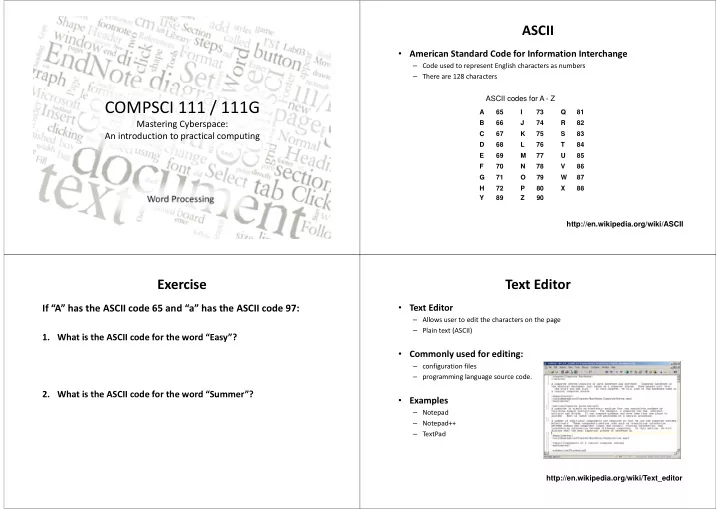
ASCII American Standard Code for Information Interchange Code used to represent English characters as numbers There are 128 characters ASCII codes for A - Z COMPSCI 111 / 111G A 65 I 73 Q 81 Mastering Cyberspace: B 66 J 74 R


slide-1
SLIDE 1

12/01/2016 1 12/01/2016 COMPSCI 111/111G - Lecture 08 1

Word Processing

COMPSCI 111 / 111G

Mastering Cyberspace: An introduction to practical computing

ASCII

  • American Standard Code for Information Interchange

– Code used to represent English characters as numbers – There are 128 characters http://en.wikipedia.org/wiki/ASCII

A 65 I 73 Q 81 B 66 J 74 R 82 C 67 K 75 S 83 D 68 L 76 T 84 E 69 M 77 U 85 F 70 N 78 V 86 G 71 O 79 W 87 H Y 72 89 P Z 80 90 X 88

ASCII codes for A - Z

Exercise

If “A” has the ASCII code 65 and “a” has the ASCII code 97:

  • 1. What is the ASCII code for the word “Easy”?
  • 2. What is the ASCII code for the word “Summer”?

Text Editor

  • Text Editor

– Allows user to edit the characters on the page – Plain text (ASCII)

  • Commonly used for editing:

– configuration files – programming language source code.

  • Examples

– Notepad – Notepad++ – TextPad http://en.wikipedia.org/wiki/Text_editor

slide-2
SLIDE 2

Word Processors

  • Word Processor

– Extension of a text editor – Allow user to format the document (change the appearance of text)

  • Fonts

– Style, size, typeface

  • Paragraph

– Alignment, spacing

  • Document

– Margins, Headers, Footers http://en.wikipedia.org/wiki/Word_processor

Standards

  • Each word processor decides how to store information

– Uses special codes to identify the format of the text

  • Bold, italic
  • Font size
  • Alignment

– File is saved with these codes

  • Standards

– Proprietary (MS‐Word) – Open standard (Open Office)

What you see is what you get

  • WYSIWYG (Whizzy‐wig)

– Graphical User Interface – What the user sees is the same as the output printed

  • Most modern word processors work this way

– Microsoft Word – Open Office http://en.wikipedia.org/wiki/WYSIWYG

What you see is what you get

  • Programming is generally not WYSIWYG:
  • Examples covered in COMPSCI111:

– Wiki markup (see example below) – Latex – HTML5 – Python What you see What you get

slide-3
SLIDE 3

Basic Features of a Word Processor

  • Editing Text

– Word Wrap – Insert/ Delete – Select Text for action

  • Clipboard

– Keeps multiple clippings – Cut, Copy, Paste

  • Formatting

– Character – Paragraph – Document xxxxxxx yyyy yyyy xxxxxxx xxxxxxx xxxxxxx yyyy yyyy yyyy yyyy Clipboard Cut Paste

Insert Point/ Cursor

Font

  • Appearance of Text

– Typeface – Style (Bold, Italic) – Size (in points) – Colour – Effects

Paragraph

  • Appearance of Paragraph

– Alignment – Spacing – Indent

Styles

  • A named set of formatting changes
  • Why use styles?

– Appearance is consistent – Can apply many changes at once – Modifying a style affects all text that uses that style Manage existing styles Create a new style

slide-4
SLIDE 4

Headers, Footers and Footnotes

  • Header

– Content found in the top margin of each page in a document

  • Footers

– Content found in the bottom margin of each page in a document

Headers, Footers and Footnotes

  • Footnote

– Small note located at the bottom of a page. – Provides more information about something in the main text.

Plagiarism

  • Plagiarism involves taking another person's ideas, words or

inventions and presenting them as your own.

– Includes paraphrasing or rewording another person's work, without acknowledging its source.

  • All material, whether directly quoted, summarised or

paraphrased, must be acknowledged properly.

http://www.cite.auckland.ac.nz/index.php?p=plagiarism

References and Citation

  • Citation

– Tells readers where the information came from. – Within the text.

  • Reference

– Provides details about the source. – Should enable reader retrieval of source. – Found at the end of a document.

slide-5
SLIDE 5

RefWorks

  • Web‐based bibliographic database

– Maintain personal database of references. – Copy references from the UOA library catalogue (as well as other library databases) into reference database. – Insert references into documents in a variety of citation styles.

  • Advantages

– Platform independent. RefWorks account accessible from any platform with compatible web browser and Internet access. – UOA students can create a RefWorks account for free.

  • Guides and tutorials available

http://www.library.auckland.ac.nz/refworks/guides‐tutorials.htm http://www.library.auckland.ac.nz/endnote/endnote.htm

Write‐N‐Cite

  • Utility program that lets users interface between their

RefWorks reference database and their MS Word documents.

– Available for free for MS Word on Windows and Mac operating systems from RefWorks website.