Complete Vehicle Testing of Car Occupant Muscle Responses for - - PowerPoint PPT Presentation

complete vehicle testing of car occupant muscle responses
SMART_READER_LITE
LIVE PREVIEW

Complete Vehicle Testing of Car Occupant Muscle Responses for - - PowerPoint PPT Presentation

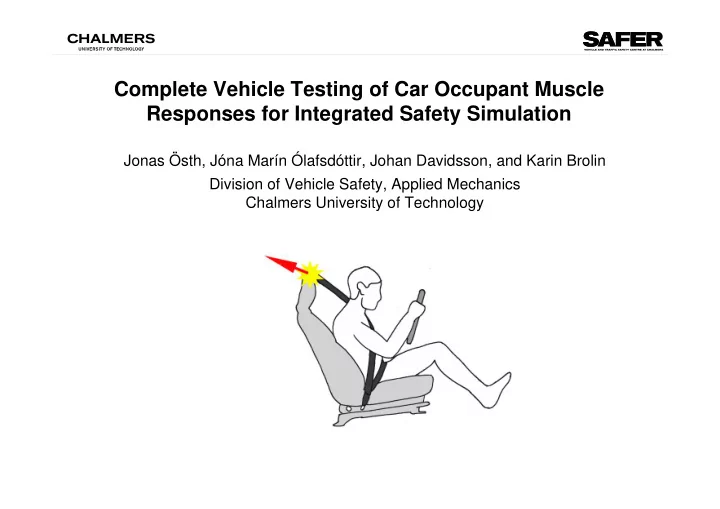
Complete Vehicle Testing of Car Occupant Muscle Responses for Integrated Safety Simulation Jonas sth, Jna Marn lafsdttir, Johan Davidsson, and Karin Brolin Division of Vehicle Safety, Applied Mechanics Chalmers University of Technology


slide-1
SLIDE 1

1 Complete Vehicle Testing of Car Occupant Muscle Responses for Integrated Safety Simulation

Jonas Östh, Jóna Marín Ólafsdóttir, Johan Davidsson, and Karin Brolin Division of Vehicle Safety, Applied Mechanics Chalmers University of Technology

slide-2
SLIDE 2

2

Background

Aim: Model occupant pre-crash responses with an FE HBM. Achieved through modeling of neuromuscular control. Requires validation data in relevant test cases.

Chalmers Active Human Body Model Project

slide-3
SLIDE 3

3

Volunteer Test Aims

  • Generate sets of validation data for ”Active HBM”
  • Investigate occupant kinematic and muscle

responses in potential pre-crash scenarios

References: Östh J, Ólafsdóttir JM, Davidsson J, Brolin K (2013) Driver Kinematic and Muscle Responses in Braking Events with Standard and Reversible Pre-tensioned Restraints: Validation Data for Human Models. Stapp Car Crash Journal 57:1–41. Ólafsdóttir JM, Östh JKH, Davidsson J, Brolin K (2013) Passenger Kinematics and Muscle Responses in Autonomous Braking Events with Standard and Reversible Pre-tensioned Restraints. Proceedings of the IRCOBI Conference; Gothenburg, Sweden, pp. 602–617

slide-4
SLIDE 4

4

Volunteers

  • 11 males and 9 females
  • No history of neck injury
  • Sampling criteria: M50 and F50 +/- 10 kg and +/- 10 cm

Male Female 20 40 60 80 100 120 140 160 180 200 Height (cm) M50 F50

Height

10 20 30 40 50 60 70 80 90 Weight (kg) M50 F50

Weight

20 40 60 80 100 Sitting Height (cm) M50 F50

Sitting Height

5 10 15 20 25 30 35 40 45 Age (years)

Age

slide-5
SLIDE 5

5

Electromyography

  • Surface electrodes on major muscles of upper body
  • Normalized with MVCs in driving posture
slide-6
SLIDE 6

6

Test Cases

Belt pulls 170 N 0.2 s

Autobrake PT Autobrake SB Driver Brake

11 m/s2

Driver and Passenger

slide-7
SLIDE 7

7

Test Vehicle

slide-8
SLIDE 8

8

Passenger Side

slide-9
SLIDE 9

9

Rear Seat…

slide-10
SLIDE 10

10

”Test Track”

slide-11
SLIDE 11

11 Autobrake PT Autobrake SB Driver Brake

slide-12
SLIDE 12

12 6

Autobrake SB Autobrake PT

slide-13
SLIDE 13

13

Head Displacements: Drivers

In steady-state braking (1.5–1.7s)

Autobrake PT2–4 Autobrake SB Driver Brake 20 40 60 80 100 120 140 160 180 200 Head X displacement (mm) Male Female

*

* p<0.05

>

slide-14
SLIDE 14

14

Shoulder Belt and Steering Wheel Forces: Drivers

Autobrake PT Autobrake SB Driver Brake

slide-15
SLIDE 15

15

Muscle Responses: Drivers

Autobrake PT Autobrake SB Driver Brake

slide-16
SLIDE 16

16 Driver Braking

References: Östh J, Eliasson E, Happee R, Brolin K (2014) A Method to Model Anticipatory Postural Control in Driver Braking Events. Gait and Posture 40(4):664–669. Östh J, Brolin K, Bråse D (2014) A Human Body Model with Active Muscles for Simulation of Pre-Tensioned Restraints in Autonomous Braking Interventions. Traffic Injury Prevention, 16(3):304–313.

Autonomous Braking (SB)

Model Validation

slide-17
SLIDE 17

17

Conclusions

  • Seat-belt pre-tension affects occupant postural responses

– Pre-tension induces startle response in some volunteers

  • Driver Brake postural responses are different from postural

response to Autobrake

  • Low muscle activations in normal driving (<5% for most

muscles)

  • Co-contraction of antagonist muscles in steady state braking
slide-18
SLIDE 18

18

Future work

  • Extend AHBM to cover lateral (steering) emergency avoidance

maneuvers

  • Conduct new volunteer for validation data and investigation of

postural control in these events

  • Challenges

– Repeatability of steering maneuvers with non professional

drivers

– Effect of external threat (crash risk) – Large test matrix (many combinations, pre-tensed belt,

combined with braking)

slide-19
SLIDE 19

19

Acknowledgements

Project partners Autoliv Research, Volvo Group, Volvo Cars, and Umeå University Funding VINNOVA – Swedish Governmental Agency for Innovation Systems, through the FFI – Vehicle and Traffic Safety research program