Compiling Data to establish base-line and benchmarks OBJECTIVES - - PowerPoint PPT Presentation

compiling data to establish base line and benchmarks
SMART_READER_LITE
LIVE PREVIEW

Compiling Data to establish base-line and benchmarks OBJECTIVES - - PowerPoint PPT Presentation

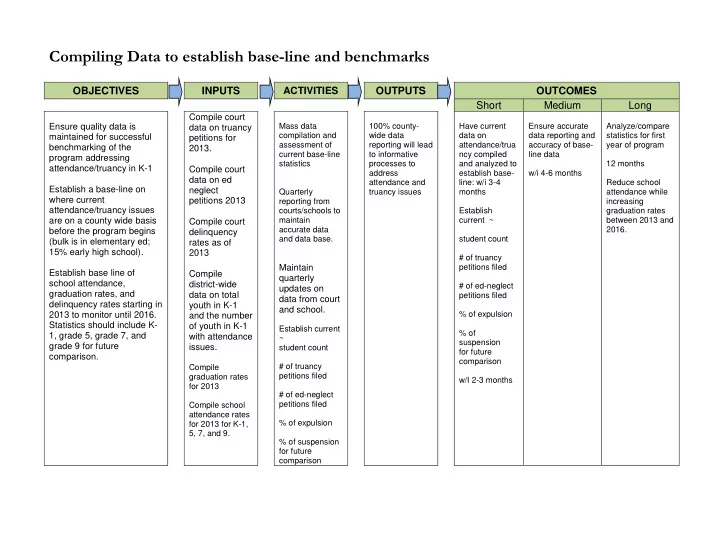
Compiling Data to establish base-line and benchmarks OBJECTIVES INPUTS ACTIVITIES OUTPUTS OUTCOMES Short Medium Long Compile court Ensure quality data is Mass data 100% county- Have current Ensure accurate Analyze/compare data on


slide-1
SLIDE 1

Compiling Data to establish base-line and benchmarks

OBJECTIVES INPUTS ACTIVITIES OUTPUTS OUTCOMES Short Medium Long

Ensure quality data is maintained for successful benchmarking of the program addressing attendance/truancy in K-1 Establish a base-line on where current attendance/truancy issues are on a county wide basis before the program begins (bulk is in elementary ed; 15% early high school). Establish base line of school attendance, graduation rates, and delinquency rates starting in 2013 to monitor until 2016. Statistics should include K- 1, grade 5, grade 7, and grade 9 for future comparison. Compile court data on truancy petitions for 2013. Compile court data on ed neglect petitions 2013 Compile court delinquency rates as of 2013 Compile district-wide data on total youth in K-1 and the number

  • f youth in K-1

with attendance issues.

Compile graduation rates for 2013 Compile school attendance rates for 2013 for K-1, 5, 7, and 9. Mass data compilation and assessment of current base-line statistics Quarterly reporting from courts/schools to maintain accurate data and data base.

Maintain quarterly updates on data from court and school.

Establish current ~ student count # of truancy petitions filed # of ed-neglect petitions filed % of expulsion % of suspension for future comparison 100% county- wide data reporting will lead to informative processes to address attendance and truancy issues Have current data on attendance/trua ncy compiled and analyzed to establish base- line: w/i 3-4 months Establish current ~ student count # of truancy petitions filed # of ed-neglect petitions filed % of expulsion % of suspension for future comparison w/I 2-3 months Ensure accurate data reporting and accuracy of base- line data w/i 4-6 months Analyze/compare statistics for first year of program 12 months Reduce school attendance while increasing graduation rates between 2013 and 2016.

slide-2
SLIDE 2

OBJECTIVES INPUTS ACTIVITIES OUTPUTS Short Medium Long

Adopt model policies to address absenteeism/early truancy to decrease elementary (K-5) absenteeism by 5% throughout Jackson County by 2017 Community Stakeholders Year 1: Able Training coaches & Committee will complete a System Scan/data collection to identify root causes involving absenteeism/early truancy Identification of root cause

  • f absenteeism

County wide awareness of policies and procedures to address student absenteeism County wide use of absenteeism policies and procedures School/Justice Taskforce Jackson County Superintendents & JCISD will review existing model policies protocols involving absenteeism/early truancy Policy and process implementation Family needs are assessed and barriers are indentified Improved parenting and parental management practices JCISD Establish a collective agreement between County Superintendents addressing concerns involving absenteeism/ early truancy Improved policies Community resources and supports are secured to meet famiy needs and reduce barriers that affect attendance Parents will increase their understanding of the value of their child's education Consistent use of absentieeism policies and procedures Elementary School Administrators Jackson County Superintendents will Establish/revise absenteeism policies and a flowchart of procedures Parents will understand Michigan's Compulsory School Attendance law, local district attendance policies and implications of continued absenteeism Children will improve school attendance Children will improve school attendance Cradle to Career Group Year 2: Community Stakeholders & Committee will begin to develop community partnerships Community partnerships Families will improve communication with school Children will improve grades and academic performance Early Truancy Coordinator The ISD & Committee will research program planning and development Family and school attachment Existing policies/ protocols used elsewhere such as Midland, Ingham and Eaton Counties The committee will research additional funding mechanism as plan is developed Interns Year 3: The Committee/School districs will provide Jackson County with an evidence-based absenteeism/early truancy prevention program Provide Jackson County with an evidence-based absenteeism/early truancy intervention program Existing policies from

  • ther schools

End of year progress review- JCISD Reduction of Absenteeism Medical Community

OUTCOMES

SCHOOL - JUSTICE PARTNERSHIP LOGIC MODEL Goal of Absenteeism

Absenteeism Committee Members: Kriss Giannetti, Maureen Keene, Scott Dukate, Vicotria Burke and Anissa Lewis
slide-3
SLIDE 3

SCHOOL-JUSTICE PARTNERSHIP LOGIC MODEL For Goal of Intervention & Resource Board

OBJECTIVES INPUTS ACTIVITIES OUTPUTS OUTCOMES Short Medium Long

Will provide alternative ideas and resources for expulsions and suspensions. Gather specific and consistent data for all schools for suspensions and expulsions. Resources from the Michigan School – Justice Partnership will be reviewed and shared with community partners. Develop a team that will gather data, to share county wide. The team will include school principals, teachers, board members, DHS, and mental health representatives. Team members will provide feedback to schools. Training for school principals and boards will be provided. Current data is district specific and inconsistent in content. The team will review task force data and resources. The team will develop a resource list and determine alternative plans for suspension and expulsion. The team will review current suspension and expulsion practices county-wide. The team will develop training packages for individual schools. The team will provide families and opportunity to participate in the development of policies and practices. County-wide data collection. Developing model policies for truancy. Developing model policies for suspension and expulsion. Providing resource information to schools and school boards. Policies and practices informed by community partners. Reduction in the number of out of school suspensions and expulsions. Provide resources and alternatives action plans for schools. Share current successful practices among schools. Link current school programs together in collaborative efforts to share resources. Parent and student representatives to be invited in the development

  • f new policies

and practices. What are the current practices for suspension and expulsion, county wide? What data is available to develop a baseline for the number of suspensions and expulsions, county wide? Are suspension and expulsion rates affected by the strategies implemented? Are we able to have parent and student involvement in planning? Are suspensions and expulsions up

  • r down in number
  • ver the baseline?

Did attendance increase, as measured by annual student count? Is there community buy in with the suspension and expulsion goal? Is the resource team being utilized? What impact has the change made over time? (2-5 years) What impact, if any, has the change made on student performance? What impact, if any, has the change made on graduate rates? What impact, if any, has the change made on arrests, court referrals, and delinquency in the community?

slide-4
SLIDE 4

SCHOOL-JUSTICE PARTNERSHIP LOGIC MODEL EXAMPLE- Community Resource Access

A logic model provides for a logical progression from the goals and objectives of your interventions through the desired outcomes. This draft logic model offers considerations to help your Home Team design activities to achieve the following goals:

  • 1. Align policies with emerging research and best practice models designed to encourage student success.
  • 2. Increase the use of best practices by developing a strong continuum of behavioral interventions.
  • 3. Ensure that the entire community, including students and families, are effectively engaged in the development of evidence-based policies and

best practices. OBJECTIVES INPUTS ACTIVITIES OUTPUTS OUTCOMES Short Medium Long

Parents/guardians and professionals have awareness

  • f and access to sufficient

community resources when dealing with truancy or educational neglect. Central Michigan (CM) 2-1-1/ LifeWays CMH School-Justice Partnership Team Current data set from CM 2-1-1 database for baseline. Cradle-2-Career Asset List ABLe Change System Scan Results for information and gap analysis

  • Human

Services Coordinating Agency

  • School

system/ISD

  • Judicial

System

  • School staff
  • Parents/kids

By June 30, 2014 School- Justice Team establish baseline - Identify what resources are already available to parents and professionals dealing with truancy and/or educational neglect. By June 30, 2014 Cradle-2- Career Survey School Staff to help identify what questions or services they might inquire about on behalf

  • f their students

By June 30, 2014Cradle-2- Career Survey Parents to help identify what questions or services they might inquire about on behalf

  • f their children

By August 31, 2014 School- Justice Team identify gaps in community resources and evaluate feasibility of remediation By July 31, 2014 CM 2-1-1 strengthen resource list in database for both parents/ guardians and professionals to access. By October 31, 2014 School- Justice Team issue Public Service Announcement directing professionals and parents to CM 2-1-1 Database By June 30, 2014 CM 2-1-1 conduct webinar training on database Ensure baseline is captured in CM 2-1-1 Database Increased awareness of current truancy/ educational neglect resources. Action Plan for gap reduction developed by Community Collaboration. Facilitate training to school teachers & support staff

  • n database w/

pretest/posttest Resource referral is built into school/court processes Developed action plan for gap reduction or remediation. Embed resource referral into school/court processes for behavior change. Increase in referrals of current community resources Increased awareness of CM 2-1-1 to meet

  • ther family needs

that often challenge school attendance. Truancy and Educational Neglect resources sustained and strengthened through continued funding. Truancy and Educational Neglect resources sustained and strengthened through increased utilization. Increase of parent and professional resources for truancy and educational neglect