Compiling for Parallelism & Locality Announcement Need to make - - PDF document

compiling for parallelism locality
SMART_READER_LITE
LIVE PREVIEW

Compiling for Parallelism & Locality Announcement Need to make - - PDF document

Compiling for Parallelism & Locality Announcement Need to make up November 14th lecture Last time Data dependences and loops Today Finish data dependence analysis for loops CS553 Lecture Compiling for Parallelism &


slide-1
SLIDE 1

1

CS553 Lecture Compiling for Parallelism & Locality 2

Compiling for Parallelism & Locality

Announcement

– Need to make up November 14th lecture

Last time

– Data dependences and loops

Today

– Finish data dependence analysis for loops

CS553 Lecture Compiling for Parallelism & Locality 3

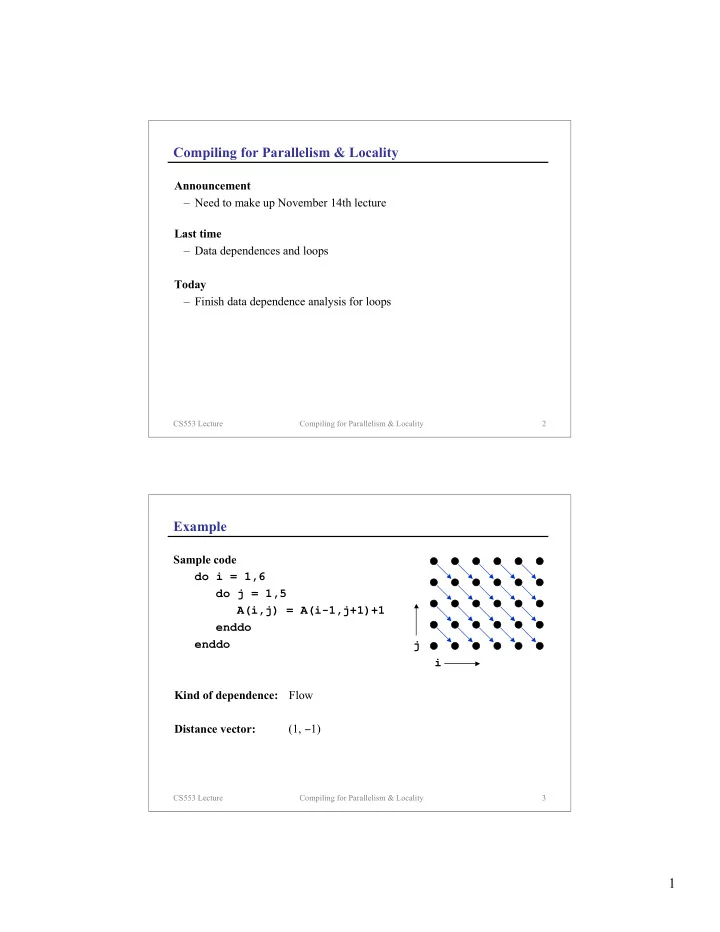
Example

Sample code do i = 1,6 do j = 1,5 A(i,j) = A(i-1,j+1)+1 enddo enddo

Kind of dependence: Distance vector:

i j Flow (1, −1)

slide-2
SLIDE 2

2

CS553 Lecture Compiling for Parallelism & Locality 4

Exercise

Sample code do j = 1,5 do i = 1,6 A(i,j) = A(i-1,j+1)+1 enddo enddo

Kind of dependence: Distance vector:

i j Anti (1, -1)

CS553 Lecture Compiling for Parallelism & Locality 5

Direction Vector

Definition

– A direction vector serves the same purpose as a distance vector when less precision is required or available – Element i of a direction vector is <, >, or = based on whether the source of the dependence precedes, follows or is in the same iteration as the target in loop i

Example

do i = 1,5 do j = 1,6 A(j,i) = A(j-1,i-1)+1 enddo enddo

Direction vector: Distance vector:

j i (<,<) (1,1)

slide-3
SLIDE 3

3

CS553 Lecture Compiling for Parallelism & Locality 6

Distance Vectors: Legality

Definition

– A dependence vector, v, is lexicographically nonnegative when the left- most entry in v is positive or all elements of v are zero Yes: (0,0,0), (0,1), (0,2,-2) No: (-1), (0,-2), (0,-1,1) – A dependence vector is legal when it is lexicographically nonnegative (assuming that indices increase as we iterate)

Why are lexicographically negative distance vectors illegal? What are legal direction vectors?

CS553 Lecture Compiling for Parallelism & Locality 7

Loop-Carried Dependences

Definition

– A dependence D=(d1,...dn) is carried at loop level i if di is the first nonzero element of D

Example

do i = 1,6 do j = 1,6 A(i,j) = B(i-1,j)+1 B(i,j) = A(i,j-1)*2 enddo enddo

Distance vectors:

(1,0) for accesses to A (0,1) for accesses to B

Loop-carried dependences

– The i loop carries dependence due to A – The j loop carries dependence due to B

slide-4
SLIDE 4

4

CS553 Lecture Compiling for Parallelism & Locality 8

Idea

– Each iteration of a loop may be executed in parallel if it carries no dependences

Example

do i = 1,6 do j = 1,5 A(i,j) = B(i-1,j-1)+1 B(i,j) = A(i,j-1)*2 enddo enddo

Parallelize i loop?

Parallelization

i j Iteration Space Distance Vectors: (1,0) for A (flow) (1,1) for B (flow)

CS553 Lecture Compiling for Parallelism & Locality 9

Idea

– Each iteration of a loop may be executed in parallel if it carries no dependences

Example

do i = 1,6 do j = 1,5 A(i,j) = B(i-1,j-1)+1 B(i,j) = A(i,j-1)*2 enddo enddo

Parallelize j loop?

Parallelization

i j Iteration Space Distance Vectors: (1,0) for A (flow) (1,1) for B (flow)

slide-5
SLIDE 5

5

CS553 Lecture Compiling for Parallelism & Locality 10

Problem

– Loop-carried dependences inhibit parallelism – Scalar references result in loop-carried dependences

Example

do i = 1,6 t = A(i) + B(i) C(i) = t + 1/t enddo

Can this loop be parallelized? What kind of dependences are these?

Scalar Expansion: Motivation

i Convention for these slides: Arrays start with upper case letters, scalars do not No. Anti dependences.

CS553 Lecture Compiling for Parallelism & Locality 11

Scalar Expansion

Idea

– Eliminate false dependences by introducing extra storage

Example

do i = 1,6 T(i) = A(i) + B(i) C(i) = T(i) + 1/T(i) enddo

Can this loop be parallelized?

i Disadvantages?

slide-6
SLIDE 6

6

CS553 Lecture Compiling for Parallelism & Locality 12

Scalar Expansion Details

Restrictions

– The loop must be a countable loop i.e. The loop trip count must be independent of the body of the loop – There can not be loop-carried flow dependences due to the scalar – The expanded scalar must have no upward exposed uses in the loop do i = 1,6 print(t) t = A(i) + B(i) C(i) = t + 1/t enddo − Nested loops may require much more storage − When the scalar is live after the loop, we must move the correct array value into the scalar

CS553 Lecture Compiling for Parallelism & Locality 13

Example 2: Parallelization (reprise)

Why can’t this loop be parallelized?

do i = 1,100 A(i) = A(i-1)+1 enddo

Why can this loop be parallelized?

do i = 1,100 A(i) = A(i)+1 enddo 1 2 3 4 5 ... i 1 2 3 4 5 ... i Distance Vector: (1) Distance Vector: (0)

slide-7
SLIDE 7

7

CS553 Lecture Compiling for Parallelism & Locality 14

Sample code

do j = 1,6 do i = 1,5 A(j,i) = A(j,i)+1 enddo enddo

Why is this legal?

– No loop-carried dependences, so we can arbitrarily change order of iteration execution

Example 1: Loop Permutation (reprise)

do i = 1,5 do j = 1,6 A(j,i) = A(j,i)+1 enddo enddo

CS553 Lecture Compiling for Parallelism & Locality 15

Dependence Testing

Consider the following code…

do i = 1,5 A(3*i+2) = A(2*i+1)+1 enddo

Question

– How do we determine whether one array reference depends on another across iterations of an iteration space?

A(3*i+2) = A(2*i+1)+1

slide-8
SLIDE 8

8

CS553 Lecture Compiling for Parallelism & Locality 16

Dependence Testing in General

General code

do i1 = l1,h1 ... do in = ln,hn A(f(i1,...,in)) = ... A(g(i1,...,in)) enddo ... enddo

There exists a dependence between iterations I=(i1, ..., in) and J=(j1, ..., jn)

when – f(I) = g(J) – (l1,...ln) < I,J < (h1,...,hn)

CS553 Lecture Compiling for Parallelism & Locality 17

Algorithms for Solving the Dependence Problem

Heuristics – GCD test (Banerjee76,Towle76): determines whether integer solution is possible, no bounds checking – Banerjee test (Banerjee 79): checks real bounds – I-Test (Kong et al. 90): integer solution in real bounds – Lambda test (Li et al. 90): all dimensions simultaneously – Delta test (Goff et al. 91): pattern matches for efficiency – Power test (Wolfe et al. 92): extended GCD and Fourier Motzkin combination

Use some form of Fourier-Motzkin elimination for integers – Parametric Integer Programming (Feautrier91) – Omega test (Pugh92)

slide-9
SLIDE 9

9

CS553 Lecture Compiling for Parallelism & Locality 18

Dependence Testing: Simple Case

Sample code

do i = l,h A(a*i+c1) = ... A(a*i+c2) enddo

Dependence?

– a*i1+c1 = a*i2+c2, or – a*i1 – a*i2 = c2-c1 – Solution exists if a divides c2-c1

CS553 Lecture Compiling for Parallelism & Locality 19

Example

Code

do i = l,h A(2*i+2) = A(2*i-2)+1 enddo

Dependence?

2*i1 – 2*i2 = -2 – 2 = -4

(yes, 2 divides -4) Kind of dependence?

– Anti? i2 + d = i1 ⇒ d = -2 −Flow? i1 + d = i2 ⇒ d = 2 i1 i2

slide-10
SLIDE 10

10

CS553 Lecture Compiling for Parallelism & Locality 20

GCD Test

Idea

– Generalize test to linear functions of iterators

Code

do i = li,hi do j = lj,hj A(a1*i + a2*j + a0) = ... A(b1*i + b2*j + b0) ... enddo enddo

Again

– a1*i1 - b1*i2 + a2*j1 – b2*j2 = b0 – a0 – Solution exists if gcd(a1,a2,b1,b2) divides b0 – a0

CS553 Lecture Compiling for Parallelism & Locality 21

Example

Code

do i = li,hi do j = lj,hj A(4*i + 2*j + 1) = ... A(6*i + 2*j + 4) ... enddo enddo

gcd(4,-6,2,-2) = 2 Does 2 divide 4-1?

slide-11
SLIDE 11

11

CS553 Lecture Compiling for Parallelism & Locality 22

Concepts

Improve performance by ...

– improving data locality – parallizing the computation

Data Dependences

– iteration space – distance vectors and direction vectors – loop carried

Transformation legality

– must respect data dependences – scalar expansion as a technique to remove anti and output dependences

Data Dependence Testing

– general formulation of the problem – GCD test

CS553 Lecture Compiling for Parallelism & Locality 23

Next Time

Lecture

– Value dependence analysis