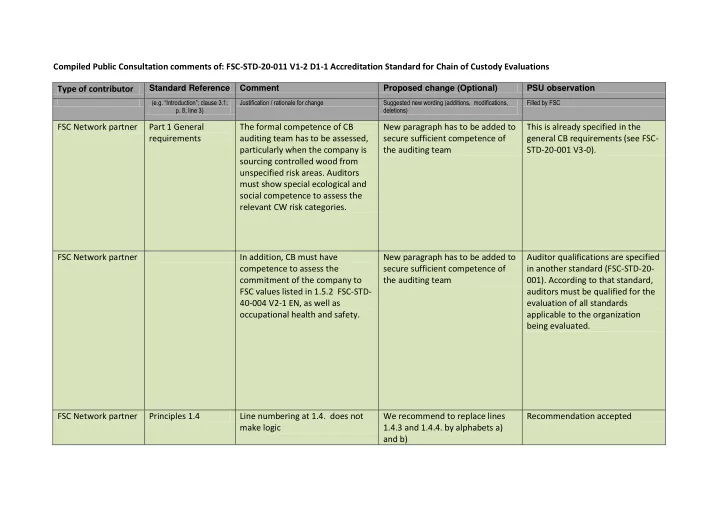
SLIDE 1 Compiled Public Consultation comments of: FSC-STD-20-011 V1-2 D1-1 Accreditation Standard for Chain of Custody Evaluations Type of contributor
Standard Reference Comment Proposed change (Optional) PSU observation
(e.g. “Introduction”; clause 3.1;
Justification / rationale for change Suggested new wording (additions, modifications, deletions) Filled by FSC
FSC Network partner Part 1 General requirements The formal competence of CB auditing team has to be assessed, particularly when the company is sourcing controlled wood from unspecified risk areas. Auditors must show special ecological and social competence to assess the relevant CW risk categories. New paragraph has to be added to secure sufficient competence of the auditing team This is already specified in the general CB requirements (see FSC- STD-20-001 V3-0). FSC Network partner In addition, CB must have competence to assess the commitment of the company to FSC values listed in 1.5.2 FSC-STD- 40-004 V2-1 EN, as well as
- ccupational health and safety.
New paragraph has to be added to secure sufficient competence of the auditing team Auditor qualifications are specified in another standard (FSC-STD-20- 001). According to that standard, auditors must be qualified for the evaluation of all standards applicable to the organization being evaluated. FSC Network partner Principles 1.4 Line numbering at 1.4. does not make logic We recommend to replace lines 1.4.3 and 1.4.4. by alphabets a) and b) Recommendation accepted
SLIDE 2 FSC Network partner Documented procedures 2.2. Term outsourcing is unclear. Definition for outsourcing has to be added to Terms and definitions Recommendation accepted FSC Network partner 4 Certification decision-making 4.2.2.e 'sufficient' is unclear expression. Whole paragraph needs to be
- revised. Line e) should also end up
with 'or' to complete the list a)..f) Our recommendation for 4.2.2.e: 'Repeated failure of the company to demonstrate that organizational control is operating properly, or; Recommendation accepted Certificate Holder Annex I: Chain of Custdoy Certification Reports Part II: Main Evaluation Reports Box 1: 1.1d The fullfillment of this requirement creates a huge treshold for both the Certification Body and the Certificate Holder whereas this information is not used for any pupose Deletion of requirement Recommendation accepted Certificate Holder Annex I: Chain of Custdoy Certification Reports Part II: Main Evaluation Reports Box 1: 1.1e The fullfillment of this requirement creates a huge treshold for both the Certification Body and the Certificate Holder whereas this information is not used for any pupose Deletion of requirement Recommendation accepted Certificate Holder Annex I: Chain of Custdoy Certification Reports Part III: Surveillance Audit Reports Box 2: 5.2b The fullfillment of this requirement creates a huge treshold for both the Certification Body and the Certificate Holder whereas this information is not used for any pupose Deletion of requirement Recommendation accepted
SLIDE 3 Certificate Holder Annex I: Chain of Custdoy Certification Reports Part III: Surveillance Audit Reports Box 2: 5.2d The fullfillment of this requirement creates a huge treshold for both the Certification Body and the Certificate Holder whereas this information is not used for any pupose Deletion of requirement Recommendation accepted Certification Body Terms and definitions: Individual COC certificate FSC COC certificate type that only covers one single legal entity. In Spain, there are also inscriptions
- f freelance persons(Autónomos)
that can sell materials, are not inscribed as companies, are inscribed with their own names, they also can hired personnel. This "autónomos" can sell material and some of them shows interest in coc certification. This can also be consider as legal entities? if so,can the standard specified further that legal entiries can be consider company names and personal names inscribed in a merchants register? Recommendation accepted Certification Body FSC-STD-20-001 should be FSC- STD-20-011 FSC-STD-20-011 (Version 1-2) EN Recommendation accepted
SLIDE 4 Certification Body D Terms and definitions Individual COC certificate: The definition says FSC COC certificate type that only covers
- ne single legal entity. However,
AnnexII specifies conditions where an individual COC certificate can have more than on legal entities. Therefore the definition is contradictory to AnnexII. Recommendation accepted Certification Body Clause 2.2.2 d) It is unclear what 'exclusively'
- means. Temporally or physically? If
- utsourced company handles
certified materials at temporal designated space without physical boundaries within a factory, is this considered as exclusive? Exclusive means temporally and
- physically. If the processor has
certified and non-certified materials in the same physical location, then this option is not applicable. Certification Body Clause 7.3 e) and, Caluse 7.4 Clause 7.3 e) says the company's complexity and scale of the activities are used to determine the company's annual growth limits. Whereas clause 7.4 clearly specifies the rule to be followed to determin annual growth limits. How does clause 7.3 e) work when there is a concrete rule specified in clause 7.4? The Clause was revised to address the inconsistency.
SLIDE 5
Certification Body Caluse 7.4 What is the rational for the number 40? The number was proposed by the working group responsible for the revision of this standard. The new draft standard no longer includes this requirement. Certification Body Clause 8 Table A includes information about audit type (i.e.surveillance, Re-evaluation, Main evaluation etc). Then this table should not be included in Part II Main Evaluation. The standard looks poorly structed. Sections 8 and 15 should be removed and integrated into a new annex. Recommendation accepted Certification Body Clause 8 Table A Complexity mentions about having high risk contractors. But high risk contractors are sampled and visited anyway and so should not be deal with here. If complexity is the subject, sourcing reclaimed material should be included here. High risk outsourcing, CW verification program and Reclaimed material verification program need to be included in the risk table in order to ensure that these high risk Participating Sites are evaluated by CBs. Certification Body Clause 15 Sections 8 and 15 should be removed and integrated into a new annex. Recommendation accepted Certification Body Clause 19.2 If there was no outsourcing of FSC activity, there is not much to see, even if a contractor is high risk. I suggest adding a NOTE like following:High risk contractors which have not had any FSC activity since the previous audit do not need to be included in the population from which the sample is drawn. Recommendation accepted. The revised clause specifies "since the previous audit".
SLIDE 6 Certification Body Clause 19 Many certificate holders wish to add high risk contractors at the time of surveillance and Re- evaluation. So it is helpful if there is a clear rule about if new high risk contractors need be sampled from a separate set to existing high risk contractors. If new contractors should be separated from existing ones, description like clause 15.2 is very helpful here. Recommendation accepted. Certification Body Clause 21.2.3 This should be consistent with 15.2. being added … at the time of … -> have been added … by the time of … Recommendation accepted. Certification Body Front page - standard number FSC-STD-20-001 Incorrect standard number FSC- STD-20-001 Should read: FSC-STD-20-011 Corrected. Certification Body Page 7, Definitions, definition of Evaluation The definition of evaluation does not include full list of all types of audits Additional audit types:
Evaluation
- Certificate Transfer Evaluation
Recommendation accepted.
SLIDE 7 Certification Body Paragraph 20.1 , page 28 FSC certificate suspension should not be a reason for extra on-site audit if the company wishes to reinstate their certificate. Simply the suspension is not always related with full breakdown in COC system and can be caused by other issues such as: one Major NCR
- verdue or non-payment for
certification services. If the company has closed outstanding certification and financial issues the Certificaition Body should not authomatically require extra inspection to confirm that and should go back to regular surveillance audits cycle. Still the decision about the eventual extra audit is at CB's discretion and may be executed in practice. Wording: "b) Tthe company’s certificate is currently suspended." should be removed Recommendation rejected. The new audit is not required because the company wants to reistate their certificate, but because the company is required to comply with a new standard version and the CB should confirm that the company has adjusted its COC system to the new standard version.
SLIDE 8 Certification Body Paragraph 20.3, page 28 See comment above. Wording proposed for removal: "20.3 When a new or a revised certification standard becomes effective while an organization’s Chain of Custody certificate is suspended the following applies:20.3.1 The certification body shall conduct an assessment
- f the organization’s procedures
to ensure that they are in compliance with relevant new standard requirements at the time when suspension is lifted." Recommendation rejected. The new audit is not required because the company wants to reistate their certificate, but because the company is required to comply with a new standard version and the CB should confirm that the company has adjusted its COC system to the new standard version. Certification Body PART II: MAIN EVALUATION REPORT, par. 1.1 c) i) page 31 "The size class of the site in terms of annual turnover" Can auditors just collect a raw figure of the turnover in local currency? This can be further classified in the Head Office to appropriate class, so we can avoid misinterpretation and confusion with local exchange rates during the audit. Certainly, it is not the
- bjective of COC audit to argue
about what exhange rate should be used... I propose wording: "The size class
- f the site in terms of annual
turnover" to be removed and replaced by "Annual turnover figur in local currency." Recommendation rejected. The auditor can collect the information in the company format. However, the evaluation report shall contain the AFF according to FSC Policy categories. Certification Body PART II: MAIN EVALUATION REPORT, Section 8 Selection of participants in group and multi-site certificates New sampling methodology should not affect any certification arrangements before the effective date of the standard. Revising the contracts is the most unprofessional practice and can cause legal actions. I propose a NOTE to be added: "New sample selection methodology does not apply to certificate holders contracted before the effective date of this standard" Recommendation rejected. The FSC normative framework needs periodic update and companies shall update their systems following the standard transition rules.
SLIDE 9 Certification Body General No reference to FSC Project
- Certification. Lack of Accreditation
Standard for FSC Project Certification. New standard should be released (or section added to 20-011) setting the clear rules. This is not possible at the moment. FSC will revise project certification standard after the conclusion of FSC-STD-40-004 review process. Certificate Holder 9.3 Evaluation at the level of the
- perational site.This proposed
change apply to companies with a single chain of custody certificate with more than one site and that uses the credit system. According to the standard all sites must be visited during the annual CoC
- audit. Since the company apply
the Credit system there is often no reason to visit each site or mill. All incoming and outgoing fsc certified products are handled in
- ne or several calculation sheets
(often excel). The excel sheets are
- ften managed by a central
department and not by the sites themselves. When the Organization holds a single chain of custody certificate and uses the credit system as the control system, it is up to the Certification Body to decide how many sites to visit during annual audits. Recommendation rejected. Companies with several sites may also apply for multi-site certification in order to benefit of a reduced CB auditing intensity. Certification Body various assumes that standard 40-003 will be approved with no distinction between groups and multi-sites will need to wait until new 40-003 standard is approved or will need to be approved simultaneously The two standards are planned to be approved simultaneously.
SLIDE 10 Certification Body A Scope and various places in standard,
includes in scope auditing of COC
- perations with CWRAs . I think
intention is to develop a separate standard for CBs auditing of Companies who have CWRAs, since there are likely to be specific new requirements relating to eg. consultation, sampling, timing of audits etc. coming out of Karen Steer's working group on CW Following motion at last 2 GAs, the procedure for development and revision of standards is being revised to put normative documents on a regular review cycle, specifically to remove the scenario where a standard is changed and then changed again a few months later. The way to approach the CW assessment requirements therefore needs to be co-ordinated together with this standard or needs to be removed from the scope of this standard so that a separate standard can be written. The Controlled Wood and accreditation standards are being revised simultaneously by the CW Technical Commitee. However, while the revised CW standard is not available, the accreditation standard will include only the requirements applicable to the current standard version. Certification Body B2 and footnote 1 it is likely when FSC-PRO-001-01 is finalised there will be both a Valid and Effective date incorporate Valid and Effective date as per procedure Recommendation accepted Certification Body definitions - individual coc certificate and Annex 2 of standard The definition is in direct conflict with Annex 2 of this standard. - is the intention that multiple legal entities can be included within the scope of a single/individual COC certificate as per Annex 2? Is this a simple way of lowering AAF for companies? What does "identical
- wnership structure" actually
mean (eg. would same shareholders but in different proportions qualify?)? please clarify The term individual COC certificate was replaced by Single COC certificate.
SLIDE 11 Certification Body defnitions -multi-site coc certificate this is different to how multi-site coc certificates are defined in the new draft 40-003 same definition please if new 40- 003 is passed Recommendation accepted Certification Body definitions - participating site Defines as : "Site of an
- rganization or single legal entity
included in the scope of a multi- site certificate." Not clear if a single legal entity with multiple sites fits into this clarify Recommendation accepted Certification Body 1.2 is this correct? In fact a certificate holder may have eg. minor CARs which become Major at surveillance (with a 3 month close
correct to "at the time of Main Evaluation", ie. a certificate not issued at main evaluation if any major non-compliances found Recommendation accepted Certification Body Note under 2.2.2 not sure of the rationale for including CPI here. What about if the company is outsourcing in a country with low CPI but own country (ie. not across borders)? In theory this carries the same risk. In practice I think CPI is too crude a tool to use here. CBs already have the option of deciding to insist on audits which we could use if
- utsourcing really does appear
- risky. Otherwise risk criteria much
better delete CPI Note There are evidences that the cross-border outsourcing is riskier to the system, since it is more difficult to companies and CBs to ensure and verify conformance at the contractor level. Therefore, the CPI is being used as a risk indicator.
SLIDE 12 Certification Body 7.4a) sometimes we might want to limit growth further ie. before they get to 39 members. (Actually I think there should be a maximum
- verall number of members of
multi-site certificates except perhaps retailers) "up to a number determined by the CB but being no more than 40 participating sites " The "unlimited growth up to 40 sites" was removed from the
- standard. Please check revised
version. Certification Body 11.2 & 19.2 We support the revised definitions
- f high risk in 2.2. However needs
to be more clear at 11.2 that the sample taken is from high risk contractors only (otherwise pointless to classify them at all) 11.2: "The sampling number (y) shall be at a minimum the square root of the number of high risk contractors (x), rounded to the upper whole number…." . Same principle for 19.2- add "….square root the number of high risk contractors…" Recommendation accepted Certification Body 20.1a) and 20.2 references should be updated ie. to latest version of 20-011 v1-2 update references Recommendation accepted Certification Body Annex 1, Box 1 , 1.1c suggest removing version no. of AAF policy as this policy is likely to be revised before the standard is next revised see left The standard clause will refer to the latest version of the AAF policy Certification Body 8.2 risk factor complexity the CW complexity factor should
- nly apply if risk analysis is taking
- place. If the CW certification only
involves trading of CW in a transfer system ther is no additional complexity remark: if there is only trade of CW in a transfer system this factor is not applicable Recommendation accepted
SLIDE 13 Certification Body 1.3, 6.2, 6.3 and
Inconsisent formatting Clauses a-d should be changed to 1.3.1 - 1.3.4 for consistency with
- ther requirements; same for 6.2
a-e and 6.3 a-d, among others. Recommendation accepted Certification Body 1.3.b Revise statement to make grammatically correct. "...including non-certified suppliers as part of FSC Controlled Wood and reclaimed material verification programmes; and contractors as part of outsourcing agreements, within the scope of the evaluation:" Recommendation accepted Certification Body 1.3.c Footnote 2 (pg 10) Footnote is incomplete; missing reference to sampling of reclaimed material suppliers who are included in a supplier audit program. "The sampling of suppliers is applicable for suppliers at Forest Management Unit level located in districts that have not been classified as ‘low risk’ for at least
- ne of the five FSC Controlled
Wood categories and suppliers of reclaimed material included in a supplier audit program. Recommendation accepted Certification Body 1.4.3/1.4.4 Inconsisent formatting 1.4.3 and 1.4.4 shoud be changed to 1.4.2.a and 1.4.2.b since they represent options under 1.4.2. Recommendation accepted Certification Body 1.4 NOTE Use of the term "operation" in the note under 1.4 is inconsistent with 1.4.4 and Annex II The statement, "Each site shall be audited if the scope of the evaluation is an individual Chain of Custody operation." should be changed to similar statement in Annex 2: "All sites or operations included in the scope of an individual Chain of Custody certificate shall undergo full evaluations by the certification Recommendation accepted
SLIDE 14 body." Certification Body 2.2.1 & Note under 2.2.2 For most clarity, the note under 2.2.2 should become 2.2.1.f 2.2.1.f: Company is outsourcing across national borders to a country with CPI lower than 5. The note is not under 2.2.1 because the requirements of 2.2.2 would remove the need for audits in some cases of outsourcing across national borders to a country with CPI lower than 5. Certification Body 4.5.1 & 4.6 Footnote 6 Requires further clarification. 4.5.1 says minor NCs shall be corrected within 1 year, but footnote says compliance must be checked by next annual audit (which is defined as once per year, but not more than 15 mos. from last audit. It is very confusing and impractical to state that company must be in conformance within 12 mos, but CB may not evaluate for up to 15
- months. It would be best to state
clear requirement in 4.5.1 and remove the footnote. 4.5.1: Minor non compliances shall be corrected prior to the next annual audit (under exceptional circumstances timeline may be extended to 2 audit periods); And delete Footnote 8. Recommendation accepted
SLIDE 15 Certification Body 6.3.b, Footnote 8 Includes description related to old product classification system. The last sentence was when company was required to define products at the PRODUCT TYPE level. New classification system allows more flexibility and is based on Levels, not Product Class, Product Type, Product sub-type system. Delete last sentence. "The minimum level of detail required for defining the scope of a Chain of Custody certificate is information
- n the level of the product type."
Recommendation accepted Certification Body 7.4.a Unlimited growth up to 40 is very risky and allows companies to take advantage of the multi-site option. For example, a company can be assessed with 2 sites, receive their certificate, and then add 38 sites during their first week. Companies would do this since it would greatly reduce the cost of first year's certification. It would be good to understand the rationale
- here. Very large multisites (over 40
sites) are not the norm. In fact, our CB only has only 12 certificates globally (group & multisite) with
Delete 7.4.a and set annual growth rate at 100%, based on number of participating sites at the time of last evaluation (main, re-eval, annual audit), in all cases. Alternatively, if FSC wants to set an exact number, "40" should be significantly reduced, we suggest "10". The "unlimited growth up to 40 sites" was removed from the
- standard. Please check revised
version.
SLIDE 16 Certification Body 7.4 This requirement does not allow CB flexibility to set the growth rate lower than what is defined in a) - c) based on audit results. Add a requirement (?7.5) or note that should allows CBs to reduce the annual growth limit based on client resources, non-conformity, scope limitations, etc. The new draft under consultation provides more flexibility for the CB to define the growth limits for groups and multi-site certificates. Please check the draft under consultation. Certification Body 8.1 & 8.2 Neither requirement specifically allows for CBs to sample at higher
- rates. CBs should have flexibility to
go above sampling rates when additional risk/conformity issues are found. Both requirements should specify that this is requirement for minimum number of sites to be sampled. The table provides a standardized audit sampling methodology which already includes the risk analysis to define the sampling intensity. Therefore, there is little room for CBs to justify a higher sampling. Certification Body Table A (pg. 17): Complexity Row Complexity statement does not capture reclaimed material sourcing, which has similar risks as CW verification programs. Revise complexity statements to include "… CW verification program, reclaimed material sourcing and/or high risk
Recommendation accepted Certification Body Table A (pg. 17): System for Controlling FSC Claims This is not clear in cases where sites use multiple systems. For example, Multisite certificate has 4 sites and all operate under both the credit and transfer system. Is this 0.1 risk factor since all sites are using same system(s)? Or would they be given a 0.2 because the certificate includes more than
Change to: Certificate scope includes one control system OR Certificate scope includes more than one control system. Recommendation accepted
SLIDE 17 Certification Body 15.1, 2nd NOTE (waives) It is clear that participating sites would need to meet eligibility requirements defined in 13.2.1, but it is not clear if Central Office would need to make formal declaration and follow process under 13.2.1 (i. - iii.) Can participating sites be removed from equations for more than 2 consecutive years? Clarify that Central Office shall submit signed declaration listing participating sites that meet 13.2.1
- description. This is best way to
ensure that participating sites are not removed from the equation for more than 2 consecutive years. Recommendation accepted Certification Body 18.1 It is not clear whether reclaimed material supplier sampling in multisite certificates is conducted at the certificate holder level (like Annex 3 fieldwork) or linked to the specific participating site that is sourcing reclaimed material (like high risk subcontractors). If sampling a multisite, would we
- nly apply reclaimed material
sampling if the participating site was selected, or should this be happening every year, on a certificate level? Suggest sampling these on a certificate basis, just as CW Annex 3 fieldwork (similar risks): "For certificates with suppliers of reclaimed materials included in a Supplier Audit Program, the CB shall carry out annual on site verification audits of at least 20%
- f the total suppliers selected by
all sites under certificate holder's reclaimed Supplier Audit Program, unless..." Recommendation partially
- accepted. The supplier sampling
shall be conducted at Participating Site level, considering the Participating Sites selected in the current evaluation.
SLIDE 18 Certification Body Annex II, 1.ii. This requirement can be deleted due to changes in FSC database. This provision was originally included because FSC database
- nly allowed for listing one
address on a single certificate, thus this address had to be the invoice address so customers could check validity. This is no longer the case, as multiple addresses now appear on single certificate records. There is no reason why one legal entity that has 2 sites involved with invoicing couldn't act under an individual certificate, especially since customers can verify both addresses on info.fsc.org. Delete 1.ii. Recommendation rejected. Companies invoicing products separately shall apply for mult-site certification.
SLIDE 19 Certification Body Single-site Chain of Custody certificates - > Individual Chain of Custody certificates in "Terms and definitions" in page 6, and many others Proposed change of "Single-site Chain of Custody certifiate" to "Individual Chain of Custody" should not be introduced. 1) "Single-site" is more easily recognized and understood to be compared with "Multi-site" rather than "individual". 2) Rationale for changing into "Individual" is unclear 3) Changing the name of certificate type causes much confusion among CHs, leading to increased cost for certificate re- issuance Remain unchanged Recommendation accepted Certification Body the low risk categorization for
in clause 2.2.2, page 11 It says "…if a low risk of contamination may be demonstrated through:" By the term "through", it is unclear whether all of the following indicator a) to e) needs to be applied or whether any one of a) to e) is sufficient. Should modify the wording as "…demonstrated through any of the following:" Recommendation accepted
SLIDE 20
Certification Body Risk Factors in clause 8.2, page 17 in "Complexity" it mentions "Certificate scope without CW verification program" By the term "CW verification" it is unclear whether it refers to Annex 2/ Annex 3 based on FSC-STD-40- 005 or whether it includes trading activities of FSC-CW materials in general. Should modify the wording as "…own CW verification program" Recommendation accepted Certification Body Footnote 9 in clause 12, page 23 Accoding to Advice Note issued by FSC 01 March 2013 should be 02 March 2013 Recommendation accepted Certification Body Footnote 10 in PARTIII, page 24 It mentions "…but not later than 15 months…" The audit date could be scheduled ahead of / behind the original proposed schedule, and consequently, sufficient range should be allowed. 16 months, intead of 15 months, should be applied, granting CHs 2 months before/after the certain date for audit Recommendation rejected. Ideally, the audits should be schedulled every 12 months. The footnote specifies 15 months, which gives already 3 months flexibility. Certification Body Note for participating site sampling in clause 15.1, page 26 Good point to clearly document that participatin sites without an FSC activiies since the previous audit may be excluded from the sample equation. This idea should also be applied for sampling of outsourcing contractors -> See clause 19.1 Recommendation accepted
SLIDE 21 Certification Body Selecton and surveillance of contractorsin clause 19, page 27 in clause 15.1, page 26 Refer to clause 15.1 "NOTE" for excluding of participating sites without FSC activities since the previous audit from the sampling
- slection. The same idea should be
applied for outsourcing contractors without any FSC- related orders since the previous audit.Selecting and visiting contractors at surveiilance/renewal audits should be decided upon the actual implementation of CoC control at each contractor. If no FSC-related
- utsourced work has been
- rdered since the previous audit,
then such contractors should be excluded from the sampling. . Should add:Contractors operatin under outsourcing agreements which have not had any FSC activity since the previous audit do not need to be included in the population of contractors from which the sample is drawn Recommendation accepted
SLIDE 22 Certification Body FSC outsourcing activityNOTE in clause 19.2, page 27 It mentions "NOTE: If a certificate holder starts outsourcing activities after the main evaluation."It is not clear what "starts outsourcing activities"means. In Japan, vast majority of CHs start ordering FSC- related outsourcing work to their contractors after they receive FSC- CoC certificates. Therefore, if "starts outsourcing activities" means "give the first order of FSC- related outsourcing work to registered contractors," then almost all CHs must apply at their surveillance the sampling intensities specified for main evaluation, even when such sampling intensities have been already been applied at main
- evaluation. It is believed that the
intended meaning of it is rather that "newly including outsourcing processes to the certificate scope". Should modify the wording:OLD: starts outsourcing activitiesNEW: add outsourcing processes to its certificate scope The note was removed from the standard.
SLIDE 23 Certification Body General It is disadvantageous for CHs and CBs to have FSC standards revised
- ne after another. The revision
process of FSC standard should include the issue that different standards should be reviewed and updated in one lump. Recommendation accepted Certification Body 2.2.2 - Note Outsourcing across national borders to countries with Corruption Perception Index (CPI) lower than 5 has to be considered high risk activity only if low risk is not met by enterprises Recommendation rejected. Certification Body 4.5 - footnote 4 Although good practices recommend the inclusion of all non-confomities identified in audit during the closing meeting, the RRA process is the moment when CB effectively makes the decision
- f certification/mantainance of
certification. Deadline for NCR conformance shall begin counting in final report conclusion. The footnote allows CBs to present the CARs at the time of the final report submission. Please consult the revised draft standard. Certification Body C - References FSC-STD-40-004b not included. Refer to Germplasm Resources Information Network (GRIN) Taxonomy Species Online Database Online databases are non- normative references. The references section shall contain
- nly normative references.
SLIDE 24
Certification Body 7.3 - c It is not clear if this analysis applies to Central Office or to new sites that are entering the multi-site certificate (applicant). Negative aspect: if this performance analysis considers site's individual CARs instead of Central Office's CARs, there is a risk of forbid the entry of new sites with no reason. The clause relates to the Central Office's ability in managing the Participating Sites. Therefore, the requirement applies at Central Office level and not at Participating Sites level. Certification Body 8.2 - Table A Consider the geographic distribution as a risk factor, including it in Table A. In large countries, the geographical distribution may be a relevant criterion, where in small countries, it may be irrelevant. Therefore, working group recommened other criteria for the risk determination. Certification Body 12.6 Methodology for derrogation analysis and approval by FSC is not clear. The derogation procedures no longer require FSC's approval. The Certification Body can approve it directly. Certification Body 16. There is no mention on CVA process. Indicate the audit type (on-site or desk) recommended to each specific CAR type. The new definition of evaluation also includes other audit types. Certification Body 9.4 and 16.2 The frequency of allowed desk audits is not clear. The revised draft standard specifies annual audits. Certification Body 9.4 The given example (eg.: agents) is not applicable. Corrected. Certification Body title page typo 20-011 (not 20-001) Recommendation accepted
SLIDE 25 Certification Body Terms This standard uses the terms "compliance" and "conformance"
- interchangably. Compliance (non-
compliance) is normally used in reference to legal requirements where as conformance (non- conformance) is used in reference to voluntary requirements (non- governmental regulations that a company adopts). Suggest replace all "compliance" with "conformance". Recommendation accepted Certification Body Definitions not clear what a sub-site is (how it is different from a 'company
- wned warehouse') and whether
- r not sub-sites are subject to any
audits as all auditing requirements
The definition of sites explain that sub-sites do not have purchase, processing or sales on their own. Therefore, a company owned warehouse may be classified as a sub-site if it does not perform any
- f the activities above. The
concept of sub-sites was removed from the standard. Certification Body General The more data collected in the report, the harder it is for the client to read through and take away the important information. Remove requirements to include data that is available in the certificate database and data that does not add value to the audit or is not related to conformance with requirements. The data available in the database cannot be removed from the report, as many certification bodies indeed use the report as a way of collecting information for the database. PSU has revised the reporting requirements in order to eliminate unnecessary information.
SLIDE 26 Certification Body General The 40-004 and 40-005 standards are also under revision. I realize that you're trying to align the standard with the changes to 40- 003 but can't it wait just a few months so we don't have to update our quality system twice in the same year and have two separate auditor trainings? suggest to wait to incorporate changes from 40-005 and 40-004 standard revisions, as well as minor components becoming
- bsolete, before this document is
finalized. The accreditation standard shall be revised again to reflect the changes in FSC-STD-40-004 and FSC-STD-40-005, once the revision process of both standards is concluded. Certification Body 4.7 interpretation: 5 or more major CARs for a central office/group manager vs. 5 or more major CARs for a site of a multi-site/group certificate. 5 or more major CARs at central
- ffice/group entity level results in
suspension of certificate. 5 or more major CARs at a participating site results in suspension of that site. Recommendation accepted Certification Body Section 8, Risk Matrix Seems like a great idea. Suggest to test it using current certificate holder scenarios to be sure it works as its intended to. Thank you for the feedback and suggestion. Certification Body 8.5 and 15.1 NOTE Often it seems appropriate and plausible to assess conformance through a desk audit. It is really the intention to require on-site audits of the central offce all the time? The Central Office shall be evaluated in each audit in addition to the selected Participating Sites. Yes, it is the intention to require
- n-site audits of the Central Office.
SLIDE 27
Certification Body 13.2.1 Many companies have an endless supply of non-certified material that is included in their controlled wood verfiication program that they use in their non-FSC products but would use in their FSC products when they have a sale. Thus, it seems more important to limit waives to when they have sold FSC Mixed or FSC Controlled Wood products, rather than when they have just received it. 13.2.1 For operations or (sets of) sites that have not produced, labelled or sold any FSC-certified material, and have not sold any FSC Controlled Wood since the previous audit, surveillance audits may be waived. (remove "have not sourced controlled material or") Recommendation accepted Certification Body Annex 1, Part II, Box 1, 1.1d) and e) (in Box 1) This is not a requirement in FSC- STD-40-004 so often clients do not have this information available. It's also onerous to collect this information, especially per product type per site. It's not a manditory field in the FSC certificate database so this information is only available in the client's report of their audit. Remove this requirement. No added value for anyone. Recommendation accepted
SLIDE 28 Certification Body Annex 1, Part II, Box 1, 1.2.1 CBs should be required to keep the FSC database current (this has been SCS's understanding however it seems not all CBs have the same interpretation). Most company's PGLs change a couple times a year, at least - species and product types and FSC categories/claims. To include it in the report is only to record a timestamp version which quickly becomes inconsistent with the database. Make it explicate that CBs need to maintain the FSC certificate database and remove the requirement to include the company's PGL in the report. Recommendation partially
- accepted. The product group
information is also used in the report to identify the scope of the
- evaluation. The CB shall include a
list of product groups in the report, but they are no longer required to include this information per site/participating site. Certification Body Annex 1, Part II, Box 1, 1.2.3 Some clients source from hundreds of suppliers of non- certified material. To list them all in the report seems unnecessary if it is available to the auditor. Remove this requirement. No need to list suppliers in the report. They change regularly so it isn't even a good resource for
- investigations. You'd always need
to go back to the client for current information. Recommendation rejected. This information in needed in case of investigations. Certification Body Annex 1, Part II, Box 1, 1.2.3 At an evaluation audit, companies
description of the wood supplied, species and volume of wood supplied" because they haven't begun processing FSC material. This information could be provided as a general overview, not a detailed list and information. Recommendation accepted Certification Body Annex 1, Part II, Box 1, 1.2.4 a) The justification for outsourcing is always the same - they do not have inhouse capasity. Remove 1.2.4a) Recommendation accepted
SLIDE 29 Certification Body Annex 1, Part II, Box 1, 1.2.4 d) and e) Contact details of all outsourcers (including those audited) is
- nerous to include in the report
and is best to contact the client for current information when needed. When scoping the next year's audit, we contact the client for a new list and do not reference the previous year's report because it's not likely to be current. remove contact details requirement Recommendation rejected. It is not clear why this information is
- nerous to the Certification Body.
CBs could ask certificate holders to provide a list of contractors to be attached to the report. Certification Body Annex 1, Part II, Box 1, 4.3 Explicately explaining that a company doesn't meet the rquirements of low risk is
- awkward. The justifications are an
internal process. The client agrees to the audit plan and scope of the audit - that should be sufficient information for their needs. Suggest that this be removed from reporting requirements. Recommendation accepted Certification Body Annex 1, Part II, Box 1, 5.2b) Have never understood what this is requiring. Compliance with 40- 005 requirements is covered under 5.2a). The company risk assessment or Annex III report would include the client's justification of low risk for each CW category. Remove, or make clear what the requirement is. Also state, "where applicable" at end. Recommendation accepted
SLIDE 30 Certification Body Annex 1, Part III. Box 2, 2.1 Surveillance audits are supposed to be check-ups on conformance. This requirement to include
- bservations demonstrating
compliance or non-compliance with each applicable requirement makes every audti a full evaluation. Allow for sample-based audits of applicable requirements for companies that had no Major CARs at their previous audit. All requirements pertaining to any minor CARs issued would have to be reviewed plus a sample of the applicable requirement. Every applicable requirement would be covered in evaulation and re- evaluation audits and also over the course of the 4 surveillance audits. This is how it's done in Forest Management audits. It helps to reduce auditing costs, making certification more accessable to smaller businesses. Recommendation rejected. FM audits are considerably more complex and costly than COC
- audits. Under the current
requirements, one auditor and
- ne day audit sounds reasonable
to cover all applicable COC requirements for the majority of certificate holders. Certification Body Annex 1, Part III. Box 2, 4.1 Identifying the "factors that allowed the noncompliance" is a root cause alaysis which should be conducted by the client, not the
- auditor. The auditor can make an
educated guess but its best for the client to do their own analysis. If the auditor is wrong about the root cause, the nonconformance might continue. Require a description of the nonconformance (activity that doesn't conform to requirmenets) instead of the factors that lead to the nonconformance. Recommendation accepted
SLIDE 31 Certification Body Annex 1, Part III. Box 2, 5.2 b) and d) It's extremely onerous to collect this information per site, per product type, per material
- category. This information is not
collected in the FSC certificate database so this information is
- nly available in the client's report
- f their own audit.
Remove this requirement. No added value for anyone. Recommendation accepted Certification Body Annex 1, Part III, 5.2 The justification for waiving a survillance audit is always the same - that the company did not produce, label or sell and FSC- certified material… since their previous audit. suggest to remove this from the reporting requirements and instead that CBs be required to keep a record of the clients signed declaration with the report. Recommendation accepted Certification Body Annex 1, Part IV. 8.1 Companies are not allowed to use the statement "FSC Controlled Wood" in segregation marks and there's nothing exceptional to report on use in sales and transport documents aside from what's recorded in the checklist for the standard. suggest to remove from reporting requirements Recommendation accepted Certification Body Annex 1, Part VI: Minor Components Isn't this going away at the end of the year? Suggest to remove. Recommendation accepted
SLIDE 32 Certification Body Annex 1, Part V, 9.2 c) CBs should be required to keep the FSC database current (this has been SCS's understanding however it seems not all CBs have the same interpretation). Most company's PGLs change a couple times a year, at least - species and product types and FSCmaterial categories. To include it in the report is only to record a timestamp version which quickly becomes inconsistent with the database. Suggest that it be explicate that CBs need to maintain the FSC certificate database and remove the requirement to include the PGLs of all participating sites in the report. Recommendation rejected. The purposse of requiring product groups information is to have a record of the certificate scope under evaluation at the time of the audit. Certification Body Annex 1, Part V, 10,1 a) Explicately explaining that a company doesn't meet the rquirements of low risk is
- awkward. The justifications are an
internal process. The client agrees to the audit plan and scope of the audit - that should be sufficient information for their needs. Suggest that this be removed from reporting requirements. Could be required that an internal record be maintained to demonstrate justification for sampling instead
- f including this in the report for
the client. With the new sampling methodology proposed in the draft standard, this requirement is no longer necessary.
SLIDE 33 Certification Body Annex 1, footnote 4 How could a company formally accept a corrective action request that has not yet been formally presented to them? This still leaves it open to interpretation as to whether CARs timelines commence from the closing meeting or the final report. The final report is more "formal" than the closing meeting so we would take that interpretation, however someone else might consider the closing meeting formal enough and consider that the commencement of the timeline. Suggest the time for commencement either be set to the date the final report is sent to the client so there is no ambiguity,
- r that it say that the CB shall
determine in their procedures when the CAR deadline commences, based on "formal presentation to the certificate holder". The option "formally accepted" was removed from the sentence. Certification Body Part 1, footnote 6 We support this interpretation. Grammar: missing a comma after "...Clause 4.5.1" Suggest that this clause be included in the body of the standard and/or in reference to 4.5.1. "Minor CARs shall be assessed for conformance no later than the next surveillance/re- evaluation audit. In the case that the deadline of the minor CAR has been extended, as per the requirements for extension
conformance shall be assessed no later than the next subsequent surveillance/re-evaluation audit." Recommendation accepted
SLIDE 34 Certification Body Definition of Evaluation It is not clear whether the definition of Main Evaluation is supposed to also include expansion of scope audits for new activities/products/sites. Part two
- f the standard would seem to
imply that. Clarify in the definitions The same requirements of this standard apply to all types of COC evaluation. Certification Body Definition of "individual COC certificate" This definition is not clear. Can "one single legal entity" include many sites? The definition directly contradicts Annex II, which states that "several legal entities" can be included in an individual COC certificate. Change "legal entity" to "site" in both the definition of "individual COC certificate" and in Annex II. The term individual COC certificate was replaced by Single COC certificate. Certification Body General There is a lot of language throughout the standard which references company-conducted controlled wood risk assessments. While it would be ideal to wait until the controlled wood standard is finalized before finalizing 20- 011, if that is not possible then it should be stated that company risk assessments will be phased
- ut, similarly to footnote 9 for
minor components. The accreditation standard shall reflect the terminology of the current version of FSC-STD-40-005. Once the new version of FSC-STD- 40-005 is published, the accreditation standard shall also be revised. Certification Body 6.1 Annex III is referenced but that Annex has been removed entirely in the revision. Remove text "(see ANNEX III)" Recommendation accepted
SLIDE 35
Certification Body 7.4.b This new requirement states that the “annual growth limit shall be fixed at 100%”; however, some multi-site certificate holders would not be able to manage a 100% growth rate annually. Change the language to read "annual growth limit shall be a maximum of 100%" to allow CBs to decide appropriate growth. Recommendation rejected. The working group responsible for the review of FSC-STD-40-003 has decided that the growth should be limited to 100%. Certification Body 20.3.1 This requirement does not specify whether the assessment is required to be on-site or not. It is unclear why suspended certificates have been separated from certificates with waived audits in section 20. Section 20.2 should be revised to include both certificate holders with waived audits and those that have been suspended. 20.2.2 should be applicable in the case of suspended certificates as well. This section was removed from the standard.
SLIDE 36 Certification Body 4.5.1 & 4.6 The timeframe of closing minor CAR's within one year seems inconsistent with footnote 6. If the intention is to audit the corrective action at the time of the next audit but that the minor CAR still needs to be closed within one year, then this is difficult to audit because it is often difficult to confirm the exact date that a corrective action was implemented. The difference between one year from the time the CAR is issued and when the next surveillance audit occurs is usually not more than a few weeks to a couple of months. Additionally, the next surveillance audit frequently occurs less than
- ne year from the time the CAR is
- issued. Therefore, it makes more
sense to align the timeframe for correction with the time that the corrective action will be assessed – i.e. at the time of the next surveillance audit. Modify 4.5.1 so that minor CAR's must be corrected by the time of the next audit. Recommendation accepted.
SLIDE 37 Certification Body 12.4 When a certificate holder is certified to 40-005, we include on the certificate their district of
- rigin as well as whether or not
they are certified to sell FSC Controlled Wood. The intention of this is to ensure that their certificate encompasses the entire scope of their FSC activities. However, this is currently out of conformance with section 12.4. Modify section 12.4 to allow wording on the certificate to cover the entire scope of the certificate holder's controlled wood activities. The Clause 12.4 was removed from the standard. Certification Body 8.2 a central office for a multisite can apply to a significant amount more control over participating site than a group administrator. This difference should be reflected in the risk factors. Add common ownership as a risk
- factor. Score .1 for common
- wnership, and .3 for
heterogenous ownership. Recommendation accepted Certification Body 7.3 7.3 references evaluation audits, this generally pertains to companies with no history of certification, however 7.3c suggests that the CB consider previous performance. This requirement is either contradictory or misplaced. Remove or relocate clause 7.3 Clause 7.3 was removed from the
- standard. Please see new clause
2.6 in the revised draft. Certification Body 7.3e Note It is unclear whether the note at 7.3e pertains to all of 7.3 or just 7.3e. Make it clear in the annotation to which clause the note applies. Clause 7.3 was removed from the
- standard. Please see new clause
2.6 in the revised draft.
SLIDE 38 Certification Body 7.4 The language is difficult to interpret and leaves little
- pportunity for CBs to slow the
rate of expansion for underperforming Central Offices. Maximum rate of growth for group and multi-site certificates 7.4 The certification body shall define a maximum annual rate of growth for participating sites that the Central Office may add to the multi-site certificate via internal audit (see 40-003). 7.5 The default growth rate shall be based on the number of Participating Sites included in the scope of the certificate at the time
Evaluation, Surveillance, Expansion
- f Scope, Re-Evaluation, etc…).
The default growth rates are defined as follows:
- a. Unlimited growth rate until the
multi-site certificate reaches 40 Participating Sites in total;
- b. A maximum rate of growth of
100% for multi-site certificates with more than 40 Participating Sites in total; 7.6 The Certification Body may limit the growth rate to something
- ther than the defaults listed in
7.5, based on the identification/determination of potential areas of weakness in any Please see Clause 6.1 in the revised draft.
SLIDE 39
- f the following areas (risk
criteria?):
- i. degree of heterogeneity
(certificates with a high diversity in terms of categories of business activities can be considered ‘high risk’)
- ii. complexity (certificates with CW
verification program and/or high risk outsourcers can be considered ‘high risk’)
- iii. system for controlling FSC
claims (complexity increases with Credit, and to a lesser extent Percentage systems)
- iv. Central Office’s performance
(number and/or types of CARs issued, etc..)
- v. Other criteria, as deemed
relevant by the certification body NOTE: In cases where the certification body imposes a growth rate lower than the default, the certification body shall document the rationale for the lower growth rate and provide this rationale to the certificate-holder. 7.7 If the number of Participating Sites exceeds the growth rate, then the certification body shall perform an Expansion of Scope
SLIDE 40
audit, comprised of an audit of the Central Office and a sampling (as specified in Clause 8.2) of all sites added to the certificate since the previous evaluation. Certification Body 8.4 Sets of sites should not be excluded from site selection Sets of sites is no longer required, since it does not fit into the current sampling methodology.
SLIDE 41 Certification Body 8.3c It is unclear what "size" means? Should be changed to "amount of FSC activity at Participating Sites" Recommendation rejected. Amount of FSC activity is also unclear. Certification Body 8.3 Randomness is incongruous to the notion of identifying and controlling risk. There are many prespriptive criteria for identifying risk that should be explicit in
- justification. Randomness should
not be a primary criteria for site
- selection. And the criteria for site
selection should be made more specific and robust; see 'Sets Of Sites' below. 8.3 The certification body shall then select specific participating sites to achieve the required sample number for evaluation. In the selection process the certification body shall ensure that the overall sample selected is representative of the entity under evaluation and covers the widest possible range in terms of: a) Geographic distribution;b) Control systems usedc) complexity of scope (e.g. CW verification program, 40-007 Reclaimed Material sourcing)d) Types of sites included in the scope of the certtificate, according to 'sets of sites' (or 'categories of business activity), e) diversity of processes, activities and/or products produced; f) Size and/or significance of a Participating Sites within the overall scope of the certificate; g Use of high-risk
- utsourcers; h) Potential weak
areas of the management system identified by internal reports and/or previous certification body assessments;i) Stakeholder complaints or evidence of non- Please check the new risk criteria in the revised draft standard.
SLIDE 42 conformances received by the certification bodyj) Other criteria, as deemed relevant by the certification body.Note: The certification body should avoid visiting the same participating site(s) in consecutive audits, unless this is deemed necessary according to the above criteria: Participating Sites with an associated higher risk (e.g. Controlled Wood verification program, high risk outsourcing, more complex manufacturing and distribution activities, etc.) may be preferred for evaluation over
- ther sites that perform less risky
- r complex activities (e.g. trading
- ffices, organizations that only
manufacture FSC certified products, etc.).
SLIDE 43 Certification Body Section 21 FSC should have more clearly- defined parameters that allow sites without FSC activity to be excluded from the sampling pool
- f Re-Evaluation audits. SCS
suggests 2 additional clauses 21.2.4. In cases of multi-site
certification body audits all sites with FSC activity, at minimum only those sites with FSC activity need to be included in the site selection for Re-Evaluation audits. The certification body may audit additional sites that have not had FSC activity since the previous surveillance audit if they deem it
- necessary. (references 13.2.1 and
the Note in 15.1). 21.2.5. In cases of multi-site organizations where the certification body conducts sample-based audits, at minimum only those sites with FSC activity need to be included in the sample for Re-Evaluation
- audits. The certification body may
include additional sites that have not had FSC activity since the previous surveillance audit in the sample if they deem it
- necessary. (again, references
13.2.1 and the note in 15.1 instead
Recommendation accepted. Please see Clause 6.5
SLIDE 44 Certification Body 15.2 and 21.2.3 rewrite to make it simpler and clearer If the Central Office has added new Participating Sites via internal audit since the previous surveillance audit, they shall be considered as an independent set separate from existing Participating sites, and for the next surveillance audit shall be sampled separately according to the requirements detailed in Clause 8.2. Upon completion of the next surveillance audit , these shall be considered to be part of the ‘existing’ set of sites, for purposes
- f future surveillance or re-
evaluation audits. Recommendation rejected. This clause does not refer to the CB evaluation of sites added via Central Office's audits, but to the sites that are being added at the time of the CB evaluation. Certification Body Annex II does this even apply anymore? If the intention of the revised multi- site standard is to make it mandatory for any certificae with >1 site to meet the requirements
- f that standard, then how can
there be any room for Annex II anymore? Wouldn't all multi-site
- rganizations with >1 legal entity
have to fall into the eligibility criteria in 1.1.a. or 1.1.c. of the draft multi-site standard? It is hard to imagine a scenario with multiple legal entities but not multiple sites. remove Annex II and all reference to Annex II (e.g.. 16.1) The Annex II requirements will be
- maintained. However, they were
moved to FSC-STD-40-003.
SLIDE 45 Certification Body Sets Of Sites the revised 20-011 standard gets at 'sets of sites' but calles them 'categories of business activity' and buries them in a footnate (#1)
- f the revised risk factor table in
Section 8.2., but then emphasizes them with the chart/diagram in Annex III. Sets of Sites should actually be made more robust, and referenced accordingly in all discussions of site selection where appropriate (see our revision to 8.3, above). Note that this robustness in the draft 20-011 would need to be mirrored by similar incorporation into the draft 40-003 standard as well (use same definition/term, the same table/chart as Annex III, and require the Central Office to categorize all participating sites into at least one of the sets/categories--a site may qualify for inclusion in >1 set or category type. Make 'sets of sites' or 'categories
- f business activity' an actual
definition in the Glossary; for the table in Annex III, more clarity/definition is needed. For example, the category 'Pulp and Paper Industry' could include Primary and Secondary mills. suggest that 'Pulp and Paper Industry' be a Secondary Manufacturing category, and include all processes such as converting that happen after the chipping/pulping operation. This would differentiate Secondary paper mfg from secondary wood products mfg. For site selection purposes (section 8.2, 8.3 and all
reference/utilize these as a basis), sets of sites should be referenced. Include mention of sets of sites in 14.1.a and 14.2.a (see note above about rewriting/merging these 2 items), Part V Section 9 (rewrite 9.2.c. as follows: The Set Type(s)
- r Business Category(ies) and FSC
product group list including all product groups fo the participating sites. The concept of sets of sites was removed from the standard.
SLIDE 46 Certification Body Sub Site, Company-
and outsource warehouser/logistics provider a subsite is vaguely defined (see note about Sub-Sites, above), and it seems that there is contradiction in the way that subsites are evaluated, as compared to company-owned warehouses and
- utsource warehousers. Suggest
that if any subsite or warehouse (add'l certified location) meet any
- f the risk criteria for outsourcers
in 2.2.2a, b, c, or e, that site audits may be waived. Otherwise, a company owned warehouse that is in every way identical to a low risk warehouser will need to be auidited, while the outsource warehouse will not need to be audited. Recommendation accepted.