Comparison of subdominant eigenvalues of some linear search schemes - - PDF document

comparison of subdominant eigenvalues of some linear
SMART_READER_LITE
LIVE PREVIEW

Comparison of subdominant eigenvalues of some linear search schemes - - PDF document

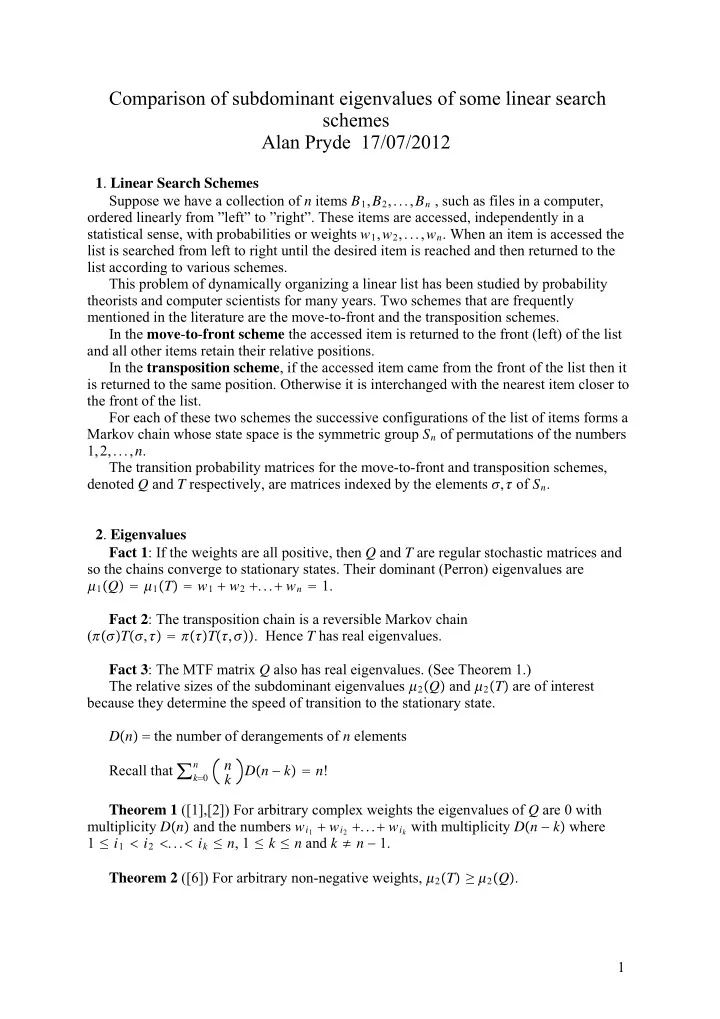
Comparison of subdominant eigenvalues of some linear search schemes Alan Pryde 17/07/2012 1 . Linear Search Schemes Suppose we have a collection of n items B 1 , B 2 ,..., B n , such as files in a computer, ordered linearly from left to


slide-1
SLIDE 1

Comparison of subdominant eigenvalues of some linear search schemes Alan Pryde 17/07/2012

  • 1. Linear Search Schemes

Suppose we have a collection of n items B1,B2,...,Bn , such as files in a computer,

  • rdered linearly from ”left” to ”right”. These items are accessed, independently in a

statistical sense, with probabilities or weights w1,w2,...,wn. When an item is accessed the list is searched from left to right until the desired item is reached and then returned to the list according to various schemes. This problem of dynamically organizing a linear list has been studied by probability theorists and computer scientists for many years. Two schemes that are frequently mentioned in the literature are the move-to-front and the transposition schemes. In the move-to-front scheme the accessed item is returned to the front (left) of the list and all other items retain their relative positions. In the transposition scheme, if the accessed item came from the front of the list then it is returned to the same position. Otherwise it is interchanged with the nearest item closer to the front of the list. For each of these two schemes the successive configurations of the list of items forms a Markov chain whose state space is the symmetric group Sn of permutations of the numbers 1,2,...,n. The transition probability matrices for the move-to-front and transposition schemes, denoted Q and T respectively, are matrices indexed by the elements , of Sn.

  • 2. Eigenvalues

Fact 1: If the weights are all positive, then Q and T are regular stochastic matrices and so the chains converge to stationary states. Their dominant (Perron) eigenvalues are 1Q  1T  w1  w2 ... wn  1. Fact 2: The transposition chain is a reversible Markov chain (T,  T,. Hence T has real eigenvalues. Fact 3: The MTF matrix Q also has real eigenvalues. (See Theorem 1.) The relative sizes of the subdominant eigenvalues 2Q and 2T are of interest because they determine the speed of transition to the stationary state. Dn  the number of derangements of n elements Recall that ∑k0

n

n k Dn − k  n! Theorem 1 ([1],[2]) For arbitrary complex weights the eigenvalues of Q are 0 with multiplicity Dn and the numbers wi1  wi2 ... wik with multiplicity Dn − k where 1 ≤ i1  i2 ... ik ≤ n, 1 ≤ k ≤ n and k ≠ n − 1. Theorem 2 ([6]) For arbitrary non-negative weights, 2T ≥ 2Q. 1

slide-2
SLIDE 2
  • 3. Example n  3

Relative to reverse lexicographical order 123,213,132,312,231,321 the move-to-front t.p.m with weights a,b,c is given by , 123 213 132 312 231 321 123 a b c 213 a b c 132 b a c 312 a c b 231 a b c 321 a b c Q  a b 0 c 0 0 a b 0 0 0 c 0 b a c 0 0 0 0 a c b 0 a 0 0 0 b c 0 0 a 0 b c eigenvalues: a  b  c,a,b,c,0,0 T  a b c 0 0 0 a b 0 0 c 0 b 0 a c 0 0 0 0 a c 0 b 0 a 0 0 b c 0 0 0 a b c eigenvalues: a  b  c,..... Question: Why are the eigenvalues of Q so simple and those of T so intractable?

  • 4. Some calculations

Fact 4: We write permutations in the form   1,2,...,n or   1,2,...,n. Then Q,  w1 if    wk if   k,1,...,k−1,k1,...,n for some k  1

  • therwise

and 2

slide-3
SLIDE 3

T,  w1 if    wk if   1,...,k−2,k,k−1,k1,...,n for some k  1.

  • therwise

Fact 5: Each row of both Q and T contains the weights w1,w2,...,wn exactly once each, whereas the diagonals contain the weights exactly n − 1! times each. Fact 2: The Markov chain for the transposition scheme is reversible. Proof: Set   w1

n−1 w2 n−2 ...wn−1 1

. Then T,  T, which is the defining condition for reversibility. In particular, summing over , we obtain T  1T and so  is a stationary distribution for T in the case of probabilities w1,w2,...,wn summing to 1. Fact 6: If all weights are positive, T is similar to a symmetric matrix U. Proof: Let R be the square diagonal matrix with R,   . Set U  RTR−1. The reversibility condition becomes Tt  R2TR−2 and so Ut  U. Fact 7: For non-negative weights, T has real eigenvalues. Proof: A simple calculation shows that for positive weights U,  w1 if    wk−1wk if   1,...,k−2,k,k−1,k1,...,n for some k  1.

  • therwise

For the general case of non-negative weights R−1 may not exist so we define U by this last

  • identity. By a simple continuity argument, T and U again have the same characteristic

polynomial. We will refer to U as the symmetrized form of T and sometimes write U  Uw1,w2,...,wn to denote its dependence on the weights. For any matrix A with real eigenvalues, of size m by m say, we denote its eigenvalues by 1A,...,mA when arranged in decreasing order and by 1A,...,mA when the

  • rder is increasing.
  • 5. Proof of theorem 2.

Theorem 2 For arbitrary non-negative weights, 2T ≥ 2Q. Proof Order the n! row and column indices  so that for the first n − 1! indices n  n, for the next n − 1! indices n  n − 1 and so on. Then U has a block decomposition U  Uij for 1 ≤ i,j ≤ n whose diagonal blocks are of the form Uii  Uw1,w2,...,wn1−i,...,wn. The symbol wj is used to denote that wj is omitted. So 1Uii  w1  w2 ... wn1−i ... wn. For example, when n  3 : 3

slide-4
SLIDE 4

U  a ab bc ab b ac bc a ac ac c ab ac b bc ab bc c . To simplify notation we will assume that w1 ≤ w2 ≤...≤ wn. As each Uii is Hermitian, there are unitary matrices Vi such that each Vi

∗UiiVi is a diagonal matrix.

If Z  diagV1,...,Vn then Z∗Z  I and Z∗UZ is a block matrix whose diagonal blocks are diagonal matrices whose diagonal elements are the eigenvalues of the Uii. Now remove from Z the two columns corresponding to the Perron eigenvalues 1Uii for i  n − 1,n to obtain a non-square matrix W  diagW1,...,Wn. Then W∗W  Ik, the identity matrix of order k  n! − 2 and W∗UW is a block matrix whose diagonal blocks are diagonal matrices whose diagonal elements are the eigenvalues of the Uii with the two Perron eigenvalues 1Un−1,n−1 and 1Unn omitted. So traceW∗UW  ∑

i1 n

traceWi

∗UiiWi

 ∑

i1 n

traceUii − 1Un−1,n−1 − 1Unn  traceU − w1  w2  w3 ... wn − w1  w2 ... wn  traceU − w3 ... wn − w1  w2 ... wn  traceQ − 2Q − 1Q  ∑

i1 n!−2

iQ. By the generalized Rayleigh-Ritz theorem (see Horn and Johnson 4.3.18) we have

i1 n!−2

iU  mintraceX∗UX : X∗X  In!−2 and therefore

i1 n!−2

iT  ∑

i1 n!−2

iU ≤ ∑

i1 n!−2

iQ. Since T and Q have the same trace and the same Perron eigenvalue, we conclude that 2T ≥ 2Q. 4

slide-5
SLIDE 5

Using similar techniques, further information can be readily gained about the eigenvalues of T. For example: Theorem 3 For non-negative weights, ∑i1

k iT ≤ 0 for 1 ≤ k ≤ n!/2.

Proof Since the result is trivially true when n  2, we may proceed by induction on n. Assume it is valid for lists of length n − 1 for some n  2. Take matrices Uii as in the proof

  • f Theorem 2. By the induction hypothesis and the generalized Rayleigh-Ritz theorem, for

1 ≤ i ≤ n and 1 ≤ h ≤ n − 1!/2 there are matrices Wih of size n − 1!  h with

  • rthonormal columns such that traceWih

∗ UiiWih ≤ 0. Given 1 ≤ k ≤ n!/2 choose integers

h1,h2,...,hm where 1 ≤ m ≤ n, 1 ≤ hi ≤ n − 1!/2 and h1  h2 ... hm  k. Let W be the n!  k block matrix whose diagonal blocks are Wi  Wihi for 1 ≤ i ≤ m with zeros

  • elsewhere. Then W∗W  Ik and traceW∗UW  ∑i1

m traceWi ∗UiiWi ≤ 0 so

∑i1

k iT ≤ 0.

Example 2 The situation is different if negative weights are permitted. For example, consider the case n  3 and weights −1,2,4. The eigenvalues of Q are 5,4,2,−1,0,0 and those of T are approximately 5.0,−3. 429, 3. 128  1. 283i,1. 086  1. 643i. So the eigenvalue with second largest modulus for Q is 4 and for T is −3. 429.

  • 6. A closer look at T and Q.

Let Tj and Qj be the t.p.m s corresponding to weights 0,...,0,1,0,...,0. Then Fact 8

  • 1. T  w1T1 ...wnTn
  • 2. Q  w1Q1 ...wnQn
  • 3. Tj

n  Tj n−1  Qj

  • 4. Qi Qj,  1 if  can be obtained from  by moving i to the front then j to the front

and Qi Qj,  0 otherwise.

  • 5. Qj

2  Qj.

  • 6. QhQj1Qj2...QjkQh  Qj1Qj2...QjkQh
  • 7. The semigroup generated by Q1,...,Qn consists of idempotents.
  • 8. The algebra generated by Q1,...,Qn is triangularizable.
  • 9. The eigenvalues of Q are of the form w11 ...wnn where j is an eigenvalue of Qj

namely 0 or 1. References [1] R.M. Phatarfod, On the matrix occuring in a linear search problem, J. Appl. Prob. 28 (1991), 336-346. [2] R.M. Phatarfod, A.J. Pryde and D. Dyte, On the move-to-front scheme with Markov dependent requests, J. Appl. Prob. 34 (1997), 790-794. [3] J.A. Fill, An exact formula for the move-to-front rule for self-organising lists, J. Theoretical Prob. 9 (1996), 113-160. 5

slide-6
SLIDE 6

[4] A.J. Pryde and R.M. Phatarfod, On some multi-request move-to-front heuristics, J.

  • Appl. Prob. 35 (1998), 911-918.

[5] P.R. Jelenković, A. Radovanović, The persistent-access-caching algorithm, Random Structures and Algorithms 33 (2008), 219-251. [6] A.J. Pryde, Comparison of subdominant eigenvalues of some linear search schemes, Linear Algebra Appl. 431 (2009), 1439-1442 6