SLIDE 1
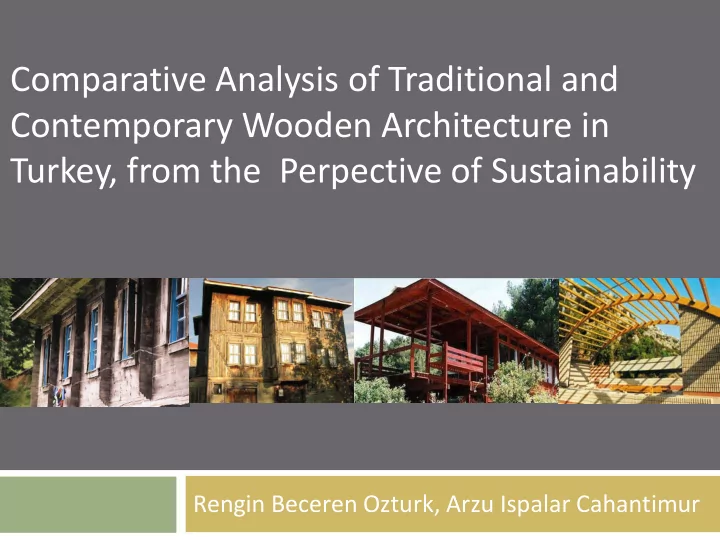
Comparative Analysis of Traditional and Contemporary Wooden Architecture in Turkey, from the Perpective of Sustainability
Rengin Beceren Ozturk, Arzu Ispalar Cahantimur
SLIDE 2
Agenda
Introduction Wooden Building Culture in Turkey Comparative Analysis of Turkish Wooden Architecture Conclusion
SLIDE 3
Introduction
The aim of sustainable development which is to improve the quality of human life without exceeding the carrying capacity of the ecosystems that sustain it, complements its definition. Traditional wooden buildings of Turkish architecture are excellent examples of self-sufficiency in building scale. The wooden material and the wooden construction systems used in these buildings satisfy the necessity of reducing the energy and resources used and the waste produced during their life-cycles.
SLIDE 4
Wooden Building Culture in Turkey
In traditional Turkish architecture, wooden has been used so much structurally by its handling strength, isolation properties, suitability for different dimensions, adaptability for variety of forms and assembling properties. In traditional Turkish houses, the wooden material -that is made of alternatively chestnut, pine tree, willow and poplar trees, according to the regional climatic conditions- is mainly used for the constructive elements.
SLIDE 5
Wooden Building Culture in Turkey
Log House Hatıl Hımış Dizeme Bağdadi
Elements form the buildings affecting their aesthetic texture and integrate with the traditional differences The classification of traditional wooden buildings in Turkey, depending on the structural elements in the walls, is summarized below:
SLIDE 6
Wooden Building Culture in Turkey
Log House
The oldest and historical method of wooden construction in which logs slightly processed are overlapped and anchored at the ends. Walls constituted with logs make a function both bearing and dividing. Modern log houses have been started to construct using new techniques in Turkey in recent years.
SLIDE 7
Wooden Building Culture in Turkey
Hatıl
In the Hatıl construction, horizontal timbers embedded into bearing wall masonry. In hatıl construction system the main materials of construction are mostly stone with mud mortar and slightly wood.
SLIDE 8 Wooden Building Culture in Turkey
Hımış
A timber frame with masonry infill such as bricks, adobes or stones. This type of construction is a variation on a shared construction tradition that has existed through history in many parts of the world, from ancient Rome almost to the present. In this type
construction the timber elements constitute important elements by providing the armature for the masonry infill.
SLIDE 9
Wooden Building Culture in Turkey
Dizeme
In some regions of Turkey, like North-west Anatolia, wood is used as infill materials of building constructions instead of masonry. Short rough timbers elements called as “dizeme” are used as infill and they are lightly nailed studs or horizontal framing elements in this construction.
SLIDE 10 Wooden Building Culture in Turkey
Bağdadi
In this type of construction, the voids between timber framing members is filled with lighter materials or with trunk shells are transformed into a filling material by sand and lime mortar. The interior surfaces of walls are covered by lath and plaster work or wood, whereas the
- uter surfaces are either plastered or non-
plastered or wooden plastered .
SLIDE 11 Wooden Building Culture in Turkey
Bağdadi
In this type of construction, the voids between timber framing members is filled with lighter materials or with trunk shells are transformed into a filling material by sand and lime mortar. The interior surfaces of walls are covered by lath and plaster work or wood, whereas the
- uter surfaces are either plastered or non-
plastered or wooden plastered .
SLIDE 12
Wooden Building Culture in Turkey
New Buildings by Traditional Systems
Today, new wooden houses are still being constructed with traditional construction systems in Turkey.
SLIDE 13
Wooden Building Culture in Turkey
New Buildings by Laminated Technology
Laminated wood technology that provides many advantages for architectural design is used for construction of various kinds of buildings in Turkey.
SLIDE 14
Wooden Building Culture in Turkey
Examples From The World
Construction components that are used in different forms and for big open spaces, can be produced by laminated wood technology. These components can be produced in many different formations like; flat and curve beams, arcs, shears, and knuckles. Turkey follows The World trends in applying laminated wood technologies and applications.
SLIDE 15 Comparative Analysis of Turkish Wooden Architecture
There are many characteristic types
traditional wooden architecture including domestic and monumental buildings in Turkey, resulting from cultural attributes, related to material availability and climate. The wood is the best material reflecting the traditional way of life.
Examples of Wooden Architecture
SLIDE 16
Comparative Analysis of Turkish Wooden Architecture
Wooden Materials Usage in Houses
The wooden houses which are the best examples of civil architectural heritage in Turkey are located especially near shore and forest sides, densely in the Marmara, the Black sea, and the Aegean regions. Economical and technological reasons had given rise wooden to be used as a building material for centuries in Turkey.
SLIDE 17 Comparative Analysis of Turkish Wooden Architecture
Wooden Materials Usage in Public Buildings
The life time environmental impact
traditional Turkish wooden buildings are lower than any other kind of buildings by reducing the energy and resources used and waste produced. Wooden material is still preferred to be used with its superior properties like; having heavy load carrying capacity, ecological availableness, recycling ability, great resistance to fire and earthquakes.
SLIDE 18
Conclusion
Sustainability, equity and security can be achieved through a fundamental alteration of the values that shape and inform our lives. We must commit ourselves to living in harmony with our environment and with the fellow inhabitants of our planet and ensuring that our decisions reflect the interests of the generations to come.
SLIDE 19 Conclusion
We, as design professionals, are all responsible to protect biodiversity and nurture nature as part of the co-evolution of the sociosphere and biosphere in which natural history and human history have been rightly interwoven. To select the right local material at the right place, for the right design and apply it with the right system may be the first choice to take the necessary action. Turkish wooden building culture, whether traditional or contemporary, reflects the responsibility of the designers and users. More stress should be put on its necessity to become a nationwide construction system in order to achieve sustainable urban development.
SLIDE 20 Thank You
Uludağ University, Department of Architecture, Bursa/Turkey
Rengin Beceren Ozturk, Arzu Ispalar Cahantimur