
SLIDE 1
Comparative analysis of HIV Comparative analysis of HIV-
- 1
Comparative analysis of HIV- - 1 1 Comparative analysis of HIV - - PowerPoint PPT Presentation
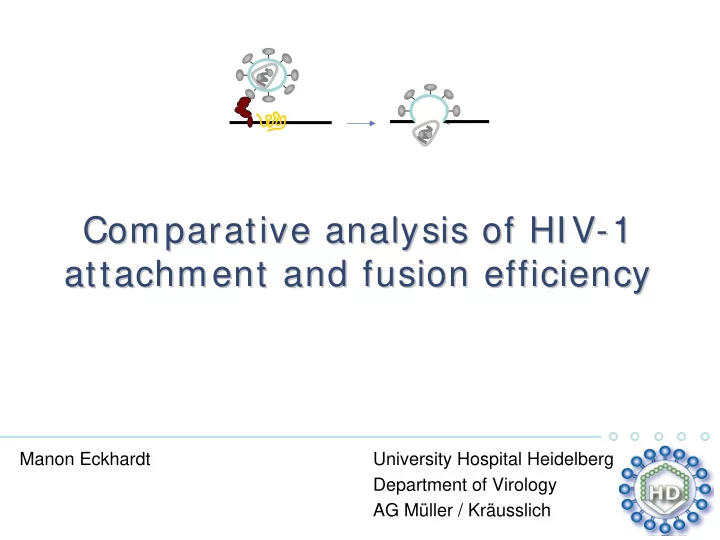
Comparative analysis of HIV- - 1 1 Comparative analysis of HIV attachment and fusion efficiency attachment and fusion efficiency Manon Eckhardt University Hospital Heidelberg Department of Virology AG Mller / Krusslich Background
HI V entry
the plasma membrane
fusion fusion attachment attachment
Karlsson Hedestam et al., Nature Reviews Microbiology 2008
hemophiliac cohort (Bonn, 1980s) phenotyping done in Bonn based on SI/ NSI bulk sequencing of Env-sequences (Virology
Köln)
selection of 8 sequences (MPII Saarbrücken) insertion of V3-loop sequences in Env-
expression plasmid
production of isogenic pseudovirions
carrying different Envs
pure X4:
220, 286, 685
dubious:
409, 651, 924
pure R5:
822, 838
comparison with reference strains:
NL4-3 NL4-3 R5 Env(-)
220 SI CTRPNNNTIKGISIGPGRAVIATRKIIGDIRQAHC 286 SI CTRPHNNIKRHRIHIGPGRSFHTTKGITGNIRQAHC 409 SI CTRPGNNTRKSITRTPGRVIYATGAIIGDIRQAHC 651 SI CTRPNNNTRKSVRIGPGDIFITTDIIGNIRQAHC 685 SI CTRPNNNIMRRIHIGPGRAFYATRKIIGNIRQAHC 822 NSI CTRPNNNTRRSIHIAPGRAFYTTGQIIGDIRQAHC 838 NSI CTRPNNNTRKSIHIGPGKAFYTTGEIIGDIRQAHC 924 SI CFRPNNNTRKGIHIGPGRAFYTTGEIIGDIRRAYC NL4-3 CTRPNNNTRKSIRIQRGPGRAFVTIGKI GNMRQAHC NL4-3 R5 CTRPNNNTRKGIHI--GPGRAFYTTGEIIGDIRQAHC
(A) Generation of HCV pseudoparticles carrying Vpr.BlaM fusion protein (B) Principle of BlaM Assay
520 nm 447 nm cytoplasm loaded with β-Lactamase cleavable dye CCF2 (green) Entry by fusion Vpr.BlaM enters the cytoplasm cleavage of CCF2 (blue product)
β-Lactamase
L unet CD
6h incubation
0,0 0,5 1,0 1,5 2,0 2,5 3,0 3,5 4,0 HCVpp (50ng p24) Env(-) (50ng Pseudotyp re l Bla M a c tivity
HDL
VSV-G (1ng p24) no inhibitor Bafilomycin α-CD81 low (0,4µg/ml)
ratio green/blue
(B) fluorimetric read-out (96-well plate) (bulk-quantitative) (A) microscopic read-out (qualitative) (C) FACS read-out (quantitative)
no virus VSVpp HCVpp
34.16%
C8 1 6 6 _ HI V
incorporation
0.01%
C8 1 6 6 _ no virus
receptor and/ or coreceptor(s)
Johnston et al. (Benhur Lee Lab UCLA)
range of endogenous expression range of endogenous expression
variation
variation
I nhibitors of HI V entry
fusion inhibitor (Enfuvirtide – T20) co-receptor antagonist (Maraviroc - MVC)
AMD3100 (X4 antagonist)
(approved for cancer therapy)
Esté & Telenti, Lancet 2007
Enfuvirtide ( T2 0 ) Maraviroc ( MVC)
Maraviroc ( MVC)
Capsid (CA)
Matrix (MA) Nucleocapsid (NC)
p6
eGFP gag
pol env nef tat rev vpu vpr vif
HIV genome
MA eGFP CA NC p6
plating on poly-L- Lysin coated LabTek-chambers microscopy and analysis binding of virus, washing, fixation 1x10⁶ cells addition of fluorescently labelled virus
fluorescently labelled particles
bound virus / cell HIV Env(-)
Alexander Thielen Kasia Bozek Joachim Büch Eugen Schülter
Saleta Sierra Manon Eckhardt
Medical Systems Biology Initiative
Susanna Trapp
Virology Cologne - Köln Rolf Kaiser Eva Heger Saleta Sierra Aragon Eugen Schülter MPI Informatics - Saarbrücken Thomas Lengauer Kasia Božek Alexander Thielen Joachim Büch ZMBH Heidelberg Monika Langlotz Virology Heidelberg Barbara Müller Hans-Georg Kräusslich