SLIDE 1
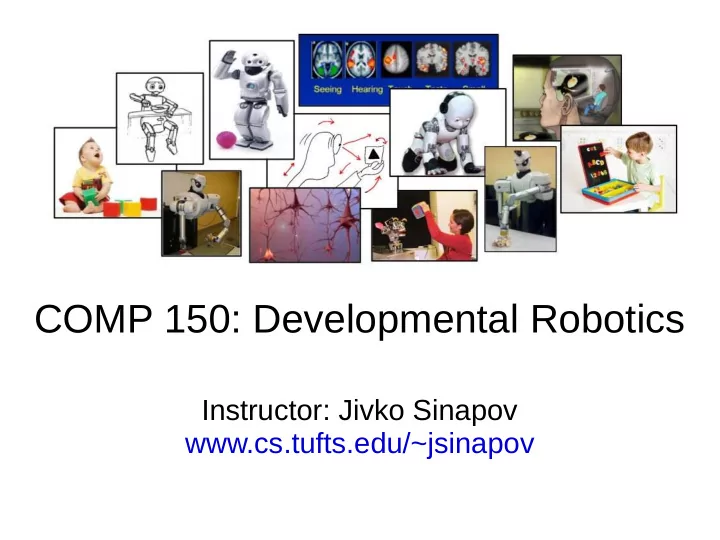
COMP 150: Developmental Robotics
Instructor: Jivko Sinapov www.cs.tufts.edu/~jsinapov
SLIDE 2 Introduction
- Welcome!
- Who am I?
- Who are you?
- What to expect
SLIDE 3
SLIDE 4
My robot friends...
SLIDE 5
SLIDE 6
Stand or Sit
SLIDE 7
What is a robot?
(class discussion)
SLIDE 8
Robots in Industry
SLIDE 9
Mobile Robots
SLIDE 10
“Service” Robots
SLIDE 11
Planetary Exploration Robots
SLIDE 12
Driverless Cars
SLIDE 13
Entertainment Robots
SLIDE 14
Robots in Science Fiction
SLIDE 15
SLIDE 16
SLIDE 17
Toyota's Attempt 20 years later...
SLIDE 18
Toyota's Attempt 20 years later...
SLIDE 19
Why are we not there yet? What are the greatest difficulties towards getting robots to be autonomous and intelligent?
SLIDE 20 Developmental Robotics
“Truly intelligent robot behavior cannot be achieved in the absence of a prolonged interaction with a physical or social
- environment. In other words robots must
undergo a developmental period similar to those of humans and animals.”
SLIDE 21 Developmental Robotics
- Relatively small sub-field...but with great
potential
- Started early 2000s – many ideas have now
filtered out and become mainstream
SLIDE 22 Repeating Themes
- Pre-programming is not enough!
- Interaction
- Embodiment
- Self-organization
- Grounding
- Verification and correction of internal
representations
SLIDE 23 Topics
– Robot architectures, mobile robots and robot
manipulators, learning methods for robots
- What is intelligence?
- Theories of Development
– Nature vs Nurture? Or something else?
- Embodiment and the Sense of Self
– Body scheme, self-recognition
SLIDE 24 Topics (2)
- Learning about objects and their affordances
- Tool use in humans, animals, and robots
- Multi-modal sensing and self-organization
- Theories of vision in humans and robots
- Social learning
– Language, scaffolding, socially-guided learning
SLIDE 25
Robot Simulators
SLIDE 26
What is Intelligence?
SLIDE 27
Embodiment
SLIDE 28
The Sense of Self
SLIDE 29
Body Schema
SLIDE 30
Extensible Body Schema
SLIDE 31
Self-Recognition
SLIDE 32
Self-Recognition in Robots
SLIDE 33
Theories of Development
SLIDE 34
Theories of Development
SLIDE 35
Affordances
SLIDE 36
Example: Doors
SLIDE 37
Learning Affordances
SLIDE 38
Tool Use
SLIDE 39
Tool Use by Robots
SLIDE 40
Sensory Substitution
SLIDE 41
Image-to-Sound Mapping
SLIDE 42
Sensory Substitution
SLIDE 43
Theories of Vision
SLIDE 44
SLIDE 45
SLIDE 46
Language Acquisition
SLIDE 47
Language Acquisition
SLIDE 48
...and much more!
SLIDE 49 Reading Assignment 1
SLIDE 50 Homework 0
- Read the syllabus and the course web page
and think of a question you have that is not answered – email it to me (subject: [comp150])!
http://www.cs.tufts.edu/comp/150DR/
SLIDE 51
Questions / Comments?