SLIDE 1
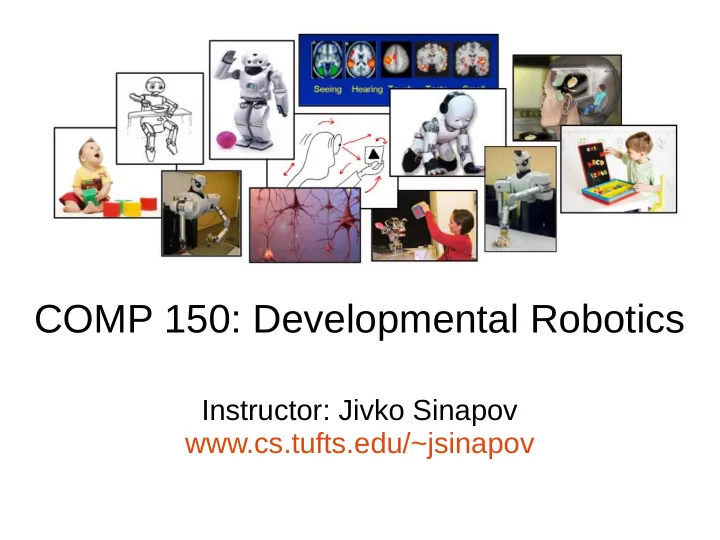
COMP 150: Developmental Robotics
Instructor: Jivko Sinapov www.cs.tufts.edu/~jsinapov
SLIDE 2
Language Acquisition
SLIDE 3
Something fun...
SLIDE 4
Announcements
SLIDE 5 Project Deadlines
- Project Presentations: Dec 5 and 7
- Final Report + Deliverables: Dec 11
- Deliverables:
– Presentation slides + videos – Final Report (PDF) – Source code (link to github repositories)
SLIDE 6 Presentation Guidelines
- 10 minutes talk + 5 min for questions
- Practice! Time your presentation when you
practice and use a timer during the actual presentation as well
- My advice: find another group and practice
to each other
- Format: Google Slides (so that we don’t
have to switch computers)
SLIDE 7 Presentation Schedule – Tue Dec 5
- Raina Galbiati, Doo-yun Her, and Cassie Collins
- Azmina Karukappadath, Sam Weiss, and Yuelin
Liu
- Timi Dayo-Kayode, Michael Edegware, and
Jong Seo Yoon
- Matt Ryan
- Meghan O'Brien, Tooba Ahsen, and Elizabeth
Lanzilla
SLIDE 8 Presentation Schedule – Thu Dec 7
- Julia Novakoff, Teddy Laurita, and George
Pesmazoglou
- Eric Chen, Matt Shenton, and Avi Block
- Ari Brown and Julie Jiang
- Christopher Hylwa, Sonal Chatter, and Brett
Gurman
- Brad Oosterveld, Tyler Frascav
SLIDE 9 Final Report Guidelines
- Approximately 8 pages + 1 page for references
- Default Google Doc template or default overleaf
LaTeX template
- A bit about the structure…
- May include appendix if you have a lot of visual
results
SLIDE 10 Last Readings and Homework
SLIDE 11
Language Acquisition
SLIDE 12
The Turing Test
SLIDE 13
The Turing Test
SLIDE 14
The Turing Test
SLIDE 15
The First ChatBot (~1966)
SLIDE 16 ELIZA
- http://psych.fullerton.edu/mbirnbaum/psych101/
Eliza.htm
SLIDE 17
Discussion: what is missing from programs like ELIZA?
SLIDE 18 Natural Language Processing
- The study of algorithms and data structures
used to manipulate text and text-like data
- Applications in information retrieval, web
search, dialogue agents, text mining, etc.
- Traditionally, not concerned with connecting
semantic representations to the real world
SLIDE 19
Example: Computing Parse Trees
SLIDE 20 Example: Document Classification
https://abbyy.technology/_media/en:features:classification- scheme.png
SLIDE 21 Example: Word Embeddings
https://image.slidesharecdn.com/introductiontowordembeddings-160405062343/95/a-simple-introduction-to-word-embeddings-5-638.jpg?cb=1494520542
SLIDE 22 The Symbol Grounding Problem
“How can the semantic interpretation of a formal symbol system be made intrinsic to the system, rather than just parasitic on the meanings in our heads? How can the meanings of the meaningless symbol tokens, manipulated solely on the basis
- f their (arbitrary)shapes, be grounded in
anything but other meaningless symbols?”
SLIDE 23
Deb Roy, “Grounding Language in the World: Schema Theory Meets Semiotics” (2005)
SLIDE 24
Circular Definitions
SLIDE 25
Grounding
SLIDE 26
Sensor Projections
SLIDE 27 Sensor Projections
INPUT IMAGE Color Histogram
SLIDE 28
Transformer Projection
SLIDE 29 Transformer Projection
Color Histogram Entropy of Histogram
SLIDE 30 Categorizer
Entropy of Histogram “Multicolored”
SLIDE 31
Action Projector
SLIDE 32
SLIDE 33
SLIDE 34
Schemas for Actions
SLIDE 35
Schemas for Objects
SLIDE 36
Spatial Relations
SLIDE 37 Deb Roy’s Definition of Grounding
- “I define grounding as a causal-predictive cycle
by which an agent maintains beliefs about its world.” (p. 8)
- “An agent’s basic grounding cycle cannot
require mediation by another agent.” (p. 9)
- “An autonomous robot simply cannot afford to
have a human in the loop interpreting sensory data on its behalf.” (p. 9)
SLIDE 38
- “Cyclic interactions between robots and their
environment, when well designed, enable a robot to learn, verify, and use world knowledge to pursue goals. I believe we should extend this design philosophy to the domain of language and intentional communication.” (p. 5)
SLIDE 39
- “causality alone is not a sufficient basis for
grounding beliefs. Grounding also requires prediction of the future with respect to the agent’s own actions.” (p. 10)
- “The problem with ignoring the predictive part of
the grounding cycle has sometimes been called the ”homunculus problem”.”
SLIDE 40
SLIDE 41
Take Home Message
Language should be grounded in terms of the robot’s own perceptual and sensorimotor capabilities
SLIDE 42
Thomason, J., Sinapov, J., Svetlik, M., Stone, P., and Mooney, R. (2016) Learning Multi-Modal Grounded Linguistic Semantics by Playing I, Spy In proceedings of the 2016 International Joint Conference on Artificial Intelligence (IJCAI)
SLIDE 43 43
Motivation: Grounded Language Learning
Robot, fetch me the green empty bottle
SLIDE 44 44
Exploratory Behaviors in our Robot
SLIDE 48 48
Sensorimotor Feature Extraction
Time Joint Efforts (Haptics) . . . . . .
SLIDE 49 49
Sensorimotor Contexts
grasp lift hold lower drop
proprio- ception
push press
haptics
look
audio shape color VGG
SLIDE 50 50
Sensorimotor Contexts
grasp lift hold lower drop
proprio- ception
push press
haptics
look
audio shape color VGG
SLIDE 51 51
Feature Extraction: Color
Color Histogram (4 x 4 x 4 = 64 bins)
Object Segmentation
SLIDE 52 52
Feature Extraction: Shape
3D Object Point Cloud Histogram of Shape Features
SLIDE 53 53
Joint-Torque values for all joints Joint-Torque Features
Feature Extraction: Haptics
SLIDE 54 54
Feature Extraction: Audio
audio spectrogram Spectro-temporal Features
SLIDE 55 55
Feature Extraction: VGG
SLIDE 56 56
Feature Extraction: VGG
SLIDE 57 57
Data from a single exploratory trial
grasp lift hold lower drop
proprio- ception
push press
haptics
look
audio shape color VGG
x 5 per object
SLIDE 58 58
Category Recognition Overview
Category Recognition Models
Sensorimotor Feature Extraction Interaction with Object Category Estimates
. . . Empty? Red? Container?
Sinapov, J., Schenck, C., and Stoytchev, A. (2014). Learning Relational Object Categories Using Behavioral Exploration and Multimodal Perception In the Proceedings of the 2014 IEEE International Conference on Robotics and Automation (ICRA)
SLIDE 59 59
Key Questions
How can the robot learn object-related words from everyday human users? Do human users use non-visual object descriptors when referring to objects?
SLIDE 60 60
Object Exploration Dataset
32 common household and
Each object was explored a total of 5 times with 7 different behaviors The robot perceived objects using the visual, auditory, and haptic sensory modalities
Thomason, J., Sinapov, J., Svetlik, M., Stone, P., and Mooney, R. (2016). Learning Multi-Modal Grounded Linguistic Semantics by Playing I, Spy In proceedings of the 2016 International Joint Conference on Artificial Intelligence (IJCAI)
SLIDE 61 61
Our attempt: I-Spy game
SLIDE 62 62
Learning Words via Game-play
Human: “an empty metallic aluminum container”
SLIDE 63 63
Semantic Parsing
SLIDE 64 64
Example Words for an Object
SLIDE 65 65
Learning Words via Game-play
SLIDE 66 66
Learning Words via Game-play
Human: “a tall blue cylindrical container”
SLIDE 67 67
Learning Words via Game-play
Robot: “open half-full container”
SLIDE 68 68
Asking Verification Questions
SLIDE 70 70
“can” “tall” “half-full” “pink” WORD F-measure improvement as a result of adding non- visual modalities 0.857 0.516 0.463
. . . . . . . .
SLIDE 71 71
Summary of Experiment
- The robot learned over 80 words through interactive
game play
- The robot's word representations were grounded in
multiple behaviors and sensory modalities
– Active action selection when classifying a new object – Active action selection when learning a new words – Actively seek humans out for help with learning about
SLIDE 72 72
“Opportunistic” Active Learning
Thomason, J., Padmakumar, A., Sinapov, J., Hart, J., Stone, P., and Mooney, R. (2017) Opportunistic Active Learning for Grounding Natural Language Descriptions In proceedings of the 1st Annual Conference on Robot Learning (CoRL 2017)
SLIDE 73 73
“Opportunistic” Active Learning
Thomason, J., Padmakumar, A., Sinapov, J., Hart, J., Stone, P., and Mooney, R. (2017) Opportunistic Active Learning for Grounding Natural Language Descriptions In proceedings of the 1st Annual Conference on Robot Learning (CoRL 2017)
SLIDE 74 74
What actions should the robot perform when learning a new word?
- Baseline: perform all actions on a set of labeled
- bjects and estimate which ones work well
- But can we do better?
SLIDE 75 75
Behavior Scores for Words
SLIDE 76 76
Word Embeddings
Thomason, J., Sinapov, J., Stone, P., and Mooney, R. (2018) Guiding Exploratory Behaviors for Multi-Modal Grounding of Linguistic Descriptions To appear in proceedings of the 32nd Conference of the Association for the Advancement of Artificial Intelligence (AAAI)
SLIDE 77 77
Word Embeddings
Thomason, J., Sinapov, J., Stone, P., and Mooney, R. (2018) Guiding Exploratory Behaviors for Multi-Modal Grounding of Linguistic Descriptions To appear in proceedings of the 32nd Conference of the Association for the Advancement of Artificial Intelligence (AAAI)
SLIDE 78 78
Word Embeddings
Thomason, J., Sinapov, J., Stone, P., and Mooney, R. (2018) Guiding Exploratory Behaviors for Multi-Modal Grounding of Linguistic Descriptions To appear in proceedings of the 32nd Conference of the Association for the Advancement of Artificial Intelligence (AAAI)
SLIDE 81 Discussion
- What are some of the limitations of these
approaches?
SLIDE 82
Project Breakout
SLIDE 83
SLIDE 84