
SLIDE 1
COMMUNITY HEALTH WORKERS AND CHRONIC DISEASE PREVENTION
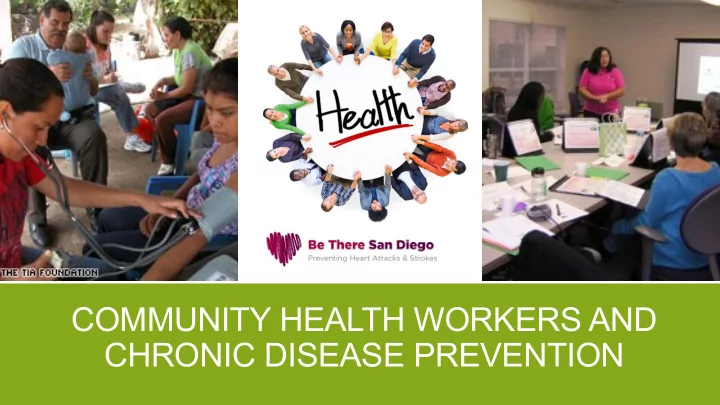
COMMUNITY HEALTH WORKERS AND CHRONIC DISEASE PREVENTION HEALTH - - PowerPoint PPT Presentation
COMMUNITY HEALTH WORKERS AND CHRONIC DISEASE PREVENTION HEALTH State of complete physical, mental, and social well-being and not merely the absence of disease or infirmity World Health Organiza?on Elimina?ng health dispari?es
COMMUNITY HEALTH WORKERS AND CHRONIC DISEASE PREVENTION
HEALTH
“State of complete physical, mental,
and social well-being and not merely the absence of disease or infirmity”
World Health Organiza?on
Elimina?ng health dispari?es con?nues to be a priority in the U.S. as first outlined in the Department of Health and Human Services, Health People 2000 report, and later reaffirmed in the Health People 2020 report
SOCIAL DETERMINANTS OF HEALTH
The condi?ons in which people are born, grow, live, work, and age, including the health system. These circumstances are shaped by the distribu?on of money, power and resources at global, na?onal and local levels, which are themselves influenced by policy
responsible for health inequi?es – the unfair and avoidable difference in health status seen within and between countries”
World Health Organiza?on - WHO
2014 NATIONAL HEALTHCARE QUALITY AND DISPARITIES REPORT
▪ Dispari?es in quality of care remained prevalent and few dispari?es were eliminated ▪ Only half of people with high blood pressure have it controlled ▪ Increase in admission for diabetes pa?ents ▪ People with Asthma who are taking preven?ve medica?on daily/almost daily
“Dispari)es in quality and outcomes by income, race, and
ethnicity are large and persistent”
LET’S GET HEALTHY CALIFORNIA 2012
▪ Experiencing unprecedented levels in chronic disease ▪ Alarming high rates of obesity and resul?ng condi?ons such as diabetes, may reverse the progress in increasing life expectancy made over the last 100 years ▪ For the first ?me ever, this genera?on of children may not live as long as their parents ▪ Our health care delivery system is fragmented, uncoordinated, and financially unsustainable ▪ Healthcare costs con?nue to surpass the rate of infla?on
LET’S GET HEALTHY CALIFORNIA 2012
▪ Maintaining a healthy popula?on is key to California’s future prosperity ▪ Managing of chronic disease required a range of supports
▪ California is being tasked to reduce rates of: ▪ Adults with high cholesterol who are managing condi?on ▪ Adults with hypertension/controlled HBP ▪ Prevalence of diabetes ▪ Rates of obesity
COMMUNITY HEALTH WORKER MODEL
▪ Emergent evidence points to the effec?veness of the CHW model in addressing chronic disease. ▪ Our popula?on is aging and suffering from higher rates of chronic disease. ▪ Health care is costly and expenditures con?nue to rise. ▪ Growing movement among health care organiza?ons to adopt the CHW model to address preven?on and chronic disease. ▪ Evidence points to the CHW model as an effec?ve strategy to engage pa?ent, increase preven?on and compliance, and decrease chronic disease rates.
A CHW IS A…..
“…frontline public health worker who is a trusted member of and/or has an unusually close understanding of the community served. This trus)ng rela)onship enables the worker to serve as a liaison/ link/intermediary between health/social services and the community to facilitate access to services and improve the quality and cultural competence of service
individual and community capacity by increasing health knowledge and self-sufficiency through a range
informal counseling, social support and advocacy.”
The American Public Health Associa?on
THE CHW (PROMOTORA) MODEL
§ Peer educa?on model § Used to reach hard to serve popula?ons § Used to connect popula?ons to needed services
“A Model for Building Healthy Communi?es” (The Promotor Model, The California Endowment 2011)
WHY THIS MODEL?
▪ It’s a public health model ▪ Removes barriers ▪ Culturally appropriate ▪ Linguis?cally appropriate ▪ Builds community capacity ▪ Empowers pa?ents/parents/community ▪ Improves community and popula3on health ▪ Addresses the three components of the triple Aim!
CHWS HAVE MANY TITLES
▪ Promotores ▪ Outreach Workers ▪ Lay Workers ▪ Health Educators ▪ Peer Educators ▪ Parent Liaisons ▪ Pa?ent Liaisons ▪ Community Workers ▪ Case Manager ▪ Enrollment Specialist ▪ Advocates ▪ Parent Educators ▪ Health Coaches ▪ Many others
HHS ACTION PLAN TO REDUCE RACIAL AND ETHNIC HEALTH DISPARITIES, APRIL 2011
Strategy II.B: ▪ Promote the use of community health workers and Promotores Ac3ons ▪ II.B.1 Increase the use of Promotores to promote par?cipa?on in health educa?on, behavioral health educa?on, preven?on, and health insurance programs
STATE INNOVATION PLAN GOALS
▪ Popula?on health improvements ▪ Community based interven?ons ▪ Reducing dispari?es “CHWs are a promising strategy to address these goals”
Leveraging Community Health Workers within California’s State Innova?on Model July 2013
PROMOTORES/ CHWS
Address the Triple Aim Decrease Health Dispari?es Improve Popula?on Health
CHW CONTRIBUTIONS TO THE TRIPLE AIM
▪ CHWs reduce costs through fewer hospitaliza?ons and emergency room visits ▪ Improve health by keeping pa?ents engaged and helping them adhere to their care plan in controlling chronic disease ▪ Improve quality of care by improving u?liza?on and reten?on in care
Massachuseds Department of Public Health: Achieving the Triple Aim: Success with Community Health Worker 2015
CHW CONTRIBUTIONS TO THE TRIPLE AIM
CHWs reduce costs -Studies showed net cost savings in CHW interven?ons Boston Children’s Hospital – Pediatric Asthma Management Program – Decrease of 68% in ED visits/ 84.8% in hospitaliza?ons CHWs improve health -Studies reveal significant posi?ve changes in chronic disease management Teams working with high risk pa?ents –Ajer 1 yr, pa?ents had sta?s?cally significant improvements (cholesterol, HBP, HbA1c, ) CHWs improve quality of care - CHWs provide educa?on, care coordina?on, and engage pa?ents Diabetes teams – Reduc?on in % of diabetes pa?ents not seen; and clinically significant drops in HbA1c levels
Massachuseds Dept of Public Health: Achieving the Triple Aim: Success with Community Health Worker 2015
PENN UNIV HEALTH SYSTEM – IMPACT
condi?ons and help them in naviga?ng the health care system
homelessness, transporta?on, etc)
“HEALTH CARE TEAMS”
TEAM-BASED CARE
▪ Team based care is an emerging tool that offers the
the central challenges in health care today.
(Ins)tute of Medicine: Best Care at Lower Cost 2011)
▪ An approach to achieving beder health outcomes at lower costs through pa?ent-centered medical homes u?lizing team- based care.
(J. Ambulatory Care: Community Health Workers Integra?on into the Health Care Team Accomplishes the Triple Aim in a Pa?ent Centered Medical Home: Findley, et al 2014)
Comprehensive and coordinated care improves health outcomes
HEALTH CARE TEAMS
▪ Team-based care is “an opportunity for beder health care in America,” and is widely recognized as an essen?al tool for a more pa?ent-centered effec?ve health care delivery system. ▪ A team climate is associated with beder processes of care for pa?ents with diabetes and beder con?nuity of care, access to care, and pa?ent sa?sfac?on. ▪ Team members are all responsible for ensuring pa?ents receive both clinical and self-management services and support needed. ▪ The addi?on of key skills to the pa?ent care team has significantly improved outcomes in several chronic condi?ons.
TEAM BASED CARE
In order for team based care to be effec?ve, it must include a comprehensive approach that addresses popula?on health. In recognizing the important role of the social determinants of health, health care approaches must center on health and not illness, and must recognize that improving health goes beyond the clinical seEng.
PATIENT CARE TEAMS
Effec?ve chronic disease preven?on relies on mul?disciplinary care teams
▪ Help pa?ents navigate the complexi?es of the health care system ▪ Wider range of skills and exper?se- coordinates disciplines ▪ Team members take responsibility for popula?on based interven?ons ▪ Team members complement the doctor in cri?cal care func?ons ▪ Pa?ents cared by a team have beder outcomes and improved clinical and health status ▪ CHWs have long played a crucial part in health care
WHAT DO WE KNOW?
Health Dispari?es
physical health
geYng worse
Health Care Teams
CHWs
health
triple aim
Health care teams + CHWs = Beder Health Outcomes
CHWS & PATIENT CARE TEAMS
▪ CHWs play an important role in bridging the language and cultural gaps ▪ CHWs bring experience-based exper?se ▪ CHW interven?on have been proved to work in chronic disease management ▪ Chronically ill pa?ents benefit from a care team that includes both clinical skills and self management support skills ▪ Pa?ents with greater needs benefit from the involvement of CHWs ▪ CHWs ease the difficul?es of caring for vulnerable popula?ons.
CHW CONTRIBUTION TO HEALTH CARE TEAMS
▪ Strengthen provider –pa?ent communica?on ▪ Bring experienced-based exper?se ▪ Removes barriers in accessing and receiving quality care ▪ Help pa?ent more effec?vely self manage their illnesses ▪ Mo?vate medica?on adherence ▪ Facilitate enrollment in health insurance/programs ▪ Coordinate/Increase access to health and social services ▪ Increase pa?ent’s use of preven?ve services
CHWs improve popula0on health and reduce health dispari0es
California Health Workforce Alliance: Taking Innova?on to Scale: Community Health Workers, Promotores and the Tripe Aim (2013)
CHW CONTRIBUTION TO HEALTH CARE TEAM
▪ Help pa?ents adopt posi?ve health behaviors ▪ Promote use of primary and follow up care ▪ Increase woman’s knowledge about preven?on prac?ces ▪ Provide basic health educa?on ▪ Support the delivery of clinical care services ▪ Help pa?ents navigate complex health systems
California Health Workforce Alliance: Taking Innova?on to Scale: Community Health Workers, Promotores and the Tripe Aim (2013)
SAN FRANCISCO GENERAL HOSPITAL
Team Care Innova?on: Language concordant health workers in teamlet with physician for chronic care. ▪ The project called “teamlet” had one clinician and one health workers as a team. ▪ CHWs in included in clinician visits and mee?ngs with pa?ent in post-visit sessions to discuss chronic disease management. ▪ The goal is to improve the pa?ent’s experience at the clinic by giving them more ?me and aden?on than the clinician can provide. ▪ The health worker speaks the pa?ent’s language and usually acts as the translator for the pa?ent. ▪ The clinician and health worker discuss the pa?ent’s plan. The health workers conducts follow up between visits, checks on the pa?ent’s progress, and helps the pa?ent navigate the system. The health worker works closely with the clinician to address any pa?ent needs and concerns. hdp://www.annfammed.org/content/5/5/457.full
HARBOR–UCLA MEDICAL CENTER’S FAMILY HEALTH CENTER
Team Care Innova?on: Promotora-based team for obesity preven?on/treatment.
▪ 71% of pa?ents had an annual income under $15,000 and 64% were uninsured ▪ Health educa?on session in local schools ▪ Teamed up with CHWs to conduct nutri?on classes. CHWs successfully taught the classes in the community and later taught family medicine residents to lead the classes. ▪ Due to the success of this project, CHWs began providing health educa?on and follow up with pa?ents and making sure pa?ents understood and followed the physician’s instruc?on ▪ The case study was highlighted as a model that provides several lessons, including demonstra?ng that CHWs can be members of a primary health team and also that primary health teams can base their ac?vi?es in the community.
hdp://www.chcf.org/~/media/MEDIA%20LIBRARY%20Files/PDF/PDF%20B/PDF %20BuildingTeamsInPrimaryCareCaseStudies.pdf
BRONX-LEBANON HOSPITAL IN NEW YORK
CHWs present cases as part of Health Care Team integra3on:
▪ U?lized CHWs in their programing since 2007 – they have over 30 CHWs who are part of pa?ent care teams ▪ CHWs assist in preparing pa?ents for discharge, track down pa?ents who miss appointments, and make home visits to support pa?ents and address barriers ▪ CHWs present their cases at team mee?ngs - has been an eye opening experience for medical staff who were used to trea?ng the pa?ent in the clinical seYng only and the home condi?ons where not previously known or considered ▪ Trained other team staff so that they understand the CHW role and their value to the team ▪ Rate of return of 2:1, through decrease in readmissions rates and emergency room
alloca?on hdp://chwnetwork.org/_templates/80/a_bronx_tale.pdf
GARDENA MEDICAL – KAISER PERMANENTE
Decreasing the Dispari3es Gap at the Local Level – Hypertension: ▪ Noted a low blood pressure (BP) control rate for black members ▪ Created high-func?oning primary care teams with non-physician team members ▪ Team members were trained and roles were clearly defined. Team member’s responsibili?es included pa?ent follow up and educa?on on lifestyle modifica?ons self-management, and behavior changes ▪ Building trust among the target popula?on was vital, therefore a culturally appropriate communica?on approach was key in the interven?on ▪ Involving the community was also recognized as a key strategy. Hos?ng educa?on events and an outreach campaign were among the successful strategies ▪ Results: From June 2011 to February 2014, the overall BP control rate for blacks went from 77.0% to 81.4% but more significantly it narrowed the disparity gap between whites and blacks from 6.3% to 2.8% hdp://www.ncbi.nlm.nih.gov/pmc/ar?cles/PMC4732795/
MORE EVIDENCE - CASE STUDIES
▪ Molina Health Care: CHWs as Community Connectors reach high-cost u?liza?on pa?ents through home visits to connect them to resources; address quality of care; and break down barriers. Return on investment of 4:1 ▪ Inland Empire Navigator Program: Targeted pa?ent who had 2+ ED visits though a CHW program. Decrease of 42% in avoidable ER visits. hdps://ww3.iehp.org/en/about-iehp/innova?on/
health-navigator-program/
▪ Cambridge Health Alliance-MA: CHW and Nurse visited asthma pa?ents aimed to reduce triggers and op?mize medica?on management. ROI 4:1 with decrease in ED admission 10% to 2%
California Health Workforce Alliance: Taking Innova?on to Scale: Community Health Workers, Promotores and the Triple Aim (2013)
CHANGING APPROACH TO HEALTH CARE
▪ CHWs are essen?al members of the health care team ▪ CHWs are cri?cal intermediaries between health systems and broader efforts to improve health ▪ Organiza?onal cultures must address the social determinants
provider to address SDH ▪ CHWs help the team understand the pa?ent’s background, constrains, and preferences ▪ CHWs are community-cultural liaisons
“Healthcare accounts for only a small propor)on of what contributes to health and wellness”
California Health Workforce Alliance: Community Health Workers in California 2015
BEST PRACTICE EVIDENCE
Incorpora3ng CHWs in: ▪ Chronic care – Posi?ve effects on diabetes and hypertension ▪ Team based care -Improved health, equity, and efficiency
California Health Workforce Alliance: Community Health Workers in California 2015
CHWS AND HYPERTENSION
73 million Americans or nearly 1 in 3 have hypertension -IOM recommends CHWs as an interven?on ▪ Hypertension is one of the na?on’s leading cause of death ▪ IOM iden?fied high priority areas to accelerate progress in hypertension reduc?on and control ▪ CHWs can help achieve higher medica?on adherence and play an important role in linking pa?ents to the health care systems ▪ Use of CHWs in hypertension interven?ons will lead to a significant public health improvement; reduc?on in the prevalence of hypertension and ul?mately reduce health dispari?es and mortality
Ins?tute of Medicine. A Popula?on-Bases Policy and Systems Change Approach to Prevent and Control Hypertension 2010
EVIDENCE OF COST SAVINGS
Denver Health ▪ Outreach program with 12 CHWs documented a ROI of $2.28 to $1.00 – largely due to decrease in inpa?ent u?liza?on New Mexico’s Medicaid Managed Care Program ▪ CHW interven?on yield a significant decrease in emergency room and inpa?ent service use – cost difference es?mated at $1.5 million CareOregon ▪ CHW interven?on resulted in decrease in inpa?ent and emergency u?liza?on
Leveraging Community Health Workers within California’s State Innova?on Model July 2013 (pg 9)
BEST PRACTICE MODELS
▪ Place CHWs as part of team based care in health seYng serving medically complex pa?ents with significant chronic disease and medical costs ▪ Place CHWs as part of health care team in community seYng to deliver a range of preven?ve programs, community wellness ini?a?ves, chronic disease preven?on, and program to promote ac?ve lifestyles and healthy ea?ng
Both models show promise in achieving the goals of the Let’s Get Health California and State Innova?on Model
Leveraging Community Health Workers within California’s State Innova?on Model July 2013
CHWS & HEALTH CARE TEAMS
▪ Evidence supports that the use of health care teams in health seYngs improves pa?ent care and increases health outcomes. ▪ Incorpora?ng CHWs into the health care team directly addresses the triple aim by improving the pa?ents’ experience, improving popula?on health, and reducing long term costs of trea?ng chronic disease.
INTEGRATION OF CHWS INTO HEALTH CARE TEAMS
▪ CHWs must be included and valued as members of the health care team ▪ Other health care team members must recognize their role and contribu?ons ▪ CHWS serve a cri?cal role as cultural mediators and as such should be given the opportunity to be part of the case consulta?on and care plan ▪ CHWs are translators of culture and barriers ▪ CHWs can help facilitate communica?on and interac?on with the pa?ent ▪ CHWs must be fully integrated as members of the team
RECOMMENDATIONS
1) Funding for CHWs:
▪ New CMS rule: Value/performance based payments ▪ ACA2703 – CHWs as part of Home Health teams ▪ Opera?ng budget alloca?on by u?lizing rate of return ▪ Federal and State grants ▪ Founda?on funding
2) Recrui3ng the right CHWs:
▪ Job descrip?ons must clearly outline necessary skills/competencies ▪ CHWs should reflect the community - (Peer Model) ▪ Reques?ng unnecessary skills, experience, or educa?on will deter the right candidates ▪ Important to understand CHWs value and contribu?ons
RECOMMENDATIONS
3) Training CHWs: ▪ Training should focus on the Na?onal recognized core competencies and skills ▪ Training should focus on the role scope of work of CHWs ▪ Online resources and disease specific training tools ▪ Most CHWs are primarily trained on the job and through experience in the job ▪ Ini?al training and development is vital to their success ▪ Include ongoing training and evalua?on. 4) CHW Supervision: ▪ Consider the unique skills of CHWs ▪ As peers to the target community may face similar challenges ▪ Must have a clear understanding of their role and value in reaching community ▪ Supervisors must understand the need for constant communica?on, mentoring, coaching, and feedback CHWs are an asset to organiza?ons but are ojen underu?lized!
MARGARITA HOLGUIN SEPTEMBER 2016