Community Engagement Core o n Mission: to develop and adapt best - - PowerPoint PPT Presentation

community engagement core
SMART_READER_LITE
LIVE PREVIEW

Community Engagement Core o n Mission: to develop and adapt best - - PowerPoint PPT Presentation

C E Community Engagement Core o n Mission: to develop and adapt best practices to work with residents m g a m and local leaders of affected communities to facilitate prevention and g intervention strategies that result in


slide-1
SLIDE 1

Baylor‐Rice Superfund Research Program

C

  • m

m u n i t y E n g a g e m e n t C

  • r

e

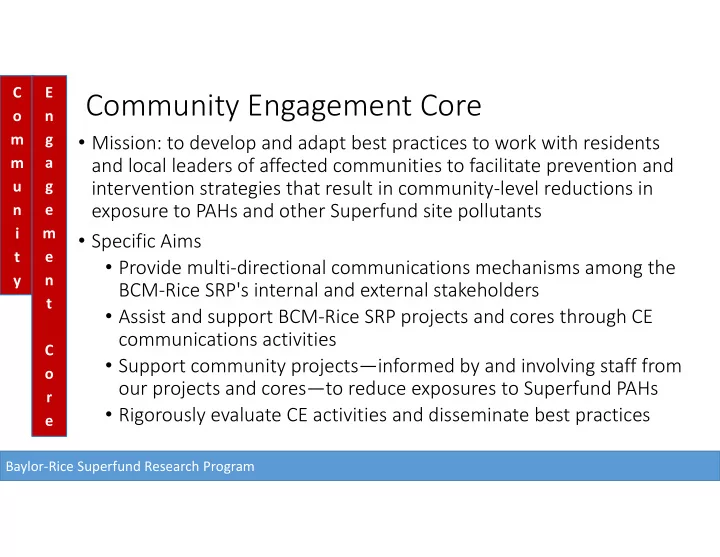
Community Engagement Core

  • Mission: to develop and adapt best practices to work with residents

and local leaders of affected communities to facilitate prevention and intervention strategies that result in community‐level reductions in exposure to PAHs and other Superfund site pollutants

  • Specific Aims
  • Provide multi‐directional communications mechanisms among the

BCM‐Rice SRP's internal and external stakeholders

  • Assist and support BCM‐Rice SRP projects and cores through CE

communications activities

  • Support community projects—informed by and involving staff from
  • ur projects and cores—to reduce exposures to Superfund PAHs
  • Rigorously evaluate CE activities and disseminate best practices
slide-2
SLIDE 2

Baylor‐Rice Superfund Research Program

C

  • m

m u n i t y E n g a g e m e n t C

  • r

e

Background

  • 15 Superfund sites in

Harris County

  • In 2018, Bayou City

Waterkeeper filed suit against the City of Houston in the U.S. District Court for over 9,300 potential Clean Water Act violations

slide-3
SLIDE 3

Baylor‐Rice Superfund Research Program

C

  • m

m u n i t y E n g a g e m e n t C

  • r

e

Background

  • Historically high rates of Preterm

Birth

  • PTB complications include

chronic lung disease deficits later in life

  • Overarching hypothesis is that

maternal exposure to PAHs increases risk of PTBs and augments major morbidities (e.g., lung disease deficits)

Kahr MK, Suter MA, Ballas J, et al. Preterm birth and its associations with residence and ambient vehicular traffic exposure. Am J Obstet Gynecol. 2016;215(1):111.e1‐111.e10. doi:10.1016/j.ajog.2016.01.171

slide-4
SLIDE 4

Baylor‐Rice Superfund Research Program

C

  • m

m u n i t y E n g a g e m e n t C

  • r

e

Superfund Sites and Target Communities

  • Target Communities surrounding the Ship

Channel and Superfund sites

  • Harrisburg/ Manchester, Galena Park,

Channelview, Pasadena, Deer Park, and the Highlands

  • EJ communities impacted by heavy

industrialization, poverty, and environmental health effects of Superfund sites

Neighborhood Population Race/Ethnicity (data: ACS, 2016) Median Income ↓ US Poverty Level (12.3%) HS diploma or Higher White Black Asian Other Hispanic Harrisburg 53,280 62.5 3.0 2.8 31.7 87.9 37,763 22.5 51.9 Galena Park 11,119 78.2 5.6 0.1 16.1 83.8 44,467 21.5 58.8 Channelview 38,289 55.9 15.3 1.6 27.2 60.3 53,744 19.7 68.6 Pasadena 149,043 75.3 2.3 2.1 20.3 62.2 48,607 19.6 71.3 Deer Park 32,010 86.2 1.5 1.5 10.8 26.3 78,703 8.6 87.6 Highlands 7,522 84.2 3.1 0.4 12.3 24.8 58,295 17.3 82.8

slide-5
SLIDE 5

Baylor‐Rice Superfund Research Program

C

  • m

m u n i t y E n g a g e m e n t C

  • r

e

Multi‐directional Communication Mechanisms

  • Have remained in contact with SAB, albeit no face‐to‐face meetings:

activities include virtual meeting with CEC, surveys, interviews

  • Environmental Justice Encuentros
  • Reflects concept of encounter or discovery to convene

communities, researchers, policy makers, and others in small groups

  • Used to promote community and research communications
  • Increase use of EH science as basis for public health advocacy
  • Six Encuentros: focus on health and EH in context of disparities
  • Purpose: identify and prioritize issues and road ahead
  • Introduce concept of Community Science Workshops to facilitate

community and research projects

  • Next steps: synthesize meeting outcomes to inform Center

research projects and potential new research (CSWs)

slide-6
SLIDE 6

Baylor‐Rice Superfund Research Program

C

  • m

m u n i t y E n g a g e m e n t C

  • r

e

Community Project: Prenatal Education on environmental Exposures during Pregnancy Study (PEEPS)

  • Linked to projects: Role of PAH Exposures in Preterm Birth (Aagaard) and

Increased Risk of Premature Infants to Chronic Lung Disease (Moorthy)

  • In conjunction with community clinic partner, HOPE Clinic
  • Purpose: to reduce maternal environmental exposures to toxicants

through a prenatal education program to learn how to:

  • Reduce exposures from seafood
  • Understand risk to self and child
  • Make informed nutrition choices
  • Received IRB approval, IRB # 20‐0026
  • Updating curricula and educational

materials to reflect new guidelines

  • Written materials will be translated into multiple languages
  • Initial prenatal education classes will be piloted at HOPE Clinic
slide-7
SLIDE 7

Baylor‐Rice Superfund Research Program

C

  • m

m u n i t y E n g a g e m e n t C

  • r

e

Community Project: Prenatal Education on environmental Exposures during Pregnancy Study (PEEPS)

  • Upon curriculum completion:
  • Series of short videos related to seafood selection and preparation
  • Already shot footage with our (at the time) very pregnant colleague

who graciously volunteered to help

  • Obtained use of a food prep station with built‐in

video capabilities to teach preparation and cooking

slide-8
SLIDE 8

Baylor‐Rice Superfund Research Program

C

  • m

m u n i t y E n g a g e m e n t C

  • r

e

Community Project: Urban Gardening

  • Linked to projects: Pyolytic Conversion of PAHs in

Contaminated Sediments (Alvarez) and ID of PAHs/PACs in Environmental Samples Using Ultracompact Spectroscopy Platforms (Halas)

  • Urban soil frequently contaminated. Prolonged

flooding in Hurricane Harvey; many communities adjacent to Superfund sites inundated

  • Air pollutants contribute to surface soil contamination
  • Exposures through skin contact, inhalation, or ingestion
  • CEC to teach gardening workshops on prevention,

nutrition, and alternative methods of raising fruits and vegetables (e.g., hydroponic garden systems)

Hydroponic garden system to be provided for community members

slide-9
SLIDE 9

Baylor‐Rice Superfund Research Program

C

  • m

m u n i t y E n g a g e m e n t C

  • r

e

Community Project: Urban Gardening

  • Developed educational curriculum and materials
  • Supply list
  • Detailed instructions for preparation and assembly
  • Instructional video
  • Train the Trainer class scheduled for students targeted

for recruitment for assisting with dissemination and providing training workshops

  • Each participant will receive kit with pre‐prepared

supplies and handbook for assembly

  • Workshop will focus on assembly of demonstration

system (completed systems would be difficult to transport)

slide-10
SLIDE 10

Baylor‐Rice Superfund Research Program

C

  • m

m u n i t y E n g a g e m e n t C

  • r

e

Community Project: PAH Mapping and Sampling

  • Example: Houston‐Galveston Area Council Map of PCBs and Dioxins
  • Have collected data on PAH sampling for similar mapping project
  • Also working to identify potential sources of water samples for analysis

to inform outreach, research, and prevention efforts

slide-11
SLIDE 11

Baylor‐Rice Superfund Research Program

C

  • m

m u n i t y E n g a g e m e n t C

  • r

e

PAH Infographics

slide-12
SLIDE 12

Baylor‐Rice Superfund Research Program

C

  • m

m u n i t y E n g a g e m e n t C

  • r

e

Next Steps

  • Meet with stakeholder groups to plan November Encuentros
  • Synthesize Encuentro findings to inform Center research projects and

potential new research (CSWs)

  • Revamp Prenatal Education curriculum materials
  • Draft scripts for creation of videos and short animations to teach

about risk associated with seafood consumption

  • Train the Trainer Hydroponic Gardening Workshop scheduled for

November for students/trainees

  • In discussions with Toxicology faculty member to initiate PAH sampling
  • f soil, local waterways, and seafood to provide information education

and outreach informed by specific local data