Communication Communication Exercise Aphasia- is an impairment of - - PDF document

communication
SMART_READER_LITE
LIVE PREVIEW

Communication Communication Exercise Aphasia- is an impairment of - - PDF document

Presented at The University of June 2012 Nottingham, Dementia Home Care Conference Learning Outcomes To learn or revise new ways to communicate To learn or revise best practice when assisting with personal care To learn or revise


slide-1
SLIDE 1

Presented at The University of Nottingham, Dementia Home Care Conference June 2012 1

AndreaAtkin StaffNurse Nutrition Link Nurse B47 Medical Mental Health Unit (MMHU) Queen’sMedical Centre, Nottingham

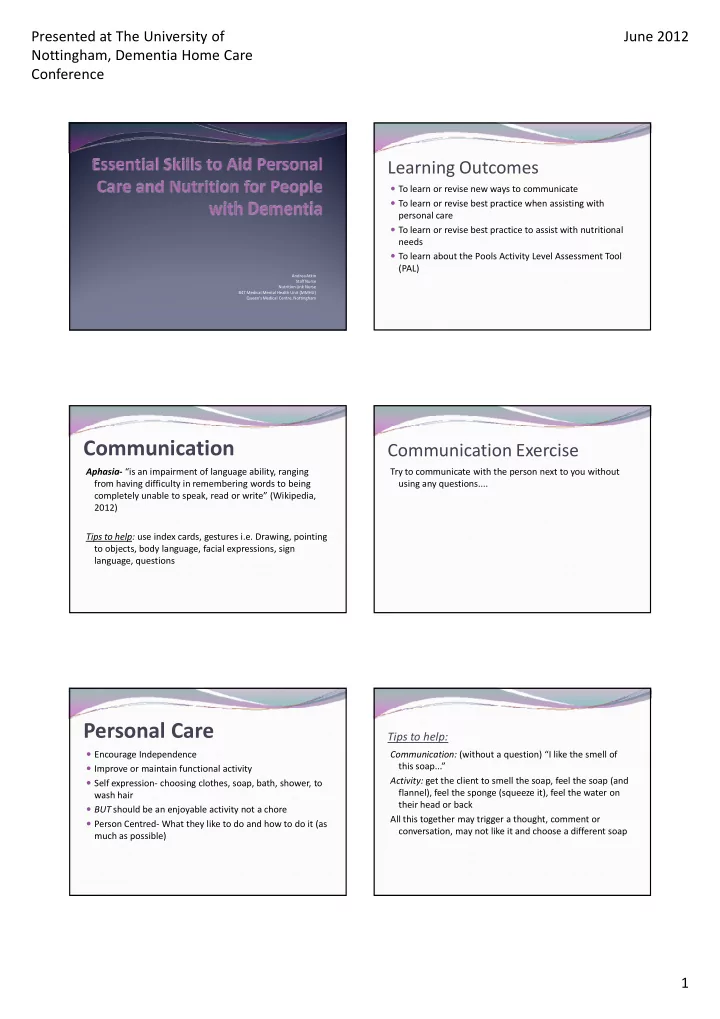
Learning Outcomes

 To learn or revise new ways to communicate  To learn or revise best practice when assisting with personal care  To learn or revise best practice to assist with nutritional needs  To learn about the Pools Activity Level Assessment Tool (PAL)

Communication

Aphasia- “is an impairment of language ability, ranging from having difficulty in remembering words to being completely unable to speak, read or write” (Wikipedia, 2012) Tips to help: use index cards, gestures i.e. Drawing, pointing to objects, body language, facial expressions, sign language, questions

Communication Exercise

Try to communicate with the person next to you without using any questions....

Personal Care

 Encourage Independence  Improve or maintain functional activity  Self expression- choosing clothes, soap, bath, shower, to wash hair  BUT should be an enjoyable activity not a chore  Person Centred- What they like to do and how to do it (as much as possible)

Tips to help:

Communication: (without a question) “I like the smell of this soap...” Activity: get the client to smell the soap, feel the soap (and flannel), feel the sponge (squeeze it), feel the water on their head or back All this together may trigger a thought, comment or conversation, may not like it and choose a different soap

slide-2
SLIDE 2

Presented at The University of Nottingham, Dementia Home Care Conference June 2012 2

Person Centred Care Exercise

Try to think of objects, smells, sounds, tastes etc that remind you of a happy time or moment in your life that you can discuss when remembered...

Nutrition

 To encourage adequate amounts of food and fluid intake  To monitor and assist with eating and drinking  Should be person centred if safe to do so depending on dietary requirements  Should be enjoyable, social, not a chore

Tips to help:

Communication: (without a question) “that dinner looks and smells nice...” Activity: get the client to look and smell the dinner, get them to try it and tell you how it tastes, may remind them

  • f a holiday etc.

It may be that they don’t like two hot meals a day, don’t fancy it and you will need to find alternatives

Other Tips:

 Make a meal look attractive  Encourage different foods and fluids  Encourage snacks  IF NOT EATING: try smaller portions try and give them what they fancy (if safe and able to do so) May need assistance if unwell (increased confusion) May only like finger foods May need adapted cutlery/ plates (OT can help) May need to eat or have a drink with them (sociable) May be aspirating and so wont eat (as they don’t like the idea of chocking)

 Make food and fluid charts for a week and check weight once a week for 2 weeks to monitor changes  Get doctor to review weight loss- may need dietician referral  Monitor if coughing, wet/ hoarse voice when eating as may be aspirating- will need a doctor to review, may need admission to hospital or SALT referral for a modified diet (as infections can occur from aspiration)  Encourage communication between care staff (communication diary- care plans, charts)

Nutrition Exercise

Using food and fluid charts provided, try to fill them out. Use the first on to write on what you had yesterday, and the second one ask the person sitting next to you. (To practice filling them out). Did anything you ate or smelt trigger a memory?

slide-3
SLIDE 3

Presented at The University of Nottingham, Dementia Home Care Conference June 2012 3

Pool’s Activity Level (PAL) Assessment Tool

Activities are all things that someone does in a day. These include, washing, dressing, eating and drinking, watching TV, listening to the radio, having a conversation, mobilising, playing a game. The best tool to assess at what level each activity can be achieved at is to use The Pools Activity Level Assessment Tool, developed by Jackie Pool (Pool, 2012). The reasons for getting the right level is so the client can feel a sense on achievement on completing the task without help that wasn’t needed. This improves self esteem and quality of life, whist being person centred. (Wenborn, Challis, Pool et al, 2008)

Pool’s Activity Level Exercise

Using the Pool’s Activity Level Assessment, think of a client and try to fill it in, you can confirm and discuss with your partner. Do you know anything about your client that may trigger memories?

Conclusion

Using effective communication can aid a person with dementia in all activities of daily living and the carers looking after them. Providing person centred care at a level appropriate for the client using the tools provided will aid personal care and nutrition and will benefit both care workers and clients

References

Pool; J (2012) The Pool Activity Level (PAL) Instrument for OccupationalProfiling: A PracticalResource for Carers of People with CognitiveImpairment, 4th Edition, London, Jessica Kingsley Publishers Wenborn; J , Challis; D, Pool; J, Burgess; J, Elliott; N and Orrell; M (2008) Assessing the validity and reliability of the Pool Activity Level (PAL) Checklist for use with older people with dementia, Aging & Mental Health, 12:2, 202 - 211 Wikipedia (2012) Aphasia [online] available at: en.wikipedia.org/wiki/Aphasia accessed on: 17/06/2012