Communication Netwoks Communication Netwoks Technology Technology - - PowerPoint PPT Presentation

communication netwoks communication netwoks
SMART_READER_LITE
LIVE PREVIEW

Communication Netwoks Communication Netwoks Technology Technology - - PowerPoint PPT Presentation

Basic Networking Principles Communication Netwoks Communication Netwoks Technology Technology and and Introduction Economics Economics Costas Courcoubetis Changes in telecommunications Network convergence In the new public network:


slide-1
SLIDE 1

Communication Netwoks Communication Netwoks

Technology and Economics Technology and Economics

Costas Courcoubetis

Basic Networking Principles Introduction

Basic concepts - 3

Basic concepts and directions in telecommunications C. Courcoubetis

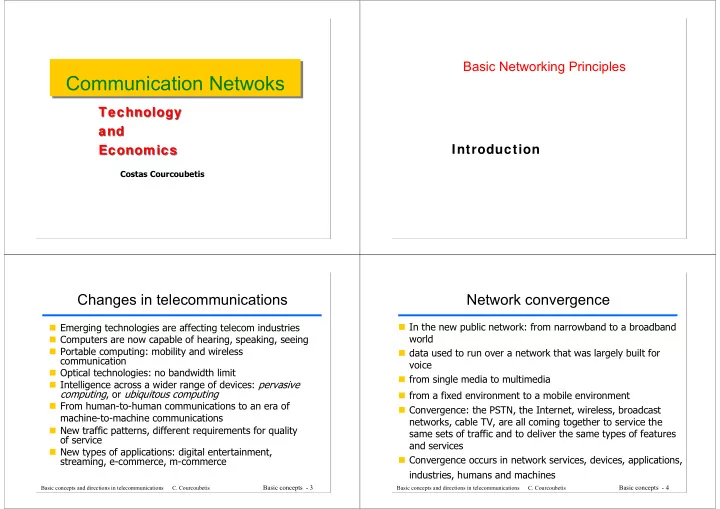
Changes in telecommunications

Emerging technologies are affecting telecom industries Computers are now capable of hearing, speaking, seeing Portable computing: mobility and wireless communication Optical technologies: no bandwidth limit Intelligence across a wider range of devices: pervasive computing, or ubiquitous computing From human-to-human communications to an era of machine-to-machine communications New traffic patterns, different requirements for quality

  • f service

New types of applications: digital entertainment, streaming, e-commerce, m-commerce

Basic concepts - 4

Basic concepts and directions in telecommunications C. Courcoubetis

Network convergence

In the new public network: from narrowband to a broadband world data used to run over a network that was largely built for voice from single media to multimedia from a fixed environment to a mobile environment Convergence: the PSTN, the Internet, wireless, broadcast networks, cable TV, are all coming together to service the same sets of traffic and to deliver the same types of features and services Convergence occurs in network services, devices, applications, industries, humans and machines

slide-2
SLIDE 2

Basic concepts - 5

Basic concepts and directions in telecommunications C. Courcoubetis

What are (communication) networks ?

Hardware and software Allow exchange of information and access to services Factors that contribute to the creation of Networks

  • Economies of scale in the production process
  • Economies of Scale in the demand (network

externalities)

Basic concepts - 6

Basic concepts and directions in telecommunications C. Courcoubetis

What are communication networks ?

Data transfer service, between high level programs

access

Communications Network

Circuit (logical) services Datagram services

ΑΤΜ Frame Relay SDH ISDN

Ethernet Internet (IP)

Basic concepts - 7

Basic concepts and directions in telecommunications C. Courcoubetis

Network architectures

Natural View: Composed of:

  • Computers, Connectors, Routers, Switches,

Logical View: Composed of services

  • Simple services -> Composite services
  • Layering of services (layered architecture)

End-to-end Services

  • Interest the end user
  • Service level agreements (SLAs)

Basic concepts - 8

Basic concepts and directions in telecommunications C. Courcoubetis

ODN model

Applications Video conferences, email, WWW Middleware Directories, security, compression, file trans., ... Bearer ATM, IP, CDPD, Frame Relay, X.25 Bit ways SONET, DBS, CATV, wireless links

slide-3
SLIDE 3

Basic concepts - 9

Basic concepts and directions in telecommunications C. Courcoubetis

Why networks exist

Point to point connectors Distributed connectors Statistical multiplexing

  • Economies of scale

Convergence of technologies

  • Economies of scope

Basic concepts - 10

Basic concepts and directions in telecommunications C. Courcoubetis

Multiplexing

1 2

Fixed TDM

1 2

Statistical TDM

Basic concepts - 11

Basic concepts and directions in telecommunications C. Courcoubetis

Networking economies

M a r k e t S h a r e Time

50% 100% Value for the user Number of conventional users

Economies of scale in production and demand: Positive feedback

Basic concepts - 12

Basic concepts and directions in telecommunications C. Courcoubetis

Historical example

The telephone network

  • Alexander Graham Bell 1876
  • 1887: 150000 tel. USA, 26000 UK, 9000 Fr, 7000
  • Rus. 1990: 181000000 tel. USA

The role of interconnection

  • 1903s: non-Bell = 50-60%, long distance = 3%
  • Demand for long distance interconnections after

1900

− Bell System: Smart interconnection strategy, evolved network for long-distance calls.

slide-4
SLIDE 4

Basic concepts - 13

Basic concepts and directions in telecommunications C. Courcoubetis

Historical example (cont.)

Inter-connectability: Competitive advantage 1984: End of the ΑΤ&T monopoly Conclusion: When you control important interfaces or bottlenecks, you must offer them in a controlled way, determining the interconnection rules. Regulating Policy: Raise of competition Basic Networking Principles Basic netw orking concepts: LANs, IP, TCP

Basic concepts - 15

Basic concepts and directions in telecommunications C. Courcoubetis

Local Area Networks (LANs)

LANs: The simplest networks Every computer has:

  • A name
  • A network address (Internet)
  • A local area network address (MAC)

LAN

alice 128 35 costas 345 37

Basic concepts - 16

Basic concepts and directions in telecommunications C. Courcoubetis

Ethernet

Switched Ethernet Hub

124 105 37 y z x x,y| data data

  • Retransmits all of the packets
  • If more than two simultaneous

transmissions, then we have conflict

Ethernet Hub

124 105 37 y z x x,y| data data Uses a switching table Α B C y -> A z -> B x -> C

slide-5
SLIDE 5

Basic concepts - 17

Basic concepts and directions in telecommunications C. Courcoubetis

Address detection

Ethernet Hub

124 105 37 y z x x,y| data data

To send a packet : Network Address

  • How do we find the local address? ARP, RARP

ARP table: 124: y 105: z

Basic concepts - 18

Basic concepts and directions in telecommunications C. Courcoubetis

Switched LANs and VLANs

Ethernet switches: send packets to destination

  • nly

VLANs: assign any terminal to a particular LAN

Basic concepts - 19

Basic concepts and directions in telecommunications C. Courcoubetis

LAN interconnection: using routing

Ε1 S s a k f Ethernet E1 Ε3 D d Ethernet E3 Ε2 Ethernet E2 Router R H h r1 r2 r3 Routing table: D, H: E3, ... S: E1, ... ARP table for Ε3: D: d, H: h, ... s,r1 S,D data r3,d S,D data

Basic concepts - 20

Basic concepts and directions in telecommunications C. Courcoubetis

Internet: the IP protocol

Ε1 S s a k f Ethernet E1 Ε3 D d Ethernet E3 H h Router R r1 r2 r3 s,r1 S,D data Router W w1 w2 w3 w4 E2 r2, w4 S,D data w3,d S,D data Routing table: D, H: W:E2,… ………. S: E1, ...

slide-6
SLIDE 6

Basic concepts - 21

Basic concepts and directions in telecommunications C. Courcoubetis

Internet: routing

Routing: Fundamental Procedure

  • destination-> Next router on adjacent LAN

Methodologies:

  • By hand (Centralized decision for everyone)
  • Using a public map
  • Hierarchical routing

Basic Problem: complexity

Basic concepts - 22

Basic concepts and directions in telecommunications C. Courcoubetis

Routing

Autonomous system (AS) AS2 AS1

Basic concepts - 23

Basic concepts and directions in telecommunications C. Courcoubetis

Information transmission

Basic protocol IP

  • connects computers, not applications

Problem:

  • congestion, breakdowns, …
  • connections at the applications level

Solution: TCP and UDP Protocol

  • Detects erroneous packets (UDP+TCP)
  • controls flow (TCP)
  • Retransmits lost packets (TCP)
  • Places packets in correct order (TCP)

Basic concepts - 24

Basic concepts and directions in telecommunications C. Courcoubetis

Connecting applications

UDP,ΤCP over IP: flow control of packets between program addresses Result: «Micro-flows»

  • We need to separate them

Α2 Α1 Β1 Β2 TCP Flow Ν1 Ν2 Ν1,Ν2 data A1,A2 Ν1,Ν2 data B1,B2 TCP/UDP header + Application ids IP Flow

slide-7
SLIDE 7

Basic concepts - 25

Basic concepts and directions in telecommunications C. Courcoubetis

Connecting applications (2)

Ν π1π2 π1 Μ π1 π2 π1 S1 S2 A π1, π2 N,Μ data : port number : network addr.

i

π

M N,

program Mailboxes for the use

  • f applications, types:

TCP, UDP Flow Control “Central mailbox” for IP packets : TCP : UDP

TCP TCP UDP UDP

π2 π2 port type

Basic concepts - 26

Basic concepts and directions in telecommunications C. Courcoubetis

Simple Transmission : UDP

IP UDP modules = data Algorithm:

  • Always send
  • Transmits with maximum rate
  • Packets can be lost!
  • Useful when:
  • The application dictates the

transmission rate

  • The connection lasts for a short

time, small number of packets. π1, π2 N,Μ data IP UDP checksum IP does not guarantee correct transmission! source destination data

Basic concepts - 27

Basic concepts and directions in telecommunications C. Courcoubetis

Flow Control: TCP

data k IP TCP modules = data = acknowledgements

Algorithm:

  • Send only when you receive acknowledgment
  • do not send if k > W
  • always chose the correct W

k = number of packets that are not acknowledged χρόνος 0 1 2 3 4

RTT W R =

RTT

Basic concepts - 28

Basic concepts and directions in telecommunications C. Courcoubetis

Connecting applications (3)

Ν π1 π2 π3 Μ π1 π2 π3 S2 A IP: Not designed to offer a Standard quality of service

slide-8
SLIDE 8

Basic concepts - 29

Basic concepts and directions in telecommunications C. Courcoubetis

The weaknesses of IP

IP is not designed to support “steady” flows We cannot create steady pipes of guaranteed diameter between nodes Specialized logic in packet level How can we support steady flows ?

  • By adding new mechanisms in the IP
  • By designing from the beginning control

mechanisms => ΑΤΜ Technology!

Basic concepts - 30

Basic concepts and directions in telecommunications C. Courcoubetis

IPv6

IP version 6: λύνει τα εξής προβλήµατα του IPv4:

  • τελειώνουν οι 32-bit διευθύνσεις -> 128 bit
  • IPv4 έχει περιορισµένες δυνατότητες QoS: flows
  • IPv4 δεν έχει ενσωµατωµένη ασφάλεια
  • βελτιωµένη απόδοση: σταθερό µήκος header, δεν επιτρέπεται

τεµαχισµός πακέτων, δεν έχει ανίχνευση λαθών

  • anycast address: (http get -> mirror sites)

[Version|Priority|Flow|Total Length|Next Header|Hop Limit|SA|DA] Βασική επικεφαλίδα: 40 bytes, ακολουθείται πιθανά από επεκτάσεις Επεκτάσεις επικεφαλίδας: Hop-by-hop, destination, routing, fragmentation, authentication, encapsulating security payload Πρόβληµα: µετάβαση από IPv4

Basic concepts - 31

Basic concepts and directions in telecommunications C. Courcoubetis

Virtual Circuits

a b c b c d c d S1 S2 S3 d a a b e 1 1 1 1 1 a,1: d,1 a,1: e,1 and c,1 a,1: b,1 1 2 1 c,1: d,2 a,2: b,1 1 2 1 d,1: e,2 a,2: c,1 VC data ATM cell 1 2 1

Basic concepts - 32

Basic concepts and directions in telecommunications C. Courcoubetis

Virtual networks

R1 R2 R3 R4 R1 R2 R3 R4 R1 R2 R3 R4 R1 R2 R3 R4 IP network R R R R

Leased line network ATM network

Logical network Using leased lines Using ATM Using IP VPN

slide-9
SLIDE 9

Basic concepts - 33

Basic concepts and directions in telecommunications C. Courcoubetis

More slides

Basic concepts - 34

Basic concepts and directions in telecommunications C. Courcoubetis

Transport services

Application A Application B network

Network interface Transport service

Basic concepts - 35

Basic concepts and directions in telecommunications C. Courcoubetis

Internet model

F T P

T E L N E T R L O G I N

S M T P D N S

...

H T T P R T P T F T P

TCP UDP IP LAN link

Basic concepts - 36

Basic concepts and directions in telecommunications C. Courcoubetis

∆ροµολόγηση: ιεραρχική

ΑΣ: Αυτόνοµο σύστηµα ΑΣ Y AΣ Χ ΑΣ Ζ ΑΣ Α

Προτιµούµενη διαδροµή προς το Α: [Υ,Χ,Ζ,Α], καθυστέρηση: 15 Προτιµούµενη διαδροµή προς το Α: [Ζ,Α], καθυστέρηση: 17