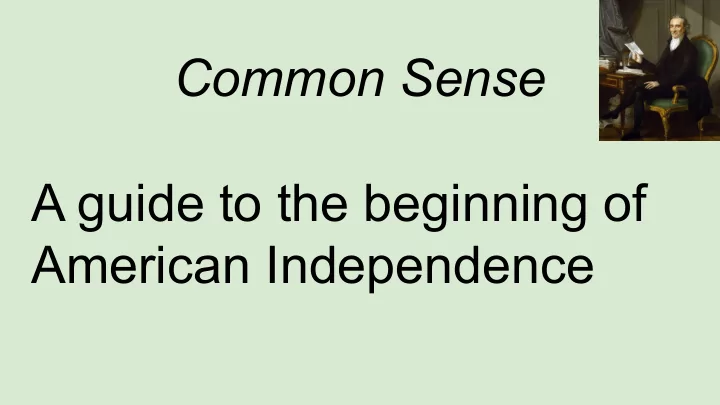
Common Sense A guide to the beginning of American Independence - - PowerPoint PPT Presentation

common sense a guide to the beginning of american
SMART_READER_LITE
LIVE PREVIEW

Common Sense A guide to the beginning of American Independence - - PowerPoint PPT Presentation

Common Sense A guide to the beginning of American Independence List of Events Leading to the American Revolution French & Indian War - fought between Britain and France over land in the Ohio River Valley; both sides wanted the resources


slide-1
SLIDE 1

Common Sense A guide to the beginning of American Independence

slide-2
SLIDE 2

List of Events Leading to the American Revolution

  • French & Indian War - fought between Britain and France
  • ver land in the Ohio River Valley; both sides wanted the

resources

  • Treaty of Paris 1763
  • Proclamation of 1763

Series of taxes on various goods Smuggling Sons of Liberty -- coordinated action against the British

slide-3
SLIDE 3

List of Events Leading to the American Revolution

  • Sugar Act (1764). This British law charged duties on sugar & molasses imported by the colonies. Several
  • ther products were also taxed.
  • Currency Act (1751 and 1764). Several Acts which regulated the issuing of money by the American

colonist.

  • Stamp Act (1765). This British law required certain printed materials including newspapers in America

be on paper produced in Britain and stamped with a revenue stamp.

  • Quartering Act (1765). This act forced the colonist to provide food and shelter for British soldiers when

needed.

  • Townshend Acts (1767). A series of acts passed By Britain beginning in 1767 that taxed the colonies.
  • Boston Massacre (1770). An angry mob of colonist confronts British soldiers in Boston. Five colonists

are killed.

  • Tea Act (1773). This act basically gave the British East India Company a monopoly on tea trade in the

Americas.

  • Boston Tea Party (1773). In response to the Tea Act patriots dressed as American Indians dump British

tea into Boston Harbor.

  • Intolerable Acts (1774). A series of laws also called the Coercive Acts passed by Britain in response to

the Boston Tea Party.

slide-4
SLIDE 4
slide-5
SLIDE 5

Patriots vs. Loyalists

  • 1. Patriot - (called Whigs) Americans who believed

the colonies had the right to govern themselves; willing to fight Britain

  • 2. Loyalist - (called Tories) colonists who felt a

deep loyalty to Britain & King; horrified by the idea of taking up arms against Britain

  • 3. Neutralist - had yet to support either side; by the

time the revolution began, many had changed their minds and joined one side

slide-6
SLIDE 6

Common Sense by Thomas Paine

  • Englishmen; self educated; penniless
  • Caught attention of Ben Franklin
  • Pamphlet published in 1775-1776
  • Woke America up
  • Reasons for Colonists to rebel against

Britain

  • Treasonous work because it contained a

radical idea that the Colonists should declare independence

  • Sold 120,000 copies in first 3 months
  • 5 months after is was published, the 2nd

Continental Congress met

slide-7
SLIDE 7

Common Sense by Thomas Paine

  • “Yo, you are an island:” An idea that an island nation in Europe

can drive policy for a continent is crazy.

  • We aren’t British anymore. We are now diversified. We are

Americans now and we have begun to build a sense of identity. This is the first example American defining literature.

  • “Yo, mama:” what kind of “mother” is Great Britain? Mother

country is not doing its motherly duties. She raises you and then violates your natural rights (and no representation).

slide-8
SLIDE 8

Common Sense by Thomas Paine

  • “Bang bang:” getting caught up in European alliances; he argues

to not sit at the drama table

  • Distance - Britain is thousands of miles away; communication is a

problem; time gap create pragmatic problems

  • Idea of Puritan Heritage: we were to be a refuge from Europe and

Catholic Church/Church of England; separate self from drama; leads us to idea to separate officially

  • Best Interest: Colonialism never will have our best interest;

London’s interests > Boston’s interests; need to rule ourselves; we need our own representation