
SLIDE 1
+
Common Core Shifts
A Parents’ Guide
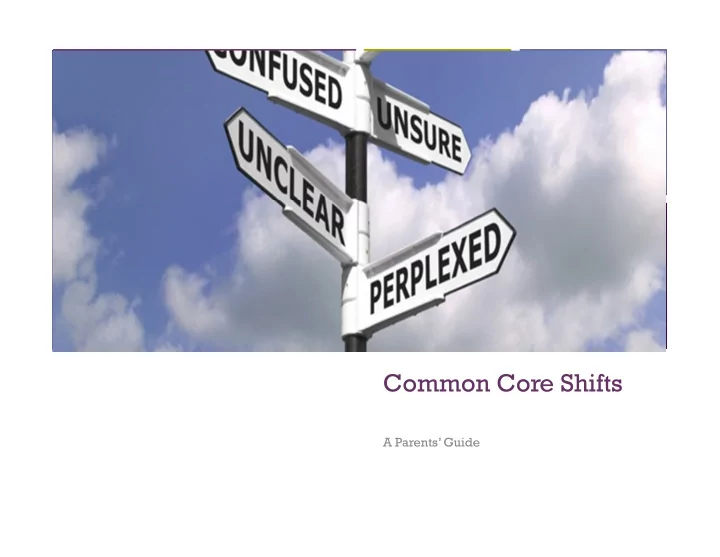
+ Common Core Shifts A Parents Guide + Rigor Anthropomorphism - - PowerPoint PPT Presentation
+ Common Core Shifts A Parents Guide + Rigor Anthropomorphism What does it mean? + + Topic 1: The Math Shifts + The Shifts: A Change in Paradigm Shift 1 Focus Teachers significantly narrow and deepen the scope of + how time and
A Parents’ Guide
Shift 1 Focus Teachers significantly narrow and deepen the scope of how time and energy is spent in the math classroom. They do so in order to focus deeply on only the concepts that are prioritized in the standards. Shift 2 Coherence Principals and teachers carefully connect the learning within and across grades so that students can build new understanding onto foundations built in previous years. Shift 3 Fluency Students are expected to have speed and accuracy with simple calculations; teachers structure class time and/or homework time for students to memorize, through repetition, core functions. Shift 4 Deep Understanding Students deeply understand and can operate easily within a math concept before moving on. They learn more than one trick to get the answer right. They learn the math. Shift 5 Application Students are expected to use math and choose the appropriate concept for application even when they are not prompted to do so. Shift 6 Dual Intensity Students are practicing and understanding. There is more than a balance between these two things in the classroom – both are occurring with intensity.
How fast should fact recall be? How can we practice at home? What is being done school?
Use mastering math facts (Download the set here)
Math sprint! (Download some here)
http://www.eduplace.com/math/mthexp/ http://www.thinkcentral.com
www.ixl.com
https://samconnect.scholastic.com/auth/pages/Logi n?zone=STRCH&ucn=600010198
Shift 1 Balance Information & Literary Text Students read a true balance of informational and literary texts. Shift 2 Knowledge in the Disciplines Students build knowledge about the world (domains/ content areas) through TEXT rather than the teacher or activities. Shift 3 Staircase of Complexity Students read the central, grade appropriate text around which instruction is centered. Teachers are patient, create more time and space and support in the curriculum for close reading. Shift 4 Text-based Answers Students engage in rich and rigorous evidence based conversations about text. Shift 5 Writing from Sources Writing emphasizes use of evidence from sources to inform or make an argument. Shift 6 Academic Vocabulary Students constantly build the transferable vocabulary they need to access grade level complex texts. This can be done effectively by spiraling like content in increasingly complex texts.
www.readworks.org
http://mrnussbaum.com/readingpassageindex/
https://student.societyforscience.org/sciencenews- students http://kids.nationalgeographic.com/kids /stories/history/
What is the reading level of www.cnn.com? How can you find out? (Click Here)