Colorectal Cancer Screening: Colonoscopy, Potential and - - PowerPoint PPT Presentation

colorectal cancer screening colonoscopy potential and
SMART_READER_LITE
LIVE PREVIEW

Colorectal Cancer Screening: Colonoscopy, Potential and - - PowerPoint PPT Presentation

Colorectal Cancer Screening: Colonoscopy, Potential and Disclosures: None Pitfalls Jonathan P. Terdiman, M.D. Professor of Clinical Medicine University of California, San Francisco Cumulative Mortality from Colorectal Cancer in the General


slide-1
SLIDE 1

Colorectal Cancer Screening: Colonoscopy, Potential and Pitfalls

Jonathan P. Terdiman, M.D. Professor of Clinical Medicine University of California, San Francisco

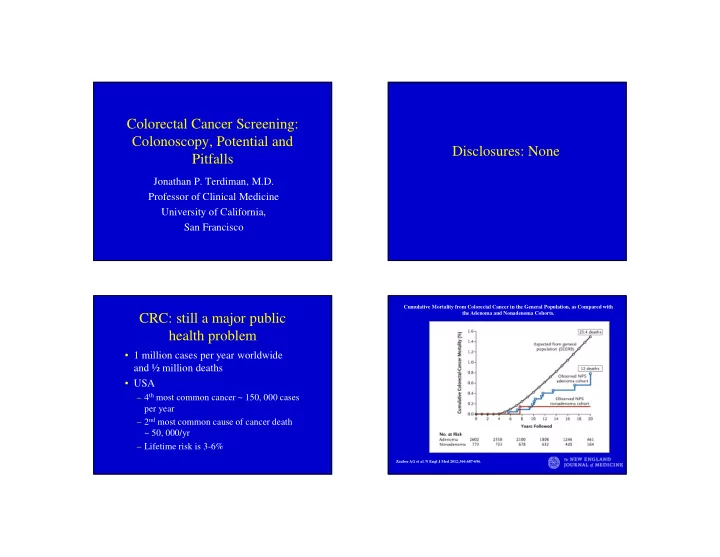
Disclosures: None CRC: still a major public health problem

  • 1 million cases per year worldwide

and ½ million deaths

  • USA

– 4th most common cancer ~ 150, 000 cases per year – 2nd most common cause of cancer death ~ 50, 000/yr – Lifetime risk is 3-6%

Cumulative Mortality from Colorectal Cancer in the General Population, as Compared with the Adenoma and Nonadenoma Cohorts.

Zauber AG et al. N Engl J Med 2012;366:687-696.

slide-2
SLIDE 2

Screening Options

  • FOBT q year
  • Flexible sigmoidoscopy q 5 yrs
  • FOBT and Flexible sigmoidoscopy
  • Colonoscopy q 10 years
  • CT colonography q 5 years

Screening Colonoscopy

  • Compelling indirect evidence that

this is the “best” test

– FOBT studies – Flex Sig Studies

– Polypectomy Studies – Cohort studies

Screening Colonoscopy: VA Cooperative Study

(Lieberman et al. NEJM, 2000)

  • Advanced adenoma in 7.9%
  • Cancer in 1.0%

– 73% with Stage I or II disease – 20% with Stage III and 6% with Stage IV

  • 44% of patients with advanced

neoplasia would have been missed by flex sig first screen

  • 30% missed by sig + FOBT

Colonoscopy in the real world: The Polyp Prevention Trials

  • 9 studies with > 20, 000 years of

patient follow-up

  • Incidence of CRC = 1.7-2.4/1, 000

person-years

  • Incidence is equivalent to general

population and 4 x that in National Polyp Study!!!

Gastroenterology 2005;129:34-41 Gastrointest Endosc 2005;61:385-91

slide-3
SLIDE 3

Impact of colonoscopy on CRC death

Baxter NN. Ann Int Med, 2009

  • 10, 292 CRC deaths and 51, 940

controls among 1.2 million Canadians, 1996-2001

  • OR for death with colonoscopy = 0.69

– Left sided cancers, OR = 0.33 – Right sided cancer, OR = 0.99

Incomplete Exam

Gastro, 2007

  • Pop-based study in Canada
  • > 300, 000 exams, 13% incomplete
  • Risk Factors

– Older age – Women – Prior operation – Test in MD office

Missed Cancers

Gastro, 2007

  • Cancers diagnosed within 3 yrs of

colonoscopy

  • Risk Factors

– Older age – Diverticular disease – Right sided cancer – Internist/Family MD doing the test – Test in a MD office

AN: Left vs. Right Polyps

Gupta S, et al. Clinical Gastroenterology and Hepatology 2012; 10:1395-1401.

slide-4
SLIDE 4

Flat & Depressed Polyps

Soetikno R, Jama 2008

  • 1819 exams, use of dye spray to confirm
  • Prevalence = 9.4% (95% CI, 8.1-10.8)
  • OR for cancer = 9.8

Incomplete Polyp Resection

Pohl H, Gastroenterology 2012

  • Prospective study of 1427 patients

who underwent colonoscopy

  • 10% inadequately resected
  • Wide range by MD (6.5-23%)
  • Risk Factors

– Large size: 17% for > 10 mm – Serrated polyps: 31% – Less than 20 polypectomies/year

Advanced Polypectomy

Holt BA, Clin Gastro Hepatol, 2012

Biological Variability

  • 51 interval cancers

– within 5 years of colonoscopy

  • MSI in 30.4% of interval cancers versus

10.3% of others (p = 0.003)

– Interval cancers 3.7 x more likely to be MSI

  • 27% of interval cancers at previous

polypectomy segment

  • Interval cancers 3 times more likely to be R

sided

Farrar WD Gastro, 2006 Sawhney MS Clin Gastro Hepatol, 2006

slide-5
SLIDE 5

Doing colonoscopy well

Barclay RL NEJM, 2007

  • 12 endoscopists doing over 2000 screening exams
  • Range of adenoma detection

– 9.4% to 32.7%

  • Range of scope withdrawal times

– 3.1 to 16.8 minutes

  • Detection rate < versus > 6 minutes

– 11.8% versus 28.3% for any adenoma (p < 0.001) – 2.6% versus 6.4% for advanced adenoma (p = 0.005)

Mean adenoma detection rate according to colonoscopic withdrawal times

Cumulative Hazard Rates for Interval Colorectal Cancer, According to the Endoscopist's Adenoma Detection Rate (ADR).

Kaminski MF et al. N Engl J Med 2010;362:1795-1803.

Benchmarks for GOOD Colonoscopy

  • Adenoma Detection Rate

– > 25% men, 15% women – PLCO data: 2.4 fold risk of interval cancer in those with lowest quartile of ADR vs. highest

  • Documentation of Prep

– 100%

  • Cecal Intubation

– >/= 95% – Recent population-based study in Canada rate was only 87%

  • Withdrawal Times

– >/= 6 minutes?

slide-6
SLIDE 6

Colonoscopy done well

Brenner, Ann Int Med, 2011

  • Population-based case-control study in

Germany

  • 1688 CRC cases and 1932 controls
  • Colonoscopy within 10 years

– 77% risk reduction for CRC – 84% for left-sided cancer – 66% for right-sided