
SLIDE 1
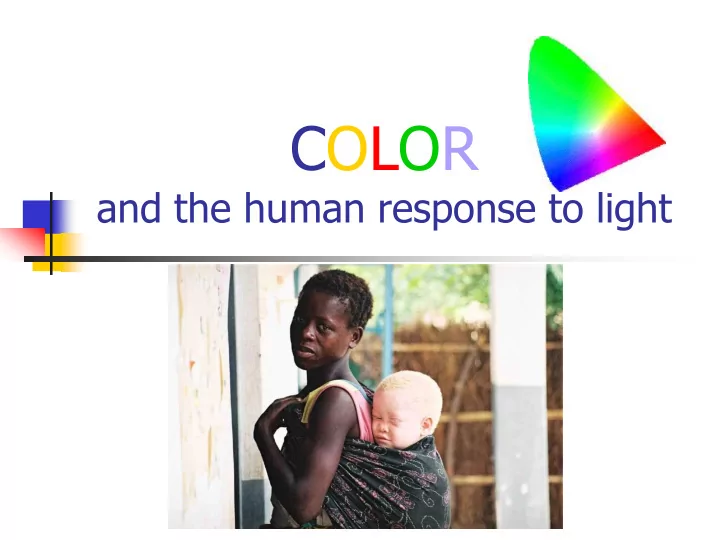
COLOR and the human response to light Contents Introduction: The - - PowerPoint PPT Presentation
COLOR and the human response to light Contents Introduction: The nature of light The physiology of human vision Color Spaces: Linear Artistic View Standard Distances between colors Color in the TV 2 How many
2
Introduction:
The nature of light The physiology of human vision
Color Spaces:
Linear Artistic View
Standard Distances between colors Color in the TV
RBG Lab CMY …
3
4
5
600 nm
Wavelength in meters (m)
Gamma X rays Infrared Radar FM TV AM Ultra- violet
10
10
10
10
4
1 10
8
electricity AC Short- wave
400 nm 500 nm 700 nm
Wavelength in nanometers (nm)
Visible light
6
Wavelength (l)
400 500 600 700 0.5 1
Relative Power
The Spectral Power Distribution (SPD) of a
light is a function P(l) which defines the power in the light at each wavelength
7
8
Some or all of the light may be absorbed depending
9
10
11
rods cones light bipolar ganglion horizontal amacrine
12
13
14
High illumination levels (Photopic vision) Less sensitive than rods. 5 million cones in each eye. Density decreases
with distance from fovea.
15
L-cones, most sensitive to red light (610 nm) M-cones, most sensitive to green light (560 nm) S-cones, most sensitive to blue light (430 nm)
16
l
17
Two lights that appear the same visually.
They might have different SPDs (spectral power distributions)
18
Tomas Young (1773-1829)
“A few different retinal receptors operating with different
wavelength sensitivities will allow humans to perceive the number of colors that they do. “
James Clerk Maxwell (1872)
“We are capable of feeling three different color sensations. Light of different kinds excites three sensations in different proportions, and it is by the different combinations of these three primary sensations that all the varieties of visible color are produced. “
Trichromatic: “Tri”=three “chroma”=color
19 R G B Brightness Hue black-white red-green blue-yellow
Cubic Color Spaces Polar Color Spaces Opponent Color Spaces
Three types of cones suggests color is a 3D
20
Colors in 3D color space can be described as linear combinations of 3 basis colors, called primaries
a
+ b + c = The representation of : is then given by: (a, b, c)
21
RGB = Red, Green, Blue Choose 3 primaries as the basis SPDs (Spectral
Power Distribution.)
400 500 600 700 1 2 3
Wavelength (nm) Primary Intensity
22
Three primary lights are set to match a test light
+
match
400 500 600 700 0.25 0.5 0.75 1 400 500 600 700 0.25 0.5 0.75 1
Test light Match light
23
(85, 38, 10) (21, 45, 72) (65, 54, 73)
Stiles & Burch (1959) Color matching Experiment. Primaries are: 444.4 525.3 645.2 Given the 3 primaries, we can describe any light with
3 values (CIE-RGB):
24 126 14 111 36 36 111 36 111 36 12 12 17 17 111 14 126 17 36 12 111 36 36 200 12 14 126 17 36 36 111 12 14 36 36 200 12 14 126 17 36 36 111 36 200 200 12 14 111 14 126 126 17 36 36 36 36 12 14 111 111 36 126 17 36 36 200 111 72 72 12 12 17 10 128 36 17 200 111 12 14 126 126 126 126 17 17 17 17 36 36 36 36 36 200 200 200 12 12 12 14 14 111 111 72 72 72 106 155
10 128 36 17 200 111 12 14 126 126 126 126 17 17 17 17 36 36 36 36 36 200 200 200 12 12 12 14 14 111 111 72 72 72 106 155 14 126 17 36 36 111 36 200 200 12 14 111 14 126 126 17 36 36 36 36 12 14 111 111 36 126 17 36 36 200 111 72 72 12 12 17 126 14 111 36 36 111 36 111 36 12 12 17 17 111 14 126 17 36 12 111 36 36 200 12 14 126 17 36 36 111 12 14 36 36 200 12
25
CMYK = Cyan, Magenta, Yellow, blacK
Magenta – removes Green
B G R
Black – removes all Yellow – removes Blue
B G R B G R
transmit Cyan – removes Red
26
Additive (RGB) Subtractive (CMYK)
27
yellow B G R
+
B G R red R = magenta B G R B G R
Example: red = magenta + yellow
28
C + M + Y = K (black)
100 50 70
=
50 20 50
+
C M Y C M Y K
Using three inks for black is expensive C+M+Y = dark brown not black Black instead of C+M+Y is crisper with more contrast
29
30
50 100 150 200 250 50 100 150 200
31
50 100 150 200 250 50 100 150 200
32
50 100 150 200 250 50 100 150 200
33
50 100 150 200 250 50 100 150 200
34
35
Hue - The color we see (red, green, purple) Saturation - How far is the color from gray
(pink is less saturated than red, sky blue is less saturated than royal blue)
Brightness/Lightness (Luminance) - How
bright is the color
white
36
Equal perceptual steps in Hue Saturation Value. Hue: R, YR, Y, GY, G, BG, B, PB, P, RP (each subdivided into 10) Value: 0 ... 10 (dark ... pure white) Chroma: 0 ... 20 (neutral ... saturated) Example: 5YR 8/4
37
38
39
Brightness Scale Saturation Scale
HSV = Hue Saturation Value HSB = Hue Saturation Brightness
40
Value Saturation Hue
41
red 0° green 120° yellow Blue 240° cyan magenta
V
black 0.0 0.5
H S
HLS = Hue Lightness Saturation
42
Problem 1: RGB differ from one device to another
43
Three primary lights are set to match a test light
+
match
400 500 600 700 0.25 0.5 0.75 1 400 500 600 700 0.25 0.5 0.75 1
Test light Match light
44
RGB Color Matching Functions
Problem 2: RGB cannot represent all colors
45
CIE - Commision Internationale d’Eclairage 1931 - defined a standard system for color
representation.
XYZ tristimulus coordinate system.
X Y Z
46
Non negative over the
visible wavelengths.
The 3 primaries associated
with x y z spectral power distribution are unrealizable (negative power in some of the wavelengths).
The color matching of Y is
equal to the spectral luminous efficiency curve.
Wavelength (nm) Tristimulus values
400 500 600 700 0.2 0.6 1 1.4 1.8
z(l) y(l) x(l)
XYZ Color Matching Functions
47
RGB to XYZ is a linear transformation
48
49
Y X+Y+Z Y = y X X+Y+Z X = x x+y+z = 1 Z X+Y+Z Z = z
650 610 590 550 570 600 580 560 540 505 500 510 520 530 490 495 485 480 470 450
1.0 0.5 0.0 0.5 0.9
y
0.0
x
50
x
650 610 590 550 570 600 580 560 540 505 500 510 520 530 490 495 485 480 470 450
1.0 0.5 0.0 0.5 0.9 green yellow- green yellow
red magenta purple blue cyan white pink
y
51
CIE Standard Illuminants: 2500 - tungsten light (A) 4800 - Sunset 10K - blue sky 6500 - Average daylight (D65)
52
Given a reference white. Dominant Wavelength – wavelength of the spectral color which added to the reference white, produces the given color.
0.2 0.4 0.6 0.8 0.2 0.4 0.6 0.8
reference white
53
Given a reference white.
0.2 0.4 0.6 0.8 0.2 0.4 0.6 0.8
reference white
Dominant Wavelength Complementary Wavelength - wavelength
added to the given color, produces the reference white.
54
Given a reference white.
0.2 0.4 0.6 0.8 0.2 0.4 0.6 0.8
reference white
Dominant Wavelength Complementary Wavelength Excitation Purity – the ratio of the lengths between the given color and reference white and between the dominant wavelength light and reference white. Ranges between 0 .. 1.
purity
55
We can use the CIE chromaticity diagram to
compare the gamut of various devices:
Note, for example,
that a color printer cannot reproduce all shades available
56
Luminance Brightness (intensity) vs (Lightness) Y in XYZ V in HSV
Luminance
DI1 DI2 I2 I1
I1 < I2, DI1 = DI2 Equal intensity steps: Equal brightness steps:
57
In general, DI needed for just noticeable difference (JND) over background I was found to satisfy:
DI I = constant (I is intensity, DI is change in intensity)
Weber’s Law: Perceived Brightness = log (I)
Intensity Perceived Brightness
58
x y
0.1 0.2 0.3 0.4 0.5 0.6 0.1 0.2 0.3 0.4 0.5
Value =1/
59
0.2 0.4 0.6 0.8
y
0.2 0.4 0.6
x (Ellipses scaled by 10)
60
An improvement over CIE-XYZ that represents better
uniform color spaces
The transformation from XYZ space to perceptual
space is Non Linear.
Two standard adopted by CIE are
L*u’v’ and L*a*b*
The L* line in both spaces is a replacement of the Y
lightness scale in the XYZ model, but it is more indicative of the actual visual differences.
61
u*
50 100 150
Value =5/
200 100 50
v* u*
50 100 150 200
100 50
v*
62
Distances are not linear
in any color space.
In perceptual color space
distances are more suitable for our conception.
Measuring color
differences between pixels is more useful in perceptual color spaces.
63
+
black-white red-green blue-yellow
+ +
64
YIQ is the color model used for color TV in America
(NTSC= National Television Systems Committee)
Y is luminance, I & Q are color
(I=red/green,Q=blue/yellow)
Note: Y is the same as CIE’s Y Result: backwards compatibility with B/W TV!
Convert from RGB to YIQ: The YIQ model exploits properties of our visual system,
which allows to assign different bandwidth for each of the primaries (4 MHz to Y, 1.5 to I and 0.6 to Q)
B G R Q I Y 31 . 52 . 21 . 32 . 28 . 60 . 11 . 59 . 30 .
65
YUV is the color model used for color TV in
Israel (PAL), and in video. Also called YCbCr.
Y is luminance as in YIQ. U and V are blue and red (Cb and Cr). The YUV uses the same benefits as YIQ,
(5.5 MHz for Y, 1.3 for U and V).
Converting from RGB to YUV:
Y = 0.299R + 0.587G + 0.114B U = 0.492(B – Y) V = 0.877(R – Y)
66
U V Y
67
Light Eye (Cones,Rods) [l,m,s] Color Color standards (Munsell, CIE) Many 3D color models:
RGB, CMY, Munsell(HSV/HLS), XYZ,
Perceptual(Luv,Lab), Opponent(YIQ,YUV).
Reproducing Metamers to Colors Different reproduction Gamut Non-linear distances between colors