College Admission Testing Strategies Adam Ingersoll Co-Founder - - PowerPoint PPT Presentation

college admission testing strategies
SMART_READER_LITE
LIVE PREVIEW

College Admission Testing Strategies Adam Ingersoll Co-Founder - - PowerPoint PPT Presentation

College Admission Testing Strategies Adam Ingersoll Co-Founder & Principal, Compass Education Group Highlights of Guide to Tes+ng SAT & ACT Score Ranges at 360 Popular Colleges pp. 8-14 SAT vs ACT Score Comparison/Concordance pp. 18-23


slide-1
SLIDE 1

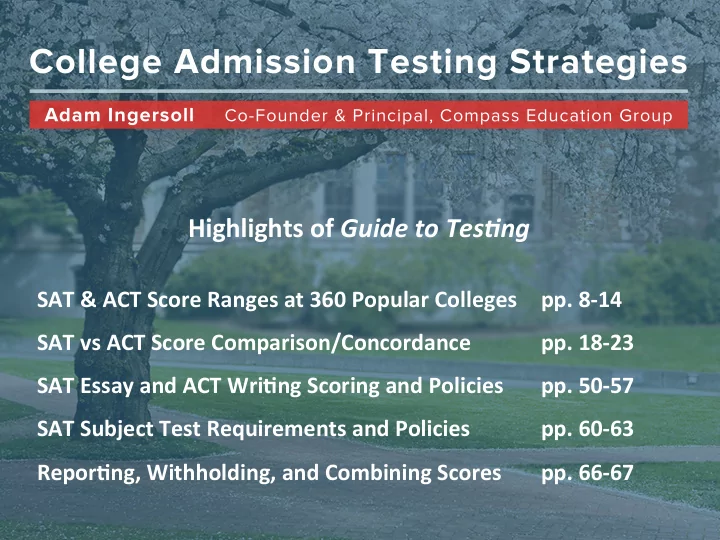
College Admission Testing Strategies

Adam Ingersoll Co-Founder & Principal, Compass Education Group

Highlights of Guide to Tes+ng

SAT & ACT Score Ranges at 360 Popular Colleges pp. 8-14 SAT vs ACT Score Comparison/Concordance

  • pp. 18-23

SAT Essay and ACT WriIng Scoring and Policies

  • pp. 50-57

SAT Subject Test Requirements and Policies

  • pp. 60-63

ReporIng, Withholding, and Combining Scores

  • pp. 66-67
slide-2
SLIDE 2
slide-3
SLIDE 3

Admission Criteria

GPA Rigor Test Scores

Recommendation Letters Recommendation Letters Personal Essay Personal Essay AP/IB Scores AP/IB Scores Demonstrated interest Demonstrated interest Extracurricular Activities Extracurricular Activities Class Rank Class Rank Legacy Status Legacy Status Financial Need Financial Need Interview Interview Work / Internships Work / Internships

slide-4
SLIDE 4

“Competition for college admission has created an unprecedented time of intense worry.” “Getting into college has never been so competitive.” “Standards have shot up. Parents who got into top notch colleges with average grades and good overall qualifications cannot understand why their kids can’t.”

New York Times, “High School Seniors’ Agony”

Unprecedented Pressure?

Written in 1957

slide-5
SLIDE 5

Flexibility ßà ßà Complexity

FREQUENT QUESTIONS ABOUT TESTING PRACTICAL TACTICAL

  • Do I need to take admission tests?
  • Should I take the SAT, ACT, or both?
  • Is the SAT or ACT essay necessary?
  • Are Subject Tests required?
  • Does the ACT replace Subject Tests?
  • If optional, should I submit my scores?
  • When should I begin/end my testing & prep?
  • How many times should I test?
  • Which colleges require reporting all scores?
  • Do colleges combine scores across dates?

Easier than ever to apply . . . . . . harder than ever to predict.

slide-6
SLIDE 6

Application Bubble A Bad Response to Anxiety

The greatest number of colleges to which a single student applied in 2014 was…

86

Source: Naviance

slide-7
SLIDE 7

See pages 4-6 of Compass Guide

Test Requirements

1,450 900 35 7

Test Requirements

SAT or ACT Required Test Optional Subject Tests ACT instead of Subject Tests

slide-8
SLIDE 8

Selective and Test-Optional

Wesleyan University Lewis & Clark College Connecticut College Washington and Jefferson College Wake Forest University Brandeis University Worcester Polytechnic Institute American

slide-9
SLIDE 9

Cynicism re Test-Optional Policies

“Why Test-Optional Colleges are Too Good to Be True” TeenLife.com, May 2016 “Even though colleges tell students submitting scores is optional, it signals the college that the student has something to hide. Colleges typically assume these students have low test scores.” Suzanne Shaffer, IEC “…applicants to ODU and elsewhere who don't submit scores will be particularly scrutinized for other evidence of potential for success.” Jane H. Dane, VP Enrollment Management

slide-10
SLIDE 10

Grade Inflation

slide-11
SLIDE 11

Standardized Tests Resist Inflation

slide-12
SLIDE 12

Standardized Tests Resist Inflation

SAT (2015)

slide-13
SLIDE 13

Competitive Landscape

80% 16% 3% 1%

Enrollment by Admission Rate

> 50% 25-50% 10-25% < 10%

Nationally:

  • Admit Rate: 70%
  • Yield: 33%

Stanford (<5%) denied 70% of applicants with perfect test scores

slide-14
SLIDE 14

Undergrads Who Earn Ph.D.’s*

Top 10 Top 20 Not Top 20

Reed #4 Carleton #6 Grinnell #7 Oberlin #10 Harvard #12 Princeton #13 Yale #14 St John’s College #17 Stanford

slide-15
SLIDE 15

ACT’s Record Growth

slide-16
SLIDE 16

Class of 2017: Compromised Options

“Old SAT” “New SAT” ACT

Was offered for the last time in January 2016 Accelerated timeline was problematic for some students Was recommended

  • nly for students with

high initial scores Practice tests were limited and unproven Concordance tools were controversial and confusing, making comparisons difficult Two month wait for reporting of scores

  • n initial test dates

Plenty of practice tests available Prep materials and

  • fferings were

well-established All test dates were available with prompt reporting of scores

slide-17
SLIDE 17

TESTING TURMOIL

A TULMUTUOUS TRANSITION J u n ‘ 1 5 : S A T t e s t m i s p r i n t July ‘15: SAT section from June thrown out Fall ‘15: ACT & SAT score reporting delays Fall ‘15: ACT essay scoring issues Fall ‘15: Widespread reports of cheating on SAT overseas Nov ‘15: Addl. SAT practice tests through Khan canceled Dec ‘15: PSAT score reporting delay Mar ‘16: New SAT debuts, 10 week wait for scores Jul ’16: Reuters uncovers international ACT cheating scandal in program owned by ACT, Inc Aug ’16: Ex-College Board employee’s home raided by FBI

slide-18
SLIDE 18

Rise of the ACT at Compass

0% 10% 20% 30% 40% 50% 60% 70% 80% 90% 100%

2005 2006 2007 2008 2009 2010 2011 2012 2013 2014 2015 2016 2017 2018 2019 2020

SAT ACT

slide-19
SLIDE 19

Increase in ACT 36s

slide-20
SLIDE 20

Class of 2018 and Beyond: Class of 2018 and Beyond: Two Equally Viable Options Two Equally Viable Options

“Old SAT” SAT ACT

Discontinued as of January 2016 Several “live” tests now available, and practice test library is growing Scaling is finalized but still some confusion around concordance Added an August 2017 test date and will shorten reporting wait time The available practice tests are growing stale and limited vs. SAT Controversy over scoring

  • f Writing (essay) seems

to be settling down Will add a July 2018 test date, score reporting continues to be prompt

X

slide-21
SLIDE 21

Comparing Test Structure

slide-22
SLIDE 22

Twins?

slide-23
SLIDE 23

Who Favors the SAT and Why?

PSAT & practice test scores clearly stronger than ACT SAT pacing and structure feels more comfortable Dread of ACT Science can’t be overcome Will need SAT for National Merit Scholarship Unavoidable conflicts with ACT dates Special accommodations granted by SAT but not ACT Believer in “no stone left unturned” approach

slide-24
SLIDE 24

Comparing P/SAT & ACT Scores

slide-25
SLIDE 25

National Merit Funnel

See page 16 of Compass Guide

slide-26
SLIDE 26

National Merit Selection Index

Higher Total PSAT Can Be Lower Selection Index STUDENT A STUDENT B Reading & Writing Math 730 690 710 720 To Calculate National Merit Selection Index:

  • 1. Drop the zeros.

73 72 69 71

  • 2. Double Reading & Writing Score.

73 71

  • 3. Add together.

+ +

215 214 Commended Scholar

  • Nat. Merit Semifinalist in IA
slide-27
SLIDE 27

PSAT Results – Sample Class

Score Change Sophomore to Junior Year Score Change Sophomore to Junior Year

240 240 120 120 200 200 160 160

Ÿ Sophomore PSAT

Sophomore PSAT n Junior PSAT Junior PSAT

slide-28
SLIDE 28

ACT Math: Structure & Pacing

Structure:

  • 60 ques@ons in 60 minutes
  • Content breakdown
  • 23% Pre-Algebra
  • 17% Elementary Algebra
  • 15% Intermediate Algebra
  • 15% Coordinate Geometry
  • 23% Plane Geometry
  • 7% Trigonometry

Pacing Concerns:

  • Average 1 minute per

question*

  • Difficulty escalates steadily

throughout

  • Problems at the end are

much harder but worth same points

  • Rushing and cherry-picking

can be dangerous

slide-29
SLIDE 29

ACT Math: Difficulty Distribution

See Compass Guide page 45 Data reflects performance of several thousand first-time ACT takers on eleven different tests.

slide-30
SLIDE 30

ACT Math: Where to Invest Effort

Percentage of Possible Points

(By Student Score Range)

0% 10% 20% 30% 40% 50% 60% 70% 80% 90% 100%

1 3 5 7 9 11 13 15 17 19 21 23 25 27 29 31 33 35 37 39 41 43 45 47 49 51 53 55 57 59

10 20 30 40 50 60

slide-31
SLIDE 31

Content Content Knowledge Knowledge Command of Command of Strategies Strategies Optimal Time Optimal Time Management Management Emotional Emotional Control Control

What Do Test Scores Reflect?

slide-32
SLIDE 32

SAT and/or ACT Essay: Required?

Yes, Still Will Caltech Claremont McKenna Dartmouth Duke Harvard Michigan Princeton Stanford UC’s Yale No, Not Anymore Columbia Cornell Johns Hopkins MIT Northwestern NYU Penn Swarthmore Tufts USC

slide-33
SLIDE 33

New ACT Essay Assignment (Debuted September 2015)

Issue: Privacy

Technology is changing our ideas about privacy. Our social media posts help us connect to friends, families, and people across the globe, but they also supply a steady stream of information to advertisers and, potentially, to governments, employers, and law enforcement agencies. Smartphone apps track our locations, buying habits, and Internet searches; that data can be both used to improve services and sold to companies to better target marketing. We’re increasingly willing to share our opinions, images, and relationships online and to turn to the Internet to run searches on

  • thers. As sharing our lives with a global audience increasingly

becomes the norm, it’s important to consider how our connected lifestyle is changing the value we place upon privacy.

Features

ü 40 minutes ü Optional* ü Based on a contemporary social issue ü Emphasis on analysis of ideas ü Students instructed to analyze and evaluate perspective, provide their

  • wn, and discuss relationships

among the perspectives ü Scored in 4 areas: Ideas and Analysis; Development and Support; Organization; and Language Use ü 2 readers assign scores of 1-6 in each domain; all four domains are averaged to create a composite Essay score: 1-12

Perspective One

Social media and smartphone apps help us navigate the world and our relationships with greater knowledge and insight. The only people who should be worried about losing privacy are those who have something to hide.

Perspective Two

When we lose our sense

  • f private lives, we lose

part of ourselves. Being

  • n public display

hinders introspection and a sense of our independent identities. When nothing is private, nothing is personal.

Perspective Three

Our desire for privacy is

  • ften rooted in

embarrassment about common human issues like illness. Letting go of

  • ld ideas about privacy

would break down barriers and help create a more open and empathetic society.
slide-34
SLIDE 34

ACT Essay Controversy & Confusion

“Counselors across the country are complaining that many of their top students, who routinely earn marks higher than 30 on

  • ther parts of the ACT, are getting writing

scores in the low-to-mid 20s.” “One Rhode Island student took the ACT in September, getting a 19 on the writing section and 30’s on the rest of the test… the student asked for a re-score and was rewarded with a huge bump, to 31.”

slide-35
SLIDE 35

ACT Essay: Comparing Old to New

Old Essay New Essay 2 1 3 7 4 10 5 12 6 16 7 7 19 19 8 8 23 23 9 9 30 30 10 32 11 34 12 36

§ 1-36 scale exaggerated differences in essay quality

§ Old 7-9 was comparable to new 19-30

§ Essay score reliability is low § Standard Error of Measurement (SEM) is 4

§ Thus a score of 20 meant that student had a 2/3 chance of falling between 16 and 24 (27th-88th percentile!)

Considerations Considerations

slide-36
SLIDE 36

ACT Essay Scoring Internal Problems

Ø ACT statement: “Initial differences in the percent of exact agreement between raters is evident for the first two administrations

  • f the new writing test, but this has been offset by the

increase in adjacent agreement. Again, as raters become more familiar and experienced in scoring with the new domain based rubrics, these issues will be mitigated.”

slide-37
SLIDE 37

New SAT Essay Assignment (Debuted March 2016)

Assignment:

Write an essay in which you explain how Paul Bogard builds an argument to persuade his audience that natural darkness should be preserved. In your essay, analyze how Bogard uses one or more of the features listed in the box above (or features of your

  • wn choice) to strengthen the logic and persuasiveness of his
  • argument. Be sure that your analysis focuses on the most relevant

features of the passage. Your essay should not explain whether you agree with Bogard’s claims, but rather explain how Bogard builds an argument to persuade his audience. As you read the passage below, consider how Paul Bogard uses:

  • evidence, such as facts or examples, to support claims
  • reasoning to develop ideas to connect claims and evidence
  • stylistic or persuasive elements, such as word choice or

appeals to emotion, to add power to the ideas expressed

[650-750 word Source Text]

Features

ü 50 minutes ü Optional* ü Based on a high-quality, previously published essay and prompt ü Emphasis on rhetorical analysis ü Students instructed to avoid including personal opinion ü Scored in 3 areas: Reading, Analysis, and Writing; 2 readers give score of 1-4

slide-38
SLIDE 38

New SAT Essay Scoring Trends

ü Scores are totaled and kept separate:

ü Reading: 6 (3 + 3) ü Analysis: 5 (3 + 2) ü Writing: 6 (3 + 3)

ü Average Scores: 5, 4, 5

ü 90% of students score a 4-6 in each area ü Analysis scores tend to be more conservative

ü Retest? If a strong test-taker scores 2 points below national

  • avg. in each area, then maybe worthwhile to retest
slide-39
SLIDE 39

Subject Test Options

Literature U.S. History or World History Math Level 2 or Math Level 1 Biology (E/M), Chemistry, and Physics Languages: French, Chinese, German, Spanish, Modern Hebrew, Italian, Japanese, Korean, Latin

slide-40
SLIDE 40

AMHERST COLUMBIA HAVERFORD UC DAVIS UVA BARNARD CONNECTICUT COLLEGE HOLY CROSS UC IRVINE VASSAR BOSTON COLLEGE CORNELL MIT UCLA WASHINGTON & LEE BOSTON UNIVERSITY DARTMOUTH POMONA UC MERCED WELLESLEY BRANDEIS DUKE PRINCETON UC RIVERSIDE WESLEYAN BROWN FRANKLIN OLIN RICE UC SAN DIEGO WILLIAMS BRYN MAWR GEORGETOWN SWARTHMORE UC SANTA BARBARA WPI CALTECH HARVARD TULANE UC SANTA CRUZ YALE CARNEGIE MELLON HARVEY MUDD UC BERKELEY UPENN

44

COLLEGES REQUIRE THE SAT SUBJECT TESTS

2006:

slide-41
SLIDE 41

CORNELL MIT CALTECH CARNEGIE MELLON HARVEY MUDD

2016: 5

COLLEGES REQUIRE THE SAT SUBJECT TESTS

slide-42
SLIDE 42

Subject Test Trends: 2010-2016

  • 50,000

100,000 150,000 200,000 250,000 300,000 350,000 400,000 450,000 500,000 1 2 3 4 5 6 7

# of Subject Tests Taken

Year

Series 1 Series 2 Series 3 2010 2011 2012 2013 2014 2015 2016 Humanities STEM Foreign Language

slide-43
SLIDE 43

Require or “Recommend” or “Consider”

Amherst Babson Barnard Bates Boston College Boston University Bowdoin Brandeis Brown Bryn Mawr Bucknell Carleton Case Western Claremont McKenna Colby Colorado College Columbia Connecticut College Cooper Union Dartmouth Davidson Duke Emory Franklin Olin George Washington Georgetown Hamilton Harvard Haverford Holy Cross Ithaca Johns Hopkins Kenyon Lafayette Macalester Miami (FL) Michigan Middlebury Mills Northwestern Notre Dame NYU Oberlin Occidental Pomona Pratt Institute Princeton Reed Rice RPI Scripps Smith Stanford Stevens Institute Swarthmore Tufts Tulane UC Berkeley UC Irvine UCLA UC Merced UC Riverside UC San Diego UC Santa Barbara UC Santa Cruz Union U of Delaware U of Georgia UNC U of Rochester UPenn USC UVA Vanderbilt Vassar Wake Forest Washington & Lee Wash U St. Louis Wellesley Wesleyan William & Mary Williams WPI Yale

slide-44
SLIDE 44

What’s a Good Subject Test Score?

Rule #1: Ignore Percentiles

SAT scores of test takers help explain why the average (mean) scores of some Subject Tests are much higher than others.

Rule #2: Compare Means

70K students take the US History ST

1.9 MILLION students take the ACT 1.7 MILLION students take the SAT

Differences in size and composition of testing populations make percentiles incomparable.

slide-45
SLIDE 45
slide-46
SLIDE 46

3 Common Timelines for Testing and Preparation

EARLY TRADITIONAL DEFERRED

Maximum use of summer before 11th grade May be seeking National Merit recognition Aiming to finish all testing by end of junior year Practice in summer before 11th grade is modest PSAT relevant only as a benchmark Testing peaks in late spring of 11th grade

  • r fall of 12th grade

Little concern with testing during fall of 11th grade Pushes most practice to summer after 11th grade Typically peaks in fall of 12th grade

slide-47
SLIDE 47

Practice Tests

  • Compass offers diagnos@c tes@ng as a complimentary

service, either via online proctoring or self-guided

  • Sessions with live online proctoring offered every weekend
  • Consulta@on to discuss results is op@onal
  • See inside back cover of Guide for details
  • Fill out reply card and we’ll follow-up with access to the schedule
slide-48
SLIDE 48

Individual Support

How we can help:

  • Monthly email newsletter
  • Proctored practice tests
  • Evaluation by Director
  • Private tutoring online

How to connect with us:

  • Fill out follow-up card
  • Call (800) 685-6986
  • Email info@compassprep.com
  • Visit compassprep.com and

subscribe to our blog

slide-49
SLIDE 49
slide-50
SLIDE 50

Q&A

800-685-6986 800-685-6986 info@compassprep.com info@compassprep.com

slide-51
SLIDE 51

Super-scoring

April ACT

English 26 Math 27 Reading 27 Science 23 Composite 26

September ACT

English 29 Math 25 Reading 24 Science 27 Composite 26

Super-scored ACT

English 29 Math 27 Reading 27 Science 27 Composite 28

slide-52
SLIDE 52

Score Choice: Procedures

SAT

  • Student selects which dates to send but cannot send sub-scores only
  • Most colleges (especially privates) combine sub-scores from multiple

settings into a “super-score”

ACT

  • Same as SAT, except that fewer colleges officially super-score

Subject Tests

  • Student selects which individual scores to send, even within test dates
slide-53
SLIDE 53

Score Choice: Policies

Score Choice Restricted Score Choice Allowed

Yale* UCLA* UC San Diego* UC Berkeley* Syracuse Stanford Scripps* Rice* Harvey Mudd Georgetown Cornell* Barnard* Williams Wesleyan Wellesley University of Chicago Princeton Northwestern MIT Harvard Duke Dartmouth Brown Amherst

slide-54
SLIDE 54

Repeat Testing

100,000 200,000 300,000 400,000 500,000 600,000 700,000 800,000 900,000 Once Repeat 1 SiUng 2 SiUngs 3 SiUngs 4 SiUngs 5+ SiUngs

slide-55
SLIDE 55

ACT Science: Structure & Pacing

Structure:

  • 40 ques@ons in 35

minutes

  • 6-7 passages
  • 5-8 ques@ons per passage
  • 3 passage types
  • Data Representa@on
  • Research Summaries
  • Conflic@ng Viewpoints

Pacing Concerns:

  • Average 5-6 minutes per

passage*

  • Difficulty escalates within

passages and from earlier to later passages

  • Time management can

be very tricky

  • Cherry-picking can be

effective if done correctly

slide-56
SLIDE 56

ACT Science: Difficulty Distribution

See page 47 of Compass Guide Data reflects performance of several thousand first-time ACT takers on eleven different tests.

slide-57
SLIDE 57

ACT Science Example

A bomb calorimeter is used to determine the amount of heat released when a substance is burned in oxygen (Figure 1). The heat, measured in kilojoules (kJ), is calculated from the change in temperature of the water in the bomb calorimeter. Table 1 shows the amounts

  • f heat released when different foods were burned in a bomb calorimeter. Table 2 shows

the amounts of heat released when different amounts of sucrose (table sugar) were

  • burned. Table 3 shows the amounts of heat released when various chemical compounds

were burned.

thermometer insulated

  • uter

container steel bomb water firing element sample stirrer

Figure 1

Table 1 Change in water Mass temperature Heat released Food (g) (°C) (kJ) Bread 1.0 8.3 10.0 Cheese 1.0 14.1 17.0 Egg 1.0 5.6 6.7 Potato 1.0 2.7 3.2 Table 2 Amount of sucrose Heat released (g) (kJ) 0.1 1.6 0.5 8.0 1.0 16.0 2.0 32.1 4.0 64.0 Table 3 Chemical Molecular Mass Heat released compound formula (g) (kJ) Methanol CH3OH 0.5 11.4 Ethanol C2H5OH 0.5 14.9 Benzene C6H6 0.5 21.0 Octane C8H18 0.5 23.9

slide-58
SLIDE 58

Table 1 Change in water Mass temperature Heat released Food (g) (°C) (kJ) Bread 1.0 8.3 10.0 Cheese 1.0 14.1 17.0 Egg 1.0 5.6 6.7 Potato 1.0 2.7 3.2 Table 2 Amount of sucrose Heat released (g) (kJ) 0.1 1.6 0.5 8.0 1.0 16.0 2.0 32.1 4.0 64.0 Table 3 Chemical Molecular Mass Heat released compound formula (g) (kJ) Methanol CH3OH 0.5 11.4 Ethanol C2H5OH 0.5 14.9 Benzene C6H6 0.5 21.0 Octane C8H18 0.5 23.9

ACT Science Example

slide-59
SLIDE 59

ACT Science Example

Based on the data in Table 2, one can conclude that when the mass of sucrose is decreased by one-half, the amount of heat released when it is burned in a bomb calorimeter will:

Table 2 Amount of sucrose Heat released (g) (kJ) 0.1 1.6 0.5 8.0 1.0 16.0 2.0 32.1 4.0 64.0

  • A. increase by one-half.
  • B. decrease by one-half.
  • C. increase by one-fourth.
  • D. decrease by one-fourth.