Why are admission systems needed? Unified Admission Systems for - - PowerPoint PPT Presentation

why are admission systems needed unified admission
SMART_READER_LITE
LIVE PREVIEW

Why are admission systems needed? Unified Admission Systems for - - PowerPoint PPT Presentation

Cambridge Assessment Seminar Anglia Assessment Ltd Why are admission systems needed? Unified Admission Systems for HEIs: Historically, restrictive admissions systems were not needed. fundamental principles, examples from In


slide-1
SLIDE 1

Cambridge Assessment Seminar Anglia Assessment Ltd G Bethell and A Zabulionis, February 2013

1

anglia assessment

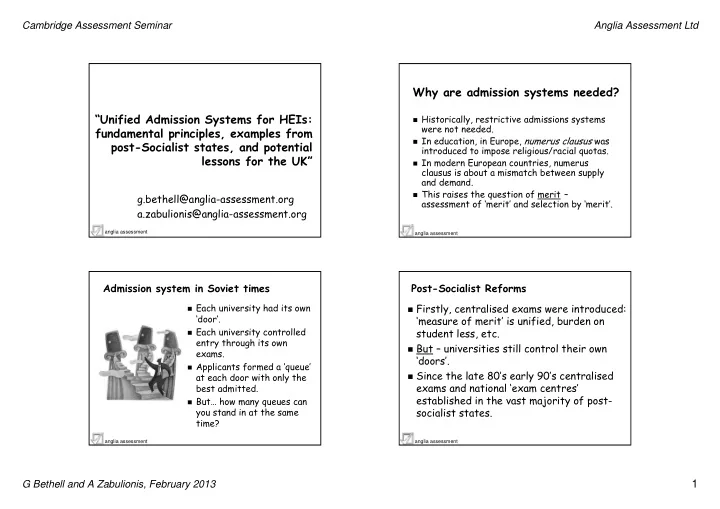
“Unified Admission Systems for HEIs: fundamental principles, examples from post-Socialist states, and potential lessons for the UK”

a.zabulionis@anglia-assessment.org g.bethell@anglia-assessment.org

anglia assessment

Why are admission systems needed?

 Historically, restrictive admissions systems

were not needed.

 In education, in Europe, numerus clausus was

introduced to impose religious/racial quotas.

 In modern European countries, numerus

clausus is about a mismatch between supply and demand.

 This raises the question of merit –

assessment of ‘merit’ and selection by ‘merit’.

anglia assessment

Admission system in Soviet times

 Each university had its own

‘door’.

 Each university controlled

entry through its own exams.

 Applicants formed a ‘queue’

at each door with only the best admitted.

 But… how many queues can

you stand in at the same time?

anglia assessment

Post-Socialist Reforms

 Firstly, centralised exams were introduced:

‘measure of merit’ is unified, burden on student less, etc.

 But – universities still control their own

‘doors’.

 Since the late 80’s early 90’s centralised

exams and national ‘exam centres’ established in the vast majority of post- socialist states.

slide-2
SLIDE 2

Cambridge Assessment Seminar Anglia Assessment Ltd G Bethell and A Zabulionis, February 2013

2

anglia assessment

What is an Admissions System’s function ?

 To allocate the right students to the right

study programmes (courses) at the right universities.

 But what does “right” mean, and from

whose point of view?

Student? University? Society?

anglia assessment

The right course for me is the one I want to study at my preferred university… The right students are the ones that will do best on my course at my university…

anglia assessment

Two alternative views. Firstly…

 The student decides where and what he/she wants to

study and submits an application through University Entrance Commission (or in UK via UCAS).

 The university concerned sets requirements for

applicants (exam results, aptitude tests, school record, work experience…)

 Based on this information, all students applying to this

course are ranked and an ordered list is prepared. The ‘top’ students from this ‘queue’ are invited - as many as there are places available on this course.

 Selected students are invited to formally accept the

university’s ‘invitation to study’.

anglia assessment

Two alternative views. Secondly…

 The student decides where and what he/she wants to

study and submits and application through a Centralised Admissions System (NOT like UCAS).

 Universities may set requirements for applicants

(subject profile, exam results, ‘performance tests’, etc.)

 Based on this information, all students are allocated to

courses according to their wishes and their proficiency (and, of course, the number of places available) – centrally, by the CAS.

 Selected students are invited to formally accept an

‘invitation to study’ on a particular course.

slide-3
SLIDE 3

Cambridge Assessment Seminar Anglia Assessment Ltd G Bethell and A Zabulionis, February 2013

3

anglia assessment

Situation in the UK

 Universities control admissions – UCAS is

(just) an administrative convenience.

 The current process takes so long that

student choices must be severely restricted.

 The bulk of the admissions process takes place

before exam results are known. Hence offers are conditional.

 This leads to perverse outcomes…

anglia assessment

UCAS – ‘choices’

Why ‘5’?

I’m passionate about Computer Science. I don’t care where I study! At least 180 institutions offer courses in this subject. UEA on its own

  • ffers 7 courses with

Computer Science in the title!

Why not?

anglia assessment

UCAS – ‘choices’

There are at least 14 institutions in the UK that

  • ffer Dentistry. Why am I

limited to just four courses?

anglia assessment

UCAS – ‘choices’

I am a brilliant student of

  • Physics. Why can’t I apply to

Cambridge and Oxford? Perhaps if I had to go to Oxford as my second choice it would raise the quality of Physics graduates there?

slide-4
SLIDE 4

Cambridge Assessment Seminar Anglia Assessment Ltd G Bethell and A Zabulionis, February 2013

4

anglia assessment

Conditional offers – part 1 Offers and decisions of applicants

  • Uni. 1
  • Uni. 2
  • Uni. 3
  • Uni. 4
  • Uni. 5

ANN BOB OFFERS In order of preference AAA ABB CCC

  

 

anglia assessment

Conditional offers – part 2 Exam results are released

  • Uni. 1
  • Uni. 2
  • Uni. 3
  • Uni. 4
  • Uni. 5

ANN BOB OFFERS In order of preference AAA ABB CCC

  

 

ABB A*AB Results

anglia assessment

Conditional offers – part 3 Outcomes – Who’s happy? Who’s not?

  • Uni. 1
  • Uni. 2
  • Uni. 3
  • Uni. 4
  • Uni. 5

ANN BOB OFFERS In order of preference AAA ABB CCC

  

 

ABB A*AB Results

anglia assessment

An alternative system next door…

Central Applications Office An LárOifig Iontrála

slide-5
SLIDE 5

Cambridge Assessment Seminar Anglia Assessment Ltd G Bethell and A Zabulionis, February 2013

5

anglia assessment

Choices

Hons.

  • Ord. + Higher Cert.

10 10

anglia assessment

Choices: caveat for applicants

Hons.

  • Ord. + Higher Cert.

10 10

anglia assessment

Scores

Irish Leaving Certificate Exam Six best scores in one sitting

anglia assessment

Example

(Bonus for Higher Level Maths)

slide-6
SLIDE 6

Cambridge Assessment Seminar Anglia Assessment Ltd G Bethell and A Zabulionis, February 2013

6

anglia assessment anglia assessment

So the Irish do use a CAS but…

 the student carries his/her ‘fixed’ score

into the competitions for each of their chosen courses*.

 As this is not the most sophisticated

model available, we call this ‘CAS Lite’.

*There are a few exceptions to this general rule.

anglia assessment

Can we adapt to incorporate university course profiles?

 A student takes A-levels in Maths,

Physics and Biology and applies for different courses.

 Perhaps ‘Astrophysics’ would like to

‘weight’ these scores: (2M+2P+1B)/5

 Perhaps ‘Maths’ would like to ‘weight’

them differently: (3M+1P+1B)/5

 Now the same exam results give the

student different scores for different courses!

anglia assessment

What are the possible consequences for applicants and universities?

slide-7
SLIDE 7

Cambridge Assessment Seminar Anglia Assessment Ltd G Bethell and A Zabulionis, February 2013

7

anglia assessment

Example 2a: Selection on score

Brigit Alan 1st wish / 54 score 2nd wish / 66 score 2nd wish / 56 score University of Manchester 1st wish / 64 score University of Leeds

anglia assessment

Example 2b: Selection on ‘wish’

Brigit Alan 1st wish / 54 score 2nd wish / 66 score 2nd wish / 56 score University of Manchester 1st wish / 64 score University of Leeds

anglia assessment

Example 3a: The 3-applicant case

Charlie Brigit Alan 3rd/49 1st/55 2nd/61 1st/41 2nd/45 University of Nottingham 2nd/51 3rd/59 University of Manchester 1st/65 3rd/69 University of Leeds

anglia assessment

Example 3b: What happens if Charlie removes his third wish?

Charlie Brigit Alan 3rd/49 1st/55 2nd/61 1st/41 2nd/45 University of Nottingham 2nd/51 3rd/59 University of Manchester 1st/65 3rd/69 University of Leeds

slide-8
SLIDE 8

Cambridge Assessment Seminar Anglia Assessment Ltd G Bethell and A Zabulionis, February 2013

8

anglia assessment

Example 3c: the new outcome – everyone moves because Charlie removed his last wish! Strange…

Charlie Brigit Alan 3rd/49 1st/55 2nd/61 1st/41 2nd/45 University of Nottingham 2nd/51 3rd/59 University of Manchester 1st/65 3rd/69 University of Leeds

anglia assessment

Example 3d: for universities?

Charlie Brigit Alan 3rd/49 1st/55 2nd/61 1st/41 2nd/45 University of Nottingham 2nd/51 3rd/59 University of Manchester 1st/65 3rd/69 University of Leeds

anglia assessment

Common Admissions System

Information from Universities Students’ wishes Students’ admission scores Outcomes: Invitations for studies

anglia assessment

Main technical principles

 Fairness – every applicant must be given

proof that all his/her ‘rejected’ higher wishes are impossible (given his/her existing admission scores).

 Uniqueness – must always lead to the same

solution e.g. outcome doesn’t depend on which course or university gets ‘first pick’.

 Finiteness – must finish (and in a reasonable

time )!

slide-9
SLIDE 9

Cambridge Assessment Seminar Anglia Assessment Ltd G Bethell and A Zabulionis, February 2013

9

anglia assessment

Technical principles are OK, but what about the underlying “philosophy”? Priorities?

 How does the technical solution chosen resolve

that strange case with two students? i.e. is this CAS system “applicant-centered” or “leaning towards the side of universities”?

anglia assessment

There are technical algorithms

(supported by well developed mathematical theories) that are able to solve the

common admission problem in both ways – university-centred v. applicant-centred. We would like to show here a simplified example of such a solution with the clear priority on the applicant’s side.

anglia assessment

      U3 U2 U1 w3 w2 w1 A10 w4 w3 w2 w1 A9 w3 w2 w1 A8 w3 w2 w1 A7 w3 w2 w1 A6 w4 w3 w2 w1 A5 w3 w2 w1 A4 w4 w3 w2 w1 A3 w3 w2 w1 A2 w3 w2 w1 A1

Idea of the algorithm

Table of study places Table of applicants

anglia assessment

      U3 U2 U1 w3 w2 w1 A10 w4 w3 w2 w1 A9 w3 w2 w1 A8 w3 w2 w1 A7 w3 w2 w1 A6 w4 w3 w2 w1 A5 w3 w2 w1 A4 w4 w3 w2 w1 A3 w3 w2 w1 A2 w3 w2 w1 A1

Step 1 Idea of the algorithm

Table of study places Table of applicants

slide-10
SLIDE 10

Cambridge Assessment Seminar Anglia Assessment Ltd G Bethell and A Zabulionis, February 2013

10

anglia assessment

A1 A10 A9 A8 A2 A3 A5 A4 A7 A6 U3 U2 U1 w3 w2 w1 A10 w4 w3 w2 w1 A9 w3 w2 w1 A8 w3 w2 w1 A7 w3 w2 w1 A6 w4 w3 w2 w1 A5 w3 w2 w1 A4 w4 w3 w2 w1 A3 w3 w2 w1 A2 w3 w2 w1 A1

Step 1 Idea of the algorithm

Outcome of Step 1

anglia assessment

U3 U2 U1 w3 w2 A10 w4 w3 w2 A9 w3 w2 w1 A8 w3 w2 w1 A7 w3 w2 w1 A6 w4 w3 w2 w1 A5 w3 w2 w1 A4 w4 w3 w2 A3 w3 w2 w1 A2 w3 w2 A1

Step 2 Idea of the algorithm

Table emptied Wishes ‘promoted for ‘unplaced students’

anglia assessment

U3 U2 U1 w3 w2 A10 w4 w3 w2 A9 w3 w2 w1 A8 w3 w2 w1 A7 w3 w2 w1 A6 w4 w3 w2 w1 A5 w3 w2 w1 A4 w4 w3 w2 A3 w3 w2 w1 A2 w3 w2 A1

Step 2 Idea of the algorithm

Fill table again

anglia assessment

A8 A2 A10 A5 A1 A9 A3 A4 A7 A6 U3 U2 U1 w3 w2 A10 w4 w3 w2 A9 w3 w2 w1 A8 w3 w2 w1 A7 w3 w2 w1 A6 w4 w3 w2 w1 A5 w3 w2 w1 A4 w4 w3 w2 A3 w3 w2 w1 A2 w3 w2 A1

Step 2 Idea of the algorithm

slide-11
SLIDE 11

Cambridge Assessment Seminar Anglia Assessment Ltd G Bethell and A Zabulionis, February 2013

11

anglia assessment

U3 U2 U1 w3 w2 A10 w4 w3 w2 A9 w3 w2 w1 A8 w3 w2 w1 A7 w3 w2 w1 A6 w4 w3 w2 w1 A5 w3 w2 w1 A4 w4 w3 w2 A3 w3 w2 w1 A2 w3 w2 A1

Step 3 Idea of the algorithm Step 4 Step 5 ... Step N

anglia assessment

This is not just a theory or a nice, untested idea. Similar CAS systems already operate in...

 Lithuania (run by the Association

  • f Universities)

 Georgia (run by the National

Assessment & Examination Centre)

 Tajikistan (in progress, supported

by WB and Soros foundation)

 More will follow shortly 

anglia assessment

Conclusions

 We need to ask fundamental questions about the

philosophy and principles underpinning the practices used to admit applicants to courses in HE.

 We must be clear as to the purposes of the

admissions system. What, as a society, do we want to achieve? What are our priorities?

 To an outsider (and to many insiders) the UK system

is cumbersome and idiosyncratic. Perhaps the Irish have found the way forward (even if they have stopped a little bit short)?

 What if, say, the Russell Group moved unilaterally to

such a system? What, if anything, would be lost? What would be gained – by applicants, by universities, by society?

anglia assessment

The critical question: Who selects?

 Student selects desired (and

available) study programme at a university of her/his choice.

OR

 University selects, for its own

study programme, the best students from applicants.

slide-12
SLIDE 12

Cambridge Assessment Seminar Anglia Assessment Ltd G Bethell and A Zabulionis, February 2013

12

anglia assessment

www.anglia-assessment.org

anglia assessment

Resources:

 Bethell, G. and Zabulionis, A. ‘The evolution of

high-stakes testing at the school-university interface in the former republics of the USSR’ Assessment in Education, 2012, Vol. 1-19

 Podcast and presentation available at:

http://www.canetwork.org.uk/events/event/high- stakes-testing-at-the-schooluniversity-interface/

 UCAS website www.ucas.ac.uk  Central Applications Office, RI www.cao.ie

anglia assessment

Thank You