Collaborative Mentoring Webinar Series Preparing Mentees & - - PowerPoint PPT Presentation

collaborative mentoring webinar series preparing mentees
SMART_READER_LITE
LIVE PREVIEW

Collaborative Mentoring Webinar Series Preparing Mentees & - - PowerPoint PPT Presentation

Collaborative Mentoring Webinar Series Preparing Mentees & Families for Successful Matches July 21, 2016 2016 Collaborative Mentoring Webinar Series Planning Team The Collaborative Mentoring Webinar Series is funded by the Office of


slide-1
SLIDE 1

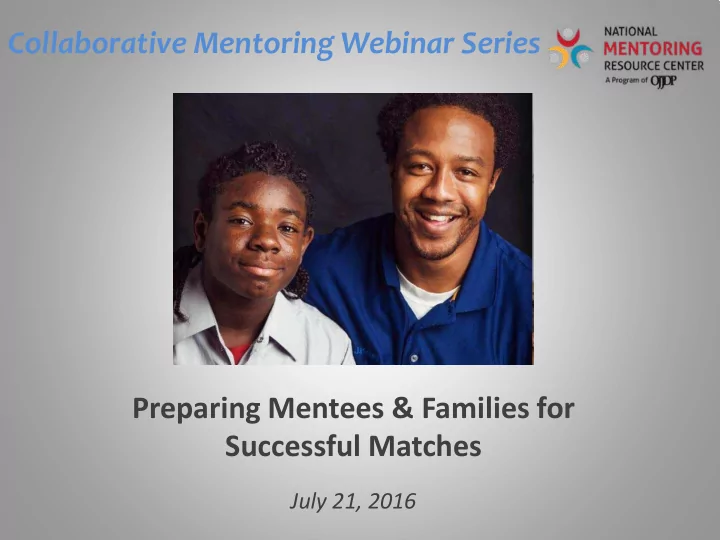
Collaborative Mentoring Webinar Series Preparing Mentees & Families for Successful Matches

July 21, 2016

slide-2
SLIDE 2

Collaborative Mentoring Webinar Series

2016 Collaborative Mentoring Webinar Series Planning Team

The Collaborative Mentoring Webinar Series is funded by the Office of Juvenile Justice and Delinquency Prevention through the National Mentoring Resource Center and facilitated in partnership with MENTOR: The National Mentoring Partnership

slide-3
SLIDE 3

Collaborative Mentoring Webinar Series

Good to Know…

One week after the webinar, all attendees receive an email with:

  • Instructions for how to access PDF of presentation slides and

webinar recording

  • Link to the Collaborative Mentoring Webinar Series webpage,

where all slides, recordings, and resources are posted. Please help us out by answering survey questions at the end of the webinar.

slide-4
SLIDE 4

Collaborative Mentoring Webinar Series

  • All attendees muted for best sound
  • Type questions and comments in

the question box

  • Respond to polls
  • Who is with us today?

Participate in Today’s Webinar

slide-5
SLIDE 5

Collaborative Mentoring Webinar Series

  • Dr. Sarah Schwartz
  • Assistant Professor of

Psychology at Suffolk University

  • Holds a doctorate in

Clinical Psychology and a master’s degree in Education

  • Research focuses on

positive youth development

slide-6
SLIDE 6

Collaborative Mentoring Webinar Series

  • Dr. Dustianne North
  • Has provided training and

technical assistance since 1995

  • Specializes in direct

practice issues as well as community issues

  • Helped to re-establish the

California Mentoring Partnership

slide-7
SLIDE 7

Collaborative Mentoring Webinar Series

Jerry Sherk, M.A.

  • Has worked in the field of

youth mentoring for over 20 years

  • Owner of Mentor

Management Systems

  • Has worked with the

California Mentoring Partnership, NMRC, and the Center for Applied Research Solutions

slide-8
SLIDE 8

Collaborative Mentoring Webinar Series

Today’s Topics

  • The Need for Mentee and Caregiver Preparedness
  • Elements of Effective Practices on Mentee & Family Prep
  • Research on Mentee Preparation and Family Engagement
  • Findings: Youth Initiated Mentoring
  • What is Mentee Preparation?
  • Mentee Training Resources
  • Preparing Parents
  • Resources
slide-9
SLIDE 9

Collaborative Mentoring Webinar Series

Poll: Mentee Preparation

Please describe the level of attention your program gives to preparing mentees and families for matches

slide-10
SLIDE 10

Collaborative Mentoring Webinar Series

Why a Training on Mentee & Family Prep? Many programs indicate: “Mentee training is something we want to do, but we haven’t gotten there yet.”

slide-11
SLIDE 11

Collaborative Mentoring Webinar Series

Why Prepare Mentees?

  • Mentee safety is #1

– Safety and well-being of mentors – Reduce liability for the organization & mentors

  • Clarity of roles and expectations
  • Better mentee commitment/motivation
  • Teach mentees healthy relationship skills and

increase their agency in their matches

  • Better match outcomes
slide-12
SLIDE 12

Collaborative Mentoring Webinar Series

Why Prepare Families?

  • Caregiver engagement is under-emphasized or

difficult to achieve in many programs

  • Caregiver engagement can support better
  • utcomes for matches and mentees

To more effectively engage families, set the tone early!

slide-13
SLIDE 13

Collaborative Mentoring Webinar Series

Elements of Effective Practices: 4th Ed.: Preparing Mentees & Families

Recruitment and Screening:

  • Program engages in recruitment strategies that realistically

portray the benefits, practices, supports--and challenges of being mentored in the program.

  • Program has established criteria for accepting youth into

the program as well as criteria that would disqualify a potential participant.

  • Parents/mentees agree in writing the minimum frequency

and duration requirements.

slide-14
SLIDE 14

Collaborative Mentoring Webinar Series

Elements of Effective Practices: 4th Ed.: Preparing Mentees, Families (Cont’d) Training and Matching:

  • Program provides mentee trainings on a variety of topics,

including risk management.

  • Program provides training for parents on a variety of

topics, including risk management.

  • Program arranges an initial meeting between the mentor

and mentee, & include parents, when possible.

  • Mentor, mentee, program staff member, and parent (when

possible), meet in person to sign an agreement consenting to program rules—frequency, intensity and duration of meetings; roles of each person; frequency of contact with program; and risk management policies.

slide-15
SLIDE 15

http://www.mentoring.org/new-site/wp- content/uploads/2015/10/Final_Elements_Checklist_Fourth.pdf

slide-16
SLIDE 16

Collaborative Mentoring Webinar Series

Template for Applications Contracts, Forms, Letters

Google: “Generic Mentoring Program Policy and Procedure Manual” Also contains a starting point for developing policies and procedures in the six core areas:

slide-17
SLIDE 17

Collaborative Mentoring Webinar Series

Different Situations, Different Strategies

  • Models (e.g., 1:1, group, team)
  • Age of mentees
  • Mentee onboarding (groups or 1 at a time)
  • Special needs (e.g. foster youth, juvenile justice

involved, disabilities)

  • Program focus (college bound, technology,
  • utdoors/nature, photography, etc.)
  • Voluntary vs mandated mentees
slide-18
SLIDE 18

Collaborative Mentoring Webinar Series

Research: Mentee Preparation

  • Little existing research on mentee prep for youth

mentoring

  • More attention in adult professional mentoring
  • Mentioned in studies addressing cultural

responsivity in mentoring (Pinkerton, 2001; Kochan, 2013)

  • New findings: Youth Initiated Mentoring, Dr.

Sarah Schwartz

slide-19
SLIDE 19

Collaborative Mentoring Webinar Series

Research: Family Engagement

  • Parent involvement de-emphasized in favor of dyad

– Parents are often seen by staff as a barrier è mentors become wary of parent interaction

(Basualdo-Delmonico and Spencer, 2016)

  • Yet caregiver engagement may support better
  • utcomes for matches and mentees

(Basualdo-Delmonico and Spencer, 2016; Higginbotham , MacArthur, & Dart, 2010)

  • Class, race differences between mentors and families

make respecting and involving parents even more important

(Basualdo-Delmonico and Spencer, 2016)

slide-20
SLIDE 20

Collaborative Mentoring Webinar Series

A New Model of Mentoring

Natural Mentoring Formal Mentoring Youth Initiated Mentoring

slide-21
SLIDE 21

Collaborative Mentoring Webinar Series

Connected Scholars Program

Intervention: Group-based workshops teaching adolescents to recruit academic and career mentors

slide-22
SLIDE 22

Collaborative Mentoring Webinar Series

Some Barriers to Connection

  • “I just try to figure things myself, and if I can’t, I

don’t know, I just leave it the way it is...”

  • “I feel like it would be kind of like disrespectful to

go talk to somebody else about your personal problem instead of like your family. It would be like, telling them that like you don’t have that much trust in them.”

slide-23
SLIDE 23

Collaborative Mentoring Webinar Series

  • “I learned that it’s good to go out and make

connections, because even if you don’t need them now, as long as you keep in touch with the person, you never know what might come up in the future.”

  • “I always used to be the guy who just sits around,

‘cause I didn’t like approaching people...So now I’m like, ‘I should go for it’...cause...you’re always gonna need somebody there to help you, somebody by your side, somebody who always has your back.”

  • “I’m more likely to want to look for a mentor.”

Changes in Knowledge, Attitudes & Skills

slide-24
SLIDE 24

Collaborative Mentoring Webinar Series

Changes in Knowledge, Attitudes & Skills

  • “[The workshop] made me learn the skills I

needed to communicate more and stay more in contact with somebody.”

  • “Like when I email [program staff], I say ‘thank

you very much for all the support that you give me throughout the project...’”

  • “There’s steps like you gotta go through to keep

that relationship going.”

slide-25
SLIDE 25

Collaborative Mentoring Webinar Series

Implications for Mentee Training

slide-26
SLIDE 26

Collaborative Mentoring Webinar Series

Q&A for all Panelists

Type your questions in the question box:

slide-27
SLIDE 27

Collaborative Mentoring Webinar Series

What is Mentee Preparation?

Steps and Processes:

  • Begins with first contact
  • Individual intake process: orient and guide
  • Group orientations and trainings for mentees
  • Matching and match initiation

Strategies for modeling healthy relationships:

  • Staff interactions with mentees
  • Thoughtful intake process
  • Formal training and activities
  • Program structures throughout the match
slide-28
SLIDE 28

Collaborative Mentoring Webinar Series

Mentee Training

  • Make sure all program operations, policies

and procedures, contracts, etc. are in place

  • Assess your objectives

– Safety, motivation, normalization, accountability

  • Age appropriate
  • Group or solo trainings
  • Length of initial trainings
slide-29
SLIDE 29

Collaborative Mentoring Webinar Series

Sample Mentee Training Agenda

slide-30
SLIDE 30

Collaborative Mentoring Webinar Series

Training Exercises

slide-31
SLIDE 31

Collaborative Mentoring Webinar Series

Launching the Relationship

Each item weighs 30 lbs

  • Listens to me
  • Good sense of humor
  • Other ______________

Each item weighs 20 lbs

  • Helps me with homework
  • Is open to new ideas...

Each item weighs 10 lbs

  • Has cool clothes
  • Has a car...

From “Training New Mentees”

slide-32
SLIDE 32

Collaborative Mentoring Webinar Series

Individual Mentee Trainings

  • Often done when mentee intakes are done

sporadically

  • Cover the same basic information as in a

group session, but can be done more quickly

  • Can use same exercises: E.g., “Build an Ideal

Mentor,” “Mentors in My Life.”

  • Provides a chance for the mentee to open,

and staff to make a connection with them.

slide-33
SLIDE 33

Collaborative Mentoring Webinar Series

Parent Engagement From the Start!

Getting Parents Onboard:

  • Make selection to program a positive: “Your daughter has

been selected because of her potential for leadership…”

  • Give them a clear understanding of what mentoring is

and is not (not a replacement parent)

  • Ask them to enourage their son or daughter to follow

through with their commitment

  • Create and communicate specific avenues for them to

engage

  • Consider the whole family, but emphasize the dyad
slide-34
SLIDE 34

Collaborative Mentoring Webinar Series

Q&A for all Panelists

Type your questions in the question box:

slide-35
SLIDE 35

Collaborative Mentoring Webinar Series

Additional Resources

slide-36
SLIDE 36

Collaborative Mentoring Webinar Series

Additional Resources

National Mentoring Resource Center Apply for no-cost help for your mentoring program at www.nationalmentoringresourcecenter.org, an online resource funded by the Office of Juvenile Justice and Delinquency Prevention and facilitated in partnership with MENTOR Mentoring Connector Recruit mentors by submitting your program to the Mentoring Connector (previously called the VRS) https://connect.mentoring.org/admin

slide-37
SLIDE 37

Collaborative Mentoring Webinar Series

Research References

Basualdo-Delmonico, A. M. and Spencer, R. (2016). A parent's place: Parents', mentors' and program staff members' expectations for and experiences of parental involvement in community-based youth mentoring relationships. Children and Youth Services Review, 61, issue C, p. 6-14, http://EconPapers.repec.org/RePEc:eee:cysrev:v:61:y:2016:i:c:p:6-14. Higginbotham, B.J., MacArthur, S., and Dart, P.C. (2010). 4-H Mentoring: Youth and Families with Promise—Adult Engagement and the Development of Strengths in

  • Youth. Journal of Prevention & Intervention in the Community, 38:3, 229-243, DOI:

10.1080/10852352.2010.486300 Kochan , F. (2013). Analyzing the Relationships Between Culture and Mentoring, Mentoring & Tutoring. Partnership in Learning, 21:4, 412-430, DOI 10.1080/13611267.2013.855862 Pinkerton, J. (2011). Constructing a global understanding of the social ecology of leaving out of home care. Children and Youth Services Review, 33(12), 2412-2416.

slide-38
SLIDE 38

Collaborative Mentoring Webinar Series

Remember…

After the webinar:

  • Please help us out by answering survey questions at

the end of the webinar.

  • Everyone will get an email with information on how to

download the slides, recording, and resources on the CMWS webpage on the MENTOR website: http://www.mentoring.org/program_resources/training_o pportunities/collaborative_mentoring_webinar_series/

slide-39
SLIDE 39

Collaborative Mentoring Webinar Series

Stay Connected

  • Email us at collaborativewebinarseries@mentoring.org
  • Tweet with hashtag #MentoringWebinar
  • Visit our webpage on the MENTOR website for past and upcoming webinars:
slide-40
SLIDE 40

Collaborative Mentoring Webinar Series

Matching August 18, 2016 1 - 2:15 pm Eastern

Join Us Next Month!