Collaborative data resources TIPharma PKPD modeling platform - - PowerPoint PPT Presentation
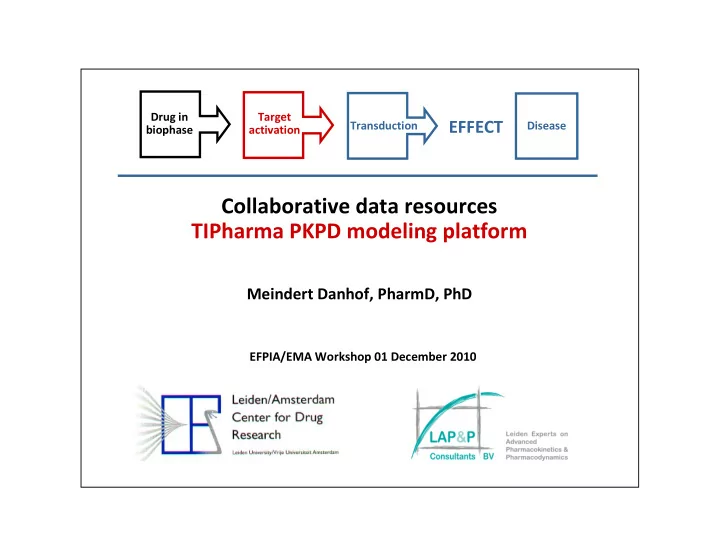
Drug in Target EFFECT Transduction Disease biophase activation Collaborative data resources TIPharma PKPD modeling platform Meindert Danhof, PharmD, PhD EFPIA/EMA Workshop 01 December 2010 Quantitative systems pharmacology utility of
Drug Dosing Pharmacology Exposure Response Disease Progression
Biological system
Outcome Efficacy Safety
Species Subject
Between system variation
Stationarity E-factors
Within system variation
Quantitative systems pharmacology utility of collaborative data resources
TI Pharma mechanism-based PKPD modeling platform the objective
Development and implementation of a mechanism-based PKPD modeling platform as the scientific basis for rational drug discovery and innovation
- Database of ‘biological system specific’ ..
…information
- Mechanism-based PKPD model library
- University-industry consortium with 4 academic and 8
industrial partners
- Dedicated infrastructure for data management, data
analysis and reporting: sharing of data, models and biological system specific information
- Emphasis on key factors in the discovery/development
and the clinical application of novel drugs
– Translational pharmacology (efficacy and safety) – Developmental pharmacology (pediatrics, elderly) – Disease system analysis (osteoporosis, COPD)
TI Pharma mechanism-based PKPD modeling platform the organization
- Development of mechanism-based PK-PD models on
basis of existing data
- Strict data access restrictions
- Centralized computing network facility for data
management and analysis
- Model library interface for users
TI Pharma mechanism-based PKPD modeling platform the operation
Data Data Data Draft Model
Pooled Data
Publication
Partner: Platform: Manager: Modeler: Partner: Public domain:
Final Model
TI Pharma mechanism-based PK-PD modeling platform the information flow
Data analysis
TI Pharma mechanism-based PK-PD modeling platform the database system
Drug N Dose Variables used for modelling & simulation and sampling scheme Moxifloxacin
- 4
3, 10, 30 mg/kg Clock time, RR, QT over 24 h plasma PK from literature
- 137
400mg Clock time, RR, QT, plasma PK over 24 h Sotalol
- 4
4, 8 mg/kg Clock time, RR, QT over 48h, plasma PK literature
- 30
160 mg Clock time, RR, QT, plasma PK over 24 h Cisapride
- 4
0.6, 2, 6 mg/kg Clock time, RR, QT, plasma PK over 24 h, plasma PK from literature
- 24
10, 20, 40, 80 mg Clock time, RR, QT, plasma PK over 24 h NCE
- 4
1.5 μg Clock time, RR, QT, plasma PK over 24 h,
- 24
1.5 μg Clock time, RR, QT, plasma PK over 24 h
Prediction of pharmacology in man cardiovascular safety
Animal to human extrapolation of in vivo concentration-effect relations
Translational slope drug effect in conscious dogs vs. clinical studies QTc slope for clinical studies QTc slope for conscious dog studies
0.08 0.06 0.04 0.02 0.00 0.00 0.02 0.04 0.06 0.08
moxifloxacin sotalol cisapride
Indentifying the animal to human translation function for QTc interval prolongation
- ther compounds
test compound
“Rotterdam study”
- Baseline = sex; linear increase with age
- Co-morbidities = heart failure, MI, diabetes
- Co-medication = anti-arrhythmics
- Between subject variability
Prediction of cardiovascular risk in real life situations not in trial simulation
QTc = baseline + drug effect + co-morbidities + co-medications + ε
Drug effect QTc = QT0 x RRα · (1 + A · cos(2π/24 · (clocktime – φ)) + slope · C)
Prediction of cardiovascular risk in real life situations not in trial simulation
- !
!
- !
!
- "
"
- !
!
- "
"
- ""#
""#
- !
!
- !
!
- ""#
""#
- !
!
#$%&'( #$%&'(
- Not in trial simulation to predict natural variation in QTc
in the target population
- Analyze relationship between variation in QTc and
cardiovascular risk in the target population – Delta analysis – Threshold analysis
- Develop and incorporate cardiovascular risk prediction
model
Prediction of cardiovascular risk from ECG findings to sudden cardiac death
Prediction of cardiovascular risk
Quantitative Systems Pharmacology utility of collaborative data resources
Interspecies variation Time variant changes Disease progression Clinical trials Clinical
- utcome
Drug treatment Non- stationarity Disease progression Clinical trials Clinical
- utcome
The concepts
- Physiologically-based PK modeling
- Mechanism-based PD modeling
- Disease system analysis
- Clinical trial simulation
- Epidemiology
The data
- Public data bases
- Proprietary data bases
- NEW data
- !
)
- Drug & Disease Model Resource (DDMoRe)