Cold planar horizons are floppy Jorge E. Santos New frontiers in - - PowerPoint PPT Presentation

cold planar horizons are floppy
SMART_READER_LITE
LIVE PREVIEW

Cold planar horizons are floppy Jorge E. Santos New frontiers in - - PowerPoint PPT Presentation

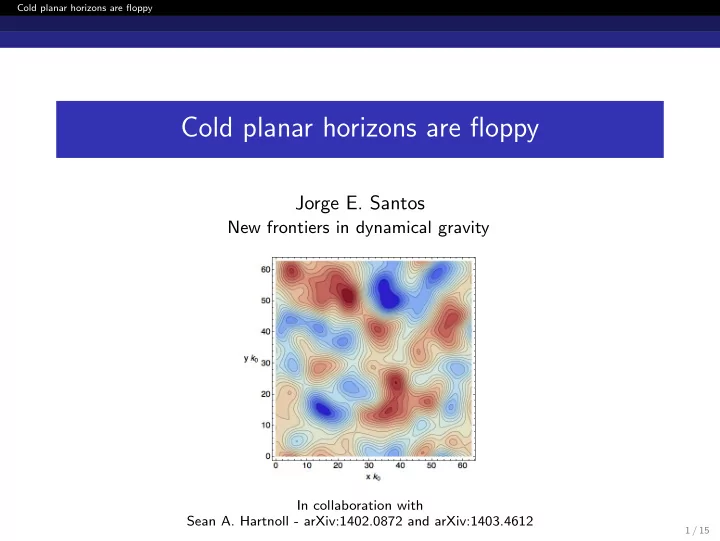
Cold planar horizons are floppy Cold planar horizons are floppy Jorge E. Santos New frontiers in dynamical gravity In collaboration with Sean A. Hartnoll - arXiv:1402.0872 and arXiv:1403.4612 1 / 15 Cold planar horizons are floppy Motivation

slide-1
SLIDE 1

Cold planar horizons are floppy

Cold planar horizons are floppy

Jorge E. Santos

New frontiers in dynamical gravity

In collaboration with Sean A. Hartnoll - arXiv:1402.0872 and arXiv:1403.4612

1 / 15

slide-2
SLIDE 2

Cold planar horizons are floppy

Motivation

The AdS/CFT correspondence maps asymptotically AdS solutions of Einsteins’ equations to states of a dual conformal field theory.

2 / 15

slide-3
SLIDE 3

Cold planar horizons are floppy

Motivation

The AdS/CFT correspondence maps asymptotically AdS solutions of Einsteins’ equations to states of a dual conformal field theory. Near horizon geometries of AdS black holes describe the low energy dissipative dynamics of strongly interacting QFTs.

2 / 15

slide-4
SLIDE 4

Cold planar horizons are floppy

Motivation

The AdS/CFT correspondence maps asymptotically AdS solutions of Einsteins’ equations to states of a dual conformal field theory. Near horizon geometries of AdS black holes describe the low energy dissipative dynamics of strongly interacting QFTs. Near horizon geometries of extremal planar black holes capture the dissipative dynamics of novel phases of T = 0 quantum matter.

2 / 15

slide-5
SLIDE 5

Cold planar horizons are floppy

Motivation

The AdS/CFT correspondence maps asymptotically AdS solutions of Einsteins’ equations to states of a dual conformal field theory. Near horizon geometries of AdS black holes describe the low energy dissipative dynamics of strongly interacting QFTs. Near horizon geometries of extremal planar black holes capture the dissipative dynamics of novel phases of T = 0 quantum matter. Extensive classification exists for translational invariant systems.

2 / 15

slide-6
SLIDE 6

Cold planar horizons are floppy

Motivation

The AdS/CFT correspondence maps asymptotically AdS solutions of Einsteins’ equations to states of a dual conformal field theory. Near horizon geometries of AdS black holes describe the low energy dissipative dynamics of strongly interacting QFTs. Near horizon geometries of extremal planar black holes capture the dissipative dynamics of novel phases of T = 0 quantum matter. Extensive classification exists for translational invariant systems. A more realistic model needs to account for a ubiquitous property of CMT systems: breaking translational invariance.

2 / 15

slide-7
SLIDE 7

Cold planar horizons are floppy

Motivation

The AdS/CFT correspondence maps asymptotically AdS solutions of Einsteins’ equations to states of a dual conformal field theory. Near horizon geometries of AdS black holes describe the low energy dissipative dynamics of strongly interacting QFTs. Near horizon geometries of extremal planar black holes capture the dissipative dynamics of novel phases of T = 0 quantum matter. Extensive classification exists for translational invariant systems. A more realistic model needs to account for a ubiquitous property of CMT systems: breaking translational invariance. What this talk is not:

2 / 15

slide-8
SLIDE 8

Cold planar horizons are floppy

Motivation

The AdS/CFT correspondence maps asymptotically AdS solutions of Einsteins’ equations to states of a dual conformal field theory. Near horizon geometries of AdS black holes describe the low energy dissipative dynamics of strongly interacting QFTs. Near horizon geometries of extremal planar black holes capture the dissipative dynamics of novel phases of T = 0 quantum matter. Extensive classification exists for translational invariant systems. A more realistic model needs to account for a ubiquitous property of CMT systems: breaking translational invariance. What this talk is not: ∂x is broken explicitly in all matter sectors.

2 / 15

slide-9
SLIDE 9

Cold planar horizons are floppy

Motivation

The AdS/CFT correspondence maps asymptotically AdS solutions of Einsteins’ equations to states of a dual conformal field theory. Near horizon geometries of AdS black holes describe the low energy dissipative dynamics of strongly interacting QFTs. Near horizon geometries of extremal planar black holes capture the dissipative dynamics of novel phases of T = 0 quantum matter. Extensive classification exists for translational invariant systems. A more realistic model needs to account for a ubiquitous property of CMT systems: breaking translational invariance. What this talk is not: ∂x is broken explicitly in all matter sectors. For other setups recall Jerome’s talk.

2 / 15

slide-10
SLIDE 10

Cold planar horizons are floppy

Motivation

The AdS/CFT correspondence maps asymptotically AdS solutions of Einsteins’ equations to states of a dual conformal field theory. Near horizon geometries of AdS black holes describe the low energy dissipative dynamics of strongly interacting QFTs. Near horizon geometries of extremal planar black holes capture the dissipative dynamics of novel phases of T = 0 quantum matter. Extensive classification exists for translational invariant systems. A more realistic model needs to account for a ubiquitous property of CMT systems: breaking translational invariance. What this talk is not: ∂x is broken explicitly in all matter sectors. For other setups recall Jerome’s talk. What I am going to describe doesn’t happen in such setups.

2 / 15

slide-11
SLIDE 11

Cold planar horizons are floppy Outline

1 The Einstein-Maxwell system 2 Breakdown of Perturbation theory 3 Zero Temperature Numerics 4 Results 5 What about AdS4? 6 Conclusion & Outlook

3 / 15

slide-12
SLIDE 12

Cold planar horizons are floppy The Einstein-Maxwell system

The bulk theory we study is governed by the Lagrangian

S = 1 16πGd

  • ddx √−g
  • R + (d − 1)(d − 2)

L2 − 1 2F abFab

  • ,

where F = dA and L is the AdSd length scale.

4 / 15

slide-13
SLIDE 13

Cold planar horizons are floppy The Einstein-Maxwell system

The bulk theory we study is governed by the Lagrangian

S = 1 16πGd

  • ddx √−g
  • R + (d − 1)(d − 2)

L2 − 1 2F abFab

  • ,

where F = dA and L is the AdSd length scale. Comments:

4 / 15

slide-14
SLIDE 14

Cold planar horizons are floppy The Einstein-Maxwell system

The bulk theory we study is governed by the Lagrangian

S = 1 16πGd

  • ddx √−g
  • R + (d − 1)(d − 2)

L2 − 1 2F abFab

  • ,

where F = dA and L is the AdSd length scale. Comments: Field content: gravity and Maxwell field

4 / 15

slide-15
SLIDE 15

Cold planar horizons are floppy The Einstein-Maxwell system

The bulk theory we study is governed by the Lagrangian

S = 1 16πGd

  • ddx √−g
  • R + (d − 1)(d − 2)

L2 − 1 2F abFab

  • ,

where F = dA and L is the AdSd length scale. Comments: Field content: gravity and Maxwell field Consider solutions in the Poincar´ e patch with fixed boundary metric

ds2

∂ = −dt2 + dx2 + dw2

4 / 15

slide-16
SLIDE 16

Cold planar horizons are floppy The Einstein-Maxwell system

The bulk theory we study is governed by the Lagrangian

S = 1 16πGd

  • ddx √−g
  • R + (d − 1)(d − 2)

L2 − 1 2F abFab

  • ,

where F = dA and L is the AdSd length scale. Comments: Field content: gravity and Maxwell field Consider solutions in the Poincar´ e patch with fixed boundary metric

ds2

∂ = −dt2 + dx2 + dw2

Translational invariance is explicitly broken via the boundary behaviour of At:

At(x, w, y) = µ(x, w) + ρ(x, w) y + . . .

4 / 15

slide-17
SLIDE 17

Cold planar horizons are floppy The Einstein-Maxwell system

The bulk theory we study is governed by the Lagrangian

S = 1 16πGd

  • ddx √−g
  • R + (d − 1)(d − 2)

L2 − 1 2F abFab

  • ,

where F = dA and L is the AdSd length scale. Comments: Field content: gravity and Maxwell field Consider solutions in the Poincar´ e patch with fixed boundary metric

ds2

∂ = −dt2 + dx2 + dw2

Translational invariance is explicitly broken via the boundary behaviour of At:

At(x, w, y) = µ(x, w) + ρ(x, w) y + . . .

Focus on d = 4, with µ(x) = ¯ µ [1 + A0 cos(kLx)].

4 / 15

slide-18
SLIDE 18

Cold planar horizons are floppy The Einstein-Maxwell system

The bulk theory we study is governed by the Lagrangian

S = 1 16πGd

  • ddx √−g
  • R + (d − 1)(d − 2)

L2 − 1 2F abFab

  • ,

where F = dA and L is the AdSd length scale. Comments: Field content: gravity and Maxwell field Consider solutions in the Poincar´ e patch with fixed boundary metric

ds2

∂ = −dt2 + dx2 + dw2

Translational invariance is explicitly broken via the boundary behaviour of At:

At(x, w, y) = µ(x, w) + ρ(x, w) y + . . .

Focus on d = 4, with µ(x) = ¯ µ [1 + A0 cos(kLx)]. Moduli space space of solutions is 2D: A0 and k0 ≡ kL/¯ µ.

4 / 15

slide-19
SLIDE 19

Cold planar horizons are floppy Breakdown of Perturbation theory

An infamous solution:

5 / 15

slide-20
SLIDE 20

Cold planar horizons are floppy Breakdown of Perturbation theory

An infamous solution: Study time independent perturbations of extremal RN:

ds2 = L2 y2

  • −G(y)(1 − y)2dt2 +

dy2 G(y)(1 − y)2 + dx2 + dw2

  • ,

A = L √ 6 (1 − y)dt ,

with G(y) = 1 + 2y + 3y2 and δAt(0, x) = L

√ 6 A0 cos(kLx).

5 / 15

slide-21
SLIDE 21

Cold planar horizons are floppy Breakdown of Perturbation theory

An infamous solution: Study time independent perturbations of extremal RN:

ds2 = L2 y2

  • −G(y)(1 − y)2dt2 +

dy2 G(y)(1 − y)2 + dx2 + dw2

  • ,

A = L √ 6 (1 − y)dt ,

with G(y) = 1 + 2y + 3y2 and δAt(0, x) = L

√ 6 A0 cos(kLx).

Possible to do analytically, but not illuminating.

5 / 15

slide-22
SLIDE 22

Cold planar horizons are floppy Breakdown of Perturbation theory

An infamous solution: Study time independent perturbations of extremal RN:

ds2 = L2 y2

  • −G(y)(1 − y)2dt2 +

dy2 G(y)(1 − y)2 + dx2 + dw2

  • ,

A = L √ 6 (1 − y)dt ,

with G(y) = 1 + 2y + 3y2 and δAt(0, x) = L

√ 6 A0 cos(kLx).

Possible to do analytically, but not illuminating. Instead, take near horizon limit: t = τ/ε , y = 1 − ερ/6 with ε → 0.

5 / 15

slide-23
SLIDE 23

Cold planar horizons are floppy Breakdown of Perturbation theory

An infamous solution: Study time independent perturbations of extremal RN:

ds2 = L2 y2

  • −G(y)(1 − y)2dt2 +

dy2 G(y)(1 − y)2 + dx2 + dw2

  • ,

A = L √ 6 (1 − y)dt , (1)

with G(y) = 1 + 2y + 3y2 and δAt(0, x) = L

√ 6 A0 cos(kLx).

Possible to do analytically, but not illuminating. Instead, take near horizon limit: t = τ/ε , y = 1 − ερ/6 with ε → 0. Brings line element (1) to

ds2 = L2 1 6

  • −ρ2dτ 2 + dρ2

ρ2

  • + dx2 + dw2
  • ,

A = L ρ √ 6 dτ .

5 / 15

slide-24
SLIDE 24

Cold planar horizons are floppy Breakdown of Perturbation theory

Dream: Study finite size time independent perturbations about pure AdS2 × R2 - if a breakdown occurs, likely to be universal, since it

  • nly depends on near horizon geometry.

6 / 15

slide-25
SLIDE 25

Cold planar horizons are floppy Breakdown of Perturbation theory

Dream: Study finite size time independent perturbations about pure AdS2 × R2 - if a breakdown occurs, likely to be universal, since it

  • nly depends on near horizon geometry.

Start with AdS2 × R2 written in Poincar´ e-like coordinates ds2 = L2

2

  • −ρ2dτ 2 + dρ2

ρ2

  • + L2dx2 + L2dw2

and A = L2 ρ dτ .

6 / 15

slide-26
SLIDE 26

Cold planar horizons are floppy Breakdown of Perturbation theory

Dream: Study finite size time independent perturbations about pure AdS2 × R2 - if a breakdown occurs, likely to be universal, since it

  • nly depends on near horizon geometry.

Start with AdS2 × R2 written in Poincar´ e-like coordinates ds2 = L2

2

  • −ρ2dτ 2 + dρ2

ρ2

  • + L2dx2 + L2dw2

and A = L2 ρ dτ , where L2 ≡ L/

√ 6, and ρ = 0 is the horizon location.

6 / 15

slide-27
SLIDE 27

Cold planar horizons are floppy Breakdown of Perturbation theory

Dream: Study finite size time independent perturbations about pure AdS2 × R2 - if a breakdown occurs, likely to be universal, since it

  • nly depends on near horizon geometry.

Start with AdS2 × R2 written in Poincar´ e-like coordinates ds2 = L2

2

  • −ρ2dτ 2 + dρ2

ρ2

  • + L2dx2 + L2dw2

and A = L2 ρ dτ , where L2 ≡ L/

√ 6, and ρ = 0 is the horizon location.

Solve for the Kodama-Ishibashi variable: Φ(1)

− (ρ, x) = ˜

γ cos(kLx)ρν−(kL) where ν−(kL) =

  • 1

2 −

  • k2

L

3 + 1 2 − k2

L

6 − 1 2 > 0 .

6 / 15

slide-28
SLIDE 28

Cold planar horizons are floppy Breakdown of Perturbation theory

Dream: Study finite size time independent perturbations about pure AdS2 × R2 - if a breakdown occurs, likely to be universal, since it

  • nly depends on near horizon geometry.

Start with AdS2 × R2 written in Poincar´ e-like coordinates ds2 = L2

2

  • −ρ2dτ 2 + dρ2

ρ2

  • + L2dx2 + L2dw2

and A = L2 ρ dτ , where L2 ≡ L/

√ 6, and ρ = 0 is the horizon location.

Solve for the Kodama-Ishibashi variable: Φ(1)

− (ρ, x) = ˜

γ cos(kLx)ρν−(kL) . Third order Kodama-Ishibashi variable grows faster than first order: Φ(3)

− (ρ, x) = . . . + ˜

β(ν−) δL2 ρν−(kL) log ρ cos(kLx) + . . .

6 / 15

slide-29
SLIDE 29

Cold planar horizons are floppy Breakdown of Perturbation theory

Dream: Study finite size time independent perturbations about pure AdS2 × R2 - if a breakdown occurs, likely to be universal, since it

  • nly depends on near horizon geometry.

Start with AdS2 × R2 written in Poincar´ e-like coordinates ds2 = L2

2

  • −ρ2dτ 2 + dρ2

ρ2

  • + L2dx2 + L2dw2

and A = L2 ρ dτ , where L2 ≡ L/

√ 6, and ρ = 0 is the horizon location.

Solve for the Kodama-Ishibashi variable: Φ(1)

− (ρ, x) = ˜

γ cos(kLx)ρν−(kL) . Third order Kodama-Ishibashi variable grows faster than first order: Φ(3)

− (ρ, x) = . . . + ˜

β(ν−) δL2 ρν−(kL) log ρ cos(kLx) + . . . Breakdown of perturbation theory - resumm perturbation theory.

6 / 15

slide-30
SLIDE 30

Cold planar horizons are floppy Breakdown of Perturbation theory

A tale of two resummations:

Preserving AdS2 × R2:

7 / 15

slide-31
SLIDE 31

Cold planar horizons are floppy Breakdown of Perturbation theory

A tale of two resummations:

Preserving AdS2 × R2: Promote ν− to be a function of ˜ γ2, in such a way that the expansion cancels the log.

7 / 15

slide-32
SLIDE 32

Cold planar horizons are floppy Breakdown of Perturbation theory

A tale of two resummations:

Preserving AdS2 × R2: Promote ν− to be a function of ˜ γ2, in such a way that the expansion cancels the log. Similar to the construction of Geons where ω is promoted to be a function of ε.

7 / 15

slide-33
SLIDE 33

Cold planar horizons are floppy Breakdown of Perturbation theory

A tale of two resummations:

Preserving AdS2 × R2: Promote ν− to be a function of ˜ γ2, in such a way that the expansion cancels the log. Similar to the construction of Geons where ω is promoted to be a function of ε. For kL ≪ 1, ν− dangerously approaches 0 as k4

L - exponent

might become negative ⇒ lattice relevant in IR.

7 / 15

slide-34
SLIDE 34

Cold planar horizons are floppy Breakdown of Perturbation theory

A tale of two resummations:

Preserving AdS2 × R2: Promote ν− to be a function of ˜ γ2, in such a way that the expansion cancels the log. Similar to the construction of Geons where ω is promoted to be a function of ε. For kL ≪ 1, ν− dangerously approaches 0 as k4

L - exponent

might become negative ⇒ lattice relevant in IR. Destroying AdS2 × R2:

7 / 15

slide-35
SLIDE 35

Cold planar horizons are floppy Breakdown of Perturbation theory

A tale of two resummations:

Preserving AdS2 × R2: Promote ν− to be a function of ˜ γ2, in such a way that the expansion cancels the log. Similar to the construction of Geons where ω is promoted to be a function of ε. For kL ≪ 1, ν− dangerously approaches 0 as k4

L - exponent

might become negative ⇒ lattice relevant in IR. Destroying AdS2 × R2: Add the following third order term: η(ν−)ρν−x sin(kLx) .

7 / 15

slide-36
SLIDE 36

Cold planar horizons are floppy Breakdown of Perturbation theory

A tale of two resummations:

Preserving AdS2 × R2: Promote ν− to be a function of ˜ γ2, in such a way that the expansion cancels the log. Similar to the construction of Geons where ω is promoted to be a function of ε. For kL ≪ 1, ν− dangerously approaches 0 as k4

L - exponent

might become negative ⇒ lattice relevant in IR. Destroying AdS2 × R2: Add the following third order term: η(ν−)ρν−x sin(kLx) , where η(ν−) can be chosen to cancel the diverging log.

7 / 15

slide-37
SLIDE 37

Cold planar horizons are floppy Breakdown of Perturbation theory

A tale of two resummations:

Preserving AdS2 × R2: Promote ν− to be a function of ˜ γ2, in such a way that the expansion cancels the log. Similar to the construction of Geons where ω is promoted to be a function of ε. For kL ≪ 1, ν− dangerously approaches 0 as k4

L - exponent

might become negative ⇒ lattice relevant in IR. Destroying AdS2 × R2: Add the following third order term: η(ν−)ρν−x sin(kLx) . Close to x = 0, perturbation theory is saved, however away from x = 0 perturbation theory breaks down!

7 / 15

slide-38
SLIDE 38

Cold planar horizons are floppy Breakdown of Perturbation theory

How to decide which is which? Proceed without any approximation - Numerics.

8 / 15

slide-39
SLIDE 39

Cold planar horizons are floppy Zero Temperature Numerics

Ansetzen & Numerics

Most general line element, without any gauge choice, and compatible with our symmetries takes the following form

ds2 = L2 y2

  • −(1 − y)2 G(y)Adt2 +

B (1 − y)2 G(y)(dy + F dx)2 + S1dx2 + S2dw2

  • A = L

√ 6 (1 − y) P dt . where G(y) = 1 + 2y + 3y2. For A = B = S1 = S2 = P = 1 and F = 0 it reduces to extreme RN black hole.

9 / 15

slide-40
SLIDE 40

Cold planar horizons are floppy Zero Temperature Numerics

Ansetzen & Numerics

Most general line element, without any gauge choice, and compatible with our symmetries takes the following form

ds2 = L2 y2

  • −(1 − y)2 G(y)Adt2 +

B (1 − y)2 G(y)(dy + F dx)2 + S1dx2 + S2dw2

  • A = L

√ 6 (1 − y) P dt . where G(y) = 1 + 2y + 3y2. For A = B = S1 = S2 = P = 1 and F = 0 it reduces to extreme RN black hole.

Comments:

9 / 15

slide-41
SLIDE 41

Cold planar horizons are floppy Zero Temperature Numerics

Ansetzen & Numerics

Most general line element, without any gauge choice, and compatible with our symmetries takes the following form

ds2 = L2 y2

  • −(1 − y)2 G(y)Adt2 +

B (1 − y)2 G(y)(dy + F dx)2 + S1dx2 + S2dw2

  • A = L

√ 6 (1 − y) P dt . where G(y) = 1 + 2y + 3y2. For A = B = S1 = S2 = P = 1 and F = 0 it reduces to extreme RN black hole.

Comments: Small irrational powers - (1 − y)ν−(kL) - ν−(1) ≈ 0.012.

9 / 15

slide-42
SLIDE 42

Cold planar horizons are floppy Zero Temperature Numerics

Ansetzen & Numerics

Most general line element, without any gauge choice, and compatible with our symmetries takes the following form

ds2 = L2 y2

  • −(1 − y)2 G(y)Adt2 +

B (1 − y)2 G(y)(dy + F dx)2 + S1dx2 + S2dw2

  • A = L

√ 6 (1 − y) P dt . where G(y) = 1 + 2y + 3y2. For A = B = S1 = S2 = P = 1 and F = 0 it reduces to extreme RN black hole.

Comments: Small irrational powers - (1 − y)ν−(kL) - ν−(1) ≈ 0.012. Use finite difference patch near H and spectral collocation.

9 / 15

slide-43
SLIDE 43

Cold planar horizons are floppy Zero Temperature Numerics

Ansetzen & Numerics

Most general line element, without any gauge choice, and compatible with our symmetries takes the following form

ds2 = L2 y2

  • −(1 − y)2 G(y)Adt2 +

B (1 − y)2 G(y)(dy + F dx)2 + S1dx2 + S2dw2

  • A = L

√ 6 (1 − y) P dt . where G(y) = 1 + 2y + 3y2. For A = B = S1 = S2 = P = 1 and F = 0 it reduces to extreme RN black hole.

Comments: Small irrational powers - (1 − y)ν−(kL) - ν−(1) ≈ 0.012. Use finite difference patch near H and spectral collocation. Very steep gradients - need to use adaptive mesh refinement in finite difference patch.

9 / 15

slide-44
SLIDE 44

Cold planar horizons are floppy Zero Temperature Numerics

Ansetzen & Numerics

Most general line element, without any gauge choice, and compatible with our symmetries takes the following form

ds2 = L2 y2

  • −(1 − y)2 G(y)Adt2 +

B (1 − y)2 G(y)(dy + F dx)2 + S1dx2 + S2dw2

  • A = L

√ 6 (1 − y) P dt . where G(y) = 1 + 2y + 3y2. For A = B = S1 = S2 = P = 1 and F = 0 it reduces to extreme RN black hole.

Comments: Small irrational powers - (1 − y)ν−(kL) - ν−(1) ≈ 0.012. Use finite difference patch near H and spectral collocation. Very steep gradients - need to use adaptive mesh refinement in finite difference patch. Use De-Turck method - thank you Toby!

9 / 15

slide-45
SLIDE 45

Cold planar horizons are floppy Zero Temperature Numerics

Ansetzen & Numerics

Most general line element, without any gauge choice, and compatible with our symmetries takes the following form

ds2 = L2 y2

  • −(1 − y)2 G(y)Adt2 +

B (1 − y)2 G(y)(dy + F dx)2 + S1dx2 + S2dw2

  • A = L

√ 6 (1 − y) P dt . where G(y) = 1 + 2y + 3y2. For A = B = S1 = S2 = P = 1 and F = 0 it reduces to extreme RN black hole.

Comments: Small irrational powers - (1 − y)ν−(kL) - ν−(1) ≈ 0.012. Use finite difference patch near H and spectral collocation. Very steep gradients - need to use adaptive mesh refinement in finite difference patch. Use De-Turck method - thank you Toby! Alternatively, use very, very small T/¯ µ.

9 / 15

slide-46
SLIDE 46

Cold planar horizons are floppy Results

Results:

10 / 15

slide-47
SLIDE 47

Cold planar horizons are floppy Results

Results: To measure deviations from AdS2 × R2: ̟ ≡ Wmax Wmin − 1 , where W = (∂w)a(∂w)a|H.

10 / 15

slide-48
SLIDE 48

Cold planar horizons are floppy Results

Results: To measure deviations from AdS2 × R2: ̟ ≡ Wmax Wmin − 1 , where W = (∂w)a(∂w)a|H.

0.0 0.5 1.0 1.5 2.0 5 10 15 20 A0

v

10 / 15

slide-49
SLIDE 49

Cold planar horizons are floppy Results

Results: To measure deviations from AdS2 × R2: ̟ ≡ Wmax Wmin − 1 , where W = (∂w)a(∂w)a|H. For small A0, ̟ ∝ A0 - broken translational invariance ∀A0=0!!!

0.0 0.5 1.0 1.5 2.0 5 10 15 20 A0

v

10 / 15

slide-50
SLIDE 50

Cold planar horizons are floppy Results

Results: To measure deviations from AdS2 × R2: ̟ ≡ Wmax Wmin − 1 , where W = (∂w)a(∂w)a|H. For small A0, ̟ ∝ A0 - broken translational invariance ∀A0=0!!! We repeated this calculation for several values of k0, and find similar results.

0.0 0.5 1.0 1.5 2.0 5 10 15 20 A0

v

10 / 15

slide-51
SLIDE 51

Cold planar horizons are floppy Results

Results: To measure deviations from AdS2 × R2: ̟ ≡ Wmax Wmin − 1 , where W = (∂w)a(∂w)a|H. For small A0, ̟ ∝ A0 - broken translational invariance ∀A0=0!!! We repeated this calculation for several values of k0, and find similar results.

0.0 0.5 1.0 1.5 2.0 5 10 15 20 A0

v

Einstein’s equations chose a resummation that renders the IR floppy - broken translational invariance.

10 / 15

slide-52
SLIDE 52

Cold planar horizons are floppy Results

Emergent picture:

AdS4 + μ + α cos (kLx) AdS x R

2 2

Inhomogeneous IR E

11 / 15

slide-53
SLIDE 53

Cold planar horizons are floppy What about AdS4?

Periodic potentials in AdS4

Having seen the results in AdS2, one might wonder whether the same happens in AdS4 for which ¯ µ = 0.

12 / 15

slide-54
SLIDE 54

Cold planar horizons are floppy What about AdS4?

Periodic potentials in AdS4

Having seen the results in AdS2, one might wonder whether the same happens in AdS4 for which ¯ µ = 0. The T = 0 case was considered first by Chesler, Lucas and Sachdev.

12 / 15

slide-55
SLIDE 55

Cold planar horizons are floppy What about AdS4?

Periodic potentials in AdS4

Having seen the results in AdS2, one might wonder whether the same happens in AdS4 for which ¯ µ = 0. The T = 0 case was considered first by Chesler, Lucas and Sachdev. We will restrict to T = 0, which was not covered by their analysis.

12 / 15

slide-56
SLIDE 56

Cold planar horizons are floppy What about AdS4?

Periodic potentials in AdS4

Having seen the results in AdS2, one might wonder whether the same happens in AdS4 for which ¯ µ = 0. The T = 0 case was considered first by Chesler, Lucas and Sachdev. We will restrict to T = 0, which was not covered by their analysis. Can be done in an analytic perturbative expansion (valid for small lattice amplitude) and numerically, for any lattice amplitude.

12 / 15

slide-57
SLIDE 57

Cold planar horizons are floppy What about AdS4?

Periodic potentials in AdS4

Having seen the results in AdS2, one might wonder whether the same happens in AdS4 for which ¯ µ = 0. The T = 0 case was considered first by Chesler, Lucas and Sachdev. We will restrict to T = 0, which was not covered by their analysis. Can be done in an analytic perturbative expansion (valid for small lattice amplitude) and numerically, for any lattice amplitude. Results: Recall At(x, 0) = α cos(kLx).

12 / 15

slide-58
SLIDE 58

Cold planar horizons are floppy What about AdS4?

Periodic potentials in AdS4

Having seen the results in AdS2, one might wonder whether the same happens in AdS4 for which ¯ µ = 0. The T = 0 case was considered first by Chesler, Lucas and Sachdev. We will restrict to T = 0, which was not covered by their analysis. Can be done in an analytic perturbative expansion (valid for small lattice amplitude) and numerically, for any lattice amplitude. Results: Recall At(x, 0) = α cos(kLx). 1D moduli space: ˜ α ≡ α/kL.

12 / 15

slide-59
SLIDE 59

Cold planar horizons are floppy What about AdS4?

Periodic potentials in AdS4

Having seen the results in AdS2, one might wonder whether the same happens in AdS4 for which ¯ µ = 0. The T = 0 case was considered first by Chesler, Lucas and Sachdev. We will restrict to T = 0, which was not covered by their analysis. Can be done in an analytic perturbative expansion (valid for small lattice amplitude) and numerically, for any lattice amplitude. Results: Recall At(x, 0) = α cos(kLx). 1D moduli space: ˜ α ≡ α/kL. IR does not break ∂x.

12 / 15

slide-60
SLIDE 60

Cold planar horizons are floppy What about AdS4?

Periodic potentials in AdS4

Having seen the results in AdS2, one might wonder whether the same happens in AdS4 for which ¯ µ = 0. The T = 0 case was considered first by Chesler, Lucas and Sachdev. We will restrict to T = 0, which was not covered by their analysis. Can be done in an analytic perturbative expansion (valid for small lattice amplitude) and numerically, for any lattice amplitude. Results: Recall At(x, 0) = α cos(kLx). 1D moduli space: ˜ α ≡ α/kL. IR does not break ∂x. Good agreement between numerics and analytic results: 10th order.

1 2 3 4 5 0.0 0.2 0.4 0.6 0.8 1.0 a é

  • »»∂t »»2

»»∂w »»2

12 / 15

slide-61
SLIDE 61

Cold planar horizons are floppy What about AdS4?

Periodic potentials in AdS4

Having seen the results in AdS2, one might wonder whether the same happens in AdS4 for which ¯ µ = 0. The T = 0 case was considered first by Chesler, Lucas and Sachdev. We will restrict to T = 0, which was not covered by their analysis. Can be done in an analytic perturbative expansion (valid for small lattice amplitude) and numerically, for any lattice amplitude. Results: Recall At(x, 0) = α cos(kLx). 1D moduli space: ˜ α ≡ α/kL. IR does not break ∂x. Good agreement between numerics and analytic results: 10th order. No phase transition up to ˜ α ∼ 6.

1 2 3 4 5 0.0 0.2 0.4 0.6 0.8 1.0 a é

  • »»∂t »»2

»»∂w »»2

12 / 15

slide-62
SLIDE 62

Cold planar horizons are floppy What about AdS4?

Disorder in AdS4:

One periodic source does not do, what about many?

13 / 15

slide-63
SLIDE 63

Cold planar horizons are floppy What about AdS4?

Disorder in AdS4:

One periodic source does not do, what about many?

Φs(x, w, 0) = 2 ¯ V

Nx−1

  • i=1

Nw−1

  • j=1

AiBj cos[k(i) x + γi] cos[q(j) w + λj] ,

13 / 15

slide-64
SLIDE 64

Cold planar horizons are floppy What about AdS4?

Disorder in AdS4:

One periodic source does not do, what about many?

Φs(x, w, 0) = 2 ¯ V

Nx−1

  • i=1

Nw−1

  • j=1

AiBj cos[k(i) x + γi] cos[q(j) w + λj] ,

where γi and λj are random phases, and Φs is the source for

  • perator of ∆+ = 2.

13 / 15

slide-65
SLIDE 65

Cold planar horizons are floppy What about AdS4?

Disorder in AdS4:

One periodic source does not do, what about many?

Φs(x, w, 0) = 2 ¯ V

Nx−1

  • i=1

Nw−1

  • j=1

AiBj cos[k(i) x + γi] cos[q(j) w + λj] ,

where γi and λj are random phases, and Φs is the source for

  • perator of ∆+ = 2.

Averaged quantities are defined as:

fR ≡ lim

Nw→+∞

lim

Nx→+∞ Nx−1

  • i=1

2π dγi 2π

Nw−1

  • j=1

2π dδj 2π f .

13 / 15

slide-66
SLIDE 66

Cold planar horizons are floppy What about AdS4?

Disorder in AdS4:

One periodic source does not do, what about many?

Φs(x, w, 0) = 2 ¯ V

Nx−1

  • i=1

Nw−1

  • j=1

AiBj cos[k(i) x + γi] cos[q(j) w + λj] ,

where γi and λj are random phases, and Φs is the source for

  • perator of ∆+ = 2.

Averaged quantities are defined as:

fR ≡ lim

Nw→+∞

lim

Nx→+∞ Nx−1

  • i=1

2π dγi 2π

Nw−1

  • j=1

2π dδj 2π f .

If we are interested in isotropic local Gaussian disorder:

N = Nx = Nw , Ai = Bj =

  • k0

N and k(ξ) = q(ξ) = ξ π k0 N .

13 / 15

slide-67
SLIDE 67

Cold planar horizons are floppy What about AdS4?

Disorder in AdS4:

One periodic source does not do, what about many?

Φs(x, w, 0) = 2 ¯ V

Nx−1

  • i=1

Nw−1

  • j=1

AiBj cos[k(i) x + γi] cos[q(j) w + λj] ,

where γi and λj are random phases, and Φs is the source for

  • perator of ∆+ = 2.

Averaged quantities are defined as:

fR ≡ lim

Nw→+∞

lim

Nx→+∞ Nx−1

  • i=1

2π dγi 2π

Nw−1

  • j=1

2π dδj 2π f .

If we are interested in isotropic local Gaussian disorder:

N = Nx = Nw , Ai = Bj =

  • k0

N and k(ξ) = q(ξ) = ξ π k0 N ,

in which case:

ΦR = 0 , and Φs(x, w, 0)Φs(s, h, 0)R = ¯ V 2δ(x − s)δ(w − h) .

13 / 15

slide-68
SLIDE 68

Cold planar horizons are floppy What about AdS4?

Results:

Example of a fully 3D backreacted run.

14 / 15

slide-69
SLIDE 69

Cold planar horizons are floppy What about AdS4?

Results:

Example of a fully 3D backreacted run. Contour plot of Φ.

14 / 15

slide-70
SLIDE 70

Cold planar horizons are floppy What about AdS4?

Results:

Example of a fully 3D backreacted run. Contour plot of Φ. Common questions:

14 / 15

slide-71
SLIDE 71

Cold planar horizons are floppy What about AdS4?

Results:

Example of a fully 3D backreacted run. Contour plot of Φ. Common questions: Since the pointwise value of |Φ| grows likes √ N, why don’t you form black holes bound states?

14 / 15

slide-72
SLIDE 72

Cold planar horizons are floppy What about AdS4?

Results:

Example of a fully 3D backreacted run. Contour plot of Φ. Common questions: Since the pointwise value of |Φ| grows likes √ N, why don’t you form black holes bound states? Is the boundary data regular enough for this problem to be well posed, as N → +∞?

14 / 15

slide-73
SLIDE 73

Cold planar horizons are floppy What about AdS4?

Results:

Example of a fully 3D backreacted run. Contour plot of Φ. Common questions: Since the pointwise value of |Φ| grows likes √ N, why don’t you form black holes bound states? Is the boundary data regular enough for this problem to be well posed, as N → +∞?

0.00 0.05 0.10 0.15 0.20 1.000 1.005 1.010 1.015 1.020 1.025 1.030 V z

gabR is accurately described by a Lifshitz geometry:

ds2R = L2 y2

dt2 y2(¯

z−1) + dx2 + dw2 + dy2

  • .

14 / 15

slide-74
SLIDE 74

Cold planar horizons are floppy Conclusion & Outlook

Conclusions: Numerical evidence that AdS2 × R2 is RG unstable. Instability does not affect AdS4. Disorder potentials affect AdS4.

15 / 15

slide-75
SLIDE 75

Cold planar horizons are floppy Conclusion & Outlook

Conclusions: Numerical evidence that AdS2 × R2 is RG unstable. Instability does not affect AdS4. Disorder potentials affect AdS4. What to ask me after the talk: What about more general deformations? Is there a full function of two variables worth of deformations? What are the implications of this IR to transport?

15 / 15

slide-76
SLIDE 76

Cold planar horizons are floppy Conclusion & Outlook

Conclusions: Numerical evidence that AdS2 × R2 is RG unstable. Instability does not affect AdS4. Disorder potentials affect AdS4. What to ask me after the talk: What about more general deformations? Is there a full function of two variables worth of deformations? What are the implications of this IR to transport? Outlook: Can these new IR geometries affect time dependence? Can we make a connection with glassy physics? . . .

15 / 15