SLIDE 1
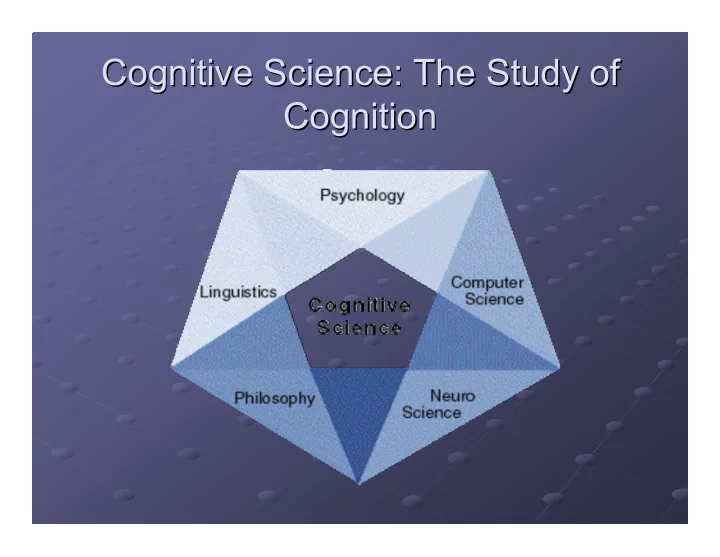
Cognitive Science: The Study of Cognitive Science: The Study of Cognition Cognition
SLIDE 2 What is Philosophy? What is Philosophy?
Philos Philos = Love of = Love of Sophia = Wisdom Sophia = Wisdom Conceptual Analysis Conceptual Analysis – – E.g. What is E.g. What is “ “Knowledge? Knowledge?” ” “ “Justice Justice” ”?, ?, “ “Freedom Freedom” ”? Break down concept into simpler ? Break down concept into simpler
- parts. E.g. Knowledge = justified true belief. The earth is
- parts. E.g. Knowledge = justified true belief. The earth is
flat flat vs vs the earth is round the earth is round Use of Logical Argument Use of Logical Argument – – Deduction: All Deduction: All men are mortal, men are mortal, Socrates is a man. Therefore Socrates is mortal. Socrates is a man. Therefore Socrates is mortal. Induction: Every swan I Induction: Every swan I’ ’ve seen has been white. ve seen has been white. Therefore all swans are white. Therefore all swans are white. Use of Use of “ “Gedanken Gedanken” ”(thought (thought)/intuition-experiments )/intuition-experiments Applied to study of mental phenomena = Philosophy of Applied to study of mental phenomena = Philosophy of Mind Mind
SLIDE 3
Philosophy of Mind Philosophy of Mind (Some Topics) (Some Topics)
What are Mental States? What are Mental States? How does the brain represent the world? How does the brain represent the world? What is consciousness? What is consciousness? Can consciousness be explained? Can consciousness be explained? Can machines think? Can machines think? Are the mind and body separate? Are the mind and body separate?
SLIDE 4 Mind-Body problem: Mind-Body problem: Dualism Dualism
DUALISTS believe that mind & brain are DUALISTS believe that mind & brain are different kinds of substances, existing different kinds of substances, existing independently, but interacting (popular independently, but interacting (popular among non-scientists) among non-scientists)
Rene Descartes (17
Rene Descartes (17th
th century
century philosopher and mathematician) philosopher and mathematician) proposed that mind and brain interact in proposed that mind and brain interact in the pineal gland the pineal gland
SLIDE 5
Descartes Descartes’ ’ Arguments For Dualism Arguments For Dualism Argument #1 Argument #1
Body is by nature extended. Mind is by its Body is by nature extended. Mind is by its nature non-extended nature non-extended Two things that have contradictory main Two things that have contradictory main properties must be distinct. properties must be distinct. Therefore, Mind and Body are distinct Therefore, Mind and Body are distinct
SLIDE 6 Descartes Descartes’ ’ Arguments (cont.) Arguments (cont.) Argument #2 Argument #2 – – Short Version Short Version
I can know with certainty the contents of I can know with certainty the contents of my mind. my mind. I cannot know with certainty the properties I cannot know with certainty the properties
- f external objects (bodies).
- f external objects (bodies).
Therefore, Mind and Body are distinct Therefore, Mind and Body are distinct
SLIDE 7
Descartes Descartes’ ’ Method of Doubt Method of Doubt
Begin by doubting everything that is Begin by doubting everything that is dubitable in any way in order to arrive at dubitable in any way in order to arrive at certainty certainty Try to build up certain knowledge from Try to build up certain knowledge from there there Called Called “ “Foundationalism Foundationalism” ” – – an an epistemological theory that requires all epistemological theory that requires all knowledge to be based on certainty and knowledge to be based on certainty and logical conclusions from indubitable logical conclusions from indubitable premises. premises.
SLIDE 8
Method of Doubt (Cont.) Method of Doubt (Cont.)
Can I be sure my senses Can I be sure my senses provide me with accurate provide me with accurate information? information? Can I know that I Can I know that I’ ’m not m not dreaming right now? dreaming right now? Can I know that I Can I know that I’ ’m not a m not a disembodied brain in a disembodied brain in a vat? vat? Throws into doubt the Throws into doubt the entire external world, entire external world, including body (and brain) including body (and brain)
SLIDE 9
Method of Doubt (Cont.) Method of Doubt (Cont.)
Evil Demon Argument Evil Demon Argument How do I know that I How do I know that I’ ’m not being m not being consistently fooled by a malevolent consistently fooled by a malevolent demon? demon? Even mathematical/logical statements Even mathematical/logical statements could be false could be false 2+2 really = 7! Squares have five sides! 2+2 really = 7! Squares have five sides!
SLIDE 10
What we know for sure What we know for sure
Even if I Even if I’ ’m being fooled. Even if I m being fooled. Even if I’ ’m dreaming, m dreaming, there is something that is being fooled and there is something that is being fooled and something that is dreaming. something that is dreaming. The thing that THINKS exists. Cannot doubt The thing that THINKS exists. Cannot doubt that, or be fooled into thinking that I exist. To that, or be fooled into thinking that I exist. To doubt, to be fooled, is to think. doubt, to be fooled, is to think. “ “Cogito Ergo Sum Cogito Ergo Sum” ” = = “ “I think therefore I am I think therefore I am” ” I can know with certainty the way things seem to I can know with certainty the way things seem to me to be me to be
SLIDE 11 The Thinker ( The Thinker (Cognizer Cognizer) )
"But what am I then? A thinking
- being. What is a thinking being?
A being which doubts, which understands, which conceives, which affirms, which denies, which wills, which rejects, which imagines also, and which perceives."
SLIDE 12 Alternatives to Dualism ( Alternatives to Dualism (“ “Monism Monism” ”) ) – – e.g. e.g. Physicalism Physicalism
Dualism Dualism – – Mental state x, e.g. Pain = property Mental state x, e.g. Pain = property
- f immaterial mind substance. Doesn
- f immaterial mind substance. Doesn’
’t get t get you very far scientifically! you very far scientifically! Identity Theory Identity Theory – – Mental state x = Brain state Mental state x = Brain state
- x. (e.g. Pain = c-fibers firing) Analogy: Water
- x. (e.g. Pain = c-fibers firing) Analogy: Water
= H2O = H2O Eliminativism Eliminativism --
“Folk Psychological Folk Psychological” ” terms terms such as belief, desire, feeling of pain, etc. such as belief, desire, feeling of pain, etc. don don’ ’t point to anything real, and should be t point to anything real, and should be eliminated from our language. Like eliminated from our language. Like “ “phlogiston phlogiston” ” – – 17 17th
th century theory of
century theory of combustion. combustion.
SLIDE 13 Behaviorism Behaviorism
Behaviorism Behaviorism – – All thinking and feeling is All thinking and feeling is
- behavior. Mental state x = Behavioral state x.
- behavior. Mental state x = Behavioral state x.
(e.g. Pain = Touching hot stove (e.g. Pain = Touching hot stove flinching and flinching and saying saying “ “ouch) -- stimulus/response pairings
- uch) -- stimulus/response pairings
When we attribute a mental state to someone, When we attribute a mental state to someone, we are not saying that he or she is in a particular we are not saying that he or she is in a particular internal state or condition. Instead, we are internal state or condition. Instead, we are characterizing the person in terms of what he or characterizing the person in terms of what he or she might do in particular situations or she might do in particular situations or environmental interactions. environmental interactions. Testable and amenable to experimentation Testable and amenable to experimentation
SLIDE 14 Problems with the alternatives Problems with the alternatives
Identity Theory: Only Identity Theory: Only biological beings like biological beings like us with brains like us with brains like
- urs can have mental
- urs can have mental
states. states. Behaviorism: I/O Behaviorism: I/O states do not account states do not account for all mentality for all mentality – – seems to define seems to define mental states out of mental states out of existence existence
SLIDE 15 Functionalism Functionalism
- 4. Functionalism
- 4. Functionalism –
–Mental state x = functional state x. I/ Mental state x = functional state x. I/Int Int/O /O state (e.g. Pain = hot stove state (e.g. Pain = hot stove regret and worry about regret and worry about hand hand flinching and saying flinching and saying “ “ouch
”) ) Multiple Multiple realizability realizability – – e.g. clocks e.g. clocks – – function of telling time function of telling time can be realized in many different ways. Analog watch, can be realized in many different ways. Analog watch, digital clock, sundial. digital clock, sundial. A.I. is based on this theory: Brain is hardware A.I. is based on this theory: Brain is hardware – – mind is mind is program program – – same program can run on different platforms. same program can run on different platforms. Consequence of the theory: Computers can have minds Consequence of the theory: Computers can have minds – – just need to instantiate right function. just need to instantiate right function.
SLIDE 16 The Problem of The Problem of Qualia Qualia -- Modern
Day Dualism? Day Dualism?
How can any theory of brain structure/function How can any theory of brain structure/function account for phenomenal account for phenomenal feel feel (i.e. (i.e. qualia qualia) )? ? Inverted Spectrum Problem Inverted Spectrum Problem
SLIDE 17 Problems with Problems with Physicalism Physicalism Subjectivity and Thomas Nagel Subjectivity and Thomas Nagel’ ’s Bat s Bat
No amount of physical knowledge will allow us to know what it is like to be a bat, that is, the subjective, first- person “feeling” of what it’s like to echolocate. Therefore, physicalism is false.
SLIDE 18 Frank Jackson: Mary the Color Frank Jackson: Mary the Color Scientist Scientist
Imagine a future neuroscientist who comes to know everything there is to know about the physical structure and activity of the brain and its visual system, of its actual and possible states. If for some reason she has never actually had a sensation-of-red (because of color-blindness, say, or an unusual environment), then there will remain something she does not know about certain sensations: what it is like to have a sensation-of-red
SLIDE 19 Zombie Argument against Zombie Argument against Physicalism Physicalism
If If physicalism physicalism is true, then it is is true, then it is not not possible for there to possible for there to be a world in which all the physical facts are the same as be a world in which all the physical facts are the same as those of the actual world but in which there are those of the actual world but in which there are additional additional facts. facts. But there is a possible world in which all the physical But there is a possible world in which all the physical facts are the same as those of our world but in which facts are the same as those of our world but in which there are additional facts. (For example, it is possible there are additional facts. (For example, it is possible that there is a world exactly like ours in every physical that there is a world exactly like ours in every physical respect, but in it everyone lacks certain mental states, respect, but in it everyone lacks certain mental states, namely any phenomenal experiences or namely any phenomenal experiences or qualia
. The people there look and act just like people in the actual people there look and act just like people in the actual world, but they don't feel anything; when one gets shot, world, but they don't feel anything; when one gets shot, for example, he yells out as if he is in pain, but he for example, he yells out as if he is in pain, but he doesn't doesn't feel feel any pain.) any pain.) Therefore, Therefore, physicalism physicalism is false. is false.
SLIDE 20 Hard Hard vs vs Easy Problems Easy Problems
Hard Hard vs vs Easy problem (David Chalmers) Easy problem (David Chalmers)
Easy: Objective study of the brain
Easy: Objective study of the brain
Causal roles played by psychological states Causal roles played by psychological states How these roles are implemented in the brain How these roles are implemented in the brain Explanations of cognitive functions Explanations of cognitive functions
Hard problem Hard problem
Phenomenal consciousness (
Phenomenal consciousness (Qualia Qualia) )
Where do feelings come from Where do feelings come from We can talk about the function of pain and the mental states We can talk about the function of pain and the mental states involved, but why does it involved, but why does it hurt? hurt?
The
The ‘ ‘easy easy’ ’ problem is quite hard. problem is quite hard.
But the hard problem is even harder
But the hard problem is even harder
SLIDE 21 Neural Correlates of Consciousness
Blood-flow variations in the visual cortex demonstrate how a subject’s brain responds to a pattern being viewed. The colors show the cortical activity corresponding to the subject’s view of either the vertical or horizontal half of the pattern.
SLIDE 22 Proposed Neural Correlates of Proposed Neural Correlates of Consciousness Consciousness
40-hertz oscillations in the cerebral cortex (Crick and Koch 1990) 40-hertz oscillations in the cerebral cortex (Crick and Koch 1990) Intralaminar Intralaminar nuclei in the thalamus ( nuclei in the thalamus (Bogen Bogen 1995) 1995) Re-entrant loops in Re-entrant loops in thalamocortical thalamocortical systems (Edelman 1989) systems (Edelman 1989) 40-hertz rhythmic activity in 40-hertz rhythmic activity in thalamocortical thalamocortical systems ( systems (Llinas Llinas et al et al 1994) 1994) Extended reticular-thalamic activation system (Newman and Extended reticular-thalamic activation system (Newman and Baars Baars 1993) 1993) Neural assemblies bound by NMDA ( Neural assemblies bound by NMDA (Flohr Flohr 1995) 1995) Certain Certain neurochemical neurochemical levels of activation (Hobson 1997) levels of activation (Hobson 1997) Certain neurons in inferior temporal cortex (Sheinberg and Certain neurons in inferior temporal cortex (Sheinberg and Logothetis Logothetis 1997) 1997) Neurons in Neurons in extrastriate extrastriate visual cortex projecting to prefrontal areas visual cortex projecting to prefrontal areas (Crick and Koch 1995) (Crick and Koch 1995) Visual processing within the ventral stream (Milner and Visual processing within the ventral stream (Milner and Goodale Goodale 1995) 1995)
SLIDE 23 Correlations are not Explanations Correlations are not Explanations
Given certain physical laws, for instance, a falling barometer allows us to infer that there has been a drop in air pressure and vice versa, but we cannot explain the drop in air pressure by reference to the falling barometer. Similarly, we can infer the height of a flagpole from the length
- f its shadow and vice versa (given the laws of
- ptics and trigonometry), whereas the length of
the shadow fails to explain the length of the flagpole.
SLIDE 24 John Searle John Searle’ ’s Chinese Room s Chinese Room Argument for why computers can Argument for why computers can’ ’t t think think
Suppose that, many years from now, we have Suppose that, many years from now, we have constructed a computer which behaves as if it constructed a computer which behaves as if it understands Chinese. In other words, the computer understands Chinese. In other words, the computer takes Chinese symbols as input, consults a large look-up takes Chinese symbols as input, consults a large look-up table (as all computers can be described as doing), and table (as all computers can be described as doing), and then produces other Chinese symbols as output. then produces other Chinese symbols as output. Suppose that this computer performs this task so Suppose that this computer performs this task so convincingly that it easily passes the Turing Test. In convincingly that it easily passes the Turing Test. In
- ther words, it convinces a human Chinese speaker that
- ther words, it convinces a human Chinese speaker that
it is a Chinese speaker. All the questions the human it is a Chinese speaker. All the questions the human asks are responded to appropriately, such that the asks are responded to appropriately, such that the Chinese speaker is convinced that he or she is talking to Chinese speaker is convinced that he or she is talking to another Chinese speaker. The conclusion proponents of another Chinese speaker. The conclusion proponents of strong AI would like to draw is that the computer strong AI would like to draw is that the computer understands Chinese, just as the person does. understands Chinese, just as the person does.
SLIDE 25
Can Machines Think? Can Machines Think? (The Turing Test, i.e. the imitation game) (The Turing Test, i.e. the imitation game)
SLIDE 26 The Chinese Room The Chinese Room
- - Imagine Searle is inside the computer
- - He manipulates Chinese symbols according to rules
- - He provides all the right outputs, such that he passes the Turing
test to the native Chinese speaker. Does he then understand Chinese? Searle says no, and neither does the computer, so computers don’t think.
SLIDE 27