Foundations of Robotics Talos, the bronze giant Hephaestus, the god - - PDF document

foundations of robotics
SMART_READER_LITE
LIVE PREVIEW

Foundations of Robotics Talos, the bronze giant Hephaestus, the god - - PDF document

Robotics: Iliad (7th-8th century BCE) Homer a great epic describing the Trojan war, a world of mythical automata, where men are instead controlled by the Gods. Foundations of Robotics Talos, the bronze giant Hephaestus, the god of mechanical


slide-1
SLIDE 1

Rod Grupen Department of Computer Science University of Massachusetts Amherst

Foundations of Robotics

Laboratory for Perceptual Robotics – College of Information and Computer Sciences

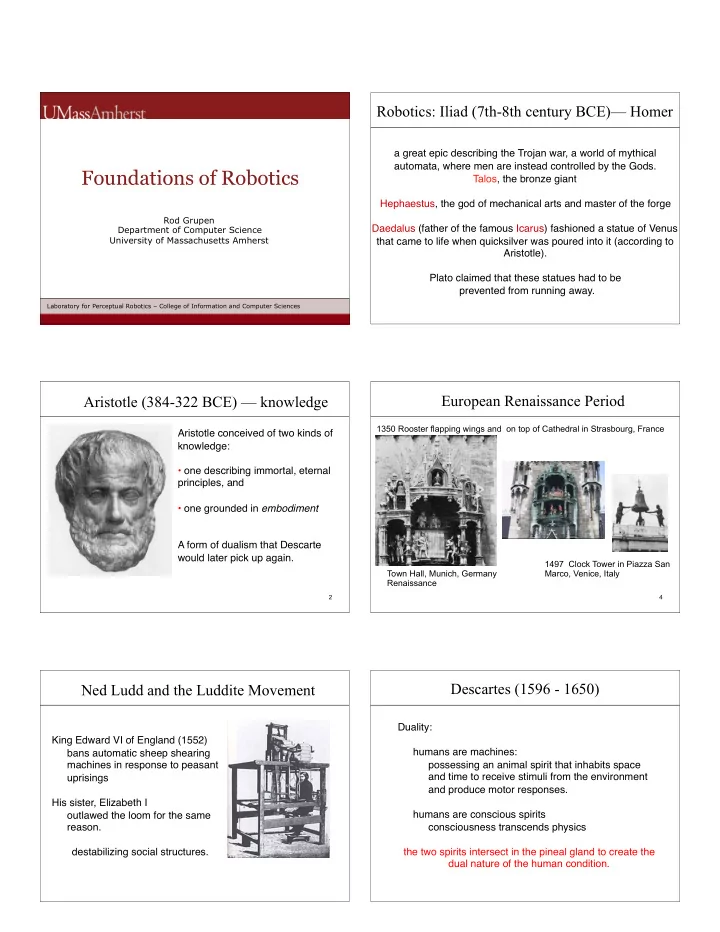
a great epic describing the Trojan war, a world of mythical automata, where men are instead controlled by the Gods. Talos, the bronze giant Hephaestus, the god of mechanical arts and master of the forge Daedalus (father of the famous Icarus) fashioned a statue of Venus that came to life when quicksilver was poured into it (according to Aristotle). Plato claimed that these statues had to be prevented from running away.

Robotics: Iliad (7th-8th century BCE)— Homer

2

Aristotle conceived of two kinds of knowledge:

  • one describing immortal, eternal

principles, and

  • one grounded in embodiment

A form of dualism that Descarte would later pick up again.

Aristotle (384-322 BCE) — knowledge

4

1497 Clock Tower in Piazza San
 Marco, Venice, Italy 1350 Rooster flapping wings and on top of Cathedral in Strasbourg, France Town Hall, Munich, Germany Renaissance

European Renaissance Period

King Edward VI of England (1552) bans automatic sheep shearing machines in response to peasant uprisings His sister, Elizabeth I

  • utlawed the loom for the same

reason. destabilizing social structures.

Ned Ludd and the Luddite Movement

Duality: humans are machines: possessing an animal spirit that inhabits space and time to receive stimuli from the environment and produce motor responses. humans are conscious spirits consciousness transcends physics the two spirits intersect in the pineal gland to create the dual nature of the human condition.

Descartes (1596 - 1650)

slide-2
SLIDE 2

Jacques de Vaucanson’s Duck (ca. 1738)

it ate food out of the exhibitor's hand, swallowed it, digested it, and excreted it, all before an

  • audience. It could drink, muddle the water with its beak, quack, rise and settle back on its legs and,

spectators were amazed to see, it swallowed food with a quick, realistic gulping action in its flexible neck. “without the shitting duck, there would be nothing to remind us of the glory of France.” Voltaire

Writer Draughtsman

The Writer of Droz, 1774 Maillardet, 1805 (Scorsese’s 2011 Hugo) Maillardet, 1805 Watt’s Governor (1788)

University of Bologna - experimental bioelectrogenesis. electric current causes the contraction of the muscles in the leg of a frog when applied directly to the muscle or at a distance through a nerve. conceived of animal electricity - a fluid secreted by the brain that flows through nerves to activate muscles.

Mary Shelley (1818)

Galvani (1791)

slide-3
SLIDE 3

15

robot - from robota, meaning serf labor, drudgery, hard work, servitude

Karel Čapek’s R.U.R., 1920

  • 1. A robot may not harm a human being, or,

through inaction, allow a human being to come to harm.

  • 2. A robot must obey the orders given to it by

human beings except where such orders would conflict with the First Law.

  • 3. A robot must protect its own existence, as long

as such protection does not conflict with the First or Second Law.

  • 0. A robot may not injure humanity or,

through inaction, allow humanity to come to harm. (added after the initial three laws in Robots and Empire)

Isaac Asimov: “Runaround,” 1942

Shakey (SRI, 1968) and Mobie (Stanford,?)

19

Stanford Scheinman Arm,1969

R2-D2 and C-3PO

Star Wars - 1977

Unimation’s Programmable Universal Machine for Assembly (PUMA)

Joseph Engelberger

PUMA, 1978

slide-4
SLIDE 4

Valentino Braitenberg Uphill Analysis Downhill Invention

Synthetic Psychology - 1984 Biomemetics: Lobster 1992

Joseph Ayers Northeastern full neural emulation Marc Raibert

MIT Leg Lab - 1989-1995

death head cockroach full gait simulation full neural simulation

Biomemetics Deaths Head Cockroach - 1998

1998 Furby $30 1999 AIBO $2000

Commercial Toys

$1.2M

Da Vinci Surgical Robot - ca. 2000

slide-5
SLIDE 5

inexpensive, reliable, functional

Market Acceptability - Roomba - 2002

1986 2012 maybe $500M!

HONDA Asimo

Boston Dynamics
 Marc Raibert

Biomemetics: BigDog 2008-2012 Biomemetics: BigDog 2008-2012 Biomemetics: Atlas 2019

a mobile manipulator a spatial Roger

uBot: 2004-2018

slide-6
SLIDE 6

UMass Laboratory for Perceptual Robotics

uBot: 2004-2018 uBot: 2004-2018

UMass Laboratory for Perceptual Robotics UMass Laboratory for Perceptual Robotics

uBot-5: 2004-present

Landau Reflex - “superman” pose, legs reflexively drop down into flexion when the infant’s head is pushed down

The Organized Infant

the inspiration for our sequential programming project hierarchy…

Developmental Trajectory

Boston Dynamics - Atlas

…the machines have caught up to the science fiction…

slide-7
SLIDE 7

HRP- DARPA Robotics Challenge

…but they have very limited means of acquiring the background control knowledge required to interact autonomously with the world… this course is about control knowledge tacit - encoded in embodiment implicit - encoded in policy explicit - codified and communicated